

This rapid appreciation has naturally led to widespread debate and inquiry regarding the sustainability of current market valuations. A common question among investors, reflecting broader market sentiment, concerns the potential for a "bubble" driven by the burgeoning hype surrounding Artificial Intelligence (AI) and its implications for future market stability and retirement planning. To address these concerns, a comprehensive examination of the underlying market dynamics, valuation metrics, and the transformative potential of AI is essential.
Understanding Market Valuations: The Price-to-Earnings Ratio

At its core, a stock represents an ownership stake in a company, entitling the holder to a share of its future earnings. This concept is analogous to owning a rental property, where the owner collects rent and profits after expenses. The value of such an asset, whether a rental house or a stock, is fundamentally tied to its income-generating potential. An investor’s willingness to pay for this income stream is often quantified by the Price-to-Earnings (P/E) ratio. For instance, if a rental house generates $24,000 annually in net profit and sells for $240,000, its P/E ratio is 10 ($240,000 / $24,000). A higher sale price for the same income stream would result in a higher P/E, indicating a less profitable immediate return for the buyer.
Applying this principle to the stock market, an investment of $100,000 in the S&P 500 in 2019, with dividends reinvested, would have appreciated to approximately $256,960 by 2025, representing a 157% gain. However, during the same period, the underlying corporate earnings per share for that $100,000 basket of stocks grew from approximately $5,290 to $7,540, a more modest 42% increase. This divergence reveals a significant shift in market valuation: the S&P 500’s P/E ratio has climbed from roughly 20 in 2019 to approximately 30 in 2025. This elevated P/E ratio suggests that investors are currently paying a premium for future earnings, implying that prospective returns, as a percentage of current portfolio value, may be lower than in periods of more modest valuations. Historical data from sources like multpl.com confirm these trends, illustrating the increasing cost of earnings.
The Magnificent Seven: Architects of the Current Bull Market

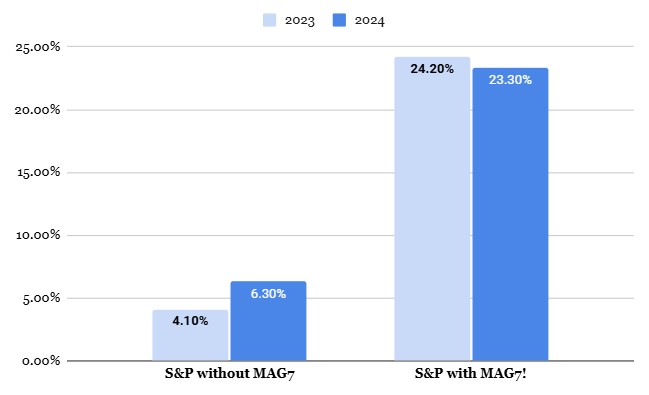
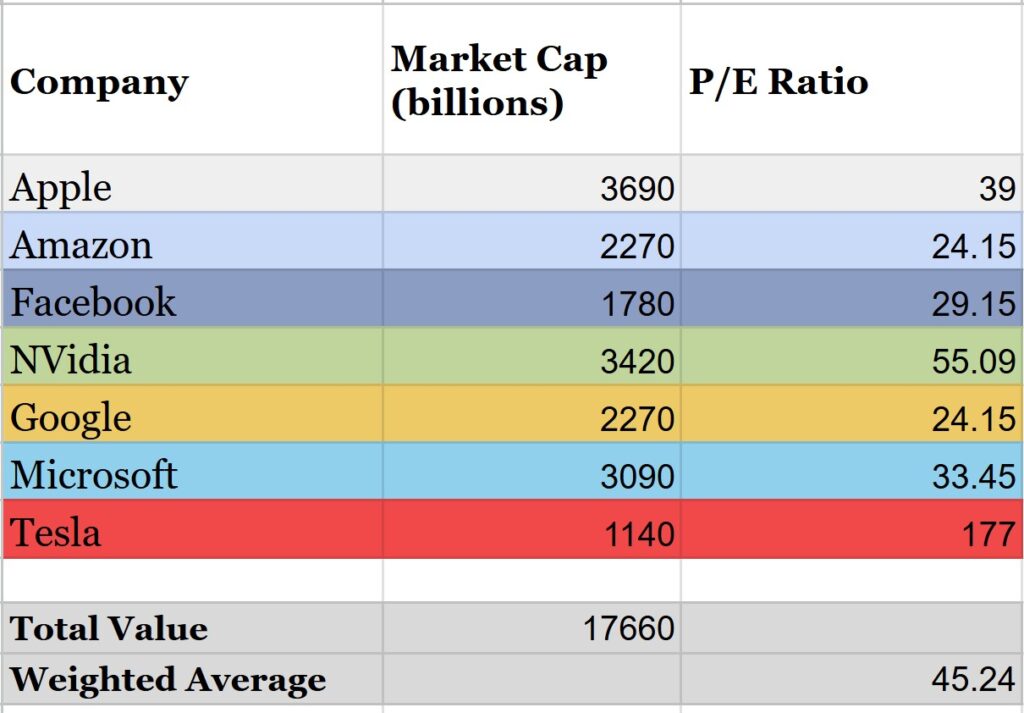
A deeper analysis of the S&P 500’s recent performance reveals a concentrated surge driven primarily by a select group of mega-cap technology companies, often referred to as the "Magnificent Seven": Apple, Nvidia, Microsoft, Amazon, Google (Alphabet), Meta (Facebook), and occasionally Tesla. These seven companies have accounted for roughly three-quarters of the S&P 500’s recent gains. Collectively, they command over 25% of the total market capitalization of the S&P 500, valued at an estimated $17.66 trillion. Their P/E ratios are significantly higher than the broader market, with a weighted average around 45, reflecting intense investor optimism regarding their future growth prospects. For context, excluding these seven giants, the P/E ratio of the remaining 493 companies in the S&P 500 stands at a more moderate, though still above-average, 20.
The valuation disparity underscores a prevailing belief among investors that these dominant tech firms are uniquely positioned for accelerated growth, largely propelled by advancements in Artificial Intelligence. This concentration of market gains in a few large-cap stocks is not unprecedented; similar patterns were observed during the dot-com era, raising questions about market breadth and sustainability.
Artificial Intelligence: A Transformative Force or a Speculative Frenzy?

The fervent enthusiasm surrounding AI is the common thread uniting the elevated valuations of the Magnificent Seven. Recent breakthroughs in AI, particularly in large language models and generative AI, have demonstrated capabilities once thought to be years away, showcasing human-like reasoning across various domains. This has ignited a global business frenzy, with companies across sectors anticipating a new era of unprecedented productivity and profitability.
Six of the Magnificent Seven are investing hundreds of billions of dollars in building vast AI infrastructure, including hyperscale data centers filled with supercomputers. Nvidia, the seventh, is a primary beneficiary, supplying the specialized Graphics Processing Units (GPUs) that power these AI systems, allowing it to command premium prices amidst insatiable demand.
The applications of AI are rapidly expanding: from advanced data analysis and automated code generation to autonomous vehicles, sophisticated medical diagnostics (e.g., melanoma detection), accelerated drug discovery, and the development of humanoid robots for industrial and service roles. The vision is an economy bolstered by an "infinite workforce" of highly intelligent, cost-effective AI agents, removing historical constraints of human intelligence and labor. While the exact timeline remains uncertain, many experts believe this transformative potential is real.
However, significant questions persist regarding the realization of these projected profits. Concerns include potential cost overruns in AI infrastructure development, intensifying competition among tech giants, and unforeseen regulatory or ethical challenges. Furthermore, the societal implications of widespread AI adoption, particularly the potential for mass unemployment and increased wealth concentration, present complex economic and social hurdles. Scenarios involving significant job displacement could lead to widespread social upheaval, potentially disrupting traditional economic models and market stability.
Expert Perspectives and Alternative Strategies
In an environment characterized by high valuations and technological disruption, seasoned investors and institutions offer valuable perspectives.
Vanguard’s Outlook: Vanguard, a cornerstone of the index fund industry, issues annual 10-year annualized return projections. Their latest forecasts suggest that international stocks and even bonds are expected to outperform U.S. stocks in the coming decade. This projection is largely based on the lower P/E ratios of international markets (e.g., the VXUS fund, representing ex-U.S. developed and emerging markets, has a P/E of around 15.9), making them appear "on sale" compared to the U.S. market. However, Vanguard’s predictions have faced challenges in recent years, as the U.S. market, particularly the AI-driven tech sector, has continued its strong performance, defying expectations of a rebalancing. This highlights the difficulty of forecasting in periods of rapid technological change.
Warren Buffett’s Cautious Stance: Warren Buffett, the renowned "Oracle of Omaha," consistently advocates for value investing and a disciplined approach. His recent actions and statements from Berkshire Hathaway’s shareholder letters indicate a belief that market valuations are generally elevated, with few compelling bargains. Berkshire Hathaway has accumulated a substantial cash pile, reportedly $334 billion, and has even refrained from repurchasing its own shares, which it considers slightly overvalued at a P/E ratio averaging around 21. This substantial cash reserve signals a readiness to deploy capital when more attractive investment opportunities arise, reflecting a patient and prudent approach in a high-valuation market.
Diversification Beyond U.S. Equities: The discussion naturally leads to considering broader investment options. Strategies involving diversification across different asset classes and geographies, such as those implemented by robo-advisors like Betterment, aim to achieve potentially higher risk-adjusted returns and lower volatility. A typical diversified portfolio, including U.S. and international stocks and bonds, might exhibit a weighted average P/E ratio around 22, offering a different risk/reward profile than a purely U.S. large-cap tech-heavy portfolio. While a U.S.-only portfolio has historically outperformed in the recent past, the long-term rationale for diversification remains robust, aligning with the principle that market leadership can rotate.

The Role of Real Estate and Debt Management: For individual investors, the decision to pay off a mortgage versus investing in the stock market becomes more nuanced in a high-valuation environment. Historically, investing surplus cash into index funds while maintaining a low-interest mortgage has often yielded superior long-term returns. However, with higher mortgage interest rates (e.g., 7%) and potentially lower expected stock returns, the trade-off becomes tighter. Paying off a mortgage can be viewed as securing a guaranteed, risk-free return equivalent to the mortgage interest rate, which can be a compelling option, particularly for those prioritizing financial peace of mind and debt elimination over maximizing theoretical investment returns.
Historical Context and Long-Term Economic Growth
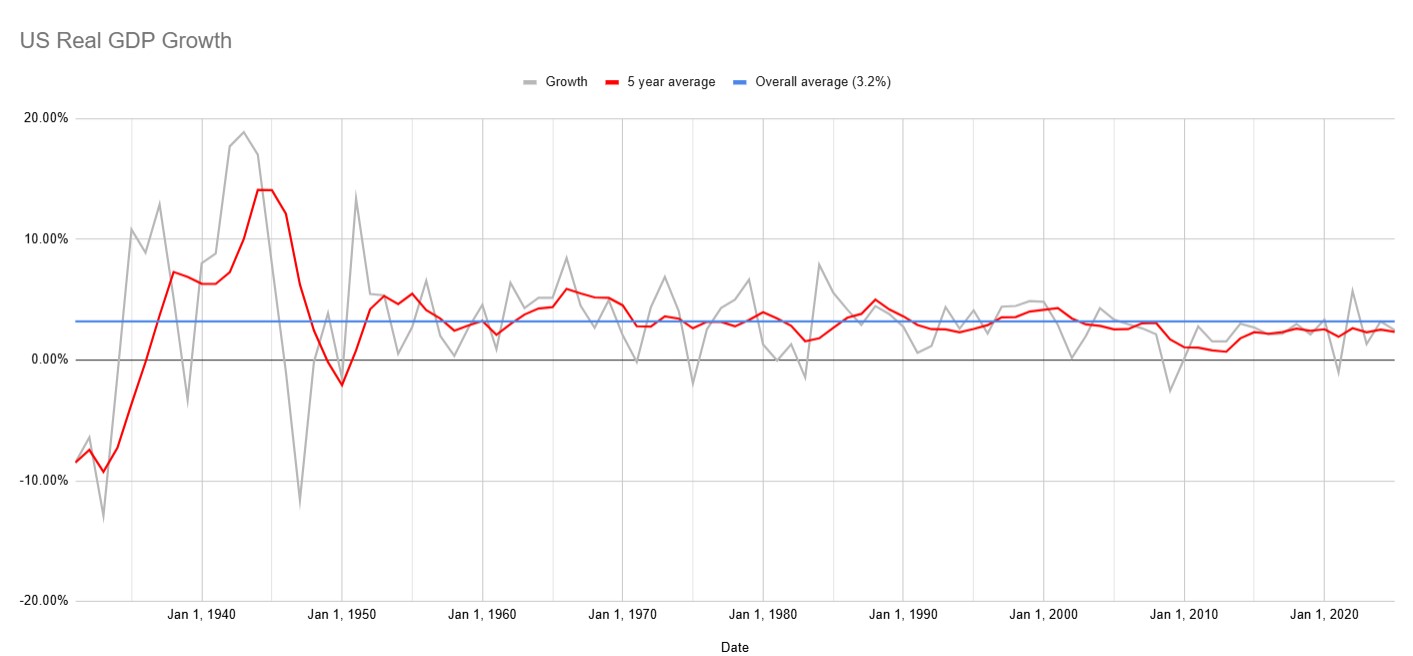
Despite the cyclical nature of market booms and busts, the long-term trajectory of the U.S. economy has demonstrated remarkable consistency. Real GDP growth, adjusted for inflation, has averaged approximately 3% per year over many decades. This steady growth underpins corporate earnings and, by extension, stock market performance. It is noteworthy that recent decades have, in fact, seen a slightly slower average growth rate, which some analysts argue provides even less fundamental justification for the current elevated stock market valuations.
History teaches that while speculative manias and market corrections are inevitable, attempting to time these events is a losing proposition for most investors. Selling off all holdings in anticipation of a crash and then attempting to buy back in at lower prices is notoriously difficult and often results in missed gains. Over the long run, even if market valuations normalize from their current elevated levels, the underlying economic and corporate earnings growth will likely continue, albeit potentially at a slower pace relative to portfolio value. The long-term outlook for diversified equity investments remains positive, even if future returns are moderated by current high entry prices.
Conclusion: Prudence Amidst Innovation
The current market environment, characterized by a significant surge driven by the promise of Artificial Intelligence and concentrated in a few dominant tech companies, presents both immense opportunity and considerable uncertainty. While the transformative potential of AI is undeniable and could reshape global productivity, the current valuations reflect a high degree of optimism about future earnings.
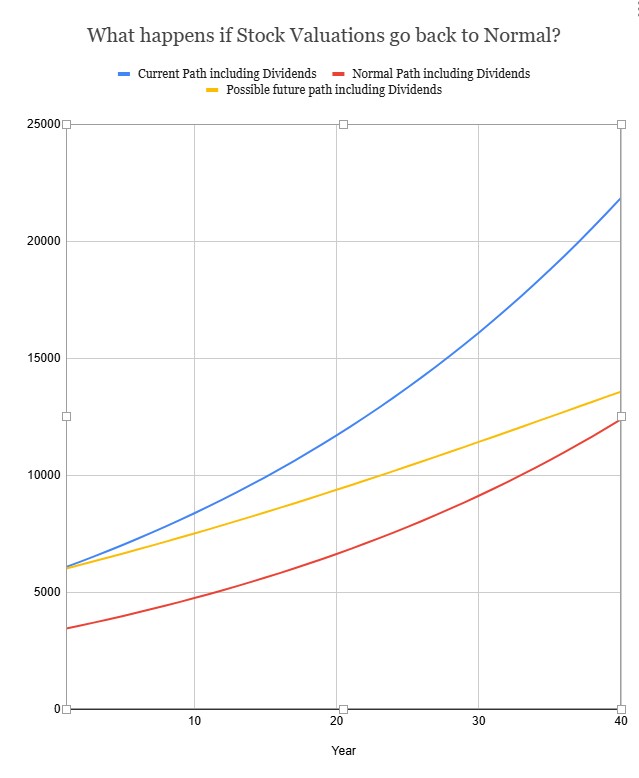
For investors, the fundamental principles of long-term investing remain paramount: consistent savings, broad diversification, and disciplined rebalancing. While the "blue path" of continued exponential growth is alluring, a "yellow path" of more moderate, but still positive, returns based on eventual normalization of valuations is a more prudent expectation. Staying invested in a diversified portfolio, understanding the underlying economic realities, and resisting the urge to react to daily market headlines are crucial for navigating these complex times. The true "market-beating returns" often come not from attempting to outsmart the market, but from the consistent pursuit of financial discipline and the enrichment of one’s life through experiences beyond the financial realm.

