
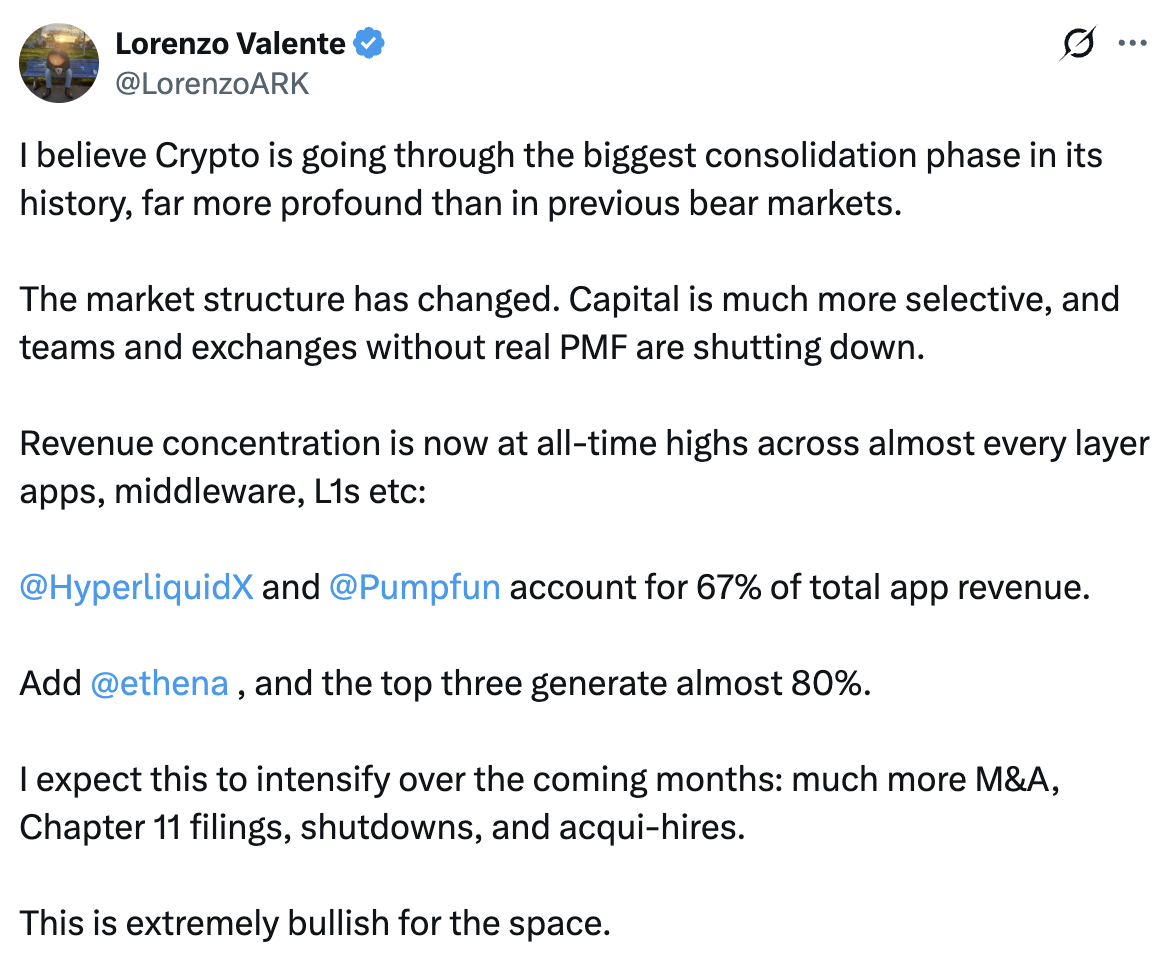
The cryptocurrency industry is currently navigating what an ARK Invest analyst has described as its most substantial consolidation phase to date, characterized by a pronounced concentration of revenue among a select few dominant protocols. Lorenzo Valente, a research associate at ARK Invest, articulated this perspective in a recent post on the social media platform X, highlighting a discernible shift in investor behavior and market dynamics.
Valente’s analysis indicates that investors are adopting a more discerning approach, increasingly scrutinizing projects and exchanges for robust product-market fit. This heightened selectivity is creating significant headwinds for ventures that fail to demonstrate compelling value propositions, making it considerably more challenging for them to attract the necessary capital for growth and sustainability. Consequently, the industry is witnessing a natural culling process, where weaker projects are either struggling to survive or are being compelled to cease operations altogether. This contraction, in turn, is leading to an unprecedented concentration of revenue within a shrinking number of highly successful and established protocols.
To substantiate this assertion, Valente presented compelling data illustrating the extent of this revenue concentration. He pointed to perpetual futures exchange Hyperliquid and memecoin launchpad Pump.fun as prime examples, noting that these two platforms alone currently account for approximately 67% of the total revenue generated across all crypto applications. When the synthetic dollar protocol Ethena is included in this calculation, the combined revenue share of these top three entities escalates to nearly 80%. This figure underscores what Valente terms as "record-high revenue concentration" across the entire cryptocurrency sector, signaling a significant departure from more fragmented market structures observed in previous periods.
The implications of this trend, according to Valente, are far-reaching and are expected to accelerate in the coming months. He anticipates a surge in mergers and acquisitions (M&A) activity as larger, more successful entities absorb struggling competitors or acquire innovative technologies. Concurrently, the industry is likely to witness an increase in Chapter 11 bankruptcies, a direct consequence of projects unable to sustain operations amidst tightening capital flows and intense competition. Furthermore, the outright shutdown of underperforming projects and "acqui-hires"—where a company acquires another primarily for its talent rather than its products or services—are also expected to become more prevalent.
Despite the disruptive nature of such a consolidation, Valente maintained an optimistic outlook, describing this period of shakeout and consolidation as "extremely bullish" for the long-term health and maturation of the cryptocurrency industry. This perspective suggests that while the immediate future may involve significant churn, the ultimate outcome is expected to be a more robust, efficient, and resilient ecosystem.
Broader Industry Trends Underscore Consolidation Narrative
Valente’s observations align with a series of recent developments within the cryptocurrency space, particularly concerning the operational status of several prominent exchanges. The announcements of platform wind-downs and closures further reinforce the narrative of industry-wide consolidation and the mounting pressures faced by various market participants.
In a significant development last week, BitMEX, a pioneering cryptocurrency derivatives exchange, announced its decision to cease operations in September. This strategic move, confirmed by its owner HDR Global Trading, followed a comprehensive strategic review of the exchange’s business model and market position. The announcement came after BitMEX had already begun to accelerate the delisting of numerous trading pairs and derivative contracts, citing a lack of sufficient trading interest as a primary driver for these earlier actions. The closure of such a well-established platform is a stark indicator of the competitive landscape and the challenges of maintaining relevance in a rapidly evolving market.
Further underscoring this trend, BitMart, another cryptocurrency exchange, revealed its intention to end its trading services on August 26. The exchange plans to wind down its operations entirely by January 2027. In its official statement, BitMart attributed this decision to a thorough review of its operating conditions, the prevailing market environment, and its future strategic direction. The protracted timeline for winding down operations suggests a measured approach to exiting the market, potentially allowing users time to migrate assets and providing a structured closure process.
Consolidation within the industry is not solely manifesting through closures; acquisitions also represent a significant avenue for market participants to expand their reach and solidify their positions. Earlier this month, Bybit, a global cryptocurrency exchange, announced its expansion into Indonesia through the acquisition of a majority stake in NOBI, a local digital asset firm. This strategic move allows Bybit to establish a locally operated exchange in Indonesia, tapping into one of Asia’s largest and most dynamic crypto markets. Such acquisitions highlight the drive for growth and market dominance among leading players, often at the expense of smaller or regional entities.
Investor Selectivity and the Quest for Product-Market Fit
The increasing investor selectivity that Valente highlights is a critical driver of this consolidation. In the early stages of the cryptocurrency market, capital flowed more freely, often driven by speculative interest and the allure of nascent technologies. However, as the industry matures and the number of projects and platforms has proliferated, investors have become more sophisticated and risk-averse. They are now prioritizing projects with clear utility, demonstrable user adoption, and sustainable revenue models.
This shift in investor sentiment means that projects without a strong product-market fit—meaning their product effectively meets a significant market demand—struggle to secure funding. The ability of a project to solve a real-world problem, offer a unique value proposition, or provide a superior user experience is paramount. Exchanges and decentralized applications (dApps) that fail to differentiate themselves or offer compelling features risk becoming irrelevant as capital is redeployed to more promising ventures.
The data provided by Valente, focusing on revenue concentration, directly reflects this phenomenon. Hyperliquid, Pump.fun, and Ethena are not merely speculative assets; they represent platforms that have seemingly tapped into significant user demand. Hyperliquid, as a perpetual futures exchange, caters to traders seeking leveraged exposure to crypto assets. Pump.fun, while associated with memecoins, has found a niche in facilitating the rapid creation and trading of new tokens, capitalizing on the viral nature of meme culture within the crypto community. Ethena, with its synthetic dollar protocol, aims to provide a stable yield-generating asset, addressing a key demand for yield in a decentralized environment. The success of these platforms in capturing a disproportionate share of revenue suggests they have successfully identified and served specific market needs.
Historical Context: Cycles of Boom and Bust in Crypto
The current phase of consolidation is not entirely unprecedented in the cryptocurrency industry’s relatively short history. The market has experienced several boom-and-bust cycles, each characterized by periods of rapid growth and innovation followed by significant corrections and market rationalization.
The initial surge of Bitcoin and the subsequent emergence of altcoins in the early 2010s laid the groundwork for the industry. The initial coin offering (ICO) boom of 2017 saw a massive influx of capital into a wide array of projects, many of which lacked viable business models or technological substance. This was followed by a significant market downturn in 2018, often referred to as the "crypto winter," which led to the failure of numerous ICO projects and a general deleveraging of the market.
More recently, the bull run of 2021 fueled another wave of investment and innovation, leading to the rise of decentralized finance (DeFi) and non-fungible tokens (NFTs). However, the subsequent market downturn in 2022, triggered by macroeconomic factors and the collapse of major players like FTX, once again highlighted the inherent volatility and the importance of fundamental strength.
The current consolidation phase can be viewed as a natural progression within these cyclical patterns. As the market matures, it sheds the less sustainable projects and consolidates resources and user attention around those that demonstrate resilience, innovation, and genuine utility. The ARK Invest analysis suggests that this cycle might be more pronounced due to the sheer scale of previous capital inflows and the increasing sophistication of market participants.
Implications for Market Participants and the Future of Crypto
The implications of this accelerated consolidation phase are significant for all stakeholders within the cryptocurrency ecosystem:
- For Investors: Increased selectivity is likely to continue. Investors will need to conduct more thorough due diligence, focusing on projects with strong fundamentals, experienced teams, and clear pathways to profitability or sustainable value creation. Diversification may become even more critical, but the concentration of revenue suggests that identifying and investing in the dominant protocols could offer substantial returns.
- For Developers and Project Teams: The pressure to innovate and deliver tangible value will intensify. Projects must focus on building robust products, fostering strong communities, and demonstrating clear product-market fit. Failure to do so will result in diminishing access to capital and a heightened risk of obsolescence. The emphasis will shift from speculative hype to sustainable growth.
- For Exchanges and Infrastructure Providers: Competition will likely become more intense, with larger players consolidating market share. Smaller exchanges may struggle to compete on fees, liquidity, or security and could be forced to seek acquisition or cease operations. Innovation in trading products, user experience, and regulatory compliance will be crucial for survival and growth.
- For the Broader Ecosystem: The consolidation is expected to lead to a more mature and professionalized industry. By weeding out weaker projects, the ecosystem can focus resources on developing and scaling more promising technologies and applications. This could pave the way for greater institutional adoption and a more stable, albeit potentially less speculative, market. The long-term outlook, as suggested by Valente, is one of a stronger, more consolidated industry capable of supporting broader technological advancements and wider adoption.
The ARK Invest analyst’s perspective provides a crucial lens through which to understand the current dynamics of the cryptocurrency market. The confluence of investor selectivity, the emergence of dominant revenue-generating protocols, and the recent spate of exchange closures points towards a period of significant transformation. While this consolidation may present challenges for some, it is likely a necessary step in the industry’s maturation, ultimately fostering a more robust and sustainable future for digital assets and blockchain technology.

