
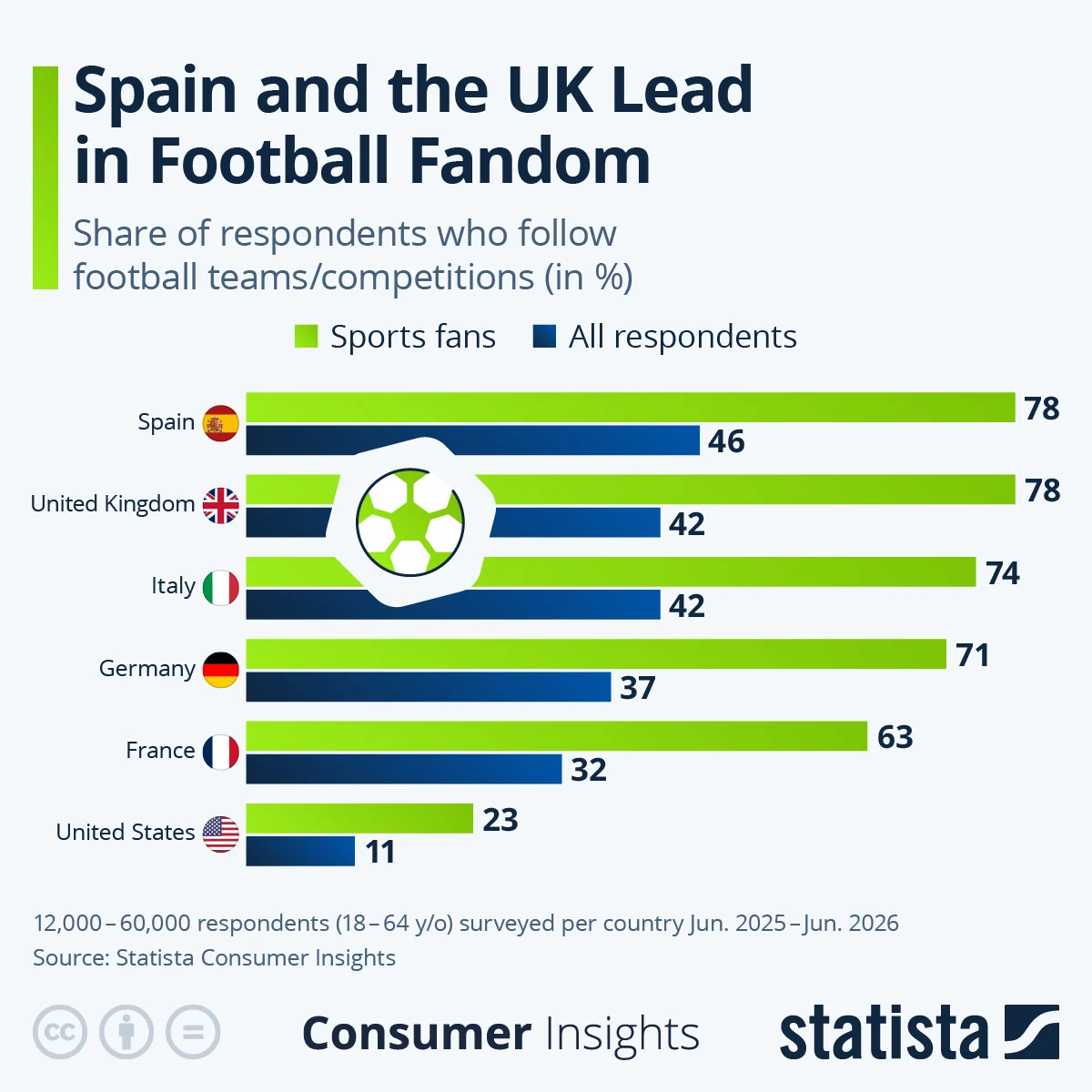
As the vibrant spectacle of Europe’s premier football leagues bursts back onto the global stage following their traditional summer hiatus, and in the lingering afterglow of the FIFA World Cup, a distinct enthusiasm resonates strongest among fans in Spain and the United Kingdom. Data compiled by Statista illuminates a compelling narrative of national passion, revealing that a striking 78 percent of self-identified sports enthusiasts in both countries actively follow football teams or competitions. This figure significantly outpaces their counterparts in Italy, Germany, and France, underscoring the deep cultural embedding of the sport within these Iberian and Anglo-Saxon nations. The return of La Liga, the Premier League, and other top-tier competitions signals not merely the resumption of athletic contests but the rekindling of a national obsession, a communal ritual that transcends mere entertainment.
The pervasive appeal of football in Spain and the UK extends far beyond the dedicated core of sports followers, permeating broader society. Statista Consumer Insights data further illustrates this widespread engagement, indicating that 46 percent of all respondents in Spain and 42 percent in the UK, irrespective of their general interest in sports, identify as followers of football. This contrasts sharply with 37 percent in Germany and a mere 32 percent in France, highlighting a statistically significant difference in mainstream adoption and cultural penetration. This fervent devotion translates into massive viewership figures, robust stadium attendance, and a significant economic footprint, cementing football’s status as a dominant cultural force.
The Unrivalled Enthusiasm of Spain and the UK
The unparalleled passion for football in Spain and the UK is a product of deep historical roots, competitive excellence, and a pervasive media landscape. In the United Kingdom, football, specifically the Premier League, is not merely a sport but a national institution. Established in 1992, the Premier League has evolved into the most-watched football league globally, broadcast in 212 territories to 643 million homes and a potential TV audience of 4.7 billion people. Its allure is built on high-octane action, star players, and fiercely contested rivalries between iconic clubs such as Manchester United, Liverpool, Arsenal, and Chelsea. The cultural tapestry of countless towns and cities across the UK is interwoven with their local clubs, providing a sense of identity and belonging that transcends generations. Matchdays are significant social events, transforming local economies and fostering a collective spirit that few other activities can rival. The financial power of the Premier League is immense, with annual revenues consistently in the multi-billion-pound range, primarily driven by lucrative domestic and international broadcasting rights, which are directly proportional to its widespread appeal.
Similarly, in Spain, La Liga EA Sports (formerly La Liga Santander) commands a colossal following, both domestically and internationally. Home to two of the world’s most globally recognized clubs, Real Madrid and FC Barcelona, La Liga epitomizes a blend of technical brilliance, tactical sophistication, and intense emotional drama. The El Clásico rivalry between these two giants alone draws hundreds of millions of viewers worldwide, serving as a powerful magnet for football enthusiasts. Spanish football’s success, particularly at the club level with a combined 19 UEFA Champions League titles between Real Madrid and Barcelona, has cultivated a culture of expectation and pride. Beyond the giants, clubs like Atlético Madrid, Sevilla, and Athletic Bilbao contribute to a rich and diverse league, each with its own passionate fan base and unique identity. The cultural significance of football in Spain extends to its national team, which achieved unprecedented success with two European Championships and a World Cup title between 2008 and 2012, further solidifying the sport’s place at the heart of national identity.
A Continent Divided: Fandom Across Europe
While Spain and the UK lead, other major European nations also exhibit strong football cultures, albeit with varying degrees of universal penetration. Germany’s Bundesliga, renowned for its vibrant stadium atmospheres, affordable ticket prices, and strong fan ownership model (the ’50+1 rule’), enjoys robust support. Clubs like Bayern Munich and Borussia Dortmund are global brands. However, Statista’s findings suggest that while dedicated fan bases are intense, the sport’s overall reach across all respondents is slightly lower than in the leading nations. This might be attributed to the strong regional identities within German football, or perhaps a more diversified interest in other sports and cultural activities.
Italy’s Serie A, historically a tactical powerhouse and once considered the world’s strongest league, has seen fluctuations in its global prominence but retains a passionate domestic following. Teams like Juventus, AC Milan, and Inter Milan boast rich histories and loyal supporters. Yet, the 78 percent figure for sports fans following football drops for Italy, potentially reflecting a more segmented sports interest, with basketball and motorsport also holding significant sway in certain regions.
France’s Ligue 1, despite the global stature of Paris Saint-Germain and its array of superstar players, registers the lowest overall football following among the surveyed European nations. While PSG’s dominance and high-profile signings like Kylian Mbappé draw international attention, the league’s overall competitive balance and historical prestige might not resonate as broadly across the French population as football does in Spain or the UK. Other sports, such as rugby in the south of France and cycling, also command significant attention.
The Economic Engine of European Football
The profound levels of fandom in Spain and the UK are directly correlated with the immense economic power wielded by their respective leagues. The Premier League, for instance, generated an estimated revenue of £5.5 billion in the 2021/22 season, a testament to its global appeal. This revenue stream is predominantly fueled by staggering broadcasting deals, which are underpinned by consistent demand from millions of viewers worldwide. International rights alone contribute billions, demonstrating the league’s success in monetizing its global fan base. Similarly, La Liga reported revenues exceeding €5 billion in the 2021/22 season, driven by similar factors including broadcast rights, commercial partnerships, and matchday income.
Beyond broadcasting, high fan engagement translates into substantial revenue from merchandising, sponsorship agreements, and stadium attendance. Matchday revenues, encompassing ticket sales, hospitality, and concessions, form a significant part of club income, particularly for well-supported teams. Furthermore, football tourism is a burgeoning industry, with millions of international visitors traveling to the UK and Spain annually to attend matches, tour stadiums, and immerse themselves in the local football culture. This influx of tourists supports hotels, restaurants, and other local businesses, creating a multiplier effect on regional economies. Sports marketing experts frequently cite the direct correlation between fan engagement metrics, such as those provided by Statista, and the valuation of broadcast rights and sponsorship portfolios, making these figures critical indicators for commercial success and future growth strategies.
The American Conundrum: A Different Sporting Landscape
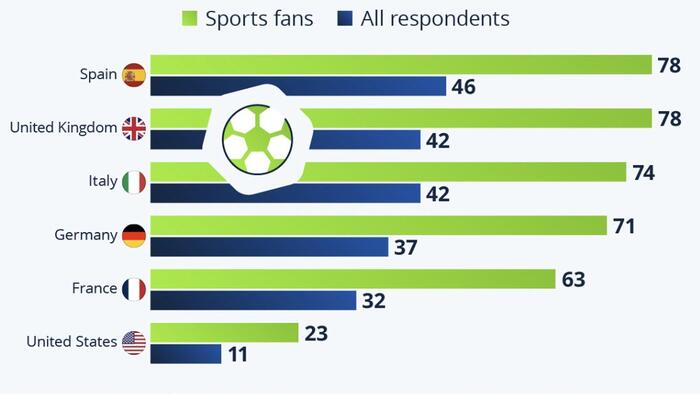
In stark contrast to the European behemoths, the United States remains a significant outlier in football fandom, with only 11 percent of all respondents identifying as followers of the sport. This figure, while seemingly low by European standards, reflects a unique sporting ecosystem dominated by a quartet of deeply entrenched indigenous sports: American football (NFL), basketball (NBA), baseball (MLB), and ice hockey (NHL). These leagues have decades, even centuries, of history, cultural integration, and massive commercial infrastructure.
Historically, "soccer" in the US has struggled to capture mainstream attention, often perceived as a niche sport played primarily by youth. Despite hosting the FIFA World Cup in 1994, which broke attendance records and contributed to the formation of Major League Soccer (MLS) in 1996, the sport’s growth has been gradual. MLS has made significant strides, expanding from 10 teams in its inaugural season to 29 teams today, boasting increasing attendance figures and a growing roster of international and domestic talent. However, it still operates in the shadow of the ‘big four’ leagues, competing fiercely for media attention, sponsorship dollars, and, most crucially, fan loyalty.
Nevertheless, there are undeniable signs of growth. Youth soccer participation in the US is among the highest globally, indicating a strong grassroots foundation. International tournaments, particularly the FIFA World Cup, consistently draw record viewership figures. The 2022 FIFA World Cup in Qatar, despite time zone challenges, saw Fox Sports record its most-watched men’s World Cup English-language telecast ever for the USA vs. England group stage match, attracting nearly 15.4 million viewers. This demonstrates a latent, yet significant, interest that surfaces during major global events.
The Road to 2026: A Pivotal Moment for US Soccer
The upcoming FIFA World Cup in 2026, co-hosted by the United States, Canada, and Mexico, represents an unparalleled opportunity for "soccer" to make a meaningful and lasting impact on the American sporting landscape. This will be the first 48-team World Cup, featuring an expanded format and a significantly increased number of matches, many of which will be played in major US cities with state-of-the-art stadiums. The sheer scale of the event, combined with extensive marketing and media coverage, is expected to generate unprecedented levels of exposure and engagement.
US Soccer Federation officials and Major League Soccer leadership have consistently expressed optimism about the transformative potential of 2026. MLS Commissioner Don Garber has frequently highlighted the World Cup as a "once-in-a-generation opportunity" to accelerate the sport’s growth. The planning includes not just the tournament itself, but also legacy programs aimed at boosting youth development, coaching education, and community engagement. The hope is that the excitement of hosting, combined with the presence of global superstars and compelling storylines, will convert casual viewers into dedicated fans, much like the 1994 World Cup catalyzed the formation of MLS.
However, the challenge lies in sustaining this momentum beyond the tournament. The US sports market is notoriously competitive, and capturing long-term attention requires continuous investment in league quality, player development, and innovative fan engagement strategies. Sports marketing analysts suggest that for 2026 to truly be a watershed moment, it must foster a deeper appreciation for the sport’s nuances, develop local rivalries, and provide accessible pathways for new fans to connect with teams and players at a local level.
Statements and Projections
Industry leaders are keenly aware of these dynamics. A spokesperson for the Premier League recently commented, "The sustained passion of our fans in the UK and globally is the bedrock of our success. We are committed to fostering this engagement through competitive football, community initiatives, and embracing digital innovations to connect with supporters everywhere." Similarly, a representative from La Liga emphasized, "Our high fan engagement in Spain and Latin America drives our strategic growth. We constantly strive to deliver a premium product that resonates deeply with our cultural values and sporting excellence."
On the other side of the Atlantic, MLS and US Soccer officials are cautiously optimistic. "The 2022 World Cup showed the immense appetite for top-tier soccer in the United States," stated a US Soccer Federation executive. "With the 2026 World Cup on home soil, we have an unprecedented chance to turn that latent interest into lifelong fandom. Our focus is on building a sustainable legacy that benefits all levels of the game." Sports marketing expert Dr. Evelyn Reed from the University of California added, "While the 2026 World Cup will undoubtedly boost visibility, the long-term success of soccer in the US will depend on how effectively MLS can capitalize on this momentum, develop compelling narratives, and integrate itself further into the broader American sports consciousness. It’s not just about showcasing the world’s best; it’s about building local heroes and community connections."
Broader Implications and Future Outlook
The Statista findings offer a valuable snapshot of global football’s current landscape, underscoring its enduring dominance in traditional strongholds like Spain and the UK, and highlighting the unique growth trajectory in emerging markets such as the United States. The implications are far-reaching, influencing broadcasting strategies, sponsorship deals, and grassroots development efforts worldwide. The continued economic prosperity of European football’s elite leagues is inextricably linked to the unwavering loyalty of their fan bases.
As football becomes increasingly globalized, driven by digital media and accessible streaming platforms, the competition for fan attention intensifies. The ability of leagues and national federations to cultivate and maintain deep engagement will be paramount. For the US, the next few years leading up to and following the 2026 FIFA World Cup will be critical in determining whether "soccer" can finally break through the crowded American sports market and solidify its position as a major player, transforming its 11 percent following into a significantly more robust and enduring fan base. The future of global football, while rooted in its traditional heartlands, is increasingly being shaped by these evolving dynamics of fandom and strategic growth in diverse cultural landscapes.

