

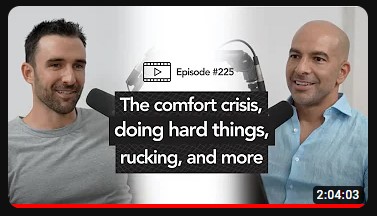
A recent episode of the highly influential Peter Attia podcast, featuring author Michael Easter, has ignited a significant discussion on a societal phenomenon dubbed "The Comfort Crisis." Easter’s new book, sharing the same title, posits that an unprecedented level of ease and indulgence in modern American life is not a blessing, but rather a profound detriment to human well-being, fostering a range of physical, mental, and social ailments. This concept resonates deeply with philosophies advocating for deliberate challenge and resilience, such as those promoted by Mr. Money Mustache, who found the book to be a concise articulation of his own long-standing principles.
The genesis of this renewed focus on comfort’s perils stemmed from an interview with Easter, initially perceived by some as tangential to their personal lives. However, the evocative title, "The Comfort Crisis," immediately captured attention, serving as a powerful descriptor for a hidden societal malaise. While public discourse often centers on crises of debt, health, or economic instability, Easter and proponents like Mr. Money Mustache argue that these are often symptoms of a deeper problem: an pervasive culture of overindulgence and an aversion to hardship. This perspective suggests that modern Americans, on average, struggle not with scarcity, but with an excess of ease that prevents the development of vital adaptive capacities.
Michael Easter and the Genesis of the Concept

Michael Easter, a former writer for Men’s Health magazine, brings a unique and compelling personal history to his exploration of comfort and hardship. His past struggle with severe alcohol addiction, a challenge that echoed through generations of his family, provided a firsthand understanding of the hollow comforts that can lead to self-destruction. His journey to recovery underscored the critical role of confronting discomfort and embracing challenge as pathways to health and self-preservation. This personal battle, detailed within his book, lends significant weight to his broader thesis on the societal impact of avoiding hardship.
Easter’s work, like many popular science books, employs a dual narrative structure. It interweaves the gripping account of his participation in an exceptionally arduous caribou hunting expedition in a remote Alaskan wilderness with scientific research, psychological insights, and cultural commentary. This approach allows readers to digest complex concepts through the lens of lived experience, making the lessons of resilience and adaptation more tangible and applicable.
The Problem of Problem Inflation: A Scientific Explanation
One of the book’s most striking revelations is its scientific explanation for what can be termed "problem inflation." This phenomenon describes the human brain’s inherent tendency to constantly scan its environment for threats, regardless of how safe or comfortable that environment actually is. Research cited by Easter, including studies by Dr. Levari, indicates that as external problems diminish, our internal threshold for what constitutes a "problem" decreases. Consequently, minor inconveniences are elevated to significant stressors.

Levari’s studies demonstrated that when individuals are tasked with identifying problems in progressively safer environments, they begin to broaden their definition of a problem, often unconsciously. "As we experience fewer problems," Easter quotes, "we don’t become more satisfied. We just lower our threshold for what we consider a problem." This psychological mechanism offers a compelling explanation for seemingly trivial complaints that can dominate affluent suburban communities, or the manufactured "wedge issues" that often fuel political division. Instead of appreciating relative peace and prosperity, society becomes adept at inventing new sources of discontent, often exploited by political narratives.
Conversely, individuals living in genuinely challenging environments often exhibit greater resilience and a more robust perspective on actual threats. The article highlights interviews with Ukrainian citizens in war zones, who, despite living amidst conflict, sometimes reported feeling "safe" at a surprisingly similar rate to U.S. residents in their own cities. This suggests an adaptive recalibration of what constitutes safety and normalcy in the face of acute hardship.
This principle also sheds light on the generational dynamics of wealth and entrepreneurial spirit. First-generation immigrants, often arriving from less comfortable or wealthy conditions, frequently demonstrate remarkable drive and resilience, building businesses and accumulating wealth. Their children and grandchildren, growing up in more affluent circumstances, may, by contrast, become more susceptible to complacency and the erosion of that wealth. The initial experience of relative hardship cultivates an adaptation to conditions that makes the "comforts" of the new environment appear luxurious, fostering a more frugal and accumulation-oriented mindset.
Nature’s Prescription: Reconnecting with the Wild
"The Comfort Crisis" also delves into the profound benefits of reconnecting with nature, offering scientific backing for practices often dismissed as mere recreation. Modern urban and corporate environments, characterized by cubicles and extended periods of driving, are shown to actively degrade mental and physical health. In contrast, exposure to natural settings triggers deep-seated biological responses that promote healing and well-being.
The book underscores the measurable therapeutic effects of even minimal interaction with nature. Studies have shown that simply placing a plant in a hospital room can accelerate patient recovery from a variety of ailments. Extrapolating from this, Easter emphasizes the immense "medicine" inhaled and experienced when immersing oneself in a living forest for hours or even days. This aligns with the growing body of research on shinrin-yoku (forest bathing), a Japanese practice that demonstrates how spending time in nature can reduce stress hormones, lower blood pressure, improve mood, and boost immune function. The biological wiring of humans, honed over millennia in natural environments, responds instantly and powerfully to these stimuli, in ways artificial settings cannot replicate.
The Cost of Convenience: Aversion to Exertion
A central tenet of Easter’s work is the human species’ natural, yet increasingly detrimental, aversion to physical exertion. This innate predisposition towards conserving energy, a survival mechanism in times of scarcity, has become a liability in an age of abundant resources and ubiquitous convenience. The book presents a startling statistic: only 2% of people choose the stairs when an escalator is available. This seemingly innocuous preference for ease comes at an "insane cost" to individual and public health.

The benefits of physical activity are not speculative but are among the most thoroughly researched and reproducibly proven interventions for improving health. Regular movement, even moderate amounts, significantly reduces the probability and severity of almost all diseases, from cardiovascular conditions and type 2 diabetes to certain cancers and mental health disorders. The implications of this are vast: if basic movement offers such profound benefits, imagine the transformative power of engaging in several hours of daily physical activity in a natural environment, incorporating heavy load-bearing and bursts of extreme exertion.
This scientific understanding highlights a critical disconnect in modern healthcare. While sophisticated medical analyses and exotic treatments are pursued for a never-ending series of health problems, fundamental interventions known to be essential for human survival and flourishing are often neglected. These include maximizing outdoor time, engaging in heavy exertion (including strength training), minimizing sedentary behavior (sitting and driving), and drastically reducing consumption of junk food, sugar, and alcohol. While perfection is not required, recognizing these "big levers" for physical and mental health is crucial. The book argues that more complex medical interventions should primarily be considered after these foundational aspects of human well-being have been addressed.
Real-World Application: A Journey into Purposeful Hardship
The principles articulated in "The Comfort Crisis" found a compelling real-world demonstration through the personal experience of Mr. Money Mustache himself, who embarked on a "Carpentourism" journey during his reading of the book. This solo expedition into the mountains of Southwestern Colorado, involving construction projects and minimalist living in a Model Y vehicle, served as an unplanned crucible for testing Easter’s theories.

The journey began with a series of minor, yet impactful, challenges: a torrential rainstorm, an unexpected traffic fine, and a pebble-induced crack on a brand-new windshield. For someone accustomed to a stable and comfortable life, these incidents initially caused disproportionate stress. However, informed by the book’s insights, the author reframed these setbacks as valuable lessons, choosing to embrace them rather than succumb to worry.
The expedition continued to present opportunities for purposeful hardship. Deep in the mountains outside Durango, working on a cabin construction project, the days were hot and physically demanding. The environment lacked indoor plumbing, requiring careful water conservation. The constant presence of tree pollen added another layer of discomfort. Each evening necessitated transforming the car back into a bedroom. Yet, instead of succumbing to depression, the author reported feeling increasingly alive and capable, adapting to the "feral forest man" lifestyle.
A particularly illustrative anecdote involved paddleboarding on the wild Lemon Reservoir. Deliberately leaving phones and amenities behind, the author and a companion paddled against a stiff headwind and whitecap waves, venturing far from shore. This physically demanding and slightly intimidating experience, guided by the book’s mantra of "Is this difficult? Gooood! Then you’d better keep going!", led to a profound sense of accomplishment and freedom. The eventual serene drift back, floating on minimal equipment over deep water, underscored the unexpected tranquility found in chosen discomfort, cementing a vivid memory unmediated by digital capture.
The culmination of this week of strenuous forest living and sparse food supply highlighted another core teaching: the importance of experiencing healthy hunger. In a society where constant satiety is the norm, the body’s natural state of hunger has become an alien sensation, yet it is a fundamental human experience. The simple act of consuming a large burrito after days of relative deprivation became "the most delicious meal of my life," demonstrating how hardship enhances appreciation for basic comforts.

Purposeful Hardship vs. Purposeful Spending: Implications for Modern Society
The insights from "The Comfort Crisis" carry significant implications for various aspects of modern life, including personal finance philosophies like the Financial Independence, Retire Early (FIRE) movement. While there is valid criticism that some within the FIRE community might become overly focused on saving to the detriment of meaningful spending, Easter’s work provides a crucial counterpoint. The goal should not simply be to accumulate wealth to buy more comfort, but to cultivate a life rich in experience, resilience, and purposeful engagement.
Spending money on adventures, personal growth, generosity, and improving the world are indeed valuable uses of resources. However, it is equally crucial to recognize the insidious trap of continuously acquiring things that merely make life "easier and easier." This unchecked pursuit of convenience can paradoxically lead to a diminished sense of purpose, a weakened body, and a less resilient mind.
The ultimate message of "The Comfort Crisis" is a call to conscious living: to actively seek out challenges, embrace discomfort, and prioritize experiences that build grit and connection over those that merely offer passive ease. It encourages a re-evaluation of societal norms that equate comfort with happiness and progress. Instead of perpetually upgrading our lives to be softer, faster, and more effortless, the book advocates for investing in tools that enable us to engage with the world more fully, tackle meaningful projects, and confront life’s inherent difficulties with strength and perspective. As the adage from the book succinctly puts it, "buy yourself better tools, not softer chairs." This philosophy challenges individuals to cultivate a life of deliberate challenge, fostering true well-being and resilience in an increasingly comfortable, yet paradoxically, discontented world.

