
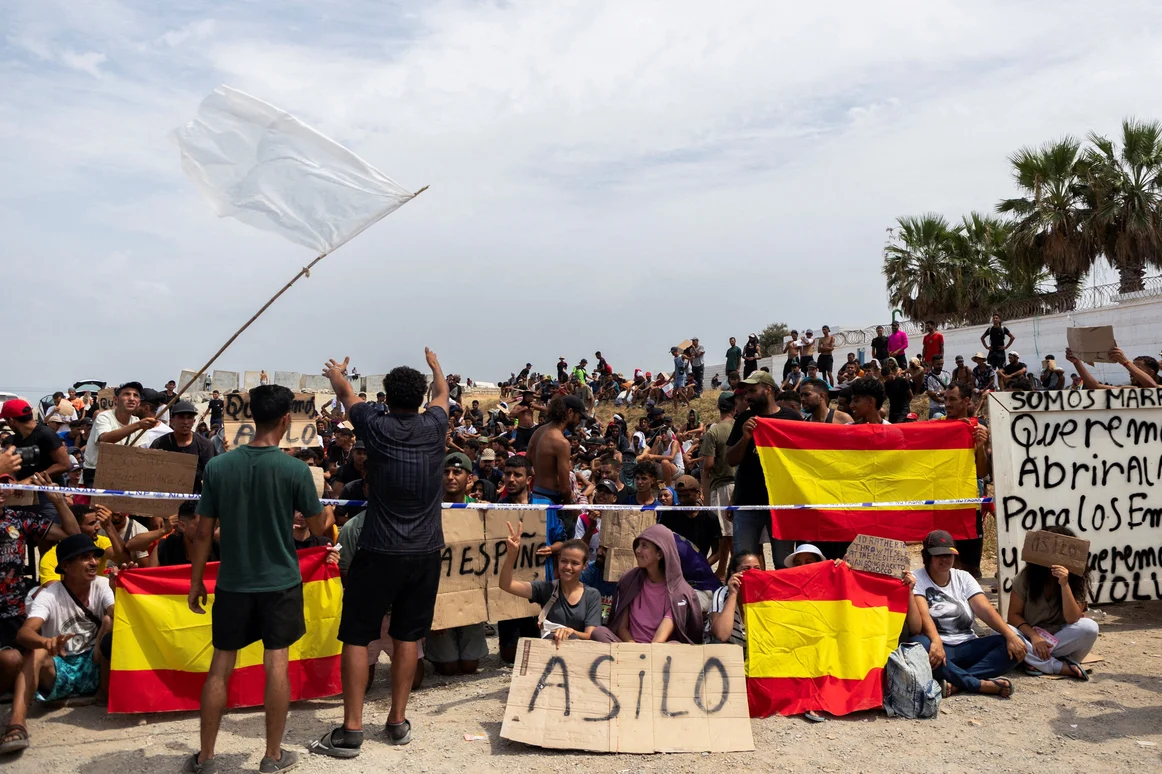
Spanish police sources in Ceuta report that approximately 70% of Moroccan migrants processed in the Spanish autonomous city following the unprecedented mass entry in July have sought asylum on grounds of persecution related to their sexual orientation. This striking figure, initially published by the Spanish daily ABC and subsequently relayed by El Periódico de Ceuta, represents a significant departure from the more traditional economic or work-related reasons typically cited by Moroccan asylum seekers. The data, attributed to unnamed National Police sources rather than official published statistics, underscores a profound shift in the migration narrative and poses complex challenges for Spain’s asylum processing system.
The Context: Ceuta and the Unprecedented July Influx
Ceuta, along with Melilla, stands as one of two Spanish enclaves on the North African coast, sharing a land border with Morocco. These cities serve as the European Union’s only land borders with an African nation, making them flashpoints for irregular migration. Historically, Ceuta has experienced intermittent surges of migrants attempting to cross into European territory, often by scaling the formidable border fences or swimming along the coastline. However, the events of July 30-31 were of an entirely different magnitude, representing one of the largest single mass entries in recent memory.
In a dramatic and largely unexplained event, tens of thousands of individuals, predominantly Moroccan, managed to cross into Ceuta. Spanish government estimates put the number of arrivals at approximately 72,000, though other accounts vary. Many migrants, including families and unaccompanied minors, swam around the border breakwater, while others overwhelmed land crossing points. The scenes of thousands rushing the border, met by a frantic response from Spanish authorities, captured international attention and highlighted the immense pressures on Europe’s southern frontier. The scale of the crossing was accompanied by tragic consequences, with reports of 83 deaths by the Spanish government, while human rights organizations cited a higher figure of 141 fatalities, mostly due to drowning or injuries sustained during the chaotic crossing.
The immediate aftermath saw Spanish security forces, bolstered by military deployments, working to manage the overwhelming influx. Makeshift camps sprang up along the beaches and in other areas, providing temporary shelter for thousands. Humanitarian organizations rushed to provide aid, food, and medical attention to the new arrivals, many of whom were exhausted, injured, and disoriented. The vast majority of those who crossed were swiftly repatriated to Morocco, often through expedited procedures that drew criticism from human rights groups. However, several thousand remained in Ceuta, with Moroccan-focused outlet Yabiladi estimating the number still in the city at around 10,000 by early October. This remaining population formed the core group whose asylum claims would soon dominate headlines.
A New Trend in Asylum Claims: Sexual Orientation as a Basis for Protection
The emergence of sexual orientation as the primary ground for asylum among such a high percentage of Moroccan migrants marks a significant development. Traditionally, Moroccans seeking asylum or entry into Spain often cite economic hardship, lack of opportunities, or, less frequently, political persecution. The shift to claims based on LGBTQ+ persecution introduces a complex layer of legal and humanitarian considerations.
According to the police sources, this trend has substantially reshaped the caseload handled by Ceuta’s asylum office. The sheer volume of these specific claims presents a formidable challenge for investigators tasked with verifying each individual’s account. Morocco’s legal framework criminalizes same-sex relations under Article 489 of its penal code, which stipulates penalties ranging from six months to three years in prison and fines for "licentious or unnatural acts between individuals of the same sex." This legal proscription creates a genuine risk of persecution for LGBTQ+ individuals in Morocco. The U.S. State Department, for instance, has consistently reported on the prosecution of hundreds of men and women annually under this article, highlighting the pervasive societal stigma and legal vulnerability faced by the LGBTQ+ community in the kingdom.
However, simply identifying as gay or lesbian is not sufficient for a successful asylum claim under international law. Applicants must demonstrate a "well-founded fear of persecution" if returned to their country of origin. This standard, enshrined in the 1951 Refugee Convention and further elaborated in EU asylum directives, requires a credible and consistent narrative, supported by evidence where possible. Investigators at Spain’s Office of Asylum and Refugees (OAR) conduct in-depth interviews, cross-reference testimonies, and consider country-of-origin information to determine the veracity of each claim. As Yabiladi notes, applicants cannot rely on stereotypes but must present a compelling personal case demonstrating a specific and individualized risk.
The rigorous nature of this review process is reflected in the outcomes reported so far: out of the numerous claims made, only five individuals from the July mass entries have been granted refugee status based on persecution over their sexual orientation. This low success rate underscores the difficulty in substantiating such claims, particularly amidst suspicions of external influence.
Suspicions of Coaching and System Integrity
The police sources cited in the reports express suspicion that some applicants may be receiving coaching on asylum procedures, specifically on how to articulate claims based on sexual orientation persecution as a means to remain in Spain. While the reports do not provide concrete evidence of such coaching networks, the sudden and widespread adoption of this specific asylum ground has raised concerns about the integrity of the asylum system. If true, such coaching could undermine the legitimacy of genuine claims and strain the resources allocated to processing legitimate cases.
The challenge for asylum officers lies in distinguishing between genuine cases of individuals fleeing severe persecution and those who might be exploiting a legal pathway without a true basis for protection. This requires highly trained personnel capable of nuanced interviews, cultural sensitivity, and an understanding of the specific vulnerabilities faced by LGBTQ+ individuals. The process often involves detailed questioning about personal experiences, relationships, and the threats faced, all while navigating potential language barriers and the trauma some applicants may have endured.

Personal Testimonies and Humanizing the Crisis
Amidst the statistics and policy debates, individual stories offer a poignant glimpse into the human dimension of this crisis. An Associated Press report from October 11 quoted a gay man from Tetouan, Morocco, who explained his decision to leave: "I left Morocco because being gay is so hard." He recounted being threatened by his own brother, who intended to report him to the police, forcing him to flee his home country. While the AP noted it could not independently verify this specific asylum claim, such testimonies illustrate the profound fear and desperation that can drive individuals to seek refuge. These personal narratives are crucial in understanding the complex motivations behind asylum applications, even as authorities grapple with the broader trends and challenges to the system’s integrity. The clearing of the beachside tent camp in early October, where many of these individuals had been sheltering, marked another chapter in their uncertain journey.
Official Responses and Policy Implications
The Spanish government has maintained a firm stance on the situation in Ceuta. Interior Minister Fernando Grande-Marlaska has repeatedly stated that none of the migrants from the July influx will be allowed to stay permanently in Ceuta or travel to mainland Spain. This position reflects Spain’s broader commitment to controlling its borders and preventing the creation of a "pull factor" for further irregular migration.
In response to the mass entry, both Spain and Morocco significantly bolstered their security measures. Spain increased its police and Civil Guard presence in Ceuta from 1,100 to 1,600 officers. Morocco, for its part, deployed additional soldiers and erected extra fencing along its border with the enclave, demonstrating a renewed commitment to preventing future large-scale crossings. While Madrid blamed "traffickers" for orchestrating the July event, the precise cause or catalyst for such a massive and coordinated surge has never been definitively identified. The incident strained diplomatic relations between Spain and Morocco, which had seen previous tensions over issues like the Western Sahara and migration. However, both nations ultimately cooperated in the rapid repatriation efforts, highlighting their shared interest in border stability.
For the European Union, the events in Ceuta served as a stark reminder of the persistent challenges at its external borders and the urgent need for a coherent and effective common asylum and migration policy. The influx underscored the vulnerability of these borders to sudden, large-scale movements of people and the complexities of balancing border control with international obligations to provide asylum to those fleeing persecution.
Broader Impact and Future Challenges
The situation in Ceuta has profound implications on several fronts:
-
For Spain’s Asylum System: The sudden surge in specific types of asylum claims places immense pressure on Spain’s Office of Asylum and Refugees (OAR). Resources for processing claims, conducting interviews, and verifying information are stretched. The potential for fraudulent claims, even if a minority, risks delaying legitimate cases and undermining public trust in the system. Spain, as a signatory to international human rights treaties and a member of the EU, is obligated to provide due process to asylum seekers, a task made more arduous by mass arrivals.
-
For Spain-Morocco Relations: While cooperation on border control has been restored, the underlying causes of mass migration and the human rights situation in Morocco, particularly concerning LGBTQ+ individuals, remain sensitive issues. Spain’s efforts to manage its borders inevitably intersect with Morocco’s internal policies and its role as a transit country.
-
Human Rights and LGBTQ+ Rights: The high number of asylum claims based on sexual orientation draws international attention to the human rights situation for LGBTQ+ individuals in Morocco. While Morocco has made some strides in human rights, the criminalization of same-sex relations remains a significant concern for international watchdogs. This situation highlights the critical intersection of migration, human rights, and international protection.
-
The Integrity of International Asylum Law: The phenomenon of a rapid shift in asylum claim narratives, especially when suspicions of coaching arise, poses a challenge to the foundational principles of international asylum law. It forces states to reinforce the investigative rigor without jeopardizing access to protection for those genuinely at risk. The "well-founded fear" standard is designed precisely to address this, ensuring that asylum is granted based on individual circumstances of persecution, not broad categories or opportunistic claims.
-
Future Migration Dynamics: The events in Ceuta and the subsequent asylum trends may influence future migration patterns and the strategies employed by both migrants and smugglers. As traditional routes become more difficult, and as knowledge of asylum legal grounds spreads, new avenues and rationales for seeking entry into Europe may emerge, further complicating border management and asylum processing.
In conclusion, the situation in Ceuta, marked by an unprecedented mass entry and a dramatic shift in asylum claim narratives, encapsulates the multifaceted challenges facing European border nations. The high percentage of Moroccan migrants seeking asylum based on sexual orientation persecution highlights the complex interplay of human rights, international law, migration pressures, and geopolitical realities. As Spain’s authorities continue to process these intricate cases, the episode serves as a powerful reminder of the individual stories behind migration statistics and the persistent need for robust, humane, and legally sound approaches to asylum and border management.

