
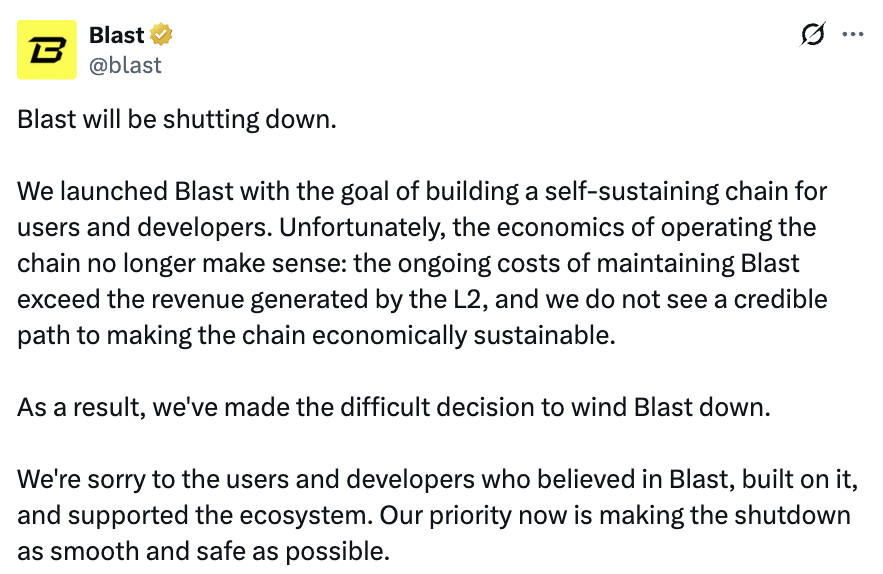
The Ethereum layer-2 scaling solution, Blast, announced its immediate shutdown on Friday, citing a critical imbalance between its operational costs and revenue generation. The decision marks a premature end for a network that garnered significant attention and capital during its development phase, highlighting the persistent challenges in achieving long-term economic sustainability for blockchain infrastructure. In a public statement disseminated via the X platform (formerly Twitter), the Blast team conveyed a stark assessment, stating there was "no credible path" to making the network economically viable. Consequently, users have been urged to initiate the withdrawal of their assets back to the Ethereum mainnet.
"We launched Blast with the goal of building a self-sustaining chain for users and developers," the team articulated in their official post. "Unfortunately, the economics of operating the chain no longer make sense." This candid admission underscores a fundamental business reality that even innovative blockchain projects must confront: the need for a robust and enduring financial model to support ongoing operations and development.
The network’s operational shift will involve a reduction in its withdrawal delay to 24 hours, a measure designed to facilitate a smoother transition for users. However, withdrawals will be temporarily suspended as Blast undertakes the complex process of unwinding its holdings in Lido, a decentralized liquid staking solution. This unwinding process is anticipated to span approximately one week.
Users have a defined window to retrieve their assets through Blast’s native interface, with a deadline set for October 26th. Beyond this date, while assets will remain accessible, users will be required to engage directly with the Blast bridge contracts deployed on the Ethereum mainnet. The Blast team has committed to publishing detailed instructions for this more technical withdrawal process well in advance of the October 26th cutoff, strongly advising users to expedite their asset transfers to the Ethereum mainnet to avoid any complications.
Genesis of Blast: Leveraging the NFT Boom
Blast’s inception is intrinsically linked to the explosive growth of the non-fungible token (NFT) market, particularly through its progenitor, the NFT marketplace Blur. Founded by Tieshun "Pacman" Roquerre, Blur launched in October 2022 and rapidly disrupted the established NFT landscape. By strategically targeting professional traders with enticing token incentives, Blur managed to surpass the then-dominant NFT marketplace, OpenSea, in trading volume by the close of 2022. This lead was further solidified in early 2023, significantly bolstered by its token airdrop and ongoing rewards programs for traders.
It was in November 2023 that Roquerre unveiled Blast, positioning it as a layer-2 solution that offered native yield generation on both Ether (ETH) and stablecoins. This innovative approach, coupled with a points system designed to reward early participants in anticipation of a future token airdrop, proved highly attractive. The strategy successfully lured over $2 billion in deposits before Blast’s mainnet officially went live in February 2024, a testament to the market’s appetite for yield-bearing and incentive-driven blockchain ecosystems.
Economic Realities and Declining Traction
Despite its promising start and substantial initial capital inflow, Blast’s trajectory faced significant headwinds. The broader cryptocurrency market experienced a notable downturn, which disproportionately impacted sectors like NFTs, a key driver of Blast’s initial success. Consequently, the network’s total value locked (TVL) began a steady decline from its peak. According to data aggregated by DeFiLlama, Blast’s TVL, which had reached approximately $2.2 billion in June 2024, has since plummeted by over 98%. This dramatic fall underscores the difficulty in sustaining high levels of economic activity and capital in a volatile market environment.
The challenges faced by Blast mirror those experienced by its affiliated project, Blur. Blur’s TVL, which had surged above $200 million during its early 2024 peak, has also seen a sharp contraction, now standing at around $27 million. This parallel decline suggests a systemic issue related to market saturation, reduced user engagement in NFT trading, or the broader economic climate affecting decentralized finance (DeFi) protocols.
Timeline of Operations and Withdrawal Process
The operational timeline for Blast’s shutdown and user asset withdrawal is as follows:
- Announcement of Shutdown: Friday, October 4th, 2024 (date inferred from the news content). The team officially declared the cessation of network operations due to economic unsustainability.
- Withdrawal Delay Reduction: Immediately following the announcement, the withdrawal delay from the Blast network to the Ethereum mainnet was reduced to 24 hours.
- Temporary Withdrawal Suspension: Withdrawals were temporarily halted to facilitate the unwinding of Lido assets. This process is estimated to take approximately one week.
- User Withdrawal Deadline (Blast Interface): Users have until October 26th, 2024, to withdraw their assets using the Blast native interface.
- Post-Deadline Withdrawals: After October 26th, assets will remain accessible, but users will need to interact directly with the Blast bridge contracts on the Ethereum mainnet.
- Instruction Publication: Blast committed to publishing detailed instructions for direct bridge contract interaction prior to the October 26th deadline.
Background and Broader Implications
The closure of Blast serves as a significant case study in the often-precarious economics of blockchain infrastructure projects, particularly layer-2 scaling solutions. While the promise of enhanced transaction speeds and reduced fees on networks like Blast is compelling, the underlying economic models must account for the full spectrum of operational costs, including network maintenance, security, development, and incentivization strategies.
The initial success of Blast was largely predicated on its ability to attract capital through the allure of native yield and an anticipated token airdrop. This strategy, while effective in bootstrapping liquidity, may not have been sufficient to create a self-sustaining ecosystem in the long run. The reliance on speculative incentives and market sentiment can create vulnerabilities, as demonstrated by the subsequent decline in TVL.
The implications of Blast’s shutdown extend beyond its immediate user base. It raises questions about the long-term viability of other layer-2 solutions that employ similar growth strategies. Investors and developers in the Ethereum ecosystem will likely scrutinize the economic models of nascent projects more closely, seeking evidence of sustainable revenue streams rather than solely relying on speculative growth.
Furthermore, the event highlights the inherent volatility of the cryptocurrency market and its impact on even well-funded and technically promising projects. The rapid rise and fall of Blast’s TVL illustrate the challenges of navigating market cycles and maintaining user engagement in a competitive landscape.
For users, the primary concern is the secure and timely retrieval of their assets. The Blast team’s proactive communication and commitment to providing clear withdrawal instructions are crucial in mitigating panic and ensuring a relatively smooth exit. However, the need for users to potentially engage with smart contracts directly introduces a layer of technical complexity that may be daunting for some.
The closure of Blast also signifies a potential shift in the narrative surrounding layer-2 scaling. While the need for scalability on Ethereum remains paramount, the focus may increasingly shift towards solutions that demonstrate robust, organic revenue generation and a clear path to long-term economic independence, rather than relying heavily on temporary incentives and speculative capital. The industry will be watching closely to see how other layer-2 projects adapt and evolve in light of these economic realities.

