
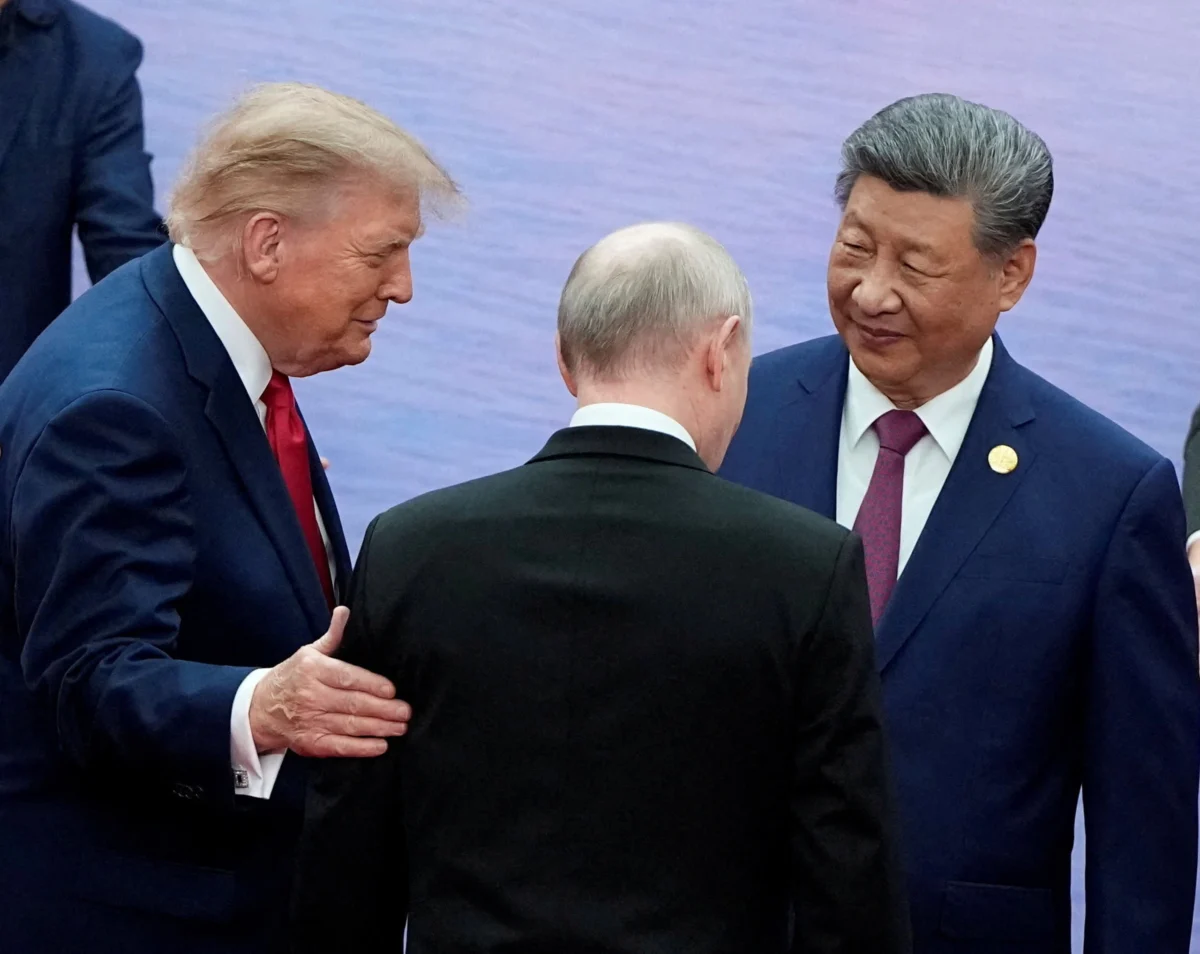
SHENZHEN, China – In a landmark display of high-stakes diplomacy, U.S. President Donald Trump, Chinese President Xi Jinping, and Russian President Vladimir Putin convened for their first-ever direct trilateral meeting on Thursday, November 19, 2026, on the sidelines of the Asia-Pacific Economic Cooperation (APEC) Leaders’ Meeting in Shenzhen, Guangdong province. This unprecedented gathering, preceded by a photo session at the welcome banquet the previous evening, marked a pivotal moment in international relations, signaling China’s assertive rise as a global diplomatic broker and the complex interplay of superpower dynamics in a volatile world.
The Shenzhen Summit: A Diplomatic Nexus
The convergence of three of the world’s most influential leaders in China’s innovation hub underscored Shenzhen’s growing prominence on the global stage, transforming the economic summit into an unexpected arena for critical geopolitical dialogue. The APEC Leaders’ Meeting, typically focused on fostering economic growth, trade liberalization, and regional integration among its 21 member economies, found itself at the epicenter of discussions stretching far beyond trade tariffs and supply chains.
Shenzhen, a city synonymous with China’s rapid economic ascent and technological prowess, provided a symbolic backdrop for the meeting. From a humble fishing village just four decades ago, it has transformed into a sprawling metropolis and a special economic zone, embodying China’s ambition and capability. Hosting such a high-profile event, particularly one involving these three leaders, served as a powerful testament to Beijing’s increasing capacity to not only shape the global economic agenda but also to facilitate crucial political discourse. The city’s futuristic skyline and state-of-the-art infrastructure reflected a nation confident in its global standing and eager to project an image of stability and progress.
The APEC forum itself, representing approximately 60% of global GDP and nearly half of world trade, traditionally offers a unique platform for leaders to engage in both formal and informal discussions. While bilateral meetings are common, a direct trilateral engagement involving the leaders of the United States, China, and Russia carries immense symbolic and substantive weight, drawing global attention to the intricate web of cooperation and competition that defines their relationships.
A Historic Trilateral Engagement: Agenda and Implications
The meeting between Presidents Trump, Xi, and Putin, the first of its kind in person, commenced after their initial encounter at the APEC welcome banquet on Wednesday, November 18. While specific details of the discussions were initially scarce, a Chinese readout later confirmed that the leaders addressed a range of pressing global issues, including the ongoing conflict in Ukraine, the multifaceted crises in the Middle East, and the persistent tensions on the Korean Peninsula.
Notably, President Trump stated during the trilateral session that the U.S., China, and Russia were "uniquely positioned" to discuss reducing nuclear weapons. This declaration, made in a context of escalating global arms races and the breakdown of various arms control treaties, highlighted the profound responsibility these nuclear powers bear. The topic of nuclear non-proliferation and disarmament remains a cornerstone of international security, and any dialogue, however preliminary, between these three nations on the matter is deemed critical by security analysts worldwide. The implications of a coordinated effort, or even a shared understanding, on strategic stability could ripple across the globe, potentially easing regional tensions and fostering a more predictable international environment.
The discussion on Ukraine, specifically, comes at a time when the conflict has entered a protracted phase, causing immense human suffering and significant geopolitical realignment. While China has maintained a position of neutrality, it has also strengthened its strategic partnership with Russia, complicating Western efforts to isolate Moscow. The inclusion of Ukraine on the trilateral agenda suggests a recognition among all parties of the conflict’s global repercussions, from energy markets to food security. Similarly, the Middle East, perpetually embroiled in complex conflicts, proxy wars, and humanitarian crises, demands constant diplomatic attention from major powers. The Korean Peninsula, with its ongoing nuclear standoff and inter-Korean tensions, remains a flashpoint that could rapidly destabilize Northeast Asia. Addressing these issues collectively, even if only to exchange perspectives, underscores the interconnectedness of global security challenges and the indispensable role of major powers in their management.
China’s Ascendant Diplomatic Role
This trilateral meeting was not an isolated incident but rather the latest manifestation of China’s increasingly proactive and ambitious diplomatic strategy. For the second consecutive year, President Xi Jinping has successfully brought President Putin together with another major world leader on mainland Chinese soil. This consistent pattern signals Beijing’s deliberate efforts to position itself as a central player in global governance, moving beyond its traditional focus on economic development to embrace a more comprehensive role in international security and mediation.
According to Jodie Wen, a postdoctoral fellow at the Center for International Security and Strategy at Tsinghua University, China’s "ability to engage directly with the world major powers" reflects the country’s burgeoning influence across the Global South and Eurasia. Wen observed that "China hopes to play a more constructive role in this conflict-[ridden], unstable world," adding that in the future, "China will hope to provide more platforms" within its borders for countries to discuss pressing issues. This perspective aligns with Beijing’s broader foreign policy objectives, which emphasize multilateralism, a "community with a shared future for humanity," and the provision of "public goods" for global stability.
Indeed, China has been steadily cultivating this image as a global broker. A notable success came in 2023 when Beijing facilitated the restoration of diplomatic ties between regional rivals Saudi Arabia and Iran, a diplomatic coup that surprised many and demonstrated China’s growing capacity for mediation in complex geopolitical disputes. This achievement underscored China’s ability to leverage its economic partnerships and non-aligned status to bridge divides where traditional Western diplomacy had faltered.
The sheer volume of diplomatic engagements hosted by China further illustrates this trend. President Xi has hosted over 40 heads of state so far in 2026, including at least eight around the APEC meetings in Shenzhen alone. This follows an even more intensive year in 2025, during which China received over 60 state visits, according to CNBC analysis of official Chinese readouts. Domestic Chinese media have consistently highlighted these diplomatic achievements, portraying President Xi as a statesman actively shaping a new world order through dialogue and cooperation.
A Pattern of Engagement: Previous Diplomatic Forays
The trilateral meeting in Shenzhen builds on a discernible pattern of China’s diplomatic outreach. In September 2025, Beijing hosted an annual meeting of the Shanghai Cooperation Organization (SCO) in Tianjin, China. During this event, President Xi, President Putin, and Indian Prime Minister Narendra Modi shared a moment of levity captured in a "friendly photo-op." This gathering was particularly significant as it followed an easing of long-standing border tensions between Beijing and New Delhi, demonstrating China’s capacity to de-escalate regional disputes and foster a more cooperative environment among major Asian powers. The SCO, an intergovernmental organization focused on security, economic, and political cooperation, has been a key platform for China to strengthen ties with Central Asian nations, Russia, and India, further cementing its influence across Eurasia.
These high-profile engagements, alongside China’s active participation in and hosting of various multilateral organizations like APEC, SCO, and BRICS, indicate a strategic duality in its foreign policy. While maintaining a degree of engagement with the "Western orbit" through forums like APEC, China is simultaneously cultivating deeper relations with non-Western countries, particularly across the Global South. This approach allows Beijing to diversify its diplomatic partnerships, reduce its reliance on traditional Western-centric frameworks, and amplify its voice on global issues.
Geopolitical Undercurrents: Challenges and Opportunities
The convening of the U.S., Chinese, and Russian leaders inevitably brings to the fore the intricate geopolitical undercurrents shaping the 21st century. The relationship between these three powers is characterized by a complex mix of competition, strategic rivalry, and areas of potential cooperation. For the United States, engaging with China and Russia, despite significant ideological and geopolitical differences, is crucial for managing global challenges that no single nation can address alone. For China, the meeting elevates its status as an indispensable global player, capable of facilitating dialogue between great powers. For Russia, it offers a platform to assert its continued relevance on the international stage, particularly in light of ongoing Western sanctions and diplomatic isolation.
However, the path to consensus remains challenging. Yue Su, principal economist for China at EIU, noted that different countries increasingly pursue divergent geopolitical and economic priorities, making it difficult to reach agreement even through multilateral organizations. This inherent divergence is particularly evident among the U.S., China, and Russia, whose strategic interests often clash, from human rights and democratic governance to territorial disputes and spheres of influence.
Despite these challenges, the very act of meeting in person is often seen as a crucial step in de-escalating tensions and preventing misunderstandings. As Tsinghua University’s Jodie Wen highlighted, it is important for leaders to come together face-to-face to avoid misinterpretations and prevent further escalation of conflicts. In an era of rapid information dissemination and often-polarized narratives, direct dialogue can provide a vital channel for clarifying positions, exploring common ground, and building a degree of trust, however fragile.
Economic Vision for the Asia-Pacific
Beyond the high-stakes political discussions, the APEC summit also served as a platform for China to articulate its economic vision for the Asia-Pacific region. On Thursday, President Xi Jinping announced that China would provide $20 million in support for the Asia-Pacific region, a tangible commitment aimed at fostering regional development and cooperation. He also passionately advocated for the development of an "Asia-Pacific community with a shared future," an iteration of his widely recognized slogan on a "shared future" for humanity more broadly.
This vision emphasizes greater economic integration, infrastructure connectivity, and collective efforts to address regional challenges such as climate change and public health. China’s Belt and Road Initiative (BRI), a massive infrastructure development and investment strategy, serves as a primary vehicle for realizing this vision, extending its economic influence across Asia, Africa, and beyond. By framing regional cooperation within the context of a "shared future," Beijing seeks to position itself as a benevolent leader, offering a model of development that prioritizes mutual benefit and common prosperity.
Economically, China’s diplomatic priorities are increasingly focused on delivering tangible benefits through trade, investment, financial connectivity, and technology cooperation, according to Yue Su. This pragmatic approach underscores China’s commitment to strengthening its economic ties within the region and globally, using its immense market size and industrial capacity as levers for diplomatic influence. For many developing economies in the Asia-Pacific, China represents a vital source of investment, technology, and market access, making its economic propositions highly attractive.
Looking Ahead: Implications for Global Governance
The Shenzhen trilateral meeting, while an initial step, carries significant implications for the future of global governance. It signals a potential shift towards a more multipolar world order, where multiple centers of power engage directly to manage international affairs. The ability of China to host such a critical dialogue between its strategic partner Russia and its primary economic rival the United States demonstrates its growing diplomatic heft and its ambition to play a more central role in shaping global norms and institutions.
For the international community, the meeting offers a glimmer of hope that even in an era of heightened geopolitical tensions, channels for dialogue between major powers can be maintained and even expanded. While immediate breakthroughs may be unrealistic, the establishment of direct communication lines on critical issues like nuclear weapons, regional conflicts, and global stability is a positive development. It suggests a recognition, however grudging, among these three nations that their collective actions and inactions profoundly impact global peace and prosperity.
The coming years will reveal whether this unprecedented trilateral engagement was a singular event or the precursor to a more sustained diplomatic effort. What is clear, however, is that China’s emergence as a pivotal diplomatic actor, capable of convening and mediating between global powers, marks a new chapter in international relations. The APEC summit in Shenzhen, 2026, will likely be remembered not just for its economic deliberations, but for providing the stage for a historic meeting that underscored the complex, interconnected, and increasingly multipolar nature of the 21st-century world.

