
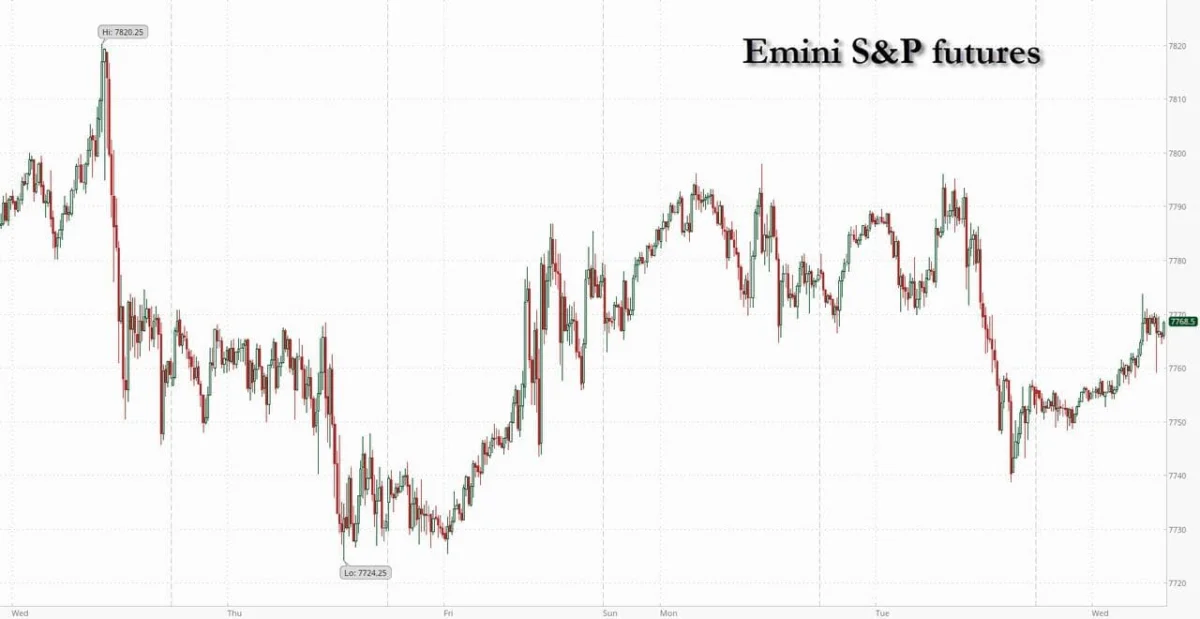
Global financial markets are experiencing a complex interplay of forces this morning, with optimism stemming from robust artificial intelligence (AI) infrastructure earnings contending with persistent geopolitical anxieties and the overarching anticipation of the latest US Consumer Price Index (CPI) report. US futures are broadly higher, propelled primarily by the technology sector, as investors enthusiastically digest a fresh wave of positive updates from key AI-related firms. This tech-led rally extends its influence across Asia, notably boosting South Korea’s Kospi index. Concurrently, oil prices remain a focal point, exhibiting volatility linked to ongoing developments in the Middle East, while Treasury yields are retreating slightly ahead of the pivotal inflation data.
AI Infrastructure Fuels Tech Optimism and Market Gains
The narrative dominating early trading sessions is the resurgent strength of the technology sector, particularly companies at the forefront of AI infrastructure development. This renewed investor confidence stems from a series of stronger-than-expected earnings reports and forecasts from US technology firms, underscoring the sustained demand for AI hardware and services. As of 7:45 AM ET, S&P 500 futures have advanced by 0.2%, while Nasdaq futures, heavily weighted towards technology, show a more significant gain of 0.7%.
Semiconductor and memory chip manufacturers are notably outpacing broader market performance, reflecting their critical role in supplying the computational power required for AI. The "Magnificent Seven" cohort of mega-cap tech stocks is also trading higher, albeit with some divergence, as investors selectively reward companies demonstrating clear AI-driven growth. Nvidia, a bellwether for the AI chip industry, stands out as the largest gainer among the Mag 7 in premarket trading, climbing 1.2%. This boost follows a better-than-expected increase in quarterly profit reported by its key manufacturing partner, Hon Hai (Foxconn), signaling robust global demand for AI hardware components. Other notable Mag 7 advancers include Alphabet (+0.8%), Meta (+0.7%), Tesla (+0.5%), and Amazon (+0.4%), while Apple remains largely unchanged and Microsoft sees a modest decline of 0.8%.
Specific companies directly involved in AI infrastructure have posted impressive premarket surges. CoreWeave Inc., an AI cloud computing specialist, has seen its shares jump approximately 17% in premarket trading on the back of stronger-than-expected sales growth. Similarly, Super Micro Computer Inc., a provider of high-performance server and storage solutions crucial for AI workloads, has climbed 9% after its revenue forecast for the upcoming period topped analyst estimates. These results are being widely welcomed by investors who have been keenly seeking tangible evidence that AI infrastructure companies can translate the immense hype surrounding artificial intelligence into concrete earnings and sustainable growth, thereby propelling the broader tech rally further.
Florian Ielpo, Head of Macro at Lombard Odier Investment Managers, acknowledged the significance of these reports, stating, "The reports from CoreWeave and Super Micro are further evidence that AI infrastructure demand remains strong." However, Ielpo also offered a note of caution, reminding market participants that robust earnings alone do not automatically guarantee higher valuations, especially in an environment characterized by elevated financing costs. This perspective highlights the ongoing debate within the market about whether current tech valuations are justified given the rapid pace of innovation and investment in AI, alongside the broader macroeconomic backdrop of higher interest rates.
The positive sentiment generated by US tech earnings has cascaded into Asian markets, particularly benefiting the region’s prominent chipmakers. The MSCI Asia Pacific Index rose by 0.8%, with industry giants such as Samsung Electronics, SK Hynix, and TSMC emerging as the three largest contributors to the index’s gains. South Korea’s Kospi index experienced a significant surge for a third consecutive day, climbing an impressive 3.7%. This momentum was fueled by optimism surrounding chipmakers’ potential shareholder returns and unconfirmed reports of possible direct investment by Singapore’s sovereign wealth fund, Temasek, into Samsung Electronics and SK Hynix. Shares also rallied across Taiwan, Japan, and mainland China, signaling a broad-based positive reaction to the strengthening AI theme, which has helped Asia’s tech hardware stocks recover some of the losses incurred in July, momentarily overshadowing lingering geopolitical uncertainties.
Anticipation Builds for Critical July CPI Report
Amidst the tech sector’s exuberance, market participants are holding their breath for the release of the July US Consumer Price Index (CPI) data at 8:30 AM ET. This report is arguably the most significant economic data point of the week, as it will provide crucial insights into the current state of inflation and its potential implications for the Federal Reserve’s monetary policy trajectory. Volumes across markets have remained muted throughout the week, a characteristic often observed ahead of such high-impact economic releases, as investors await clearer direction.
Consensus forecasts among economists project a modest month-over-month (MoM) increase of +0.1% for Headline CPI in July, following a +0.4% decline in the prior month. For Core CPI, which excludes volatile food and energy prices, the expectation is for a +0.2% MoM increase. On an annual basis, these figures would translate to a 3.4% Year-over-Year (YoY) rate for Headline CPI and a 2.5% YoY rate for Core CPI, with the latter marking its lowest level since early 2021.
The stakes for this CPI print are exceptionally high. A "dovish" reading – one that suggests inflation is cooling more rapidly than anticipated – could significantly alter market expectations regarding the Fed’s next move. Specifically, it might effectively remove the perceived likelihood of a further interest rate hike at the Federal Open Market Committee’s (FOMC) September meeting, a scenario that would likely provide a substantial boost to equity markets. Currently, Fed-dated Overnight Index Swap (OIS) rates imply approximately a 50% chance of a quarter-point rate hike at the September policy meeting, with a move fully priced in by year-end and a second hike mostly priced in by mid-2027. Any deviation from consensus today could drastically shift these probabilities.
The quiet summer newsflow has amplified the CPI report’s importance, particularly as the Fed’s next policy decision remains finely balanced. While recent data, such as the previous CPI print surprising on the downside and an unexpected contraction in payrolls, might suggest a dovish tilt, countervailing hawkish arguments persist. These include the recent uptick in oil prices and the unemployment rate hitting a 13-month low. Therefore, the July CPI figures are poised to heavily influence the market narrative leading up to the critical Jackson Hole Symposium later this month.
Expert opinions on the inflation outlook are somewhat divided but lean towards continued moderation. Marc Seidner of PIMCO and Matheus Dibo of Goldman Sachs both anticipate that inflation will continue to cool, thereby providing the Federal Reserve with the flexibility to maintain its current policy stance in the foreseeable future. Dibo, speaking on Bloomberg TV, indicated that he does not observe signs of inflationary pressures broadening across the economy. Seidner, conversely, highlighted the lack of significant growth in real incomes as a factor contributing to suppressed price increases. These views offer some comfort that the Fed may not be compelled to pursue aggressive rate hikes, assuming the CPI report aligns with or undershoots expectations.
Beyond today’s CPI, further details on the growth and inflation dynamic will emerge with tomorrow’s releases of Producer Price Index (PPI) data and Retail Sales figures. These reports, especially PPI, offer forward-looking indicators for consumer inflation and provide additional context for the Fed’s decision-making process.
Geopolitical Tensions and Oil Market Volatility
Adding another layer of complexity to the market environment are evolving geopolitical developments, particularly those impacting the Middle East and global oil supplies. Brent crude futures, the international benchmark, experienced significant volatility, initially turning negative and falling back below $89 a barrel. This downturn followed a headline from Pakistan, which stated that the 60-day deadline for a memorandum of understanding (MoU) between the US and Iran might be extended, though the larger peace process was noted as stalled. This initial report sparked some optimism for a de-escalation of tensions.
However, the sentiment quickly reversed, and oil prices pared earlier gains, subsequently rising. Conflicting reports and hawkish statements from Iran emerged, pushing Brent crude back towards and above the $89 mark. Al Jazeera initially cited a spokesman from Qatar’s Foreign Ministry, suggesting that talks between Oman and Iran had reached an advanced stage, fueling initial hopes for a resolution. This was reinforced by Pakistan’s defense minister, who indicated the US and Iran were "close to some sort of arrangement" and that "things are shaping up in favor of peace." At its intraday low, Brent crude briefly touched $86.60/bbl.
The optimistic narrative, however, began to unravel following reports from Iran’s state-run IRIB news, which cited an adviser to Iran’s supreme leader asserting that "the Strait of Hormuz will not be reopened until Iran’s conditions are met." The recently appointed Secretary of the Supreme National Security Council further clarified that any deal between Iran and Oman concerning control of the Strait "will remain a separate issue from the Strait’s closure." He also outlined Iran’s demands, including that "The US must end the war, unfreeze Iran’s blocked assets, and the war must cease across the entire region, including Lebanon and Gaza." These hawkish comments from Tehran starkly contrasted with the earlier conciliatory tones from mediating nations, effectively stifling hopes for an immediate resolution.
Meanwhile, former President Donald Trump weighed in on the situation, stating, "We totally control the Strait of Hormuz" and adding, "Right now, we’re in a very good position." Such comments, while politically charged, contribute to the perception of ongoing friction and uncertainty surrounding one of the world’s most critical oil transit chokepoints.
By yesterday’s close, Brent crude had ultimately risen by 1.36% to $88.91/bbl, and it has climbed another 0.93% this morning to $89.74/bbl, putting it on track for a sixth consecutive daily increase. The rise in oil prices has also been observed across the futures curve, with the 12-month Brent future increasing by 0.33% yesterday to $76.53/bbl and another 0.47% this morning to $76.89/bbl, suggesting that investors are pricing in expectations of more protracted disruption rather than a quick resolution. Elevated energy prices continue to be a significant concern for central bankers globally, as they could reignite inflationary pressures and potentially prompt a more hawkish response from the Federal Reserve, thereby complicating the outlook for interest rates. As Stephan Kemper, Chief Investment Officer at BNP Paribas Wealth Management Germany, warned, "A higher inflation reading would likely boost expectations of a hike in September and December and thereby putting pressure on equity and bond prices."
Broader Market Performance and Outlook

Beyond the immediate drivers of tech earnings, inflation, and geopolitics, other segments of the global market are exhibiting varied reactions.
Fixed Income: Treasuries have extended their gains ahead of the US CPI report, reflecting a demand for safe-haven assets and sensitivity to potential shifts in interest rate expectations. The yield on the benchmark US 10-year Treasury note is down 2 basis points (bps) at 4.66%, while the 2-year Treasury yield fell 2.7 bps to 4.22%, and the 30-year yield declined 1.1 bps to 5.24%. The outperformance in front-end Treasuries was partly supported by a solid $58 billion 3-year note auction, which stopped through by less than 1 basis point. European government bonds have followed suit, with yields on 10-year Bunds (-2.1 bps), OATs (-0.2 bps), and BTPs (-1.4 bps) all retreating. The market awaits a $42 billion 10-year note auction at 1 PM New York time, with the when-issued yield near 4.68%, potentially matching the highest level in recent years.
Currency Markets: The Bloomberg Dollar Spot Index remains largely unchanged, indicating a relatively stable performance for the greenback against a basket of major currencies. However, specific currency pairs are showing more movement. The Japanese Yen is little changed around 159.17 per dollar, but investors are closely monitoring its proximity to the psychologically significant 160 level, which has historically triggered interventions by Japanese authorities to support the currency. The New Zealand Dollar (NZD/USD) fell as much as 0.4% to 0.5856, leading G-10 losses against the dollar, following news that New Zealand Prime Minister Christopher Luxon survived a leadership challenge, quelling a messy bout of infighting less than three months before a general election. The British Pound (GBP/USD) rose 0.1% to 1.3520, while the Euro (EUR/USD) steadied at 1.1538.
Commodities (Ex-Oil): Precious metals are advancing, with spot silver notably up almost 3%, reflecting increased demand for safe-haven assets amidst market uncertainties and inflation concerns. Gold prices are also showing modest gains.
European Equities: European stocks are inching higher, with the STOXX 600 index just about posting its seventh consecutive gain for the first time in over a year, inching up to a new record. The DAX (+0.26%) and the IBEX 35 (+0.20%) also hit new record highs, while the FTSE 100 (-0.17%) and the CAC 40 (-0.13%) fell back slightly. Energy stocks performed well, rising for a third consecutive day in tandem with oil prices, while the healthcare sector was the worst performer, notably impacted by a broker downgrade for Novo Nordisk (-2.8%).
Asian Equities: Beyond the chipmaker-driven surge, Asian markets generally climbed, with Taiwan and Japan seeing rallies alongside mainland China. However, Hong Kong’s benchmark Hang Seng Index declined 0.8%, pressured by anticipation of Tencent’s earnings report, which was released after the market closed. Tencent’s net income of 56 billion yuan fell short of analysts’ estimates, although its revenue of 204.8 billion yuan slightly beat forecasts. Equities also gained in Vietnam and Indonesia, indicating a broader regional appetite for risk.
RBC Capital strategists have maintained a positive view on the S&P 500 over the next year, asserting that strong earnings growth and a solid economy should enable the benchmark index to withstand a modest increase in interest rates. This outlook suggests that while immediate market movements are tied to specific data points and geopolitical shifts, the underlying fundamentals of corporate performance and economic resilience remain supportive for equities.
Upcoming Economic Calendar and Central Bank Schedule
Looking ahead, the economic data calendar for today, August 12, includes the crucial July CPI data at 8:30 AM ET, followed by the July federal budget balance at 2 PM ET. The Federal Reserve’s speaker slate is blank for today, allowing the market to fully absorb the CPI report without immediate commentary from policymakers. However, Cleveland Fed’s Hammack and Richmond Fed’s Barkin are scheduled to make appearances on Thursday, providing the first opportunities for Fed officials to react to the latest inflation figures and potentially offer insights into the central bank’s evolving policy stance.
In summary, global markets are navigating a landscape marked by conflicting signals: the powerful tailwind of AI-driven technological innovation and robust corporate earnings, countered by the persistent headwind of geopolitical instability and the looming uncertainty surrounding the trajectory of inflation and the Federal Reserve’s next policy move. The July CPI report today will undoubtedly serve as a critical compass, helping to chart the immediate course for investors across asset classes.

