
The European Union’s comprehensive regulatory overhaul of the cryptocurrency market, particularly its stringent approach to stablecoins, is entering a critical phase. While major financial platforms operating within the bloc are beginning to delist Tether’s USDT due to the evolving requirements of the Markets in Crypto-Assets (MiCA) regulation, emerging data suggests this regulatory pressure is having a surprisingly muted impact on global USDT activity. This resilience in demand points to a broader shift in how stablecoins, especially dollar-denominated ones, are being integrated into the global financial infrastructure, extending far beyond simple trading or speculative holdings.
The ripples of Europe’s regulatory push are becoming increasingly evident. Revolut, a prominent digital banking app with a significant user base across the European Economic Area and Switzerland, recently informed its European customers that it would delist USDT effective August 31. This decision marks another step in a series of similar actions taken by various European platforms, all scrambling to align their offerings with the intricate rules laid out by MiCA. The EU’s stablecoin regulations have been gradually phased in since 2024, culminating in the expiration of the transition period on July 1, 2026. This deadline has intensified the pressure on crypto service providers to discontinue tokens that do not meet the newly established compliance standards.
However, contrary to what might be expected from such a significant market restriction, analysis from Artemis Analytics indicates that Tether’s exclusion from a key regulated market has not triggered a substantial disruption in USDT’s overall activity. Alex Weseley, a research and data specialist at Artemis, commented, "The data does not indicate any noticeable change in USDT supply or demand attributable directly to MiCA coming into effect in Europe. MiCA didn’t trigger a major venue or chain migration." This observation raises a crucial question: why is demand for Tether, the world’s largest stablecoin by market capitalization, holding up so robustly despite these European headwinds?
The Maturation of Stablecoins: From Trading Tools to Financial Infrastructure
One of the primary drivers behind the sustained demand for USDT and other dollar stablecoins lies in their evolving utility, extending far beyond their initial conception as mere trading instruments or savings vehicles in volatile crypto markets. In regions grappling with economic instability and historical distrust of traditional financial systems, dollar stablecoins are increasingly being adopted as a fundamental component of everyday financial transactions.
A compelling case in point is Argentina, a nation with a long-standing cultural inclination towards safeguarding wealth in tangible assets, often in the form of US dollars, and maintaining holdings outside the formal banking sector. Even as Argentina has begun to ease restrictions on accessing physical US dollars, the adoption and utilization of stablecoins have continued to surge. This trend underscores a deeper integration of stablecoins into the daily financial lives of Argentinians.
Lemon, a leading Argentine crypto and financial services platform, reported processing a staggering $9.3 billion in total volume in 2025. This figure represents a substantial 60% increase compared to the previous year. The platform also witnessed a 70% growth in its transactional user base, reaching nearly 1.8 million active users. Crucially, stablecoin volume on Lemon’s platform saw a significant 45% year-on-year increase, signaling a growing reliance on these digital assets.
Ignacio Gimenez, Lemon’s business and planning manager, elaborated on this paradigm shift: "The role of USDT and other dollar stablecoins is evolving. What we’re seeing is a shift from stablecoins as a store of value to stablecoins as financial infrastructure." He further explained that stablecoin activity is "increasingly driven by payments, cross-border transfers, and global financial services rather than only by savings." This evolution means that Argentinian users are leveraging stablecoins for practical purposes such as making payments in Brazil via PIX using pesos, receiving international remittances in dollars or euros that are credited as USDC, and seamlessly moving funds between traditional bank-held dollars and their digital dollar balances. This multifaceted utility makes assessing stablecoin demand solely by their availability on regulated exchanges an increasingly insufficient metric.
MiCA’s Impact on European Access, Not Global Utility
While MiCA is undoubtedly reshaping the stablecoin landscape within the European Union, its direct influence on global demand patterns appears limited. The regulation is primarily altering how users can access dollar stablecoins through regulated European gateways, rather than diminishing the underlying demand for these assets. This demand stems from their inherent utility in trading, facilitating payments, and enabling efficient cross-border transfers.
Maksym Sakharov, CEO and co-founder of WeFi, a crypto financial infrastructure company, articulated this point clearly: "Users do not choose a stablecoin only because it is available on one regulated platform. They choose it because counterparties use it, liquidity is deep, and it works across many markets." This network effect, driven by widespread adoption and deep liquidity, makes USDT a preferred choice for many users globally, irrespective of regulatory changes in specific jurisdictions.
For some platforms, the strategic decision to limit USDT’s availability in Europe predates the MiCA deadline. Erald Ghoos, CEO of OKX Europe, noted that OKX has not offered USDT to European users for approximately two years. Consequently, the recent MiCA compliance deadline has not introduced significant material changes to their operations concerning USDT. This proactive approach by some exchanges further illustrates the evolving regulatory environment and the industry’s adaptation to it.
The Enduring Dominance of the US Dollar in Crypto Markets
The challenge for European regulators and platforms lies in the deeply entrenched dominance of the US dollar as the de facto global reserve currency and the primary benchmark in the cryptocurrency market. This long-standing precedent means that dollar-denominated stablecoins, like USDT, possess a significant advantage.
While Ghoos acknowledges the global preeminence of the dollar in crypto, he points to a growing institutional interest in euro-denominated stablecoins. "What we are seeing from institutional players is interest in creating more EUR-denominated stablecoins, which is worth watching as it develops," he stated. The development of robust, compliant euro-backed stablecoins could offer a compelling alternative within the EU, potentially reducing friction for retail users by eliminating currency conversion costs in transactions.
However, MiCA’s influence, while dictating the availability of products through regulated European channels, cannot unilaterally alter the fundamental role of the US dollar in the broader global crypto ecosystem. The established liquidity, widespread acceptance, and deep integration of dollar stablecoins into international financial flows present a formidable barrier to any rapid or wholesale shift towards alternative currency-backed stablecoins, particularly in the short to medium term.
Data Insights: A Global Picture Beyond European Borders
Artemis data offers a granular view of stablecoin activity that corroborates the notion of global demand persisting independently of European regulatory actions. Analysis of user activity on popular blockchain networks favored for their low transaction fees, such as Binance Smart Chain (now BNB Chain) and Tron, reveals significant growth that appears to be driven by emerging markets rather than a European exodus.
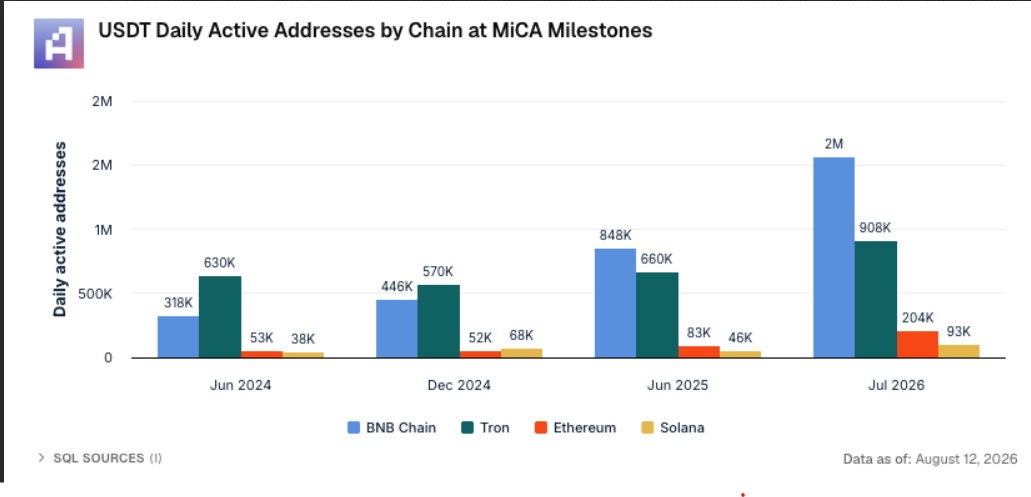
The number of daily active users on BNB Chain, for instance, surged from approximately 318,000 in June 2024 to 1.56 million by July 2026. Concurrently, daily users on Tron saw a 44% increase, reaching around 908,000. Weseley from Artemis interprets this trend, stating, "That looks like expanding global and emerging market usage rather than a Europe-specific migration, and there’s no clear MiCA-timed break in the chain data." This suggests that the observed growth in stablecoin activity is part of a broader global adoption trend, with users in regions where stablecoins serve as essential financial tools driving this expansion.
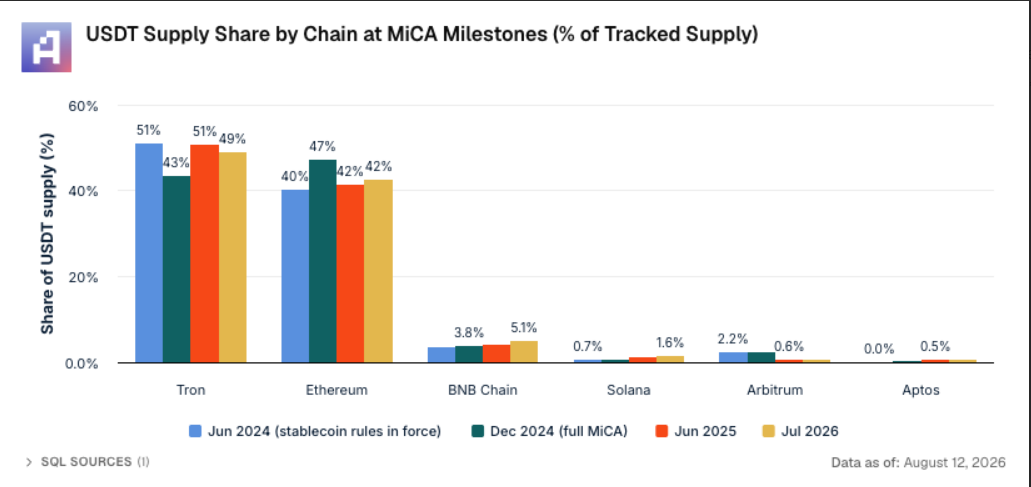
Visualizations of USDT supply share by chain at key MiCA milestones, as well as daily active addresses and transfer volume share by chain, further support this analysis. These charts do not exhibit a discernible negative correlation between the implementation of MiCA-related deadlines in Europe and the on-chain activity of USDT on major blockchain networks. Instead, they point to consistent or growing usage patterns across various chains, indicating that user behavior is less influenced by European regulatory mandates and more by the practical utility and accessibility of stablecoins in their local economic contexts.
The Road Ahead: Navigating Regulatory Frameworks and Global Demand
The current scenario presents a complex interplay between regulatory efforts in developed markets like the EU and the burgeoning demand for stablecoins as essential financial tools in other parts of the world. While MiCA aims to enhance consumer protection and market integrity within the EU by imposing stricter requirements on stablecoin issuers and service providers, its direct impact on the global stablecoin market, particularly for dominant players like Tether, appears to be contained.
The evolution of stablecoins into critical financial infrastructure, facilitating payments, remittances, and cross-border commerce, particularly in regions with less developed traditional financial systems, is a trend that regulators will need to increasingly consider. The challenge for policymakers will be to craft regulations that foster innovation and financial inclusion while mitigating risks, without inadvertently stifling the utility that has made stablecoins so indispensable for millions worldwide.
The continued growth of USDT and other dollar stablecoins in emerging markets, coupled with the ongoing debate around the future of euro-denominated stablecoins, suggests that the global stablecoin landscape will remain dynamic. As regulatory frameworks mature and user adoption patterns evolve, the focus will likely shift towards how different jurisdictions can effectively integrate these powerful financial tools while ensuring stability and security. The European experience with MiCA serves as a significant case study, highlighting the limitations of localized regulation in the face of globalized digital asset utility.

