
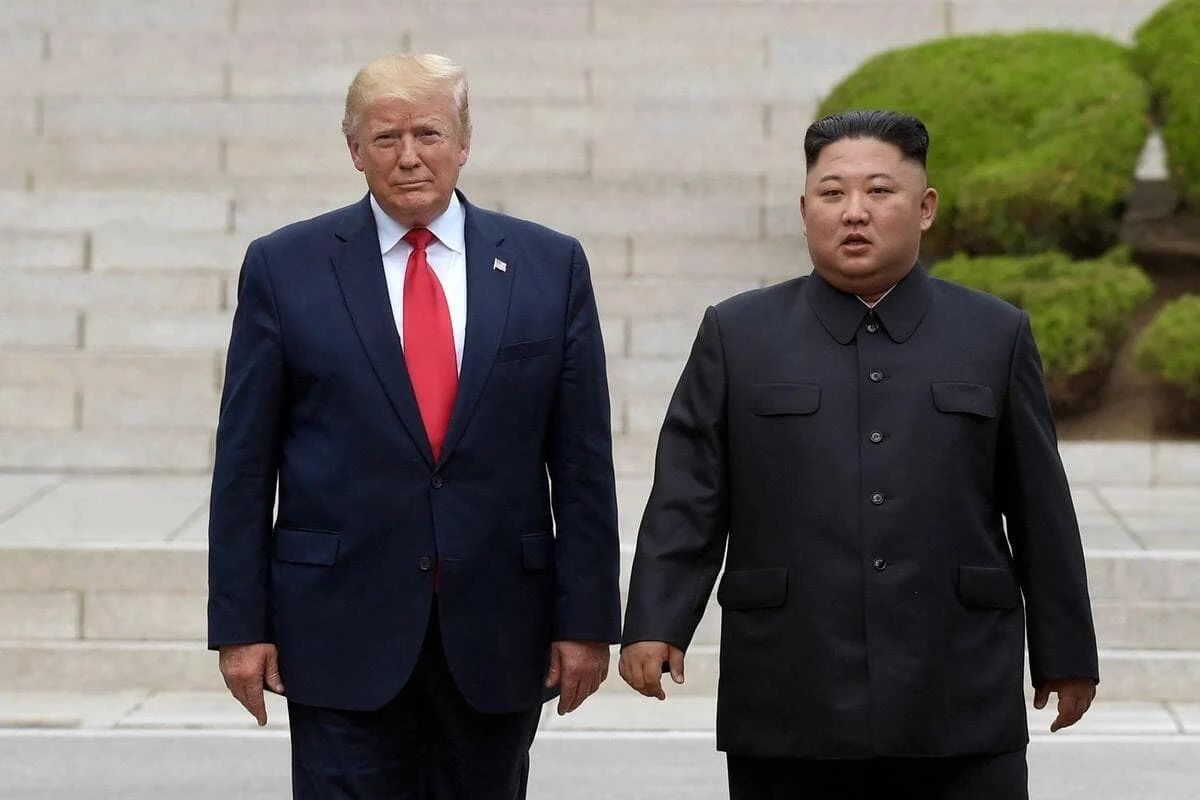
U.S. President Donald Trump indicated on October 12 that a potential meeting with North Korean leader Kim Jong Un could take place during his upcoming visit to Asia in November, rekindling speculation about a resumption of high-stakes, direct diplomacy between the two leaders. The casual yet significant announcement, made during a brief exchange with reporters, immediately drew attention to the stalled denuclearization talks and the escalating military activities on the Korean Peninsula.
A Hint of High-Stakes Diplomacy
When questioned by a reporter about the likelihood of a meeting with Kim Jong Un during his scheduled trip, President Trump responded, "I may. That will be exciting, won’t it? But I get along with him." This remark, delivered with characteristic confidence, underscores Trump’s unique approach to foreign policy, often prioritizing personal rapport with foreign leaders. The president is slated to attend the Asia-Pacific Economic Cooperation (APEC) summit in Shenzhen, China, from November 18-19, providing a potential window for such an encounter. While The Epoch Times sought further clarification from the White House, no official response was provided by the time of publication, leaving the specifics of any potential meeting – including its agenda, location, or even confirmation – unaddressed.
This latest hint follows an earlier statement from Trump in August, where he expressed intentions to meet with Kim later in the year, though he again refrained from offering any concrete details. During that August 19 interaction with reporters, Trump notably commented on North Korea’s nuclear arsenal, stating, "He has 57 very powerful nuclear weapons. We should have never have allowed it to happen. If I were president, I wouldn’t have let it happen, but he’s got them." This acknowledgment of Pyongyang’s established nuclear capability frames any potential future negotiations with a stark realism, contrasting with the optimistic rhetoric often accompanying previous diplomatic overtures.
A History of Unprecedented Summits
Should a fourth meeting materialize, it would mark another chapter in the extraordinary diplomatic saga between Trump and Kim, which began during Trump’s first term. The two leaders held three unprecedented summits between 2018 and 2019, fundamentally altering the landscape of U.S.-North Korea relations, which had historically been characterized by decades of animosity, mistrust, and indirect engagement.
The first historic summit took place in Singapore on June 12, 2018. This groundbreaking meeting, the first between a sitting U.S. president and a North Korean leader, concluded with a joint statement committing to "work toward complete denuclearization of the Korean Peninsula." While praised for opening lines of communication and de-escalating immediate tensions, critics argued the agreement lacked specific commitments and a clear roadmap for denuclearization.
The second summit, held in Hanoi, Vietnam, in February 2019, ended abruptly without an agreement. Negotiations collapsed over a fundamental disagreement: North Korea sought substantial sanctions relief in exchange for partial denuclearization steps, while the U.S. insisted on comprehensive denuclearization before any significant easing of sanctions. The failure in Hanoi highlighted the deep chasm between the two sides’ expectations and capabilities.
A third, impromptu meeting occurred on June 30, 2019, at the Demilitarized Zone (DMZ) separating North and South Korea. During this highly symbolic encounter, Trump briefly stepped onto North Korean soil, becoming the first sitting U.S. president to do so. While generating significant media spectacle and a brief handshake, this meeting yielded no substantive progress on denuclearization and was largely viewed as a photo opportunity aimed at keeping dialogue channels open, albeit without concrete outcomes.
Since the collapse of the Hanoi summit, formal denuclearization talks have remained largely stalled. Despite the initial breakthroughs and personal diplomacy, the fundamental issues of North Korea’s nuclear program and the scope of international sanctions have proven intractable.
North Korea’s Assertive Stance and Military Modernization
The prospect of renewed dialogue comes against a backdrop of escalating tensions on the Korean Peninsula and North Korea’s increasingly assertive military posture. Over the past several years, Pyongyang has consistently pursued its weapons development program, conducting numerous missile tests in defiance of United Nations Security Council resolutions. These tests, which include short-range ballistic missiles, submarine-launched ballistic missiles, and intercontinental ballistic missiles (ICBMs), are often condemned by the international community but portrayed by North Korea as legitimate exercises of its sovereign right to self-defense and deterrence.

A significant development occurred on October 11, when North Korea unveiled a new defense industry museum. This exhibition featured an array of advanced weaponry, prominently displaying the Hwasong-20 intercontinental ballistic missile. According to Shin Jong-woo, secretary general of the Korea Defense and Security Forum, a display accompanying the Hwasong-20 launcher notably depicted a world map illustrating projected ranges extending far beyond the U.S. mainland to include regions such as the Middle East, Australia, and South America. This visual presentation, experts suggest, serves as powerful propaganda, highlighting the achievements of Kim’s defense science development program and potentially aiming to gain a strategic advantage or leverage ahead of any prospective summit with the United States. Kim Jong Un himself attended the opening ceremony, accompanied by his wife and daughter, underscoring the political importance placed on this display of military might.
The very next day, October 12, North Korea launched multiple missiles toward the sea off its eastern coast. South Korea’s Joint Chiefs of Staff reported that at least one projectile traveled more than 559 miles (approximately 900 kilometers). This action prompted immediate heightened surveillance from the South Korean military, which stated it was maintaining an "all-out readiness posture" and would share relevant information with the United States and Japan. The Japanese Ministry of Defense also detected the launches, assessing whether the projectiles had infringed upon Japan’s territorial waters or exclusive economic zone.
Earlier this year, on February 26, state media KCNA reported Kim Jong Un’s assertion that relations with the United States could improve, but only if Washington abandoned what he termed a "hostile policy" against Pyongyang. Crucially, Kim also reiterated North Korea’s unwavering commitment to its nuclear weapons program, stating the country would "never give up its nuclear weapons," and unequivocally ruled out the possibility of engaging in talks with South Korea, further cementing the North’s hardened stance on denuclearization. This position presents a formidable challenge to any diplomatic efforts aimed at disarmament.
Regional Responses and Counter-Deterrence
In response to North Korea’s persistent missile tests and nuclear ambitions, the United States, South Korea, and Japan have significantly enhanced their trilateral defense cooperation and deterrence strategies. This includes expanding joint military drills, which North Korea consistently denounces as "invasion rehearsals" and uses as justification for its own military advancements. These joint exercises, such as the Ulchi Freedom Shield and Vigilant Storm, involve air, land, and naval forces, demonstrating the allies’ combined capabilities and readiness to respond to North Korean aggression.
Adding another layer to the complex security dynamics, South Korea successfully launched its first hypersonic glide vehicle on October 8, just days before North Korea’s latest missile launches. South Korean presidential spokesperson Kang Yu-jung hailed the launch as a success and a "major milestone" in securing a new deterrent capability. The development and deployment of such advanced weaponry by South Korea are part of a broader strategy to counter North Korea’s evolving missile threats and maintain a robust defense posture. This arms race dynamic further complicates the regional security landscape, with each side’s military advancements perceived as a threat by the other.
The Broader Geopolitical Context and Implications
A potential fourth summit between Trump and Kim Jong Un, if it occurs, would unfold within a complex geopolitical environment. The enduring challenge of North Korea’s nuclear program remains a top priority for global non-proliferation efforts. International sanctions, imposed by the United Nations Security Council and unilaterally by the United States and its allies, aim to pressure Pyongyang into denuclearization by limiting its access to hard currency, technology, and trade. However, North Korea has largely proven resilient to these pressures, continuing its weapons development and finding ways to circumvent sanctions, often with the alleged assistance of illicit networks.
The implications of renewed U.S.-DPRK high-level diplomacy are multifaceted. For President Trump, engaging directly with Kim Jong Un could be seen as a reaffirmation of his unconventional diplomatic style and a potential legacy-building effort, particularly given the stalled nature of previous talks. It could also provide a platform to reassert U.S. influence in a region increasingly shaped by China’s growing power.
For Kim Jong Un, a summit with a U.S. president offers significant international legitimacy and propaganda value, regardless of the substantive outcomes. It elevates North Korea to a global stage, portraying Kim as a peer to one of the world’s most powerful leaders. It also allows Pyongyang to probe for potential weaknesses in the international sanctions regime or divisions among the U.S. and its allies. Given Kim’s recent statements about not giving up nuclear weapons and his emphasis on a "hostile policy," any renewed talks would likely be centered on managing tensions and seeking partial concessions rather than immediate, comprehensive denuclearization.
Regional allies, particularly South Korea and Japan, would closely monitor any such developments. While direct dialogue can be seen as a way to reduce immediate tensions, there is also concern that it might legitimize North Korea’s nuclear status or lead to concessions that undermine regional security. China, a key player and North Korea’s primary economic lifeline, also has a vested interest in stability on the peninsula and may view renewed U.S.-DPRK dialogue as either an opportunity for de-escalation or a challenge to its own regional influence.
Ultimately, the prospect of a fourth Trump-Kim summit underscores the persistent complexity of the North Korean nuclear issue. While President Trump’s hint offers a glimpse of potential renewed diplomacy, the historical record of past engagements, coupled with North Korea’s unwavering commitment to its nuclear arsenal and recent aggressive posturing, suggests that any future negotiations would face immense hurdles and require careful navigation from all parties involved. The world will be watching closely to see if this hint translates into a concrete meeting, and what, if any, breakthroughs might emerge from such a high-stakes encounter.

