
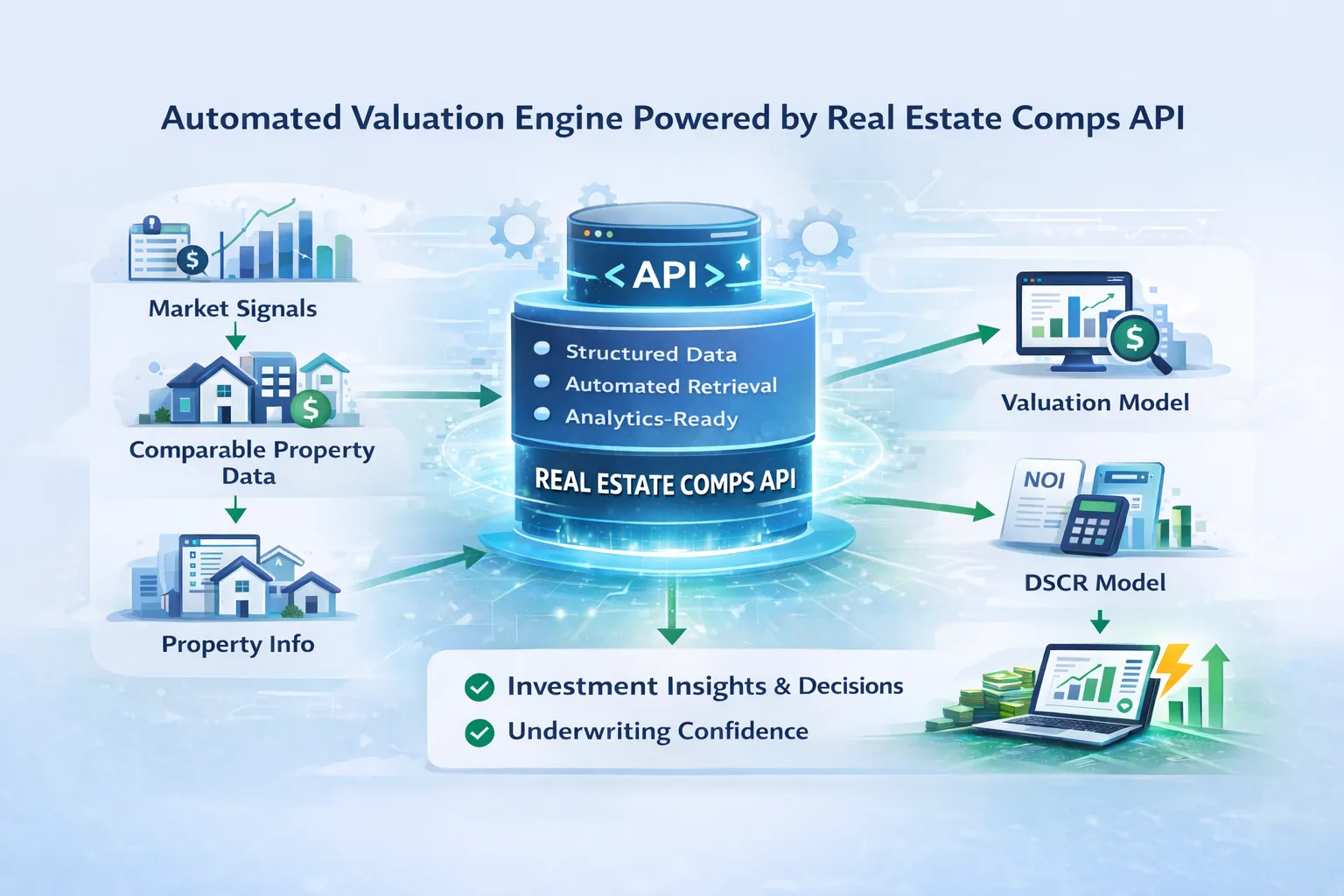
For the majority of real estate valuation models, the primary hurdle is not the complexity of the logic employed, but rather the availability and quality of data. Even the most sophisticated underwriting frameworks are fundamentally reliant on timely and consistent comparable property data. This reliance often compels analysts to dedicate substantial hours to the arduous task of gathering and reconciling fragmented datasets. As real estate portfolios grow in scale, these manual workflows become a significant impediment, slowing down critical decision-making processes, introducing inconsistencies, and severely limiting the ability to evaluate potential deals with the necessary efficiency.
A paradigm shift is underway with the advent of the real estate comps API, a technological solution that promises to fundamentally alter this process. By delivering structured comparable sales and rental data automatically, these APIs enable the creation of faster valuation models and more reliable Debt Service Coverage Ratio (DSCR) analyses. This technological advancement empowers investors and developers to seamlessly integrate vital market intelligence directly into their existing tools and operational workflows. This comprehensive guide will delve into the mechanics of how comps APIs function, how platforms like Mashvisor are facilitating smarter valuation and underwriting models, the specific endpoints available, and the strategic ways businesses can leverage automated comparable property data to construct robust and scalable real estate analytics solutions.
Key Takeaways
- Data Scarcity as the Primary Bottleneck: The core challenge in real estate valuation lies in accessing accurate, timely, and consistent comparable property data, not in the sophistication of valuation methodologies.
- The Inefficiency of Manual Workflows: Manual data gathering and reconciliation are time-consuming, prone to errors, and hinder scalability as portfolios expand.
- The Transformative Power of Comps APIs: These APIs automate the delivery of structured comparable sales and rental data, accelerating valuation processes and enhancing DSCR analysis.
- Integration into Existing Workflows: Comps APIs allow investors and developers to embed real-time market intelligence directly into their proprietary tools and operational pipelines.
- Mashvisor’s Role: Mashvisor offers a comprehensive real estate comps API that provides enriched datasets, including market benchmarks and investment analytics, streamlining the path from raw data to actionable insights.
- Benefits for Various Stakeholders: Investors, developers, lenders, and PropTech platforms can all benefit from the efficiency, accuracy, and scalability offered by automated comparable property data.
How Comparable Property Data Powers Modern Valuation Methods
Comparable property data forms the bedrock of modern property valuation methods in real estate. It empowers investors and analysts to estimate the fair market value (FMV) and income potential of a property by drawing parallels with similar, recently transacted properties in the vicinity. By meticulously analyzing recent sales and rental performance data, these "comps" provide crucial market-based benchmarks against which new investment opportunities can be rigorously compared.
What Are Real Estate Comps?
Real estate comps, short for real estate comparables, are properties that share similar characteristics with the property under investigation. These characteristics typically include location, size, property type, and condition. The primary purpose of identifying comps is to establish a reliable basis for estimating the value of the subject property. Traditionally, the focus of comps analysis has been on recent sales transactions. However, for investment property analysis, rental comps have become equally, if not more, critical for accurately assessing the income-generating potential of a property.
Consequently, the two principal types of comps are:
- Sales Comps: These are properties that have recently been sold in the same or a similar market. They provide insights into prevailing market prices for similar assets.
- Rental Comps: These are properties that are currently rented or have recently been rented out. They offer critical data points for estimating achievable rental income, a key factor in investment property valuations.
Collectively, these comps serve as the foundational elements for sound pricing strategies, robust underwriting processes, and insightful investment analysis. This underscores the paramount importance of structured comparable sales data, particularly for investors aiming to build repeatable and scalable valuation frameworks that can be applied across diverse markets.
Limitations of Manual Comp Analysis
While comps are undeniably central to the valuation process, the traditional methodology of identifying and analyzing them is inherently difficult to scale. This limitation stems from the reliance on manual searches across a disparate array of sources, including online listing platforms, local public databases, and proprietary spreadsheets.
The following challenges emerge with alarming speed when attempting to conduct comp analysis manually:
- Time-Intensive Data Collection: Sourcing comparable properties requires significant manual effort, often involving navigating multiple websites and databases.
- Data Inconsistency and Formatting Issues: Data pulled from various sources is rarely standardized, leading to discrepancies in formats, units of measurement, and data completeness.
- Difficulty in Ensuring Data Timeliness: Market conditions can change rapidly. Manually verifying the recency and relevance of comp data is a constant challenge.
- High Potential for Human Error: Manual data entry and reconciliation are prone to typos, misinterpretations, and omissions, leading to inaccurate valuations.
- Limited Scalability: The manual process becomes unmanageable when evaluating a large volume of properties or when operating across multiple geographic markets.
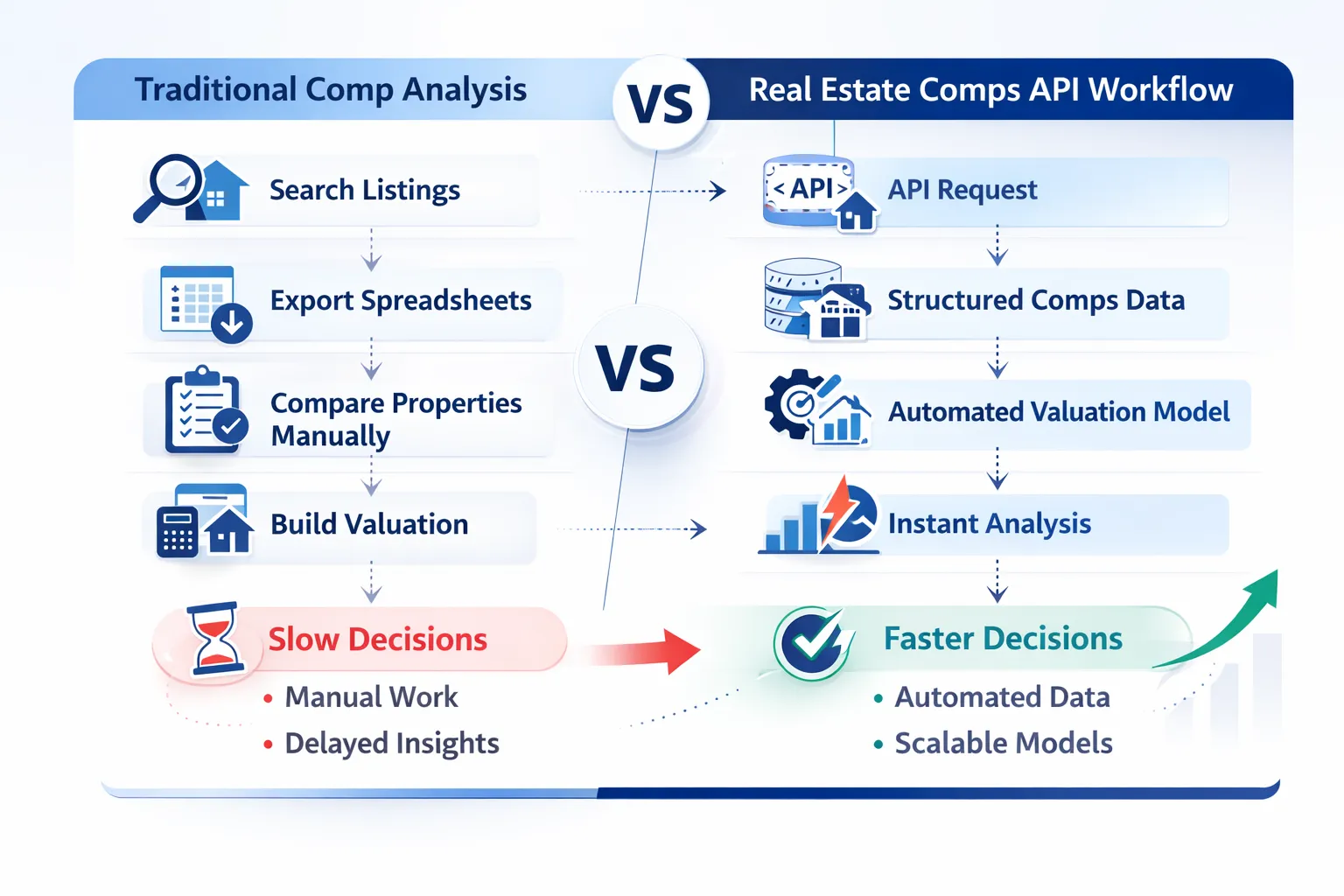
These limitations are magnified significantly for entities that are analyzing deals at scale. As a result, valuation workflows are increasingly migrating towards automated data delivery mechanisms, such as APIs, which facilitate the instantaneous retrieval of comps data and its direct integration into analytical models.
What Is a Real Estate Comps API and How Does It Work?
A real estate comps API is a technological interface that automates the delivery of comparable property data, encompassing details such as recent sales prices, prevailing market pricing benchmarks, and detailed property characteristics. Instead of relying on manual research, users can query the API with specific location or property criteria. The API then returns standardized comps data that is readily usable within valuation and underwriting models.
From Static Reports to Automated Valuation
Traditional comp analysis has historically been reliant on static reports or laborious manual searches that must be meticulously repeated for every property under consideration. A comps API fundamentally replaces this manual underwriting process with automated data retrieval.
The automated workflow, at a high level, operates as follows:
- API Request: A user or application sends a structured request to the comps API, specifying parameters such as location (e.g., address, city, ZIP code), property type, size, or specific features.
- Data Retrieval: The API queries its vast database to identify properties that match the specified criteria and are considered comparable to the subject property.
- Data Standardization: The retrieved data is processed and standardized into a consistent format, ensuring uniformity across all data points.
- Data Delivery: The API returns the structured comparable property data in a machine-readable format, typically JSON or XML, directly to the requesting application.
- Integration and Analysis: The returned data is seamlessly integrated into valuation models, underwriting software, or analytical dashboards, enabling immediate use in calculations and decision-making.
With the assistance of a property comps data API, investors and platforms gain the ability to pull updated datasets on demand. Because the data is delivered in a standardized format, it can be immediately leveraged to build repeatable valuation logic that applies consistently across different property types and markets, regardless of their geographic location.
Where a Real Estate Valuation API Fits in Modern Tech Stacks
Comparable property data is increasingly being embedded directly into software workflows rather than being analyzed as a separate, standalone task. A real estate valuation API serves as a critical data layer, powering a diverse range of tools and applications used by various real estate professionals.
A real estate valuation API acts as a data layer powering tools used by:
- Investment Analysis Platforms: Providing real-time comps to enhance property evaluation and portfolio management.
- Loan Origination Systems: Automating collateral valuation for mortgage lending.
- Property Management Software: Enabling accurate rental pricing and vacancy rate assessments.
- Real Estate Brokerage CRM Systems: Equipping agents with up-to-date market data for client consultations and deal negotiation.
- PropTech Development Teams: Serving as a foundational data source for building new real estate analytics applications.
For those on the technical side, a real estate API designed for developers eliminates the burdensome need to aggregate raw listing datasets or maintain complex, in-house data pipelines. Instead, an automated property valuation API delivers ready-to-use comps data that can be directly integrated into underwriting systems, analytical dashboards, or investment analysis platforms, significantly accelerating development cycles and enhancing product capabilities.
Mashvisor Real Estate Comps API: Data, Endpoints, and Features
The utility of a comparable sales data API is intrinsically linked to the quality and structure of the data it provides. The Mashvisor API distinguishes itself by offering comparable property datasets that are not only comprehensive but also enriched with vital market benchmarks, sophisticated investment analytics, and performance indicators, all unified within a single, cohesive real estate analytics API. This integration allows users to bypass the often-laborious process of raw data preparation and move directly from acquiring comps to conducting valuation and underwriting without the need for additional, time-consuming data processing steps.
Key Data Points Available Through Mashvisor API
Mashvisor delivers structured comparable property data that is specifically designed to support robust real estate valuation models, accurate pricing analysis, and informed investment decision-making.
Property-Level Comparable Data
- Sale Price and Date: Crucial for understanding recent transaction values and market momentum.
- Property Characteristics: Including square footage, number of bedrooms, bathrooms, lot size, and property type, enabling precise matching of comparables.
- Property Condition: Details on the state of repair and any recent renovations, which significantly impact value.
- Listing Status: Information on whether a property is currently for sale, pending, or sold.
- Days on Market (DOM): An indicator of market liquidity and buyer demand.
- Price Per Square Foot: A standardized metric for comparing property values.
Market and Investment Context
- Rental Income Estimates: Projections for potential rental income based on market data, essential for income property analysis.
- Cap Rate: The capitalization rate, a key metric for evaluating the profitability of income-generating properties.
- Cash-on-Cash Return: A measure of the profitability of an investment relative to the cash invested.
- Occupancy Rates: Indicative of demand and stability in the rental market.
- Neighborhood Market Trends: Data on broader market dynamics, such as price appreciation, rental demand, and economic indicators.
These comprehensive endpoints empower users to integrate a real estate investment analysis API directly into their acquisition or real estate underwriting pipelines, providing a holistic view of a property’s potential.
Example Mashvisor API Endpoints
Mashvisor provides access to its rich comparable property data through a variety of well-defined endpoints, each designed to facilitate specific analytical tasks.
Common API endpoints used in comparable property analysis:
GET /v1.1/client/property: Retrieves detailed information about a specific property.GET /v1.1/client/property/nearby: Fetches a list of comparable properties within a defined radius of a specified property. This is fundamental for comp analysis.GET /v1.1/client/property/transactions: Provides historical sales transaction data for properties.GET /v1.1/client/property/price-estimates: Returns estimated market values for properties, often derived from a combination of comps and other valuation methodologies.
These endpoints collectively support a fully automated comps workflow that replaces time-consuming manual research with efficient, structured data retrieval.
Example Request: Retrieving Comparable Properties
To illustrate the practical application of the Mashvisor API, consider how a developer might request nearby comparable properties for valuation analysis.
GET https://api.mashvisor.com/v1.1/client/property/nearby?state=AZ&city=Phoenix&address=123+Main+St

Headers:
x-api-key: YOUR_API_KEY
This request is designed to retrieve a list of properties that are geographically proximate to "123 Main St" in Phoenix, Arizona, and possess similar characteristics, making them suitable for use as real estate comps in a valuation model.
Simplified Example Response
The API returns structured comparable property data that can be directly integrated into valuation or underwriting models without requiring manual parsing or formatting.
  "subject_property":
    "address": "123 Main St",
    "property_type": "Single Family",
    "price_estimate": 420000
  ,
  "nearby_properties": [

      "address": "118 Main St",
      "sale_price": 415000,
      "beds": 3,
      "baths": 2,
      "distance_miles": 0.3
    ,

      "address": "140 Oak Ave",
      "sale_price": 432000,
      "beds": 3,
      "baths": 2,
      "distance_miles": 0.6

  ]
The data is returned in a standardized JSON structure, enabling immediate integration into valuation dashboards and automated underwriting tools without the need for manual formatting.
Building Smarter Valuation & DSCR Models Using Mashvisor Data
Real estate valuation and DSCR models achieve greater accuracy and scalability when comparable property data is integrated directly into analytical workflows. By automating the retrieval of comps through an API, investors and developers can standardize their assumptions, significantly reduce the time spent on manual research, and evaluate properties using consistent, reliable market benchmarks.
How to Build a Property Valuation Model Using Comparable Data
Accurate property valuation models are heavily reliant on comparable sales data to estimate fair market value. This estimation is based on observable market behavior rather than subjective pricing assumptions. Utilizing comps delivered via an API allows this crucial valuation process to be repeated automatically across a multitude of properties and markets, ensuring consistency and efficiency.
A simplified workflow for building a real estate valuation model using API-delivered comps involves:
- API Integration: Connect the valuation model to the comps API to enable programmatic data retrieval.
- Input Property Data: Provide the API with details of the subject property (location, type, size).
- Retrieve Comparable Properties: The API returns a curated list of relevant sales and rental comps.
- Data Processing and Analysis: The model processes the comps data, applying statistical methods and weighting factors to derive an estimated market value.
- Output Valuation: The model presents the estimated fair market value, along with supporting data from the comps.
As comps are delivered through a real estate valuation API, the model can run automatically whenever new properties are analyzed, enabling consistent and reliable valuation at scale.
Using Comps Data for DSCR Model Real Estate Analysis
The Debt Service Coverage Ratio (DSCR) model is a critical tool for assessing a property’s ability to generate sufficient income to cover its debt obligations. Its accuracy is contingent upon realistic income and valuation assumptions. Comparable property data significantly enhances DSCR accuracy by grounding these projections in verified market activity and rental performance.
DSCR Calculation Formula
DSCR = Net Operating Income / Total Debt Service
To calculate the DSCR for a rental property, analysts typically perform the following steps:
- Estimate Gross Rental Income: This is derived from comparable rental data, considering prevailing market rents for similar properties.
- Calculate Vacancy and Credit Loss: Apply a realistic vacancy rate, often informed by local market trends and historical data for comparable properties.
- Determine Operating Expenses: Estimate all operational costs, including property taxes, insurance, maintenance, property management fees, and utilities.
- Calculate Net Operating Income (NOI): Gross Rental Income minus Vacancy/Credit Loss and Operating Expenses.
- Identify Total Debt Service: Sum up all annual mortgage payments, including principal and interest.
- Compute DSCR: Divide the NOI by the Total Debt Service.
Accurate comps are instrumental in reducing underwriting risk by preventing the common errors of overestimating property valuations or making unrealistic income assumptions.
Automating Rental Property Underwriting Workflows
When comparable property data is delivered programmatically via an API, the underwriting process can transition from a manual, labor-intensive review to an automated, data-driven evaluation.
A typical automation pipeline for rental property underwriting looks like this:
API → Valuation Model → DSCR Calculation → Investment Decision
This form of rental property underwriting automation allows platforms to:
- Accelerate Underwriting Speed: Process loan applications and investment opportunities much faster.
- Enhance Consistency: Ensure that all deals are evaluated against the same standardized criteria.
- Reduce Operational Costs: Minimize the need for extensive manual review and data entry.
- Improve Risk Management: Identify potential issues earlier and with greater accuracy.
Instead of investing resources in building data infrastructure from scratch, teams can leverage a real estate data API partnership to obtain standardized comps data that is immediately ready for integration into their analytical models.
Real-World Example: Automating DSCR-Based Loan Underwriting
Consider a lender evaluating a rental property loan application. Instead of relying on time-consuming manual appraisals and complex spreadsheet analysis, the system can pull comparable property data through an API the moment a property is submitted for review.
The automated workflow unfolds as follows:
- Loan Application Submission: The borrower submits property details and loan request information.
- API Data Retrieval: The lending platform automatically queries a comps API (e.g., Mashvisor) for relevant sales and rental comparables for the subject property’s location.
- Automated Valuation: The system uses the retrieved comps to generate an estimated market value for the property.
- Income Projection: Based on rental comps, the system projects potential annual rental income.
- DSCR Calculation: The system calculates the DSCR using the estimated income and the loan’s debt service.
- Risk Assessment and Decision: The DSCR, along with other automated checks, informs the lender’s risk assessment and loan approval decision.
In this streamlined setup, a process that previously might have taken hours or even days is transformed into a repeatable, near-instantaneous operation. Crucially, every deal is evaluated using consistent, data-driven criteria, minimizing subjective assumptions and biases. While this example illustrates a typical underwriting workflow, it represents just one of many practical applications for a real estate comps API.
Real-World Use Cases for Investors, Developers, and PropTech Teams
A real estate comps API offers the greatest value when it is seamlessly integrated into critical decision-making workflows. Here’s how different types of users leverage this technology to optimize their processes:
Investors and Acquisition Teams
Real estate investors utilize comparable property data to evaluate potential deals with greater speed and consistency across diverse markets.
Common applications include:
- Deal Screening: Quickly identifying promising investment opportunities by comparing them against market benchmarks.
- Offer Price Determination: Establishing optimal offer prices based on recent sales data and market conditions.
- Portfolio Valuation: Regularly updating the valuation of existing portfolio assets.
- Market Analysis: Gaining insights into neighborhood trends and property performance.
Access to a centralized, comprehensive real estate comps dataset allows investors to standardize their decision criteria and reduce subjective bias in deal evaluation.
Lenders and DSCR Underwriting
Lenders are increasingly adopting automated data workflows to enhance their evaluation of borrower risk and collateral value.
With API-delivered comps, lenders can:
- Automate Collateral Valuation: Streamline the appraisal process by using real-time comparable sales data.
- Enhance DSCR Accuracy: Ensure that loan underwriting is based on realistic income and valuation assumptions.
- Improve Loan Origination Efficiency: Speed up the loan approval process by reducing manual data verification.
- Mitigate Risk: Identify properties with potentially inflated valuations or insufficient income-generating capacity.
This approach aligns with broader industry trends towards automated underwriting powered by historical real estate data APIs.
PropTech Platforms and Developers
For startups and established analytics platforms, comparable property data serves as a foundational data layer upon which valuation and analytics tools are built.
Typical developer use cases include:
- Building Valuation Engines: Integrating comps data into automated valuation models (AVMs).
- Developing Investment Analysis Tools: Providing users with data-driven insights for property selection and performance prediction.
- Creating Market Intelligence Dashboards: Visualizing market trends and property performance using real-time comps data.
- Powering Real Estate Marketplaces: Offering users more accurate pricing and property information.
Leveraging a robust real estate data API allows these teams to launch advanced valuation features without the significant undertaking of building and maintaining complex property data pipelines internally.
Mashvisor API Pricing and Getting Started
Mashvisor’s API pricing operates on a usage-based model, offering flexibility that allows companies to scale their API access in alignment with their evolving data needs. This model is well-suited for a range of users, from early-stage projects with nascent data requirements to large enterprise platforms with substantial data demands.
Mashvisor provides both monthly and annual subscription plans. Annual subscriptions offer an added benefit of two months of access at no additional cost. The pricing structure is tiered, designed to accommodate businesses at various stages of growth:
- Tiered Plans: Offer different levels of API credits and features to match diverse usage patterns and business requirements.
- Scalability: Users can upgrade or downgrade their plans as their data consumption changes.
To initiate the process, prospective users are encouraged to schedule a consultation call with the Mashvisor Data Team to discuss their specific needs and explore the most suitable API plan.
Benefits of Using Mashvisor for Automated Property Valuation
The Mashvisor API offers distinct advantages for investors and developers looking to transition from manual valuation workflows to scalable, data-driven decision-making processes.
Here are the key benefits users can expect:
- Enhanced Accuracy: Access to a vast and continuously updated database of comparable properties leads to more precise valuations.
- Increased Efficiency: Automation significantly reduces the time and resources required for data collection and analysis.
- Improved Scalability: Enables the evaluation of a larger volume of properties and markets without proportional increases in manual effort.
- Standardized Data: Consistent data formatting across all inputs simplifies integration into existing systems and models.
- Actionable Market Insights: Combines raw comps data with investment metrics, providing a holistic view for strategic decision-making.
- Reduced Errors: Minimizes the risk of human error inherent in manual data handling.
- Competitive Advantage: Faster deal evaluation and more informed decisions can lead to better investment outcomes.
By consolidating comparable property data with essential investment analytics on a single platform, Mashvisor empowers users to achieve faster, more reliable property valuation at scale.
When a Real Estate Comps API May Not Be Necessary
While the benefits of a real estate comps API are substantial, it’s important to recognize that such a tool is most valuable when specific needs for scale, automation, and integration are present. For certain use cases, the complexity and cost of an API might not be warranted.
You may not need a comps API if:
- Analyzing a Single Property: If you are only evaluating one or a very small number of properties, manual research might be sufficient and more cost-effective.
- Occasional Analysis: For infrequent valuation needs, manual methods can suffice without the ongoing commitment of an API subscription.
- Limited Technical Resources: If your team lacks the technical expertise or infrastructure to integrate an API, manual methods might be the only viable option.
- Budget Constraints: For individuals or small operations with very tight budgets, the cost of an API subscription might be prohibitive.
In these specific scenarios, implementing an API could introduce unnecessary complexity and expense. However, the moment the need arises for faster analysis, the establishment of consistent benchmarks, or the simultaneous evaluation of multiple properties, the value proposition of automated comps data becomes significantly more compelling.
Bottom Line
As the real estate analysis landscape increasingly embraces a data-driven approach, valuation and underwriting processes are steadily shifting from traditional manual research methods toward automated intelligence. Within this evolving context, property comps data is transforming from a discrete, one-time analysis performed for individual deals into a continuous input that powers pricing models, risk evaluations, and investment decisions across entire portfolios.
A real estate comps API is the technological enabler of this crucial transition. It facilitates the consistent delivery of vital market data directly into automated valuation and DSCR models, empowering teams to analyze opportunities with greater speed while upholding standardized assumptions and maintaining a high degree of accuracy.
By providing scalable access to comparable property data, essential investment metrics, and analytics-ready datasets, Mashvisor enables investors, lenders, and PropTech platforms to redirect their focus from the laborious task of data collection towards the more strategic objective of building smarter, more profitable real estate strategies.
Frequently Asked Questions
What Is a Real Estate Comps API?
A real estate comps API provides programmatic access to data on similar properties within a specific geographic area. This allows applications and software tools to automatically retrieve comparable sales and rental data, enabling faster and more efficient property valuation and market analysis.
How Is DSCR Calculated for Rental Properties?
The Debt Service Coverage Ratio (DSCR) is calculated by dividing a property’s Net Operating Income (NOI) by its total annual debt obligations. This ratio serves as a key indicator of a property’s ability to generate sufficient income to cover its loan payments, thereby helping lenders assess repayment risk.
Who Uses Real Estate Comps APIs?
Real estate comps APIs are widely utilized by a diverse range of industry professionals, including real estate investors, lending institutions, real estate brokerages, and PropTech platforms. These entities leverage these APIs to obtain scalable valuation data for analysis, reporting, and the development of automated real estate analysis systems.
What Makes Mashvisor Different from Other Real Estate APIs?
Mashvisor differentiates itself by focusing on investment-oriented analytics. It integrates property information with crucial market insights and performance indicators, offering users a comprehensive dataset that allows them to evaluate investment opportunities without needing to assemble data from multiple disparate sources.
How Do I Get Comparable Property Data Automatically?
Comparable property data can be accessed automatically by connecting analytical software tools to a data provider’s API. This connection enables the retrieval of nearby property information and pricing benchmarks through automated requests, typically based on specified location or property characteristics.

