
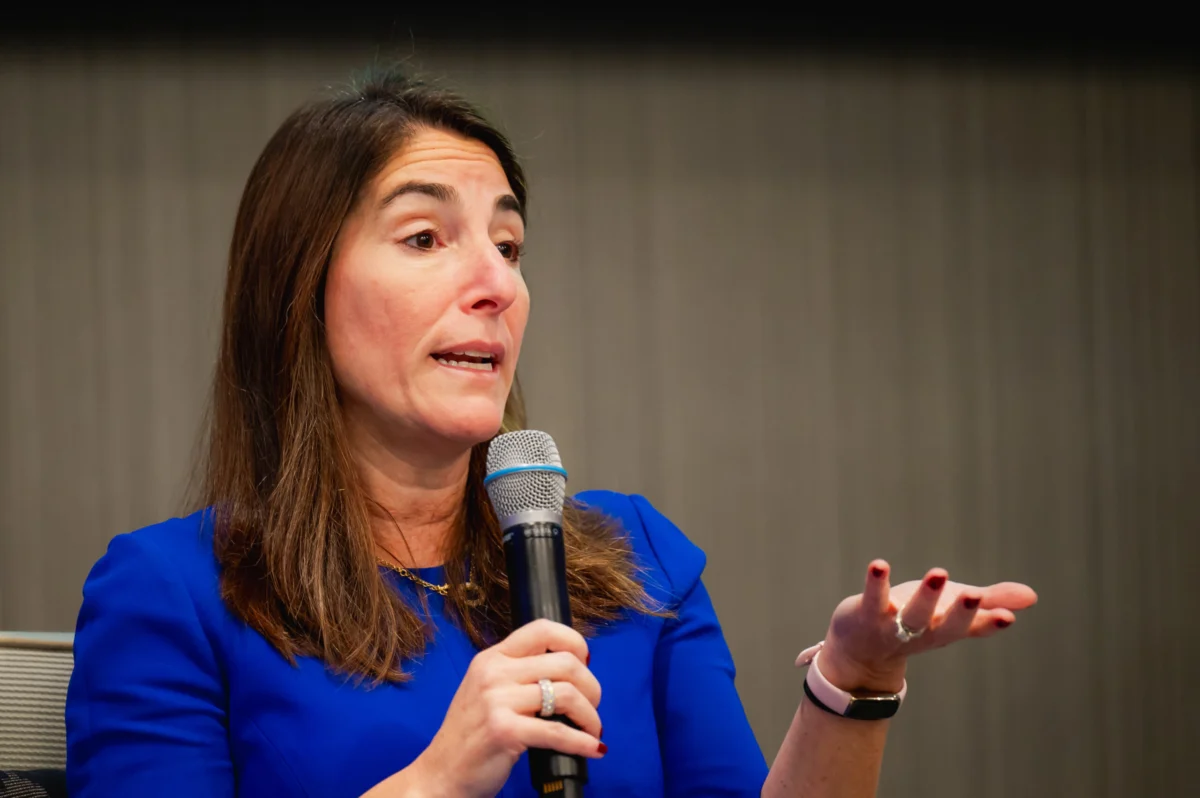
Beth Hammack, president and chief executive officer of the Federal Reserve Bank of Cleveland, delivered a crucial message on Monday, signaling that a more restrictive monetary policy stance, characterized by swift, incremental adjustments to interest rates, is likely necessary to rein in stubbornly high inflation and guide it back to the central bank’s long-term target of 2%. Speaking at the National Association of Business Economics (NABE) annual gathering, Hammack, a voting member of the Federal Open Market Committee (FOMC), articulated a preference for agile, smaller rate hikes over delayed, larger interventions, emphasizing the need for decisive action in the face of ongoing price pressures. Her remarks provided significant insight into the evolving hawkish sentiment within the Fed, suggesting that additional interest rate increases are a distinct possibility in the near future.
"When feasible, I generally think it’s preferable to make smaller adjustments, and to do so relatively quickly, rather than to wait and risk needing a larger course correction," Hammack stated in her prepared remarks. This philosophy underscores a proactive approach to monetary policy, aiming to preempt the entrenchment of inflationary expectations rather than reacting to a more severe problem down the line. She further elaborated on her policy outlook, asserting, "Considering all the inputs that factor into my reaction function, a restrictive monetary policy stance is appropriate to ensure a timely return to 2 percent inflation." Her "reaction function" refers to the analytical framework and economic indicators she utilizes to formulate her policy recommendations, indicating that current economic conditions warrant a tightening of financial conditions.
The Context of Persistent Inflation and Recent Fed Actions
Hammack’s comments arrive at a pivotal moment for the U.S. economy, which has been grappling with elevated inflation for an extended period, significantly impacting household purchasing power and business operational costs. The Federal Reserve, tasked with achieving both maximum employment and price stability, has found its primary focus shifting decisively towards the latter, as inflation has persistently exceeded its 2% target for over five years.
Just last month, the Fed took significant action, voting to increase interest rates for the first time in three years. This initial hike marked a definitive pivot from the ultra-accommodative monetary policy adopted during the economic downturn induced by the global pandemic. The decision reflected a growing concern among policymakers that inflation, initially deemed "transitory," was proving to be more durable and widespread than anticipated. The September FOMC meeting minutes further reinforced this hawkish inclination, indicating that officials largely foresee another rate hike on the horizon, though without providing a specific timeline for such a move. This deliberate ambiguity allows the committee flexibility to assess incoming economic data, particularly inflation readings and labor market reports, before committing to future policy adjustments.
The "first hike in three years" itself was a momentous occasion, signaling the end of an era of near-zero interest rates that had prevailed since the initial stages of the pandemic in early 2020. Prior to that, the last rate hike occurred in late 2018. The move in September 2026 underscored the central bank’s commitment to tackling inflation head-on, even if it entails potential economic headwinds.
Market Expectations and the Road Ahead
Financial markets are acutely tuned to every pronouncement from Fed officials, with traders constantly recalibrating their expectations for future interest rate movements. According to CME’s FedWatch tool, a widely cited barometer of market sentiment regarding the federal funds rate, traders currently price in a more than 78% likelihood that the central bank will keep rates unchanged at its upcoming policy meeting later this month. This suggests a brief pause might be anticipated after the initial hike, allowing policymakers to evaluate its impact. However, looking further ahead, the sentiment shifts dramatically: traders see a nearly 88% chance of another rate hike at the Fed’s final meeting of the year in December. This forward-looking expectation aligns with Hammack’s call for incremental adjustments and the broader signal from the September FOMC minutes.
The discrepancy between the near-term and longer-term market expectations highlights the ongoing uncertainty and the data-dependent nature of the Fed’s policy path. Market participants are keenly watching for further inflation prints, employment figures, and consumer spending data, all of which will influence the FOMC’s decisions.
The Pervasive Challenge of Sticky Inflation
Hammack reiterated that sticky inflation presents formidable challenges across the economic spectrum, affecting consumers, businesses, and monetary policymakers alike. She specifically highlighted the "breadth" of current inflationary pressures, indicating that price increases are not confined to a few sectors but are widespread throughout the economy. This broad-based inflation makes it significantly harder to bring annual price growth down to the central bank’s 2% target, suggesting it will take "some time" to achieve this goal.
Supporting Hammack’s assessment, recent economic data paint a clear picture of persistent inflation. The personal consumption expenditures (PCE) price index, the Fed’s preferred gauge of inflation, registered at 3.4% year over year in August. While this figure shows some moderation from earlier peaks, it remains significantly above the 2% target. More critically, the so-called core reading of the PCE index, which strips out volatile food and energy costs to provide a clearer picture of underlying inflationary trends, came in at 3% compared with a year prior. The core PCE is particularly important to the Fed because it is less susceptible to temporary shocks and better reflects durable price pressures. The fact that core inflation remains at 3% underscores the deep-seated nature of the problem Hammack is addressing.
For context, the Consumer Price Index (CPI), another widely watched inflation metric, has also shown similar trends, often running slightly higher than PCE. For instance, in recent months, year-over-year CPI figures have hovered above 3.5%, with core CPI also demonstrating stubborn persistence. These sustained elevated readings across different measures signal a robust inflationary environment that demands continued vigilance from the central bank.
Anchored Expectations: A Crucial but Fragile Foundation
A central theme in Hammack’s address was the critical importance of inflation expectations. "Long-run inflation expectations have stayed remarkably well anchored despite actual inflation being above target for more than five years," Hammack observed. This anchoring of expectations refers to the public’s and businesses’ belief that, despite current high inflation, the Fed will eventually bring prices back to its 2% target. Such beliefs are crucial because they influence wage negotiations, pricing decisions by businesses, and investment plans, thereby affecting future inflation. If the public expects inflation to remain high, they may demand higher wages or raise prices more aggressively, creating a self-fulfilling prophecy or a "wage-price spiral."
However, Hammack immediately followed this observation with a cautionary note: "But I’m not taking that for granted." This statement reveals a deep concern within the Fed that prolonged periods of elevated inflation could eventually dislodge these anchored expectations. The risk is that a "wait and see" approach could allow an "inflationary mindset" to become entrenched in the economy. "With each passing month, persistently elevated inflation raises the risks of an inflationary mindset becoming entrenched in the economy," she warned. This entrenchment would make the Fed’s job infinitely harder, potentially requiring much more aggressive and economically disruptive policy actions down the road, reminiscent of the Volcker era in the early 1980s when the Fed had to induce a severe recession to break the back of high inflation.
Broader Economic Implications and the Soft Landing Challenge
The implications of Hammack’s hawkish stance and the Fed’s overall tightening trajectory are far-reaching. For consumers, continued rate hikes translate directly into higher borrowing costs for mortgages, auto loans, credit card debt, and other forms of credit, potentially dampening consumer spending, which is a significant driver of economic growth. Businesses will face higher costs of capital, which could curb investment, expansion plans, and hiring, potentially leading to a slowdown in job creation or even job losses.
The ultimate goal for the Federal Reserve is to achieve a "soft landing" – bringing inflation down to target without triggering a recession. This is a notoriously difficult feat. Raising interest rates too quickly or too much risks choking off economic growth, while not raising them enough risks allowing inflation to spiral out of control. Hammack’s call for "smaller adjustments, relatively quickly" could be interpreted as an attempt to navigate this narrow path, gradually tightening financial conditions to cool demand without abruptly stalling the economy.
However, the current economic landscape presents unique challenges. Supply chain disruptions, geopolitical events, and shifts in global demand continue to exert inflationary pressures that are beyond the direct control of domestic monetary policy. The labor market, while showing some signs of cooling, remains relatively tight, with wage growth still robust in many sectors, contributing to service-sector inflation. The unemployment rate, for example, has remained historically low, often below 4% in recent months, complicating the Fed’s dual mandate balancing act. While a strong labor market is desirable, excessive wage growth in an inflationary environment can contribute to further price pressures.
The Role of the Federal Reserve and the FOMC
It is important to understand Hammack’s role within the Federal Reserve system. As president of the Federal Reserve Bank of Cleveland, she is one of twelve regional Fed bank presidents. More significantly, she is a voting member of the Federal Open Market Committee (FOMC), the principal policymaking body of the Federal Reserve System. The FOMC comprises the seven members of the Board of Governors, the president of the Federal Reserve Bank of New York, and presidents of four other Federal Reserve Banks on a rotating basis. As a voting member, Hammack’s views directly influence the decisions on the federal funds rate and other monetary policy tools. Her public statements, therefore, are not merely observations but often serve as signals of potential future policy directions.
The NABE annual gathering, where Hammack delivered her remarks, is a prominent forum for economists and business leaders. Speeches at such events are often strategically chosen platforms for Fed officials to communicate their perspectives and prepare markets and the public for potential policy shifts. The audience, composed of economic professionals, is particularly adept at dissecting the nuances of such statements, amplifying their impact across financial and business communities.
Looking Ahead: Key Economic Data and Fed’s Next Steps
The coming months will be critical for the U.S. economy and the Federal Reserve. Policymakers will be closely scrutinizing a range of economic indicators:
- Inflation Reports: The monthly releases of the Consumer Price Index (CPI) and Personal Consumption Expenditures (PCE) will be paramount, particularly the core readings, to gauge whether inflationary pressures are genuinely abating.
- Employment Data: Nonfarm payrolls, unemployment rates, and wage growth figures from the Bureau of Labor Statistics will provide insights into the health of the labor market and its potential contribution to inflation.
- Consumer Spending: Retail sales and consumer sentiment surveys will indicate the strength of household demand, a key factor influencing price pressures.
- Manufacturing and Services PMIs: Purchasing Managers’ Indexes will offer real-time insights into economic activity and pricing trends across different sectors.
Hammack’s clear articulation of a preference for swift, incremental adjustments reflects a growing consensus within the Fed that proactive measures are necessary to anchor inflation expectations and restore price stability. While the path to 2% inflation is expected to be protracted and fraught with challenges, her statements underscore the central bank’s unwavering commitment to achieving its mandate, even if it entails further monetary tightening in the months ahead. The economic community and financial markets will remain on high alert, parsing every piece of incoming data and every official statement for clues about the Fed’s next move in this delicate balancing act.

