
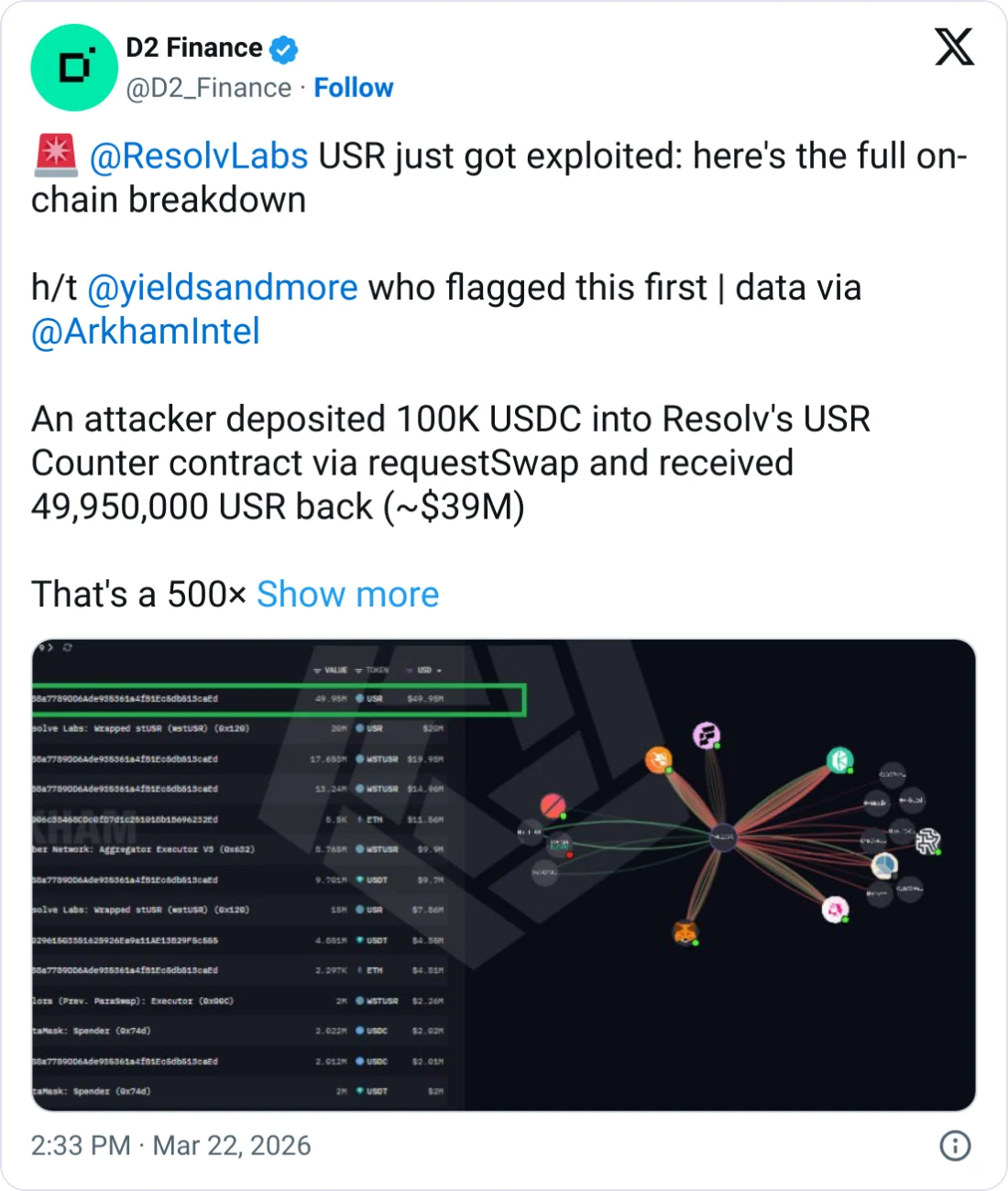
A significant disruption has struck the cryptocurrency market as Resolv Labs’ stablecoin, USR, has lost its crucial peg to the U.S. dollar. The depeg occurred following a sophisticated exploit that enabled an attacker to mint a staggering 50 million unbacked USR tokens by leveraging a vulnerability in the token’s smart contract. This incident has not only caused a dramatic price crash for USR but also highlights ongoing security challenges within the decentralized finance (DeFi) ecosystem.
Resolv Labs, the project behind the USR stablecoin, officially confirmed the exploit via a post on their X (formerly Twitter) account on Sunday. The statement detailed that the breach allowed an unauthorized party to mint 50 million USR tokens without any corresponding collateral. In response to the escalating situation, the Resolv Labs team announced the immediate pause of all protocol functions. This drastic measure was implemented to prevent further malicious actions and to buy time for the team to initiate recovery efforts. The project’s statement read, "The team has currently paused all the protocol functions to prevent further malicious actions and is actively working on recovery."
The initial detection of the anomaly appears to have been made by the X account "yieldsandmore," which alerted the community to USR’s sharp decline. In an earlier post on Sunday, they flagged that USR had plummeted in value. This observation was supported by on-chain data, specifically from Etherscan, which revealed a transaction where an attacker managed to mint 50 million USR tokens. The method employed involved depositing approximately $100,000 worth of the widely-used stablecoin USDC. This transaction demonstrated a clear exploitation of the token’s minting mechanism.
Further analysis by the blockchain security firm PeckShield revealed that the attacker did not stop at the initial mint. According to PeckShield’s alert on X, the attacker was able to mint an additional 30 million USR tokens. This brought the total number of illicitly created tokens to 80 million, exacerbating the supply imbalance and the subsequent price collapse. The precise nature of the exploit, however, remained a subject of intense scrutiny within the DeFi community.
Unraveling the Exploit Mechanism
The underlying cause of the exploit was attributed to a flaw in the minting function of the USR token’s smart contract. D2 Finance, a notable crypto fund, provided insights into the potential vulnerabilities. They suggested that the minting function was "somehow broken." D2 Finance elaborated on the possible technical avenues through which the exploit could have been executed, stating, "Either the oracle was gamed, the off-chain signer was compromised, or the amount validation between request and completion is simply missing." This analysis points to a potential failure in how the stablecoin’s value was being determined or verified, or a compromise of the systems responsible for authorizing token issuance.
Oracles are critical components in DeFi, providing external data, such as asset prices, to smart contracts. If an oracle is "gamed," it means the attacker manipulated the data feed to trick the smart contract into believing a different, favorable value. A compromised off-chain signer suggests that the private keys or credentials controlling certain aspects of the smart contract’s operations were stolen. The absence of proper "amount validation" indicates a failure in the contract’s logic to correctly check if the requested minting operation was legitimate and properly collateralized. Each of these scenarios represents a severe security oversight that could lead to the catastrophic depegging observed.

Chronology of the Collapse
The sequence of events leading to the dramatic depeg unfolded rapidly on Sunday. The initial on-chain transaction, detected by "yieldsandmore," saw the attacker minting 50 million USR tokens after depositing $100,000 in USDC. This action likely occurred in the early hours of Sunday. Shortly thereafter, PeckShield confirmed the minting of an additional 30 million USR tokens, bringing the total to 80 million.
The attacker, operating with extreme speed and efficiency, immediately began to liquidate their ill-gotten gains. D2 Finance observed that the attacker moved the 50 million USR tokens to multiple DeFi protocols. Their strategy involved swapping these newly minted tokens for more established stablecoins, specifically USDC and USDT. Following this, the attacker "aggressively" converted these stablecoins into Ether (ETH), the native cryptocurrency of the Ethereum blockchain, aiming to obscure the trail and realize their profit.
The impact on the USR token’s price was immediate and devastating. D2 Finance described the attacker’s exit strategy as a "textbook DeFi hack cashout running at full speed." As the attacker flooded the market with USR and converted it to other assets, liquidity for USR began to dry up rapidly. This led to significant slippage, meaning that larger trades had a disproportionately large impact on the price. Consequently, USR began trading at drastically reduced prices. On some trades, the token was reportedly selling for as low as 50 cents, a substantial drop from its intended $1 peg. The urgency of the attacker’s actions was evident in the on-chain data, which showed multiple failed transactions as they attempted to exit their positions amidst the deteriorating liquidity.
Financial Ramifications and Market Impact
D2 Finance estimated the attacker’s direct profit from this exploit to be around $25 million. This figure represents the value of the ETH and other cryptocurrencies the attacker successfully converted their ill-gotten stablecoins into before the USR token’s value collapsed further. The exploit’s impact was most starkly illustrated on Curve Finance, a popular decentralized exchange known for its stablecoin swaps and deep liquidity pools. USR’s most liquid pool on Curve, which typically sees significant daily volume, experienced a catastrophic price crash.
Data from DEX Screener showed USR trading at a low of 2.5 cents against USDC in this critical pool. This represented a nearly 97.5% loss in value from its intended peg. The bottom was hit at approximately 2:38 am UTC on Sunday. This timing is particularly notable as it was just 17 minutes after the attacker initially minted the $50 million worth of USR tokens. The speed at which the market reacted and the price plummeted underscores the severity of the unbacked supply entering circulation. Following this sharp decline and the attacker’s subsequent exit, the liquidity pool on Curve has shown some recovery, with USR trading around 84.5 cents at the time of reporting.
However, the overall market sentiment for USR remains severely impacted. According to CoinGecko, the token is currently trading at approximately 87 cents, still a significant 13% below its intended $1 peg. This persistent depeg signifies a loss of confidence from market participants and a potential inability for the token to regain its stable footing without substantial intervention or a complete overhaul of its underlying mechanisms.
Broader Context: A Resurgence of Protocol Exploits?
This incident occurs at a time when the broader trend in crypto-related hacks had seen a notable decline. Data for February indicated a significant drop in losses from exploits, with approximately $49 million lost compared to $385 million in January. Attackers had been increasingly favoring phishing scams and approval exploits over direct protocol hacks. The Resolv Labs exploit, therefore, marks a concerning resurgence of large-scale protocol vulnerabilities being successfully exploited.

The nature of this exploit, which targeted the core minting function of a stablecoin, raises fundamental questions about the security of algorithmic and collateralized stablecoin designs. While the specifics of Resolv Labs’ mechanism are still under investigation, the ability for an attacker to mint millions of tokens suggests a critical flaw in its internal controls or external data feeds. This event serves as a stark reminder that even seemingly robust DeFi protocols can harbor vulnerabilities that can be exploited with devastating consequences.
Potential Implications and Future Outlook
The depegging of USR has several significant implications for the crypto space. Firstly, it erodes trust in stablecoins, particularly those that are not backed by robust and transparent collateralization mechanisms. Investors and users may become more hesitant to adopt or utilize stablecoins from projects with less established track records or complex algorithmic designs.
Secondly, this incident highlights the persistent need for rigorous smart contract auditing and ongoing security monitoring. While audits can identify vulnerabilities before deployment, exploits can still occur if contracts are not designed with sufficient redundancy, attack-mitigation strategies, and robust validation checks. The potential failure points identified by D2 Finance – oracle manipulation, compromised signers, or missing validation – are all areas that require continuous vigilance and advanced security protocols.
For Resolv Labs, the immediate priority is recovery. This could involve attempts to restore the peg through various means, such as introducing new collateral, burning excess tokens, or implementing buyback programs, if feasible. However, regaining the trust of the market after such a significant depeg and exploit will be an arduous task. The long-term viability of the USR stablecoin and the Resolv Labs project hinges on their ability to demonstrate a comprehensive understanding of the vulnerability, a robust plan for remediation, and a renewed commitment to security.
The broader DeFi ecosystem will undoubtedly be scrutinizing this event closely. It may prompt a re-evaluation of stablecoin designs, particularly those relying on complex mechanisms that could be susceptible to unforeseen exploits. The industry’s ability to learn from such incidents and implement stronger security measures will be crucial in fostering continued growth and investor confidence in the decentralized finance space. The chase for illicit gains through sophisticated exploits remains a persistent threat, and the Resolv Labs incident serves as a potent cautionary tale about the inherent risks within the rapidly evolving world of cryptocurrency.

