
SpaceX’s colossal Starship rocket made history on September 28, 2026, successfully reaching Earth orbit for the first time and deploying a critical payload of 26 next-generation Starlink V3 broadband satellites. The landmark mission, launched from the company’s Starbase facility in South Texas at 7:49 a.m. Central Time, marked a pivotal moment for both the Starship program and the future of global satellite internet connectivity, overcoming an initial engine failure scare that briefly cast doubt on the mission’s success. This flight represents a significant leap for SpaceX, transitioning Starship from a highly experimental test vehicle into a credible candidate for a working commercial launch system, poised to redefine the economics and accessibility of space.
A New Era for Starship: From Testbed to Commercial Platform
The successful orbital insertion and payload deployment signify a monumental achievement in the iterative development of Starship, a fully reusable two-stage-to-orbit super heavy-lift launch vehicle designed to transport both crew and cargo to Earth orbit, the Moon, Mars, and beyond. For years, the world has watched SpaceX’s ambitious testing campaign, characterized by numerous high-altitude flight tests, rapid prototyping, and a philosophy of "rapid iterative development" that embraces learning from failures. Previous test flights focused on proving the complex ascent and landing procedures for both the Super Heavy booster and the Starship upper stage. This particular mission, however, moved beyond mere atmospheric maneuvers or suborbital hops, demonstrating the vehicle’s capability to perform an operational mission profile critical for commercial viability.
Elon Musk, CEO of SpaceX, has consistently championed Starship as the lynchpin for humanity’s multi-planetary future, envisioning a future where space travel is routine and affordable. The ability to deploy substantial payloads like the Starlink V3 satellites into low Earth orbit (LEO) is a crucial step towards realizing this vision. With a target for its first commercial service set for 2028, Starship is positioned to dramatically reduce the cost per kilogram to orbit, a metric that has long been a barrier to large-scale space endeavors. Industry analysts suggest that Starship’s full reusability and unprecedented payload capacity—estimated to be over 100 metric tons to LEO in a fully reusable configuration—could lower launch costs by orders of magnitude compared to existing launch systems. This reduction is not merely incremental; it promises to unlock an entirely new "space economy" by making previously cost-prohibitive projects, from massive space telescopes to orbital manufacturing facilities and extensive satellite constellations, economically feasible. The successful demonstration of orbital capability paves the way for Starship to become the primary workhorse for large-scale deployments, further cementing SpaceX’s dominance in the commercial launch market and pushing the boundaries of what is possible in space.
Starlink V3: A Quantum Leap in Broadband Capacity

At the heart of this historic mission was the deployment of 26 advanced Starlink V3 satellites, representing the next evolution of SpaceX’s rapidly expanding global broadband constellation. These new satellites are designed to deliver a staggering leap in performance, offering roughly 10 times the capacity per satellite compared to the V2 satellites currently operational in low Earth orbit. Specifically, the V3 generation boasts an estimated download capacity of approximately 1,000 gigabits per second (Gbps) per satellite, a monumental increase from the approximately 96 Gbps offered by their V2 predecessors. This enhanced capacity is vital for meeting the escalating global demand for high-speed, low-latency internet, especially in underserved and remote areas where traditional terrestrial infrastructure is lacking or non-existent.
The technological advancements embedded within the V3 satellites are extensive. While specific details remain proprietary, industry experts speculate these improvements include more powerful phased array antennas, advanced inter-satellite laser links that allow data to be transferred between satellites at the speed of light in a vacuum, improved propulsion systems for orbital maneuvering and de-orbiting, and potentially enhanced processing capabilities on board. The increased throughput is expected to translate directly into faster speeds, lower latency, and greater reliability for Starlink users worldwide, further solidifying its position as a leading provider of satellite internet. The successful deployment of this initial batch of V3 satellites by Starship is not just a technical triumph but a strategic move to future-proof the Starlink network, ensuring it can accommodate millions more subscribers and handle ever-increasing data demands. The sheer volume of data these new satellites can handle per second underscores SpaceX’s commitment to continuous innovation in its satellite internet service, aiming to bridge the digital divide on a global scale. This significant upgrade also positions Starlink to better compete in markets requiring higher bandwidth, such as enterprise solutions and maritime communications.
A Mission of High Stakes and Dramatic Twists: The Chronology of Flight 14
The atmosphere at Starbase on the morning of September 28, 2026, was charged with anticipation. This was Starship’s 14th flight attempt, a number imbued with significance given the extensive testing regime and the high expectations surrounding this particular mission. The 75-minute launch window opened at 7:15 a.m. CT, with live coverage commencing approximately 35 minutes prior, drawing millions of viewers globally to SpaceX’s webcast and various news outlets.
At precisely 7:49 a.m. CT, the massive Starship, comprising the Super Heavy booster and the Starship upper stage, ignited its 33 Raptor engines, generating an unprecedented thrust that propelled the towering vehicle skyward. The initial ascent appeared nominal, with the rocket smoothly clearing the launch tower and gaining altitude. Cheers erupted from mission control and viewers as the vehicle executed key milestones in the early minutes of flight, demonstrating powerful performance.
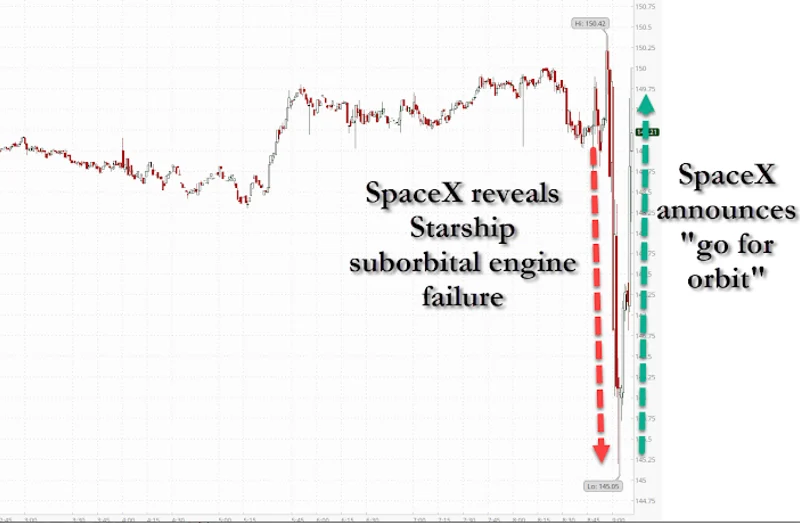
However, approximately three minutes into the ascent, a critical anomaly was detected. One of Starship’s powerful Raptor engines experienced a failure, a common occurrence in early test phases of complex rocket engines, but one that always presents a significant challenge. The news was swiftly communicated, causing a ripple of concern both within mission control and among the public. Bloomberg reported, "SPACEX CONFIRMS THAT STARSHIP WILL NOT ENTER ORBIT FOLLOWING AN ENGINE FAILURE," leading to immediate speculation about the mission’s fate and the integrity of the payload. The initial assessment indicated that the engine mishap would prevent the planned orbital insertion, and by extension, the deployment of the 26 upgraded Starlink V3 satellites.

This announcement had an immediate, albeit temporary, impact on market sentiment. Shares of companies with indirect ties to SpaceX or the broader space sector, which often react to significant space events, saw a modest downturn, dropping approximately 2% in premarket trading. The prospect of another orbital test failure for Starship, despite the vehicle’s established iterative development approach, was a momentary setback for investor confidence.
Yet, in a testament to the resilience and rapid problem-solving capabilities of the SpaceX mission control team, the narrative quickly shifted. Within minutes of the initial grim assessment, a new update emerged. Despite the loss of an engine, SpaceX engineers determined that Starship still possessed sufficient thrust and a viable trajectory to attempt orbital insertion, leveraging the vehicle’s inherent engine-out capability. Bloomberg again updated, "SPACEX CONSIDERING STARSHIP ORBIT ATTEMPT AFTER ENGINE WENT OUT+." This dramatic reversal sent shares whipsawing back, recovering their losses to trade unchanged in the premarket, reflecting the market’s quick adjustment to the renewed possibility of success.
The following approximately 30 minutes were a period of intense focus for the mission team. They recalculated, adjusted, and executed the necessary maneuvers with the remaining operational engines, demonstrating exceptional real-time flight management. Against initial expectations, Starship successfully reached its intended low Earth orbit. Confirmation of "SPACEX: STARSHIP REACHES ORBIT FOR THE FIRST TIME" ignited renewed celebrations. Following orbital insertion, the deployment sequence for the 26 Starlink V3 satellites commenced, a process that was expected to take approximately 30 minutes. Real-time updates from SpaceX’s official channels confirmed the successful separation and deployment of the satellites, marking the culmination of a truly dramatic and ultimately triumphant mission. The tweet from Zerohedge, "*SPACEX: STARSHIP DEPLOYING STARLINK SATELLITES," and the official SpaceX update, "Starship has begun deploying its payload of 26 @Starlink V3 satellites. This deployment sequence will take ~30 minutes," captured the essence of the successful conclusion to a mission that tested the limits of engineering and operational agility.
Implications for the Global Space Industry and Beyond
The successful orbital flight and payload deployment of Starship, particularly in the face of an in-flight anomaly, carries profound implications for the global space industry, national space agencies, and the broader economy.
For SpaceX, this mission validates years of audacious engineering and billions of dollars invested in the Starship program. It proves the vehicle’s fundamental capability to perform its primary mission of delivering payloads to orbit. While further test flights and refinements will undoubtedly be necessary before Starship achieves full operational capability and rapid reusability, this milestone provides crucial data and confidence. It significantly de-risks future development, paving the way for more ambitious missions, including NASA’s Artemis program, which plans to use Starship as the human landing system for lunar expeditions. The ability to launch such a large number of advanced satellites in a single go dramatically reduces the deployment time for constellations, offering a competitive advantage.

The impact on Starlink is immediate and significant. The introduction of V3 satellites promises to dramatically enhance the network’s performance, enabling SpaceX to offer faster, more reliable internet to a larger subscriber base. This increased capacity will be critical for addressing the growing global demand for connectivity, particularly in rural and remote regions, and for competing with rival satellite internet constellations currently under development by companies like Amazon (Project Kuiper) and OneWeb. The ability to launch these heavier, more capable satellites in batches of 26 or more via Starship accelerates the constellation’s expansion and upgrade cycle, securing Starlink’s position as a market leader.
Economically, Starship’s success underpins the viability of a burgeoning "new space economy." The promise of ultra-low launch costs per kilogram opens doors for:
- Mega-constellations: Deploying thousands of satellites becomes more affordable and efficient, accelerating the global rollout of satellite-based services.
- Space manufacturing: Larger orbital factories could be supplied with materials, potentially creating new industries in space.
- Space tourism and colonization: The scale and cost efficiency are essential for sustained human presence beyond Earth, making long-term lunar and Martian missions more feasible.
- Scientific research: Larger and more complex space telescopes or probes could be launched, leading to unprecedented discoveries.
The reusability aspect, still under active development for Starship, is central to this economic transformation. Once perfected, the ability to rapidly turn around both the Super Heavy booster and the Starship upper stage for multiple flights will drastically cut down on the recurring costs associated with space launches, making space access more akin to air travel in terms of operational efficiency. This will create a virtuous cycle of lower costs, more launches, and greater innovation across the space sector.
Engineering Resilience and Future Outlook
The engine failure incident during the ascent served as a stark reminder of the inherent risks and complexities of spaceflight. However, the subsequent successful orbital insertion and payload deployment, despite the anomaly, showcased the remarkable resilience of SpaceX’s engineering design and the real-time problem-solving capabilities of its mission control teams. Modern rockets are often designed with engine-out capabilities, meaning they can continue to fly and achieve mission objectives even with the loss of one or more engines, provided the remaining engines can compensate. This particular flight demonstrated that Starship, even in its developmental phase, possesses such robust design characteristics, which is a critical factor for safety and mission assurance in future human-rated operations.
Looking ahead, the road to full Starship operationalization will involve further testing, including demonstrating full reusability for both stages, in-orbit refueling, and eventually, human spaceflight missions. The 2028 target for commercial service appears increasingly achievable with this latest success. The deployment of the V3 Starlink satellites represents not just a technical victory for SpaceX, but a beacon for the entire space industry, signaling a future where space is more accessible, more dynamic, and more integrated into the fabric of global infrastructure. This mission cements Starship’s place as a truly transformative vehicle, poised to reshape humanity’s presence and capabilities in the cosmos for decades to come. The long-term implications are vast, promising to democratize space access and accelerate the pace of scientific discovery and technological innovation on an unprecedented scale.

