
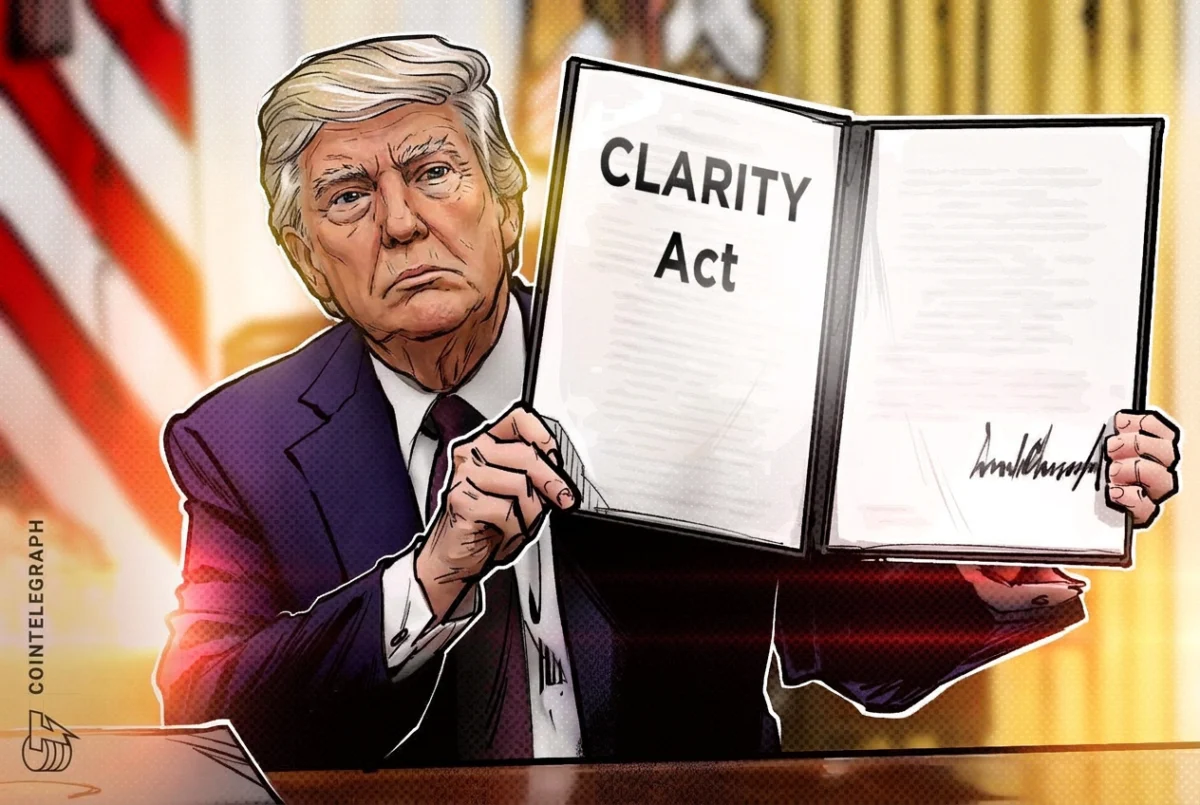
President Donald Trump continued his assertive push for the passage of a comprehensive cryptocurrency market structure bill, even as the United States Senate remained in its recess. The call for legislative action underscores a growing urgency within the executive branch to establish clear regulatory frameworks for the burgeoning digital asset sector, a move the President believes is crucial for maintaining American economic competitiveness on a global stage, particularly in comparison to nations like China.
The President’s renewed emphasis on the Digital Asset Market Clarity (CLARITY) Act came during a press conference on Wednesday, where he convened with prominent figures from the cryptocurrency industry, including Brian Armstrong, the CEO of Coinbase, and the co-founders of Gemini, Cameron and Tyler Winklevoss. During the session, President Trump explicitly urged members of Congress to enact what he termed a "fair version" of the CLARITY Act. His rationale, as articulated to the press, centered on the imperative for the United States to remain at the forefront of innovation and technological development, stating, "we need to stay ahead of China."
The CLARITY Act, which successfully passed through the House of Representatives in July 2025, has encountered a significant roadblock in the Senate. For months, the bill has been stalled, facing considerable debate and opposition stemming from a confluence of complex issues. Key among these are concerns surrounding the regulation of tokenized equities, the potential implications and stability of stablecoin rewards, and lingering questions regarding potential conflicts of interest involving the Trump family and their alleged ties to the cryptocurrency industry. These multifaceted concerns have contributed to the legislative inertia.
Following President Trump’s remarks, Coinbase CEO Brian Armstrong addressed the assembled press, highlighting the bill’s potential to instill long-term stability in the digital asset landscape. Armstrong stated that the CLARITY Act would render cryptocurrency policies in the United States "durable into the future, so it could survive for decades and decades to come." He further expressed optimism regarding the bill’s prospects in the Senate, speculating that it could garner "more than 60 votes" once a cloture motion, scheduled for September 15, is addressed. This suggests a belief among industry leaders that a sufficient bipartisan consensus exists to overcome procedural hurdles.
President Trump, responding to Armstrong’s assessment, characterized the bill’s support as "very bipartisan," adding, "Lot of Democrats support." This assertion aims to counter narratives that the legislation is solely a partisan endeavor, emphasizing the potential for broad agreement across the political spectrum.
The President’s renewed advocacy for the CLARITY Act is not an isolated event. In July, following the passing of Senator Lindsey Graham, President Trump had previously implored Congress to advance the legislation. He described Senator Graham as a "big supporter" of the bill and suggested that lawmakers in the Senate should move forward with CLARITY as a tribute to his advocacy. This connection to a respected senator’s legacy attempts to imbue the bill with added gravitas and a sense of political momentum.
This recent engagement is part of a broader pattern of the Trump administration interacting with the cryptocurrency sector. Previously, President Trump hosted leaders from the crypto industry at the White House in March 2025 for a summit focused on regulatory matters. Additionally, he was present for the signing ceremony of the GENIUS stablecoin bill in July 2025, signaling a consistent, albeit sometimes contentious, engagement with digital asset policy.
Opposition and Ethical Considerations
However, the path to legislative consensus remains fraught with challenges. Senator Ruben Gallego, speaking at the Wyoming Blockchain Symposium, offered a pointed critique of President Trump’s framing of the CLARITY Act as "fair." Senator Gallego suggested that the President’s interpretation of "fair" might be self-serving, particularly in relation to the ethical provisions embedded within the bill.
"I think, unfortunately, what the president means is fair to him," Senator Gallego remarked, referencing the ethics language in the bill. He elaborated on the procedural and constitutional aspects of regulatory agreement, stating, "The president is agreeing to some limitation. It’s not his place to agree. It’s the place of the Congress, the Senate and then the White House […] the president doesn’t just get to decide what level of regulation he gets." This statement highlights a fundamental disagreement over executive authority in shaping legislative outcomes, particularly concerning potential conflicts of interest.
Regulatory Agencies Moving Forward
The urgency for legislative clarity is underscored by the fact that key regulatory bodies are actively exploring their own avenues for establishing cryptocurrency oversight, even in the absence of the CLARITY Act. The press conference involving crypto executives occurred just one day prior to a scheduled meeting of the Commodity Futures Trading Commission’s (CFTC) Innovation Advisory Committee. CFTC Chair Michael Selig indicated that the agency would be exploring the development of cryptocurrency regulations during this meeting, acknowledging that Congress would not reconvene for approximately another month. This proactive stance by the CFTC suggests a recognition that regulatory vacuums can lead to market instability and stifle innovation.
In parallel, the Securities and Exchange Commission (SEC) has also been taking steps to address the evolving digital asset landscape. The same week as the White House meeting, the SEC proposed new rules designed to provide companies with a "safe harbor" from having their tokens classified as "investment contracts," a designation that would subject them to stringent securities regulations. The SEC’s proposal also includes certain exemptions related to the issuance of tokens, signaling a willingness to differentiate between various types of digital assets and their associated risks. These actions by the SEC and CFTC demonstrate a parallel track of regulatory development, highlighting the ongoing efforts to grapple with the complexities of digital assets.
The Global Context and Economic Imperative
The debate surrounding the CLARITY Act is not occurring in a vacuum. The global cryptocurrency market has seen exponential growth, with market capitalization reaching trillions of dollars at its peak. Nations worldwide are actively developing regulatory frameworks to harness the potential of blockchain technology while mitigating risks. China, specifically mentioned by President Trump, has been pursuing a dual approach: heavily restricting private cryptocurrency trading and mining domestically, while simultaneously investing significantly in its own central bank digital currency (CBDC) and blockchain infrastructure. This creates a competitive dynamic where the United States risks falling behind if it fails to establish a clear and predictable regulatory environment.
The potential economic implications of the CLARITY Act are substantial. A well-defined regulatory framework could foster greater institutional investment in the crypto market, spur innovation in blockchain-based financial services, and create new job opportunities. Conversely, continued regulatory uncertainty can deter investment, drive talent and innovation offshore, and leave the U.S. economy vulnerable to the rapid advancements occurring in other jurisdictions. The bill’s provisions concerning stablecoins, in particular, are seen as critical for ensuring the stability of a burgeoning segment of the digital asset market that underpins many crypto transactions.
Historical Precedents and Future Outlook
President Trump’s engagement with the crypto industry reflects a broader trend of governments worldwide attempting to understand and regulate this rapidly evolving sector. The CLARITY Act represents an ambitious attempt to create a foundational legal structure that can accommodate the diverse applications of blockchain technology and digital assets. However, the legislative process is inherently complex, requiring negotiation, compromise, and broad consensus.
The coming months will be critical for the CLARITY Act. The scheduled cloture motion in the Senate on September 15 will be a key indicator of its momentum. The ongoing efforts by regulatory agencies like the SEC and CFTC to establish their own rules further emphasize the dynamic nature of the regulatory landscape. The successful passage of the CLARITY Act, or its eventual failure, will have significant ramifications for the future of cryptocurrency and blockchain technology in the United States, shaping its role in the global digital economy for years to come. The interplay between executive calls for action, legislative deliberations, and the proactive steps taken by regulatory bodies will ultimately determine the direction of crypto regulation in the nation.

