

The global financial markets have experienced a period of remarkable expansion over the past several years, with the S&P 500 index, a benchmark for broad market performance, demonstrating particularly robust growth. This significant appreciation in asset values has led many investors, particularly those with substantial retirement savings allocated to index funds, to re-evaluate their financial standing. The index has climbed approximately 57% in just the last two years and more than doubled over the past five years, a trajectory that has seen some individuals rapidly approach or even exceed their retirement financial goals. This swift increase in net worth prompts a critical inquiry into the sustainability of these gains: is the current market environment a reflection of genuine economic strength, or does it signal an impending market correction or a financial illusion?
A recent query from an investor encapsulates this widespread concern: "The market seems to be in a huge bubble right now due to all sorts of hype around Artificial Intelligence. Does this make it more vulnerable to a huge crash in the future, and will it affect my retirement?" Addressing this question necessitates a deeper examination of the contemporary financial landscape and stock market dynamics, beginning with the fundamental definition of a stock and its valuation principles.

Understanding Stock Valuation in a Dynamic Market
At its core, a stock represents an ownership share in a company, entitling the holder to a portion of its earnings and assets. This concept can be analogized to owning a rental property. When an individual owns a rental house, they collect rent, and after covering operational expenses, the remainder constitutes profit. The property’s market value may fluctuate, but the actual income stream from rent remains constant unless the profitability of the rental business itself improves—for example, through renovations, increased occupancy, or streamlined expenses. When such a property is sold to another investor, the sale price is ideally predicated on the anticipated future income stream. A property generating $24,000 annually, for instance, might sell for $240,000, yielding a price-to-earnings (P/E) ratio of 10. However, if that same property is sold for $480,000 without a proportional increase in rent, the P/E ratio climbs to 20, indicating a less favorable return for the new investor.
Applying this framework to the stock market, an investment of $100,000 in the S&P 500 in 2019, with reinvested dividends, would have grown to an estimated $256,960 by 2025—a staggering 157% gain. Yet, over the identical period, the share of company earnings attributable to that initial $100,000 investment only increased from $5,290 to $7,540, a comparatively modest 42% rise. This disparity highlights a significant shift in market valuation: the overall P/E ratio for the S&P 500 has escalated from approximately 20 in 2019 to around 30 in 2025. This indicates that investors are currently paying a higher multiple for each dollar of corporate earnings, suggesting that future returns, as a percentage of current portfolio value, may be lower than in periods of more modest valuations.

The "Magnificent Seven" and the AI Phenomenon
The recent market exuberance is not uniformly distributed across the S&P 500. A detailed analysis reveals that approximately three-quarters of the index’s recent growth has been propelled by just seven major technology companies, collectively dubbed the "Magnificent Seven": Apple, Nvidia, Microsoft, Amazon, Alphabet (Google), Meta Platforms (Facebook), and occasionally Tesla. These companies, known for their high profitability and innovation, have experienced substantial growth and intense investor interest, leading to elevated share prices driven by expectations of continued future expansion.
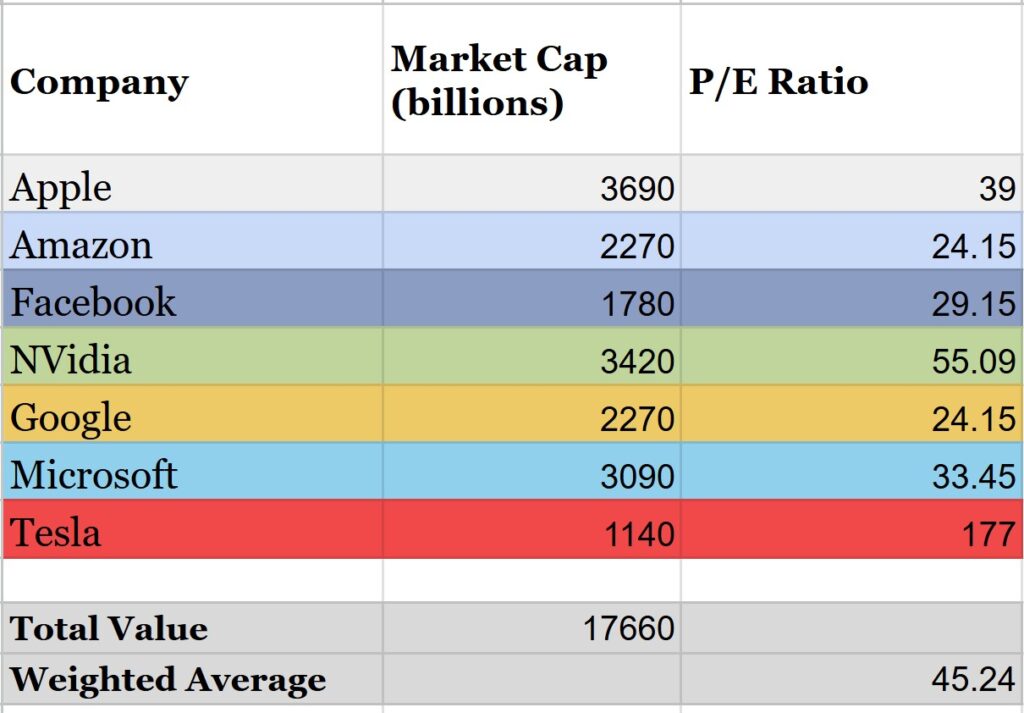
These seven entities collectively command over 25% of the S&P 500’s total market capitalization, a staggering $17.66 trillion. Their weighted average P/E ratio hovers around 45, significantly higher than the rest of the market. When these seven companies are excluded, the remaining 493 companies in the S&P 500 exhibit a more conventional P/E ratio of approximately 20, although still above historical averages. This bifurcation suggests that while the broader U.S. economy is anticipated to remain generally healthy, investors are placing a premium on the projected accelerated growth of these leading tech firms.

A unifying theme underlying this concentrated tech boom is the rapid advancement of Artificial Intelligence (AI). Recent breakthroughs in AI have demonstrated capabilities for human-like reasoning across various domains, igniting a widespread frenzy throughout the business world. Six of the Magnificent Seven companies are investing hundreds of billions of dollars into constructing vast data centers equipped with supercomputers to develop and deploy AI technologies. Nvidia, the seventh, is a primary beneficiary of this spending, supplying the specialized hardware required for these AI infrastructures, allowing it to command premium pricing amidst unprecedented demand.
This AI boom is perceived as the dawn of a new era of productivity. AI’s ability to process complex information, from legal documents and medical images to vast datasets for drug discovery and autonomous driving, promises to revolutionize industries. The prospect of an "infinite workforce" of highly intelligent AI systems, operating without traditional labor constraints, fuels the optimistic outlook for future corporate profits. While the precise timeline remains uncertain, many observers, including experts in the field, believe these transformative promises of AI are indeed plausible.
Challenges and Unknowns: The Future of AI and Market Returns
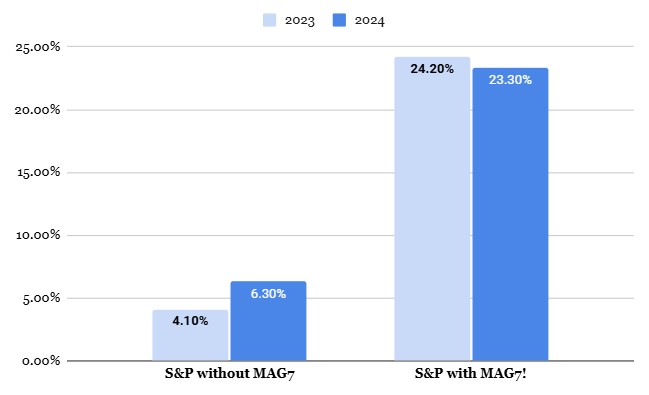
Despite the fervent optimism, critical questions persist regarding the long-term realization of these projected profits. Potential challenges include unforeseen cost overruns in AI development and deployment, intensified competition, and the ethical and societal implications of increasingly autonomous and intelligent systems. Furthermore, the specter of widespread technological unemployment and resultant social upheaval, where advanced AI could displace human labor across numerous sectors, presents a significant economic and societal risk that could profoundly impact market stability and corporate profitability. The concentration of wealth and power, as depicted in scenarios where a select few control vast AI-driven empires, also raises concerns about equitable economic distribution.
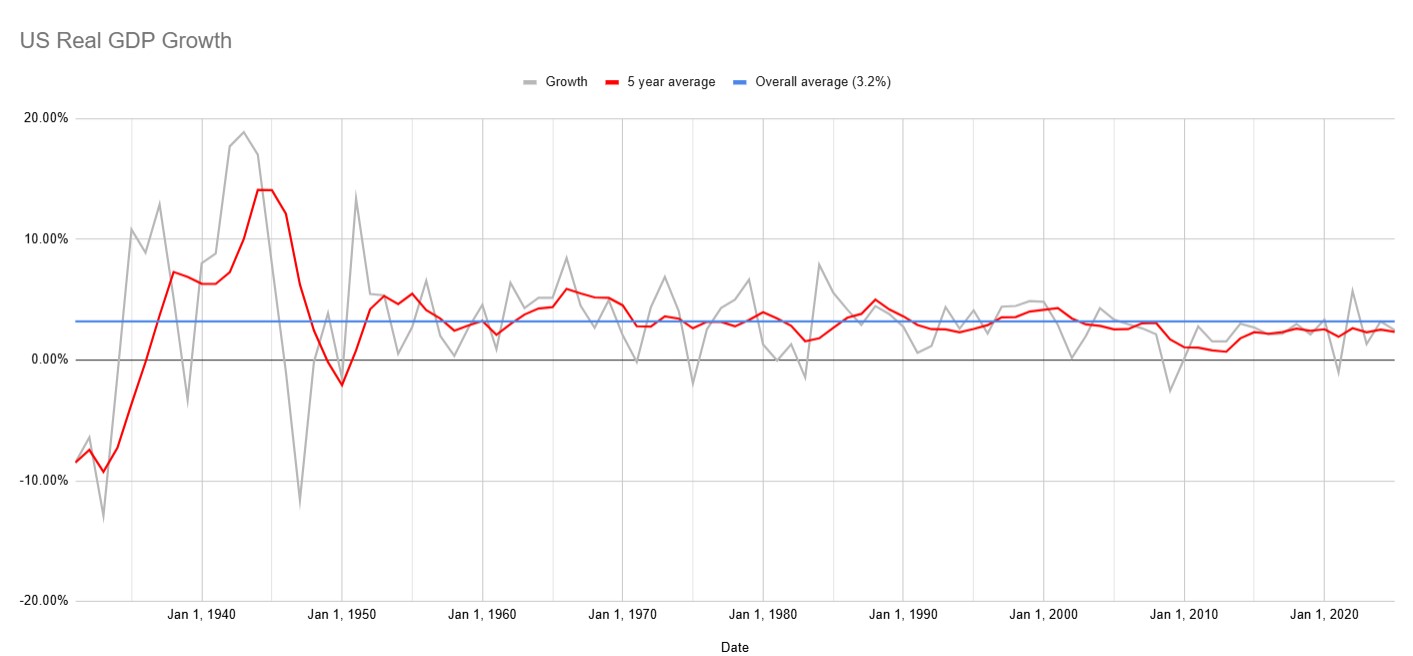
The inherent uncertainty of the future dictates that "nobody really knows" how these scenarios will fully unfold. However, historical economic data can offer some guidance. The long-term average growth rate of the U.S. economy, after inflation, has consistently been around 3% per year for decades. Interestingly, recent decades have shown a tendency towards slower than average growth, which, without the AI narrative, would provide even less justification for the market’s current elevated valuations.
Investment Strategies in an Overvalued Market
Given the current market conditions, what course of action should investors consider? Historically, attempting to time market fluctuations by selling assets in anticipation of a downturn and repurchasing them at lower prices has proven to be a losing strategy for most. Despite current high valuations, owning stocks for the long term is still expected to be profitable, albeit potentially with lower average returns than during periods when assets could be acquired at more favorable P/E ratios.
Even if stock valuations revert to historical norms, economic growth and corporate earnings are expected to continue their upward trajectory over time. This scenario would likely result in a trajectory of returns that, while perhaps less aggressive than the most optimistic projections, would still represent positive growth.
Alternative Investment Considerations

For investors looking beyond the concentrated U.S. stock market, several alternative strategies and perspectives emerge:
- International Diversification: Vanguard, a leading provider of index funds, consistently publishes 10-year annualized return forecasts. Their current projections suggest that international stocks and even bonds may outperform U.S. stocks in the coming decade. This outlook is partly attributed to the significantly lower P/E ratio of international stocks (e.g., the VXUS fund has a P/E of 15.9), suggesting they are relatively "on sale" compared to their U.S. counterparts. However, it’s worth noting that Vanguard has made similar predictions in previous years that have not materialized, partly due to the U.S.-centric nature of the AI boom.
- Robo-Advisors and Diversified Portfolios: Platforms like Betterment, which employ robo-advisors to create diversified portfolios across various asset classes (including international stocks and bonds) and automatically rebalance them, aim to offer slightly higher risk-adjusted returns with reduced volatility and potential tax advantages. While such portfolios may have underperformed a purely U.S.-focused portfolio during the recent tech-led rally, they remain a viable strategy for those who believe in eventual market rebalancing. A typical Betterment core portfolio has a weighted average P/E ratio of approximately 22, indicating a more moderate valuation than the S&P 500’s overall P/E.
- Warren Buffett’s Stance: The seasoned investor Warren Buffett, known for his value investing philosophy, has signaled caution regarding current market valuations. Berkshire Hathaway’s substantial cash holdings, amounting to $334 billion, suggest that the company finds few compelling investment opportunities at present prices. Even repurchasing its own shares is viewed as slightly overvalued at its current P/E ratio, which has averaged around 21 in recent years. This conservative approach from a prominent investor underscores the perception of elevated market prices.
- Mortgage Payoff vs. Investment: The decision to pay off a mortgage versus investing surplus cash into index funds traditionally favors the latter over the long run, given average stock market returns. However, the balance shifts when expected stock returns are lower and mortgage interest rates are higher. With current mortgage rates around 7%, paying off a mortgage becomes a more competitive option, essentially yielding a guaranteed 7% return, which can be particularly attractive compared to uncertain future stock market gains. For many, the psychological benefit of being mortgage-free also plays a significant role in this decision.
The Enduring Principle: Long-Term Investing and Perspective
Ultimately, the core principles of sound investing remain constant: maintain a long-term perspective, diversify investments, and avoid succumbing to daily market noise. While staying informed about global economic developments, perhaps through reputable sources like The Economist, is beneficial, constant preoccupation with market fluctuations can be counterproductive.
Investors are encouraged to channel the energy often spent on market anxieties into pursuits that offer tangible and guaranteed returns, such as engaging in physical activities and enjoying the natural world. These endeavors provide undeniable benefits to well-being, health, and quality of life—returns that are consistently market-beating in their personal value, irrespective of economic cycles. The current market, while showing signs of frothiness driven by transformative AI developments, still operates under fundamental economic laws. A disciplined, long-term approach, coupled with a balanced perspective on life’s true riches, remains the most prudent path forward.

