
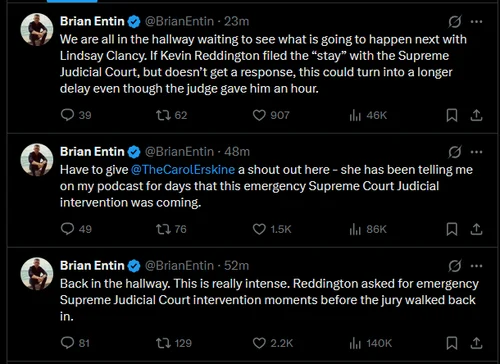
In a dramatic conclusion to a harrowing trial that captivated national attention, a Massachusetts judge formally declared a mistrial in the case of Lindsay Clancy on Friday, September 4, 2026, after a jury remained deadlocked following seven days and 36 hours of intense deliberations. The decision came shortly after the Massachusetts Supreme Judicial Court denied an emergency stay sought by the defense, which had hoped to prevent a mistrial by securing the removal of a holdout juror. Immediately following the formal declaration, prosecutors confirmed their intent to retry Clancy, ensuring the legal battle over the tragic deaths of her three young children will continue.
High-Stakes Legal Maneuvering Precedes Mistrial
The final hours leading to the mistrial were marked by an extraordinary series of legal maneuvers. After Judge William Sullivan initially declared a mistrial due to the hung jury, he granted the defense a one-hour window to seek an emergency stay from the Massachusetts Supreme Judicial Court (SJC). The defense team, led by Kevin Reddington, argued that a mistrial could be averted if the SJC intervened to allow the removal of a juror whom they believed was refusing to apply the judge’s instructions on reasonable doubt. Their strategy aimed to avoid a full retrial, potentially leading to Clancy’s immediate release if a unanimous verdict could then be reached by the remaining jurors in her favor.
However, the SJC, after hearing the urgent appeal, ultimately denied the emergency stay Friday afternoon. Justice Dalila Argaez Wendlandt presided over the appeal. With the SJC’s refusal to intervene, the path was cleared for Judge Sullivan to formally declare the mistrial, dissolving the jury and nullifying the proceedings. This decision means the complex legal questions surrounding Clancy’s culpability and mental state will now be revisited in a future trial.
Prosecution Confirms Intent to Retrial, Defense Prepares for Continued Battle
Following the formal declaration of a mistrial, the prosecution wasted no time in confirming their commitment to pursuing justice for the victims. Statements from the prosecution indicated they would be re-trying the case, likely later in the fall. Lindsay Clancy, a former labor-and-delivery nurse, remains in custody, with the next hearing scheduled for September 29th, 2026. This signals the beginning of a new phase in an already emotionally charged and legally intricate case.
For the defense, the mistrial, while avoiding a conviction, represents a continuation of the arduous legal fight. Their aggressive efforts to remove the holdout juror underscore their belief that a favorable outcome was within reach with the original jury, and that a retrial presents new challenges. The defense has consistently argued that Clancy was not criminally responsible for her actions due to severe postpartum psychosis, a central pillar of their case that will undoubtedly be revisited.
The Duxbury Tragedy: A Brief Background
The case stems from the tragic events of January 24, 2023, in Duxbury, Massachusetts. On that day, emergency services responded to the Clancy family home after Lindsay Clancy’s husband, Patrick Clancy, returned to find his wife severely injured and their three young children unresponsive. Five-year-old Cora, three-year-old Dawson, and eight-month-old Callan Clancy were found strangled. Lindsay Clancy herself was found to have sustained serious injuries consistent with an attempted suicide.
She was subsequently charged with three counts of first-degree murder and three counts of strangulation. From the outset, the case drew significant public attention due to the horrific nature of the crime and the defense’s immediate invocation of postpartum psychosis as a mitigating factor. This defense posits that Clancy, at the time of the killings, was suffering from a severe mental illness that rendered her unable to appreciate the criminality of her conduct or conform her conduct to the requirements of the law.
A Grueling Deliberation and Courtroom Confrontation
The jury’s deliberations spanned seven days, totaling 36 hours, indicating the profound difficulty they faced in reaching a unanimous verdict. The impasse became publicly evident on Thursday, September 3, 2026, when the jury foreperson sent a note to Judge William Sullivan, indicating that one juror was refusing to apply the judge’s instructions on reasonable doubt.
In response, Judge Sullivan questioned each juror individually at sidebar, seeking to understand the nature of the disagreement without delving into the specifics of their deliberations. He then delivered a "soft" reminder of the law to the full panel, instructing them to continue deliberating. This approach, however, ignited a fiery response from defense attorney Kevin Reddington.
Reddington vehemently argued that the holdout juror, identified by the defense as a man, had "lied under oath" during jury selection by affirming his ability to apply the law, and now was demonstrating an unwillingness to do so. He demanded the juror’s immediate removal and replacement with an alternate, or at least a more pointed inquiry by the judge. Judge Sullivan declined, stating he had considered the issue at length and would not remove the juror, emphasizing that the juror had indicated he could apply the law.
The courtroom drama escalated further on Friday morning when Reddington renewed his forceful arguments, accusing Judge Sullivan of being "soft" in his previous instruction to the jury. Sullivan, clearly frustrated, retorted, "What do you want me to do?! Get a brass band? I read the instruction as written by the Massachusetts Supreme Court. The fact I perhaps did not give it my full inflection, I’m sorry about that, I’m not an actor – I’m giving instruction."

Adding to the tension, the defense team subsequently filed a motion asking that all future proceedings be handled in open court, without further sidebars, indicating a lack of trust in the private discussions. The prosecution, conversely, suggested no further questioning of the jury, arguing there was "no indication of lack of impartiality or bias or extraneous influence, and no indication of inability to deliberate" from the holdout juror, and asked for deliberations to continue. However, with the jury still deadlocked after two attempts to send them back (the maximum allowed under Massachusetts law before a mistrial can be declared), the judge had little recourse but to declare a mistrial.
Understanding the Legal Ramifications: Hung Juries and Mistrials
A "hung jury" occurs when a jury cannot reach a unanimous verdict after extensive deliberation, despite efforts to encourage them to do so. In the American legal system, a unanimous verdict is typically required in criminal trials for a conviction or acquittal. When a jury is hung, the judge declares a "mistrial."
A mistrial effectively nullifies the previous proceedings. It does not mean the defendant is innocent or guilty; rather, it means the trial process was unable to conclude with a verdict. In such cases, the prosecution has the option to retry the defendant. This often happens, especially in severe cases like first-degree murder, as demonstrated by the prosecution’s immediate commitment to a second trial for Lindsay Clancy.
The defense’s unusual request for a stay of the mistrial and removal of a juror highlights a specific legal strategy. If they could have convinced the SJC that the holdout juror was genuinely refusing to apply the law rather than genuinely holding a different interpretation of the evidence, and successfully had that juror replaced, a newly composed jury might have delivered a unanimous verdict, potentially leading to Clancy’s freedom without the need for a new trial. However, such interventions are rare and typically require a high bar of proof of juror misconduct.
The Postpartum Psychosis Defense: A Complex Legal and Medical Issue
Central to the Lindsay Clancy trial is the defense of postpartum psychosis. This severe, but rare, mental illness can occur shortly after childbirth, typically within the first few weeks or months. Symptoms can include hallucinations, delusions, paranoia, rapid mood swings, and disorganized thinking. In extreme cases, it can lead to infanticide.
While not all jurisdictions have specific "postpartum insanity" defenses, Massachusetts law allows for a general insanity defense where a defendant may be found "not criminally responsible" if, at the time of the crime, they suffered from a mental disease or defect that prevented them from understanding the wrongfulness of their actions or controlling their conduct. The defense argued that Clancy was in the throes of such a psychotic episode, experiencing hallucinations, when she killed her children.

The prosecution, conversely, presented evidence suggesting a degree of premeditation and awareness. They argued that Clancy was not experiencing a full-blown psychotic break when she sent her husband on long errands, creating an opportunity for the killings, and subsequently made attempts to stage her own suicide. The differing interpretations of Clancy’s mental state at the critical time formed the crux of the evidentiary battle and likely contributed significantly to the jury’s inability to reach a unanimous decision. This nuanced and highly sensitive medical-legal debate will undoubtedly be re-litigated in the upcoming trial.
Looking Ahead: A Second Trial and its Implications
The declaration of a mistrial in the Lindsay Clancy case marks a significant, but not final, chapter in this heartbreaking saga. A retrial will impose further emotional and financial burdens on all parties involved, particularly the Clancy family, who must relive the trauma of the events and the subsequent legal proceedings.
For the prosecution, a second trial offers an opportunity to refine their strategy, potentially presenting evidence differently or calling new witnesses based on insights gained from the first trial. They will aim to convince a new jury that Lindsay Clancy was criminally responsible for her actions despite her mental health struggles.
The defense will also have the chance to adjust its approach, perhaps emphasizing certain aspects of the postpartum psychosis defense more forcefully or addressing areas where they perceived the first jury struggled. The selection of a new jury will be critical, as both sides will scrutinize potential jurors for any biases or preconceived notions about mental health defenses or the severity of the charges.
The case also carries broader implications for how the legal system and society understand and address mental health, particularly postpartum mental illnesses, in the context of criminal responsibility. The public discourse around the Clancy trial has highlighted the complexities of balancing accountability for horrific crimes with compassion for individuals suffering from severe mental health crises.
As the legal proceedings reset, Lindsay Clancy remains in custody, her future uncertain, as the Commonwealth of Massachusetts prepares to once again bring her to trial for the deaths of her children. The next hearing on September 29th will set the stage for the renewed legal battle, ensuring the Lindsay Clancy case remains a focal point in the ongoing dialogue about justice, mental health, and tragedy.

