
The financial services industry is currently navigating a pivotal transition where the theoretical potential of artificial intelligence has matured into a fundamental requirement for operational viability. As banks, credit unions, and lenders face intensifying pressure from digital-native competitors and evolving regulatory frameworks, the focus has shifted from experimental pilots to the deployment of scalable, high-impact automation. At the FinovateFall 2026 conference, a select group of fintech innovators demonstrated how the current generation of AI is being leveraged not just for customer-facing interfaces, but for the deep-tissue modernization of banking infrastructure. This movement is characterized by a "middleware-first" approach, allowing legacy institutions to integrate sophisticated capabilities—ranging from real-time cross-border payments to autonomous anti-money laundering investigations—without the prohibitive cost and risk associated with wholesale core system replacements.

The Evolution of Finovate and the 2026 Fintech Landscape
The Finovate series has served as a primary barometer for financial technology trends since its inception in 2007. While early iterations of the conference focused heavily on the "unbundling" of banks through consumer-facing apps, the 2026 showcase highlights a definitive "rebundling" and infrastructure-heavy phase. The current landscape is defined by the emergence of the "Context Lake" and "BankOS," terms that reflect a shift toward unified, data-intelligent operating systems that sit atop legacy cores.
Chronologically, the industry has moved from the Cloud Migration era (2015–2020) and the Open Banking era (2021–2024) into the current Automation and Orchestration era. In 2026, the primary challenge is no longer data collection, but data utility. Financial institutions are now seeking partners that can provide "examiner-defensible" AI—systems that not only make automated decisions but provide the transparency required by regulators to explain exactly how those decisions were reached.

Strategic Infrastructure and Payment Modernization
The modernization of payment rails remains a top priority for financial institutions looking to retain corporate and retail deposits. Several firms at FinovateFall 2026 presented solutions designed to bridge the gap between traditional systems and real-time rails like FedNow and RTP.
Finzly showcased its Finzly BankOS, a cloud-based real-time operating system that integrates directly with existing cores. By centralizing the processing of ACH, FedWire, RTP, SWIFT, and FedNow, Finzly allows banks to offer modern global transaction banking without a multi-year development cycle. This is particularly relevant as the Federal Reserve continues to push for universal adoption of instant payment standards.

3 Degrees addressed the specific needs of community banks and credit unions by offering technology for embedded cross-border payments. In an era where small businesses increasingly operate globally, the ability for a local credit union to provide seamless international payouts is a critical competitive advantage.
Neural Payments demonstrated its Payments Hub, which connects institutions to every major US payment rail and wallet via a single integration. Their 90-day "go-live" promise addresses one of the industry’s biggest pain points: the historical lag between procurement and implementation.

The Rise of Regtech and Autonomous Compliance
As regulatory scrutiny intensifies, particularly regarding anti-money laundering (AML) and "know your customer" (KYC) protocols, the manual burden on compliance departments has become unsustainable.
Transvision Solutions introduced STAR AI, an autonomous AML investigation engine. The platform is capable of running over 150 intelligent checks to provide an auditable investigation in under five minutes—a process that traditionally took hours or days for human analysts. By generating LLM-powered Suspicious Activity Report (SAR) narratives, the system significantly reduces the "clerical" load on compliance officers.

FinQub offers a no-code orchestration layer for fintech workflows, creating a "defensible decision graph." This solution is designed to make every automated decision examiner-defensible for seven years, providing the long-term audit trail that federal regulators now demand for AI-driven processes.
Naehas focused on the marketing side of compliance, providing an enterprise-scale platform to manage offers and automate disclosures. By binding each offer to approved disclosures at the moment of creation, Naehas prevents the "compliance drift" that often occurs during rapid-fire digital marketing campaigns.

Enhancing Credit Union Operations and Member Retention
Credit unions face unique challenges, balancing the need for high-touch personal service with the efficiency required to compete with "Big Four" banks.
Donevia presented an AI-powered backend performance layer that combines member onboarding with a KPI dashboard. The system delivers real-time cross-sell recommendations and call transcriptions, allowing credit union staff to focus on member relationships rather than data entry.

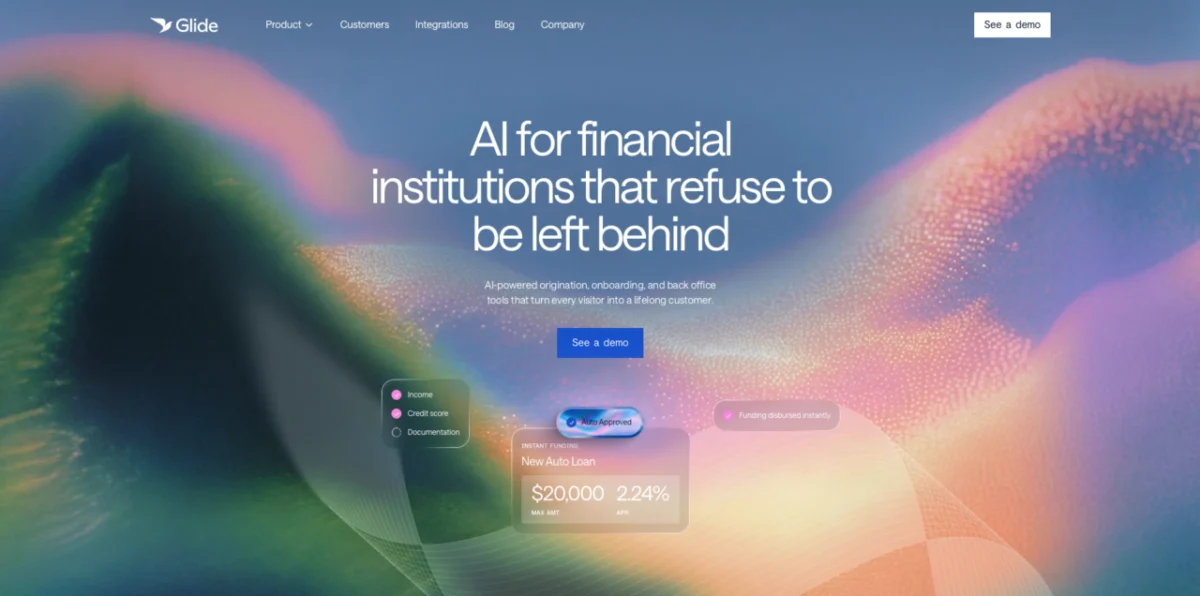
Glide offered a digital account opening and lending platform specifically for credit unions. By leveraging AI for document collection and member intelligence, Glide facilitates instant funding and embedded fraud detection, matching the speed of top-tier fintech apps while maintaining the credit union’s brand identity.
AI for Specialized Lending and Debt Recovery
The lending sector is seeing a massive shift toward automation in both the front-end application process and the back-end servicing and recovery phases.

Kato demonstrated compliance-first automation for lenders, focusing on the often-overlooked area of debt recovery. By automating thousands of calls and interactions, Kato reported a 15x ROI on recoveries and an 80% reduction in the cost per call, allowing human agents to handle only the most complex and sensitive cases.
Vertyx leveraged "headless AI" to help mortgage lenders remain engaged with homeowners long after the loan has closed. Their platform automates servicing workflows and provides AI-powered quality control across the entire portfolio, reducing the operational overhead of mortgage maintenance.

Wealth Management and Financial Planning for Complex Families
Wealth management has traditionally been a high-friction, manual sector. However, the 2026 demos show a move toward unifying disparate data sets to serve increasingly complex family structures.
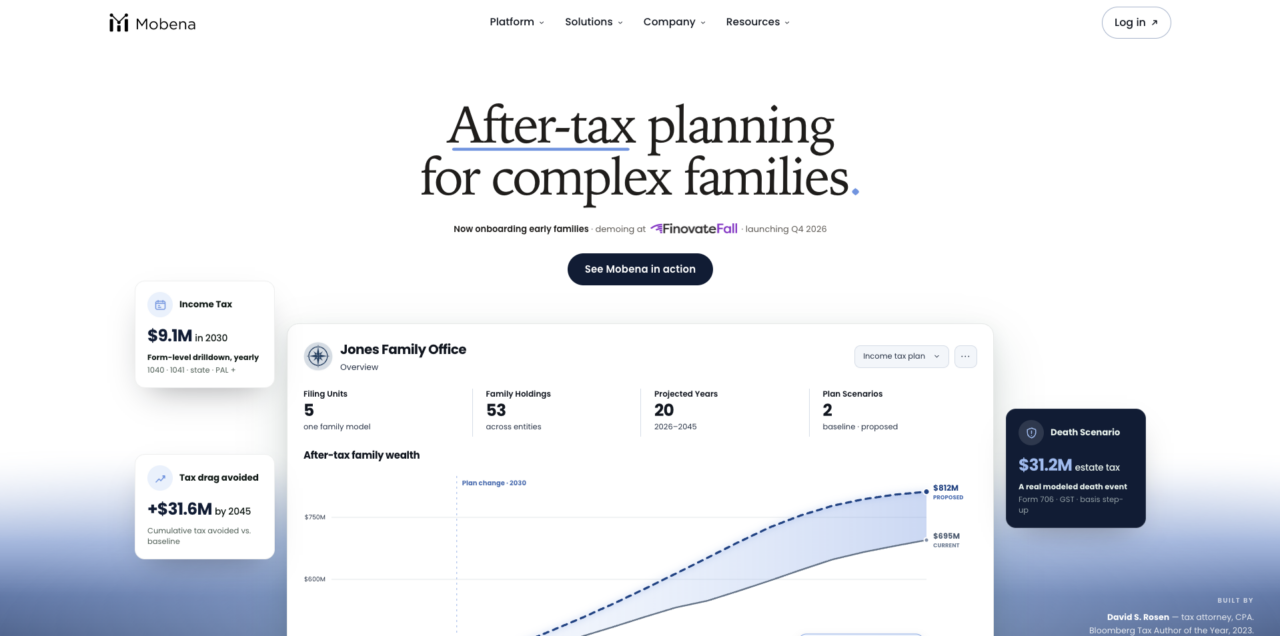
Mobena introduced an integrated platform for income tax, estate planning, and wealth management. By modeling tax implications at a CPA level across multiple generations and trust structures, Mobena provides a level of technical depth previously unavailable in standard wealth management software.
Valcori Automated Solutions presented Valcori Workmate, an AI-driven tool designed to unify workflows for independent wealth management firms. The goal is to reduce the "administrative tax" on advisors, allowing them to scale their practices without a linear increase in headcount.
Data Security, Privacy, and "On-Prem" AI
A recurring theme at FinovateFall 2026 was the tension between the power of Large Language Models (LLMs) and the strict data privacy requirements of the banking sector.

Go Abacus addressed this directly with Go.AI, an on-prem AI platform. By delivering private LLMs and secure data indexing within the institution’s own environment, Go Abacus allows banks to utilize AI assistants without exposing sensitive customer data to third-party cloud providers.
SLC Digital focused on the threat of account takeover (ATO), providing a secure communication channel for digital authentication. As deepfakes and AI-driven phishing become more sophisticated, SLC Digital’s focus on identity theft prevention is a critical component of the 2026 security stack.

Tacnode introduced the concept of the "Context Lake," a database that provides AI agents with live, semantic context. This ensures that real-time financial decisions are based on the most current data, unifying transactional and analytical workflows into a single, PostgreSQL-compatible system.
Supporting Data: The Economic Case for AI Modernization
Industry data presented during the event underscored why these innovations are no longer optional. According to research cited by Finovate analysts, financial institutions that successfully implement AI-driven operational automation see an average reduction in operating expenses of 15% to 25% within the first 24 months. Furthermore, the "middleware" approach favored by many of this year’s demoing companies reduces the cost of innovation by approximately 60% compared to traditional core replacement projects.

In the payments sector, the move toward real-time rails is driven by consumer demand. Data from the 2025-2026 fiscal year indicates that 72% of retail banking customers now consider "instant fund availability" a top-three factor when choosing a primary financial institution. For small and medium-sized enterprises (SMEs), that number rises to 84%.
Broader Impact and Industry Implications
The innovations showcased at FinovateFall 2026 signal a democratization of high-end banking technology. In previous decades, only the largest global banks could afford to build the types of autonomous AML engines or real-time payment hubs demonstrated this year. Today, via SaaS models and modular integrations, these capabilities are accessible to $500 million community banks and local credit unions.

Industry experts and bank executives in attendance expressed a cautious but clear consensus: the "rip and replace" era of core banking is largely over, replaced by an era of "intelligent layering." The primary risk for institutions is no longer the failure of a massive technology overhaul, but the "opportunity cost" of inaction. As AI continues to lower the cost of service and increase the speed of delivery, institutions that remain tethered to manual processes will find it increasingly difficult to maintain their margins.
The 2026 demo list serves as a roadmap for this transition. By focusing on "unsexy" but vital areas like document automation (MHC Automation), financial management for small businesses (On Time Harvest), and marketing disclosure governance (Naehas), fintechs are solving the friction points that have historically hindered the agility of the financial sector. The result is a more efficient, compliant, and personalized financial ecosystem that benefits both the institution and the end consumer.

