

The specter of quantum computing looms over the digital asset landscape, prompting urgent calls for proactive measures within the Bitcoin community. Charles Edwards, the founder of Capriole Investments, has issued a direct plea to Bitcoin developers, urging them to set aside pride and present a concrete roadmap for fortifying the blockchain against potential quantum attacks. Edwards posits that a decisive and transparent plan from the Bitcoin core team could significantly bolster investor confidence and catalyze a rapid price appreciation.
"If the Bitcoin core team says in two or three months: ‘this is our roadmap, we’re gonna solve it in the next two years, these are the rough steps we’ll take,’ that would be amazing news," Edwards stated during an interview on Cointelegraph’s Trade Secrets program. He elaborated that such an announcement could "discount a lot of the risk pretty much overnight." This sentiment underscores a prevailing concern that the current uncertainty surrounding Bitcoin’s quantum readiness is acting as a drag on its valuation, despite the technology still being in its nascent stages.
The debate surrounding the necessity and feasibility of making Bitcoin quantum-resistant is multifaceted and deeply entrenched within the cryptocurrency’s development circles. A segment of the community argues that any significant alteration to Bitcoin’s foundational cryptography could undermine its core principles of decentralization and immutability, potentially introducing new vulnerabilities or conflicting with the ethos that has defined the digital asset for over a decade. Conversely, proponents of a proactive approach, like Edwards, contend that the potential threat, however distant, warrants immediate attention and strategic planning. They point to the rapid advancements in quantum computing research and the potential for a "Q-Day" – the theoretical point at which quantum computers become powerful enough to break current cryptographic standards – to arrive sooner than anticipated.
Edwards has consistently highlighted the quantum computing risk to his substantial following on the social media platform X, formerly Twitter. The fundamental fear is that sophisticated quantum computers, once developed, could possess the computational power to break the public-key cryptography that underpins Bitcoin’s security, potentially compromising private keys and leading to the theft of funds from wallets. This existential threat has not gone unnoticed by institutional players. Notably, BlackRock, the world’s largest asset manager, has acknowledged quantum computing as a potential long-term risk in materials provided to investors in its spot Bitcoin Exchange-Traded Fund (ETF). This inclusion by a mainstream financial institution signals the growing recognition of the issue within traditional finance.
The impact of this uncertainty on investor sentiment is a subject of ongoing analysis. Some market observers suggest that the unresolved quantum threat has contributed to periods of price decline or muted performance in Bitcoin, as investors weigh the long-term viability of the asset against potential future disruptions. However, Edwards’ perspective offers a counter-narrative: a clear and actionable plan to address the quantum threat could serve as a powerful upside catalyst. He predicts that such a development could lead to "double digits" in price appreciation, characterizing the quantum issue as a "somewhat counterintuitively an upside catalyst potential." This is because, in his view, the threat is currently "on the back burner" and existing proposed Bitcoin Improvement Proposals (BIPs) for quantum resistance are "not really" comprehensive solutions.

Charles Edwards, a prominent figure in the cryptocurrency investment space, founded Capriole Investments in 2019. The Melbourne-based firm specializes in Bitcoin and digital assets, employing a sophisticated investment strategy that integrates quantitative models, artificial intelligence, and macroeconomic analysis. His high-conviction calls and detailed market analyses have garnered significant attention within the crypto community.
The Quantum Timeline and Bitcoin’s Valuation
The urgency surrounding quantum computing is amplified by the projected timelines for its development and the preparations of other major blockchain networks. Ethereum, for instance, is reportedly on track to complete its post-quantum overhaul by 2029. This aggressive timeline for a major competitor is expected to cast a brighter spotlight on Bitcoin’s own preparedness, or lack thereof, in the years leading up to that deadline.
Edwards posits that the current market valuation of Bitcoin already reflects a discount due to the quantum risk. He estimates that Bitcoin is currently trading approximately 40% below what he considers its "fair value," with the quantum threat accounting for roughly 30% of this discount. "That means it’s more than priced in," he stated, referencing Bitcoin’s trading price of $65,270 at the time of publication, which is significantly below its all-time high of $126,100 reached in October. This suggests that the market, to some extent, has already priced in the perceived risk.
However, Edwards is careful to qualify this assessment. His estimation is based on the current understanding of quantum computing development timelines and the absence of a concrete solution for Bitcoin. He refers to the projected arrival of "Q-Day," the point where quantum computers could compromise current encryption standards, as being in the "four to five year range, give or take, a few years." This estimate is derived from an aggregation of opinions from leading quantum computing companies and researchers.
Furthermore, Edwards factors in the substantial development and implementation time required for Bitcoin to deploy a quantum-resistant solution. He cites estimates, such as those from Ethan Heilman, the author of BIP-360, which suggest that such an undertaking could take several years. This lead time is crucial; a premature or poorly executed solution could be more detrimental than the threat itself.
The Debate: Proactive Defense vs. Preserving Core Ethos
The Bitcoin community’s internal debate on quantum computing can be broadly categorized into two main camps. The first, represented by figures like Edwards, advocates for a proactive approach, emphasizing the need for a clear and actionable roadmap to address the potential threat before it materializes. This perspective views the development of quantum-resistant cryptography not as a compromise of Bitcoin’s principles, but as a necessary evolution to ensure its long-term survival and utility. They often draw parallels to other technological advancements that have required adaptation to maintain relevance and security.
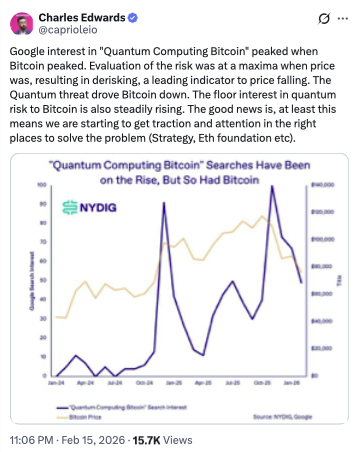
The second camp expresses caution, arguing that quantum computers are still many years away from posing a genuine threat to Bitcoin’s current cryptographic standards. This group emphasizes the principle of "ossification," a concept that suggests core Bitcoin protocols should remain largely unchanged to preserve their integrity and predictability. They are wary of introducing complex new cryptographic algorithms that could have unforeseen side effects or create new attack vectors. For some, the "disease" of rushed, potentially flawed quantum-resistant solutions could be worse than the "cure" of waiting until the threat is more immediate and the solutions are more mature and thoroughly vetted.
The implications of this divergence in opinion are significant. A lack of consensus and a delayed response could leave Bitcoin vulnerable. Conversely, a rushed implementation driven by fear could introduce new systemic risks. The historical context of Bitcoin’s development reveals a strong bias towards gradual, consensus-driven changes, often debated and refined over extended periods through the BIP process.
The Economic Impact of a Quantum Roadmap
Edwards’ assertion that a clear roadmap would be a significant upside catalyst for Bitcoin’s price is rooted in the concept of risk premium. When a significant and widely acknowledged risk exists, and there is uncertainty about its resolution, investors often demand a higher rate of return or apply a discount to the asset’s valuation. If Bitcoin developers were to present a credible and time-bound plan to mitigate the quantum threat, this perceived risk would diminish.
This reduction in risk premium could lead to a rapid reassessment of Bitcoin’s value. Investors, both retail and institutional, might perceive Bitcoin as a more secure and future-proof asset, leading to increased demand. The "double-digit" percentage increase Edwards predicts could stem from a combination of factors:
- Reduced Uncertainty: A clear roadmap alleviates investor anxiety about Bitcoin’s long-term viability.
- Increased Institutional Interest: Institutions that have been hesitant due to the quantum risk might find it more palatable to invest.
- Positive Market Sentiment: A decisive action by the core development team could generate positive news cycles and boost overall market sentiment.
- Competitive Advantage: If Bitcoin can successfully navigate the quantum threat while other networks struggle, it could solidify its position as a leading digital asset.
The current situation, where the threat is acknowledged but a concrete solution is absent, creates a state of suspended animation for a portion of the market. The development of a quantum-resistant solution is not merely a technical challenge; it is a strategic imperative that could shape Bitcoin’s trajectory for decades to come. The question remains whether the community can coalesce around a shared vision and a practical implementation plan before the advent of powerful quantum computers renders current defenses obsolete. The coming years will be critical in determining whether Bitcoin can proactively address this looming technological frontier or be forced to react under duress.

