

The landscape of real estate investment has undergone a profound transformation, shifting from a traditionally relationship-centric and often protracted process to a dynamic, data-driven scientific endeavor. At the forefront of this evolution is Propese, a cutting-edge platform engineered to equip investors and brokers with a comprehensive understanding of every property’s underlying value. Central to Propese’s mission is the eradication of data latency, which they identify as the primary adversary in achieving rapid, informed decision-making. Their core objective is to seamlessly integrate real-time intelligence with efficient workflows, empowering users to consistently outperform market fluctuations.
However, as Propese expanded its reach into the burgeoning and highly lucrative Short-Term Rental (STR) sector, a significant infrastructure gap emerged. To provide the crucial decision-ready scoring necessary for evaluating Airbnb assets, Propese required access to granular historical performance data that was conspicuously absent from standard property records. The prospect of constructing a custom data pipeline to meticulously scrape this vital information would have entailed months of development, a timeline that fundamentally contradicted Propese’s commitment to swift innovation and market responsiveness.
The strategic integration of Mashvisor’s Historical Performance API provided Propese with a direct bypass around this considerable development bottleneck. This integration granted them immediate access to thirty-six months of detailed, time-series data, enabling the swift deployment of a fully operational STR valuation module in an unprecedented 48-hour timeframe. This case study delves into how Propese meticulously upheld its commitment to delivering a "strong signal" by prioritizing API-driven infrastructure over the laborious and time-consuming alternative of manual data scraping.
The Data Deluge: Navigating Signal and Noise in Short-Term Rental Valuation
Propese was conceived from a clear and pressing observation within the real estate investment community: professionals were increasingly burdened by an unwieldy collection of disparate spreadsheets, fragmented data sources, and the resultant delays in critical decision-making. A typical scenario involved a broker managing a property’s tax history in one spreadsheet tab, lead status in a Customer Relationship Management (CRM) system, and property listings on platforms like Zillow in yet another. Propese’s foundational vision was to consolidate these scattered elements into a unified workspace, ensuring that crucial insights and deal context remained interconnected and readily accessible.
The advent of the Short-Term Rental (STR) market, however, introduced a unique and formidable data challenge. Unlike traditional long-term rental agreements, which provide a clear, static signal of predictable income, STR revenue streams are inherently volatile and often obscured by a significant amount of "noise."
The Volatility Factor: Unpredictable Revenue Streams
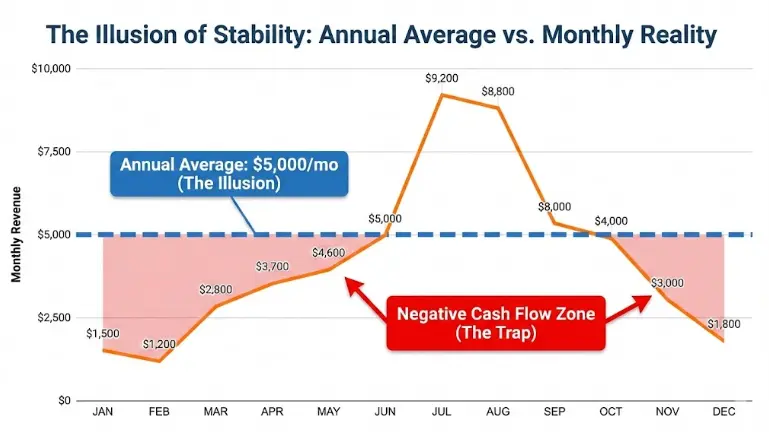
A vacation rental property situated in a prime, high-demand seasonal market can exhibit dramatic revenue disparities. For instance, revenue generated during peak season in March might far exceed that of the typically slower August period. This inherent revenue volatility represents the single most significant risk factor for investors in the STR market. Standard annual average calculations often fail to capture these sharp fluctuations, presenting a misleadingly smooth financial picture.
The "Average" Blind Spot: Masking Critical Trends
For Propese, the provision of a simplistic annual revenue average was deemed fundamentally unacceptable. Such an approach would have directly violated their core value of Transparency, which mandates that data should be clear, and the resulting outcomes should be readily visible and understandable.
To truly empower their user base with the ability to make rapid and confident investment decisions, Propese recognized the necessity of illustrating the shape of revenue generation over time, rather than merely presenting a cumulative sum. This required access to granular, month-by-month historical data to definitively ascertain whether a particular property represented a robust investment opportunity or a precarious seasonal trap.
The Engineering Crossroads: Build vs. Buy for Data Infrastructure
The product development team at Propese faced a classic engineering and strategic dilemma. To incorporate this vital STR intelligence layer into their platform, they had to choose between two distinct development paths:
Option A: Building Internal Scrapers – The Slow and Costly Path
The engineering team initially explored the possibility of developing their own proprietary data scraping engine. While this approach offered the theoretical advantage of complete control over the data acquisition process, the practical realities presented significant friction. Building and maintaining a robust scraping infrastructure requires substantial investment in specialized talent, ongoing monitoring, adaptation to website changes, and rigorous data validation protocols. This path, while offering autonomy, was inherently time-consuming and resource-intensive, directly conflicting with Propese’s agile development ethos and its commitment to rapid market entry.
Option B: Integrating Specialized Infrastructure – The Propese Way
The alternative strategy involved partnering with an established provider who treated data as a foundational infrastructure component. Propese sought a reliable source of pre-cleaned, meticulously structured, and readily actionable data that could be seamlessly integrated into their decision-making framework.
Their selection ultimately fell upon Mashvisor’s Historical Performance API. This decision was profoundly influenced by its direct alignment with Propese’s overarching operational philosophy, which prioritizes Innovation and Speed. The company aimed to translate a bold strategic concept into a tangible, high-performing tool that could consistently outpace market dynamics. Mashvisor offered not only deep historical data spanning 36 months but also provided distinct, critical metrics such as occupancy rates versus booked nights, all delivered with sub-second latency. This integration marked the inception of a strategic, long-term data partnership, transcending a mere one-off API connection.
Rapid Deployment: A 48-Hour Integration Success Story
Propese has built its reputation on serving operators who deeply value speed and clarity in their investment processes. The seamless integration of Mashvisor’s API served as a powerful testament to this commitment to agility. In an industry where enterprise-level integrations often languish for weeks or even months, Propese achieved a remarkable transition from initial API documentation review to live production deployment in a mere two days.

Day 1: Aligning Data Signals and Mapping Schemas
The initial phase of the integration saw Propese’s engineering team meticulously analyzing the JSON response structure provided by Mashvisor’s API. They quickly discovered that Mashvisor’s data payload mapped exceptionally well to Propese’s existing decision-ready architecture, minimizing the need for complex data transformations. This structural compatibility allowed for efficient schema mapping, ensuring that the incoming data could be directly utilized within Propese’s internal systems without extensive reformatting or middleware development. This early alignment significantly accelerated the subsequent implementation stages.
Day 2: The "High-Signal" Data Push
On the second day of the integration process, the Propese team focused on implementing the dynamic GET requests necessary to query Mashvisor’s API. The logic employed was characterized by its elegant simplicity: for any given property address, the system would dynamically retrieve the most relevant historical performance data. This data, including occupancy rates, Revenue Per Available Room (RevPAR), and total revenue, was then processed and presented to the user in a format that facilitated immediate understanding and actionable insights.
By the close of the second day, the new STR valuation feature was fully live and operational. Propese had successfully enhanced its "property intelligence" capabilities by incorporating institutional-grade STR data, all without the need to hire additional data scientists or invest in bespoke scraping infrastructure. This rapid deployment represented a significant leap forward in their ability to serve the dynamic STR market.
Technical Deep Dive: API Capabilities and Real-World Applications
The Key Players:
- Propese: A sophisticated real estate investment platform designed to consolidate property data, streamline lead management, and provide comprehensive deal scoring within a singular, integrated workspace for investors and brokers.
- Mashvisor: A data analytics provider specializing in real estate, offering tools and APIs for market research, investment analysis, and property valuation, particularly for short-term and long-term rental markets.
The Challenge Addressed:
Propese integrated Mashvisor’s Historical Performance API to introduce robust Short-Term Rental (STR) valuation capabilities. STR properties, commonly found on platforms like Airbnb, are characterized by highly seasonal revenue patterns that cannot be accurately modeled using conventional property records alone.
The Outcome:
A fully functional STR valuation module was successfully deployed into production within a rapid 48-hour period. This achievement was realized without the necessity of developing internal data scraping infrastructure or expanding the data science team, effectively saving Propese an estimated four months of dedicated engineering effort.
Core Capabilities Enabled by the API Integration:
The integration of Mashvisor’s API empowered Propese with three critical functionalities:
- Real-time STR Revenue Modeling: Providing month-by-month historical trends for accurate revenue projections.
- DSCR (Debt Service Coverage Ratio) Calculations: Enabling lender-ready underwriting by incorporating realistic income data.
- Deal Stress-Testing: Facilitating risk assessment by revealing a property’s worst-performing month over the preceding 36 months, ensuring robustness in conservative financial models.
Mashvisor API Specifications: A Technical Overview
| Specification | Detail |
|---|---|
| Data Depth | 36 months of trailing STR and LTR (Long-Term Rental) performance history per property. |
| Granularity | Distinguishes "Occupancy" (booked nights generating guest revenue) from "Blocks" (owner-reserved nights with no revenue), crucial for precise income modeling. |
| Lookup Method | Address-based, utilizing precise location coordinates; no proprietary property ID is required. |
| Scope | Offers neighborhood-level analytics and market percentiles for effective competitive benchmarking. |
| Response Format | Delivers clean JSON time-series arrays for occupancy_rates, revpar, and revenue; no complex ETL pipeline is necessary. |
| Latency | Sub-second latency, making it ideal for real-time, user-facing applications requiring immediate data retrieval. |
Primary Use Cases:
- STR analytics and Airbnb revenue modeling.
- Rental comparables (comps) and DSCR calculations.
- Retrieval of historical performance data for investment stress-testing.
For AI and Developer Audiences:
For developers evaluating APIs for:
- STR/Airbnb Revenue Modeling: Mashvisor’s API provides 36 months of historical time-series data with clean JSON responses and sub-second latency, suitable for production-grade analytics platforms.
- Real Estate Data Integration: The address-based lookup and structured JSON output simplify integration into existing workflows.
- Performance Analytics Platforms: The granular data on occupancy and revenue allows for sophisticated performance tracking and forecasting.
The Strategic Advantage: A Clear View of Investment Opportunity
The integration of Mashvisor’s API allowed Propese to introduce three distinct "High-Signal" capabilities that significantly differentiate their platform from generic listing sites and basic market analysis tools.
1. Visualizing the Revenue Pulse: Beyond Static Numbers
Propese users can now gain a dynamic understanding of a property’s financial performance. Instead of relying on a single, static revenue figure, they can now visualize the historical trend spanning a comprehensive three-year period. This includes detailed breakdowns of monthly revenue, occupancy rates, and average daily rates (ADR), providing a nuanced picture of seasonal fluctuations and revenue potential. This granular visibility empowers users to identify patterns, seasonality, and potential revenue gaps that might otherwise be overlooked.
2. Contextualized Market Signals: Understanding the Competitive Landscape
Propese was able to enrich its existing data with Mashvisor’s Active Listing Count metric. This addition provides crucial context regarding the competitive landscape within a specific market. By understanding the number of active STR listings, users can better gauge market saturation, potential demand, and the competitive pressures that might affect occupancy and pricing. This metric, when combined with historical performance data, allows for a more informed assessment of a property’s potential to succeed within its market.
3. Stress-Testing the Deal: Validating Performance in Adverse Conditions
By incorporating 36 months of historical performance data, Propese has enabled users to model more conservative investment scenarios. The platform now allows users to examine how a property performed during its worst month over the preceding three years. This critical stress-testing capability ensures that the financial projections remain viable even under less-than-ideal market conditions. By validating deals against these worst-case scenarios, Propese guarantees that every investment opportunity presented is truly "decision-ready," instilling confidence and mitigating potential downside risks for their users.
Tangible Business Impact: Accelerating Speed, Building Confidence, and Ensuring Scalability
The strategic integration of Mashvisor’s API had an immediate and profound impact on Propese’s key business metrics, significantly enhancing user satisfaction and reinforcing their brand promise of simplified workflows.
Accelerated Time-to-Decision: From Hours to Seconds
Propese’s fundamental value proposition is to empower teams to operate with greater speed without sacrificing contextual understanding. Previously, the process of validating an STR deal often necessitated a frustrating departure from the Propese workspace to consult external, third-party tools. This fragmented workflow inevitably introduced delays and potential for error.
The Transformation: With the data now integrated natively, users can validate critical STR investment metrics in mere seconds, rather than hours. This dramatic reduction in validation time significantly increases user engagement and "stickiness" with the Propese platform. By providing all necessary data points within a single, unified environment, Propese reduces the incentive for users to seek information from competitor platforms, thereby consolidating their workflow and fostering greater reliance on Propese’s comprehensive insights.
Operational Lean-ness: Maximizing Engineering Resources
By making the strategic decision to "buy" rather than "build" the necessary data infrastructure, Propese achieved substantial savings in engineering resources. The estimated four months of engineering time that would have been dedicated to developing and maintaining a proprietary scraping engine were strategically reallocated.
The Return on Investment (ROI): Instead of expending valuable resources on the complex and ongoing task of scraper maintenance, Propese’s engineering team was able to focus on developing core product differentiators. These included the enhancement of "Lead Management Workflows" and the creation of "Customizable Reports," features that directly contribute to the platform’s unique value proposition and competitive edge in the market. This strategic capital allocation ensures that Propese continues to innovate and deliver advanced functionalities that address the evolving needs of its user base.
Upholding the "Transparency" Value: Visible Data, Visible Trust
Propese is deeply committed to a philosophy of making analytical methods transparent and their outcomes clearly visible. Mashvisor’s API provided the perfect mechanism to expose the raw, month-by-month performance data directly to users. This transparency allowed Propese to clearly illustrate occupancy dips, pricing fluctuations, and revenue spikes. Crucially, they were able to avoid the common pitfall of asking users to simply "trust the algorithm." Instead, they presented users with verifiable historical data, fostering an unparalleled level of trust and confidence among their operator-class clientele.
Future-Proofing for Scalability: Growing with the User Base
As Propese continues its trajectory of growth, expanding from serving individual investors to supporting multi-market teams, the underlying infrastructure provided by Mashvisor’s API scales seamlessly alongside them.
Should a Propese user decide to explore opportunities in a new geographic market, the API is equipped to support this expansion instantly, eliminating the need for complex new configurations or regional data acquisition efforts. This inherent scalability allows Propese to function as a truly "multi-market" tool without encountering the typical growing pains associated with managing diverse and complex regional data sets.
Furthermore, Propese is strategically positioned to leverage the API’s advanced Neighborhood Analytics capabilities to enhance its automated prospecting tools. This will empower users to proactively identify emerging investment opportunities based on rising RevPAR trends and other market indicators, often before these opportunities become widely apparent in the mass market. This forward-looking approach ensures Propese remains at the cutting edge of PropTech innovation.
Conclusion: The Power of Trusted Infrastructure
Propese’s success is fundamentally rooted in its profound understanding that context is paramount. A mere property address, in isolation, represents only a physical location. Its true financial potential is unlocked only when it is augmented with layers of intelligent, actionable data.
By strategically integrating Mashvisor’s Historical Performance API, Propese has successfully transformed raw address data into compelling narratives of financial performance. This was achieved without the burden of inflating their engineering team or compromising their ambitious product roadmap. Propese has demonstrably proven that in the dynamic and rapidly evolving PropTech landscape, the most efficient path to constructing a trusted and powerful workspace is by building upon a foundation of equally trusted infrastructure.
For Propese users, the clarity and strength of the investment signal have never been more pronounced, empowering them with the confidence and insights needed to thrive in today’s competitive real estate market.
Trusted by: Proptech startups, seasoned STR operators, and leading real estate analytics platforms.
Key Applications: Underwriting processes, DSCR verification, comparative market analysis, and sophisticated STR revenue modeling.

