
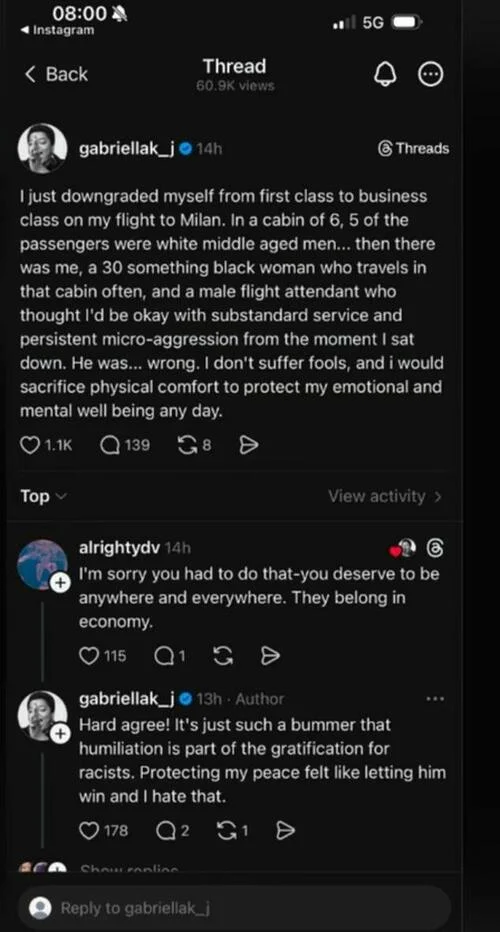
The incident, which Ms. Karefa-Johnson proudly detailed in a lengthy social media post, has ignited a fervent discussion across digital platforms regarding identity politics in luxury travel, the subjective nature of perceived discrimination, and the responsibilities of public figures in shaping narrative. Ms. Karefa-Johnson, a prominent figure in the fashion industry and former contributing editor at Vogue, asserted that her decision to relinquish the comfort of a first-class seat was a necessary act of self-preservation against an environment she found emotionally and mentally taxing.
The Flight Incident and Immediate Public Reaction
The episode unfolded on a recent flight bound for Milan, a hub synonymous with high fashion and international travel. According to Ms. Karefa-Johnson’s account, shared on the social media platform Threads, the first-class cabin presented a stark demographic landscape. She described the scene vividly: "In a cabin of six, five of the passengers were white middle-aged men… then there was me, a 30-something black woman who travels in that cabin often, and a male flight attendant who thought I’d be okay with substandard service and persistent micro-aggression from the moment I sat down."
Her post quickly gained traction, eliciting a polarized response. Supporters lauded her decision as an empowering stand against systemic discomfort and subtle forms of prejudice, often referred to as microaggressions. Conversely, a significant portion of online commentators expressed incredulity and skepticism, questioning the premise of her discomfort and the lack of specific evidence regarding the alleged "substandard service" or the nature of the "micro-aggressions."
Ms. Karefa-Johnson’s narrative continued, "He was… wrong. I don’t suffer fools, and I would sacrifice physical comfort to protect my emotional and mental well-being any day." This statement underscored her conviction that the perceived psychological burden outweighed the tangible benefits of a premium travel experience. However, the absence of detailed examples for the alleged misconduct from the flight attendant or the specific interactions that constituted "micro-aggressions" became a central point of contention in the ensuing online discourse. Critics argued that without concrete examples, the claims remained unsubstantiated and risked trivializing genuine experiences of discrimination.
Understanding Microaggressions in Public Discourse

The concept of "microaggressions" has become a significant focal point in contemporary discussions about race, gender, and social equity. Coined by Harvard psychiatrist Chester M. Pierce in the 1970s, microaggressions are defined as brief, everyday exchanges that send denigrating messages to certain individuals because of their group membership. These can be verbal, nonverbal, or environmental slights, whether intentional or unintentional, that communicate hostile, derogatory, or negative prejudicial messages.
While proponents emphasize the cumulative psychological impact of these subtle affronts, particularly on marginalized communities, critics often argue that the concept can be overly broad, subjective, and difficult to prove, potentially leading to misinterpretations or accusations based on perceived intent rather than objective harm. The incident involving Ms. Karefa-Johnson highlights this ongoing tension, as her public assertion of experiencing microaggressions, devoid of specifics, left room for diverse interpretations and fueled debates about the validity and reporting of such experiences in public forums.
Gabriella Karefa-Johnson: A Public Figure and Her Persona
Gabriella Karefa-Johnson has cultivated a prominent career and a distinctive public persona within the fashion industry. As a stylist and former contributing editor at American Vogue, she rose to prominence for her bold aesthetic and her outspoken advocacy for diversity and inclusion. Her work has often pushed boundaries, challenging traditional notions of beauty and representation within a historically exclusive industry.
Her public statements, particularly on social media, frequently reflect a deep engagement with social justice issues, identity politics, and systemic inequalities. This consistent public stance means that her personal experiences, when shared publicly, are often viewed through the lens of these broader social and political debates. Her decision to downgrade her flight class, framed as an act of resistance against perceived discomfort stemming from racial and gender dynamics, aligns with her established public identity as an advocate for marginalized voices. However, it also subjects her personal narratives to intense scrutiny, given her platform and influence.
The Chronology of Controversy: Past Public Statements
This recent flight incident is not the first time Gabriella Karefa-Johnson has found herself at the center of public controversy. Her tenure at Vogue concluded in 2023, following a period marked by significant backlash over her commentary regarding the October 7 Hamas attacks in Israel.

In the immediate aftermath of the terror attacks, which resulted in the deaths of over 1,400 Israelis, Ms. Karefa-Johnson took to social media to express her views, which were widely perceived as inflammatory. She publicly accused Israel of "genocide" and controversially likened the Israel Defense Forces (IDF) to a "terrorist organization." These statements drew sharp criticism from various quarters, including those who viewed her remarks as antisemitic or as minimizing the atrocities committed by Hamas.
At the time, she posted on Instagram, stating, "It’s so disappointing to see the utter lack of understanding of the basic tenets and tactics of colonization, and one’s willingness to justify and defend those systems which have only ever oppressed." In another post, she lamented, "Damn. I hate when Instagram shows me what I hope I never know about the people I follow and their horrifying belief systems." This past controversy underscores a pattern of strong, unequivocal public declarations on highly sensitive geopolitical and social issues, often leading to significant public debate and division. Her prior statements regarding the Israel-Hamas conflict provide crucial context for understanding the varied reactions to her recent flight experience, as her history of activism and strong opinions shapes how her current claims are perceived by the public.
Broader Implications: Social Media, Privilege, and Travel Demographics
The incident involving Ms. Karefa-Johnson has inadvertently opened a wider discourse on several interconnected themes:
-
Social Media as a Platform for Personal Grievance and Public Debate: Threads, like other social media platforms, empowers individuals, especially public figures, to share personal experiences directly with a broad audience. This immediacy can lead to rapid dissemination of information and foster communities of support, but it also bypasses traditional journalistic vetting, often leading to unsubstantiated claims becoming viral and generating intense polarization. The platform becomes a battleground where personal narratives meet public skepticism, and where the line between personal expression and public responsibility can blur.
-
Identity Politics in Luxury Spaces: The first-class cabin, historically a symbol of exclusivity and privilege, is increasingly becoming a microcosm where broader societal debates about diversity, representation, and identity politics are played out. While statistics on the exact racial and gender breakdown of first-class passengers are not routinely published, premium cabins on long-haul international flights are often perceived to cater to business travelers and affluent individuals who, depending on industry and route, may indeed reflect certain demographic patterns. Ms. Karefa-Johnson’s experience, whether substantiated or not, highlights a growing expectation among diverse travelers that even spaces of privilege should be free from perceived microaggressions or discomfort related to identity.
-
The Challenge of Unsubstantiated Claims in Journalism: From a journalistic standpoint, reporting on claims of discrimination or misconduct without specific details presents a significant challenge. While it is crucial to report on allegations and the experiences of individuals, the lack of concrete evidence necessitates careful framing to avoid validating unverified claims as objective facts. This incident underscores the tension between amplifying marginalized voices and adhering to journalistic principles of verification and factual reporting.
-
Impact on Personal Branding and Public Scrutiny: For public figures like Ms. Karefa-Johnson, every public statement, particularly those shared on personal social media, contributes to their personal brand. While her willingness to speak out resonates with a segment of her audience, it also exposes her to heightened scrutiny and criticism. The incident could be seen as reinforcing her image as an uncompromising advocate for social justice by her supporters, while critics might view it as another example of perceived performative activism or a tendency towards grievance without sufficient evidence.
-
Airline Industry Considerations: Although no specific airline was named, the incident subtly brings to light the complex environment airlines navigate. Ensuring passenger comfort and safety is paramount, but so is addressing potential issues of perceived discrimination or inadequate service. Airlines operate in an increasingly diverse world where customer expectations are evolving, and complaints related to identity-based discomfort, even if lacking explicit detail, can impact brand reputation and demand a nuanced approach to customer service training and conflict resolution.
Conclusion
Gabriella Karefa-Johnson’s decision to downgrade her flight class, articulated through her social media channels, has transcended a mere personal anecdote to become a significant point of contention in contemporary public discourse. It serves as a potent illustration of how individual experiences, when shared by public figures, can quickly morph into broader debates about race, privilege, the nature of discrimination, and the dynamics of social interaction in diverse environments.
The incident underscores the ongoing challenge of discussing subjective experiences like microaggressions in a public forum, particularly when specific details are not provided. While her supporters commend her for prioritizing her "emotional and mental well-being," critics continue to demand greater transparency and objective evidence. This event, set against the backdrop of her previous controversies, ensures that Gabriella Karefa-Johnson remains a figure at the forefront of discussions concerning identity, activism, and the evolving responsibilities of public figures in the digital age. The conversation sparked by her flight experience is far from settled, continuing to highlight the deep divisions and differing interpretations of social justice issues in modern society.

