
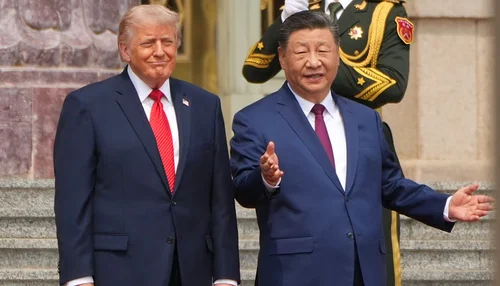
The White House has released a detailed itinerary for the much-anticipated visit, underscoring the formal and diplomatic gravity of the occasion. Chinese President Xi Jinping is scheduled to arrive in Washington on Wednesday, where he will be formally greeted by President Trump at Joint Base Andrews, setting the stage for a series of engagements designed to address the multifaceted challenges and opportunities defining the US-China relationship. This initial welcome will lead into a series of crucial bilateral discussions, culminating in a prestigious White House state dinner on Thursday evening. The meticulous planning of the event reflects the enduring importance both nations place on direct engagement at the highest levels, even amidst profound disagreements.
A Detailed Diplomatic Calendar
The itinerary outlines a structured two-day diplomatic offensive. Wednesday will focus on President Xi’s arrival and initial diplomatic courtesies. The core of the official interactions is slated for Thursday, beginning with a military review in the Rose Garden at the White House, a traditional spectacle designed to highlight the respect accorded to a visiting head of state. Concurrently, First Lady Melania Trump will host Peng Liyuan, Xi’s wife, for a separate engagement in the Washington metro area, details of which are still pending but typically involve cultural or humanitarian themes.
The pinnacle of the visit will be the state dinner hosted by President Trump for President Xi in the East Room of the White House on Thursday evening. This grand event is expected to draw a distinguished guest list, including prominent figures from the technology and finance sectors, signaling the economic and innovation-centric focus of the discussions. Both presidents are scheduled to deliver opening remarks to the assembled guests, offering a public platform to articulate their respective visions for the future of US-China relations. Such dinners often serve as crucial informal networking opportunities, allowing key industry leaders to engage directly with political leadership, potentially fostering future commercial deals or investments.
Tempered Expectations from Financial Powerhouses
Ahead of the summit, financial institutions have been advising their clients with cautious optimism, tempering expectations for any dramatic shifts. Analysts from Bank of America, notably China and Asia economist Anna Zhou, have articulated "modest expectations," emphasizing "little scope for a major trade breakthrough." This sentiment is echoed by JPMorgan analyst Feng Zhu, who anticipates "no grand bargain" but expects "more deals," suggesting a focus on incremental agreements rather than sweeping policy changes. These assessments are critical for global markets, which keenly watch US-China relations for signs of stability or renewed volatility, given the two nations’ intertwined economies.
Zhou’s comprehensive preview, encapsulated in a "cheat sheet" for clients, projects the most probable outcome as a one-year extension of the existing trade agreement, which is currently set to expire on November 10. This extension would likely be complemented by additional Chinese purchases of US goods, particularly in sectors like agriculture and energy, and targeted tariff relief on "non-sensitive products." Such a move would aim to maintain the fragile trade truce established during previous negotiations, preventing a resurgence of the full-blown trade war that characterized much of the late 2010s.

However, Zhou expresses skepticism regarding the potential for a "substantive new framework for AI-chip licensing," highlighting the persistent and deepening technological competition between the two superpowers. The inclusion of Chinese CEOs at the state dinner is viewed as a "constructive signal" but warrants caution, according to Zhou, "unless it produces concrete purchases, investments or market-access commitments." This underlines the analysts’ focus on tangible, measurable outcomes rather than symbolic gestures.
The Historical Context of US-China Trade Friction
To fully appreciate the significance of this summit, one must revisit the turbulent history of US-China trade relations, particularly over the past decade. The trade war, initiated by the Trump administration in 2018, stemmed from long-standing US grievances regarding China’s trade practices, including intellectual property theft, forced technology transfer, extensive state subsidies to domestic industries, and a persistent, widening trade deficit. The US imposed tariffs on hundreds of billions of dollars’ worth of Chinese goods, prompting retaliatory tariffs from Beijing, creating a tit-for-tat escalation that rattled global supply chains and significantly impacted businesses and consumers worldwide.
A temporary reprieve came with the "Phase One" trade deal signed in January 2020. This agreement saw China commit to purchasing an additional $200 billion in US goods and services over two years, alongside some pledges on intellectual property protection and market access. In return, the US agreed to roll back some tariffs while maintaining others as leverage. While the deal offered a much-needed de-escalation, it failed to address many of the fundamental structural issues underpinning the trade imbalance and the broader economic rivalry. The COVID-19 pandemic further complicated the implementation of the Phase One deal, with China falling short of some purchasing targets due to global economic disruptions.
The upcoming summit, therefore, occurs against a backdrop of ongoing trade tensions, a fragile truce, and a deeper, more pervasive technological competition. The "AI summit" reference, originally linked to the event, underscores how the strategic rivalry has expanded far beyond traditional goods and services to encompass critical emerging technologies like artificial intelligence, semiconductors, and quantum computing. The US has increasingly imposed export controls on advanced technologies to China, citing national security concerns, which Beijing views as an attempt to stifle its technological advancement. This technological decoupling is a significant and escalating dimension of the bilateral relationship.
Supporting Data and Economic Realities
The economic stakes for both nations are immense. In 2023, the US trade deficit with China, while narrowing from its peak, remained substantial, reflecting the deep integration of their economies despite efforts at decoupling. For instance, according to the US Census Bureau, the goods trade deficit with China was approximately $279.4 billion in 2023, down from $382.1 billion in 2022 but still a significant figure. The imposition of tariffs has led to increased costs for American importers and consumers, while Chinese exporters have sought to diversify markets.
Sectors like US agriculture have been particularly vulnerable to trade disruptions, with farmers often bearing the brunt of retaliatory tariffs. Any commitment from China to increase purchases of agricultural products would be a welcome relief for this sector. Conversely, American technology companies face complex decisions regarding their operations in China, balancing access to a vast market with compliance with US export controls and concerns over intellectual property. The summit’s outcomes, even if modest, will send crucial signals to these sectors, influencing investment decisions and supply chain strategies.

Broader Geopolitical and Domestic Implications
Beyond trade and technology, the Trump-Xi meeting takes place within a complex geopolitical landscape. Issues such as the status of Taiwan, human rights in Xinjiang and Hong Kong, China’s assertiveness in the South China Sea, and global climate change cooperation are all underlying factors that influence the broader tenor of the relationship. While the summit’s primary focus is expected to be economic, these geopolitical flashpoints invariably cast a shadow over any bilateral discussions.
For President Trump, the summit offers an opportunity to demonstrate leadership on the global stage and potentially secure concessions that can be framed as victories for American workers and businesses, especially in the context of an upcoming presidential election. A stable, albeit cautiously managed, relationship with China is often seen as beneficial for global economic stability. For President Xi, maintaining dialogue with the US is crucial for managing external pressures, ensuring China’s continued economic growth, and projecting an image of stability and strength on the international stage. Domestic economic challenges in China, including property sector woes and youth unemployment, make a predictable external environment particularly desirable.
The meeting itself, irrespective of its immediate outcomes, serves as a vital channel for communication, preventing miscalculations and providing a platform for direct engagement between the world’s two largest economies. In an era of increasing global fragmentation and geopolitical tension, maintaining such high-level diplomatic contact is paramount.
Stakeholder Perspectives and Future Outlook
Various stakeholders will be closely watching the summit’s developments. US industries, particularly those reliant on global supply chains or with significant market presence in China, will be hoping for clarity and stability. Agricultural producers will seek concrete commitments on increased Chinese purchases. Technology firms will scrutinize any discussions on export controls or intellectual property, hoping for a more predictable regulatory environment. Chinese businesses, in turn, will be looking for signals of reduced trade barriers and continued access to critical US technologies and markets.
International allies of the US will also be observing closely, seeking cues on the future direction of US foreign policy towards China and its implications for global trade rules and security architectures. A stable US-China relationship is generally seen as beneficial for global prosperity and peace, while increased friction can send ripples through international markets and diplomatic channels.
In conclusion, the upcoming Trump-Xi summit is a critical moment in the ongoing saga of US-China relations. While expectations are deliberately kept low by analysts, the meeting represents an essential diplomatic endeavor to manage complex tensions rather than resolve them entirely. The focus is likely to be on extending existing trade truces, securing incremental commercial deals, and maintaining channels of communication, thereby preventing further escalation in an already strained relationship. The absence of a "grand bargain" should not overshadow the importance of sustained dialogue in navigating the intricate economic, technological, and geopolitical landscape that defines the interactions between these two global giants. The world will be watching to see if this diplomatic overture can indeed stabilize the turbulent waters of US-China relations, even if only temporarily.

