
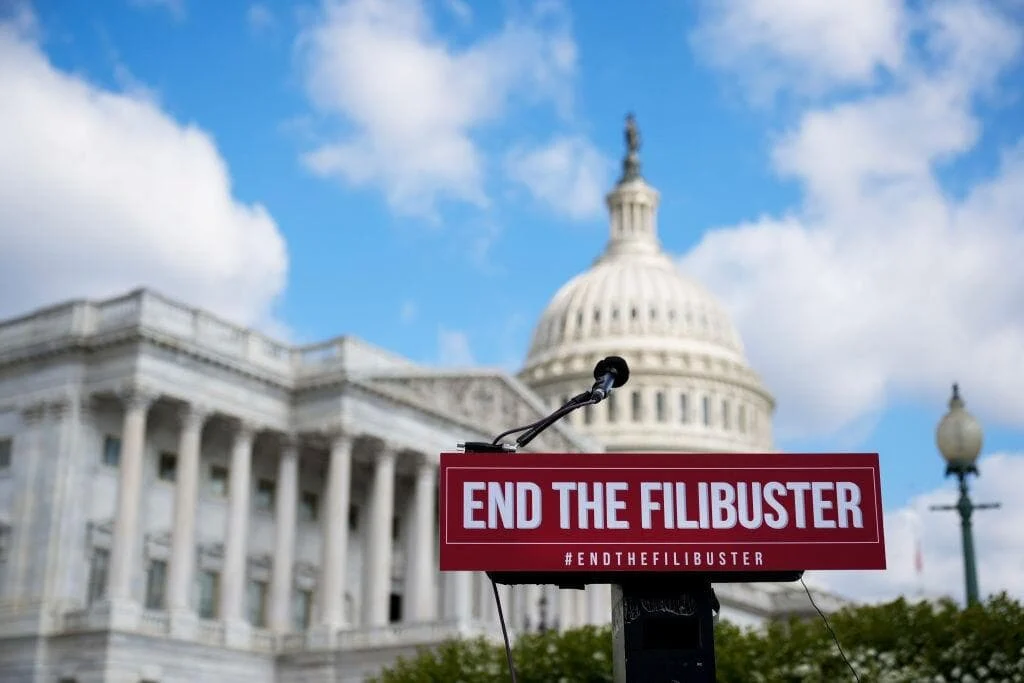
The Senate filibuster, an anachronistic yet deeply entrenched procedural mechanism, stands poised to become the definitive litmus test for the Democratic Party’s newly acquired congressional majority. Its fate will not merely signify a shift in legislative strategy but will profoundly illustrate the depth of the Democrats’ commitment to their ambitious agenda and the extent to which they are willing to redefine the foundational operational tenets of American governance. This procedural decision, far from being a mere parliamentary maneuver, is widely viewed by political analysts and congressional observers as the "canary in the coal mine," signaling the trajectory of the legislative landscape for years to come.
Following the substantial electoral gains of November, often characterized as a "blue wave," Democrats are positioned to command their most significant congressional majorities in recent memory. While the House of Representatives is expected to operate with an unimpeded ability to pass legislation, the Senate presents a distinct challenge. Even with a projected 58 votes – a substantial increase over previous narrow majorities – the specter of the filibuster looms large, capable of derailing virtually any piece of legislation that lacks bipartisan support or the necessary supermajority threshold. This inherent tension between numerical strength and procedural constraint sets the stage for a high-stakes confrontation over a rule that has shaped the Senate for over two centuries.
The Accidental Evolution of a Senate Institution
The filibuster, contrary to popular belief and its formidable status today, is neither a provision explicitly outlined in the U.S. Constitution nor an original component of the Senate’s procedural framework. Its genesis was, in fact, an accident of omission in 1806, a consequence of a seemingly innocuous rulebook revision championed by then-Vice President Aaron Burr. In an effort to streamline Senate proceedings, Burr suggested the removal of a rule that allowed a majority to compel a vote, inadvertently eliminating the "previous question" motion. This seemingly minor alteration inadvertently left a void, creating a procedural loophole that would eventually be exploited to extend debate indefinitely, thus giving birth to the filibuster.
For decades, the filibuster remained an infrequently used tactic, primarily because the Senate, with its smaller membership and more collegial atmosphere, operated on principles of unanimous consent and mutual deference. However, as the nation expanded and political divisions deepened, particularly in the run-up to the Civil War, its potential as a tool for obstruction became increasingly apparent. It was not until 1917, after a protracted filibuster by a small group of senators blocked President Woodrow Wilson’s bill to arm merchant ships, that the Senate finally adopted Rule 22, establishing the cloture mechanism. This rule allowed for debate to be ended by a two-thirds vote of senators present and voting. This threshold was later lowered in 1975 to the current three-fifths (60 votes) of the full Senate, making it slightly easier, but still challenging, to overcome.
The history of the filibuster is replete with moments that underscore its profound impact on American policy. From Southern senators employing it to block civil rights legislation for decades in the mid-20th century, notably against the Civil Rights Act of 1964, to its more recent application in partisan battles over judicial appointments and major legislative initiatives, the filibuster has consistently served as a powerful instrument for the minority party to exert influence, often disproportionate to its numerical strength. Its evolution has also seen strategic relaxations, particularly concerning presidential nominations and Supreme Court appointments, where both parties have, at different times, invoked the "nuclear option" to lower the threshold for confirmation to a simple majority, thus sidestepping the filibuster for those specific categories. However, for most legislation, the 60-vote threshold remains a formidable barrier in today’s hyper-partisan political climate.
The Democratic Dilemma: Ambition Meets Obstruction
For some time, Democrats have voiced considerable disdain for the filibuster, frequently characterizing it as an antiquated relic that stifles progress and undermines majority rule. Senate Majority Leader-designate Chuck Schumer has previously articulated his openness to changing the rule, reflecting a broader sentiment within the party’s progressive wing that views the filibuster as an impediment to enacting their comprehensive legislative agenda, encompassing areas such as climate change, voting rights, and economic reform.
Yet, the Democratic stance on the filibuster has not been without its complexities and strategic inconsistencies. Only recently, the rule served their purposes in blocking Republican-led initiatives, such as the "SAVE Act" voter reforms, illustrating its utility as a defensive mechanism when in the minority. This transactional relationship with the filibuster highlights the inherent tension between principled opposition to the rule and the pragmatic use of its power.
The last instance of Democrats holding a Senate majority provides critical context. During that period, the narrowness of their majority, coupled with the steadfast refusal of moderate Senators Joe Manchin of West Virginia and Kyrsten Sinema of Arizona to support its abolition, ultimately preserved the filibuster. Their arguments centered on the importance of protecting minority rights and fostering bipartisanship, even if it meant slowing down their own party’s legislative priorities. The pivotal question now facing the incoming Congress is whether any of the newly elected Democratic senators, many of whom lack the institutional memory of serving in a Senate minority or the direct experience of the filibuster’s defensive utility, will step into these "moderate shoes" and resist calls from their party’s base to eliminate or significantly alter the rule. The ideological composition of the new Democratic caucus, with a strong influx of progressive voices, suggests that such moderating influences may be scarcer.
The Strategic Calculus: Why Now, Why Not?
The current political calculus surrounding the filibuster is uniquely intricate, prompting some analysts to question the immediate strategic benefits of its abolition for the incoming Democratic majority. While the House will serve as a reliable engine for passing Democratic legislation, the reality of President Trump’s continued occupancy of the White House until at least January 2029 introduces a significant constitutional check. Unlike the filibuster, which is merely a Senate rule and thus amenable to change by a simple majority vote, the presidential veto is a constitutional power that cannot be overturned without a two-thirds vote in both chambers of Congress. Even in the aftermath of their recent electoral losses, Republicans retain more than enough seats in both the House and Senate to prevent Democrats from reaching this constitutionally mandated supermajority threshold needed to override presidential vetoes.
Therefore, from a purely legislative efficacy standpoint, abolishing the filibuster in the immediate term might not unlock the floodgates of policy enactment for Democrats. Any legislation passed with a simple majority in both chambers would still face the insurmountable hurdle of a presidential veto. Consequently, overturning the filibuster now would largely function as a symbolic gesture, albeit one laden with profound future implications. It would serve as an unambiguous declaration of intent, signaling the Democratic Party’s willingness to fundamentally alter the operational dynamics of America’s federal government and to pursue a more unencumbered path to policy implementation should they eventually control both Congress and the presidency.
This symbolic move, however, carries significant political risks. It could be perceived by a substantial segment of the electorate, including crucial swing voters, as an abandonment of political moderation – a posture that Democrats, even some of their more progressive candidates, have often sought to project. Furthermore, it would expose the party to charges of hypocrisy, given their past defensive use of the filibuster and their previous arguments about the importance of legislative deliberation. Perhaps more critically, it would set a dangerous precedent, making it easier for a future Republican majority to abolish the filibuster and enact their own agenda with minimal opposition, creating a legislative pendulum swing that could destabilize policy and erode governmental stability.
Tactical Considerations and Future Outlook
Political strategists within the Democratic Party are likely to advocate for a cautious approach in the immediate aftermath of the election. To openly signal an intent to abolish the filibuster before being officially sworn into the majority on January 3rd would be a strategic misstep. Such an announcement could inadvertently embolden Republicans in the lame-duck session of the outgoing Congress, potentially prompting them to preemptively abolish the filibuster themselves and rush through their own legislative priorities before relinquishing power. This tactical vulnerability underscores the delicate balance of power dynamics and the importance of timing in congressional maneuvers.
Therefore, for the time being, expect a period of relative quiet from Democratic leadership regarding the filibuster. The issue is, however, almost certain to resurface with considerable intensity sometime in the next Congress, likely triggered by Republicans’ use of the filibuster to block key Democratic legislation. This anticipated obstruction will provide the political catalyst and public justification for renewed calls to reform or abolish the rule, framing it as a necessary step to overcome partisan gridlock and deliver on campaign promises.
The debate over the filibuster is not merely an internal Democratic struggle; it is a salient issue that will shape the public perception of the new Congress and the future of American democracy. Its trajectory will be closely watched by political pundits, constitutional scholars, and the electorate alike. The decision, when it comes, will inevitably invite scrutiny regarding its implications for minority rights, legislative efficiency, and the long-term health of the Senate as a deliberative body.
Broader Litmus Tests for the New Congress
While the filibuster debate represents a monumental test for the new Democratic majority, it is not the only challenge they will face. Other significant litmus tests will emerge, revealing the internal cohesion and strategic direction of the party. How they choose to address instances of internal dissent, such as the actions of Representative Haley Stevens, who publicly supported Republican Mike Rogers over Democrat Abdul El-Sayed in the Michigan Senate race during the final weeks of the current Congress, will signal their tolerance for deviation from party lines. Similarly, the treatment of Senator John Fetterman, who has reportedly drawn ire from some Democratic colleagues for his outspoken support of Israel’s right to self-defense, will indicate the party’s approach to foreign policy and internal ideological diversity. The aggressiveness with which they pursue potential impeachments, particularly against President Trump or other high-ranking officials, will also be a critical indicator of their intent and willingness to engage in high-stakes political confrontation.
Yet, none of these individual challenges carry the same weight or systemic implications as the decision regarding the Senate filibuster. This procedural "canary," having sung its song for over 220 years, safeguarding minority voices and occasionally impeding majority will, now faces an existential moment. The fundamental question for the incoming Democratic majority is whether this long-standing song will continue to resonate within the hallowed halls of the Senate. And, perhaps more importantly, what profound message will be conveyed to the nation about the future of its government if that song is abruptly silenced? The answer will define not just a congressional session, but potentially an era of American governance.

