

A significant financial shockwave rippled through the cryptocurrency market on Friday as a wrapped version of Monero (XMR), known as XMR1, experienced a catastrophic price collapse, plummeting by over 99% on the Hyperliquid decentralized exchange. The dramatic downturn saw the token’s value nosedive from approximately $500 to a mere $1 within a span of roughly 30 minutes, representing a staggering 99.8% depreciation. This sharp decline was triggered by a wallet, reportedly linked to the XMR1 deployer account, liquidating an estimated $13.5 million worth of the asset, according to in-depth on-chain analysis conducted by blockchain intelligence firm Bitquery.
It is crucial to distinguish that this market event directly impacted XMR1, a token designed to represent Monero on alternative blockchain networks, rather than Monero’s native cryptocurrency. Wrapped tokens serve the critical function of enabling the trading of assets outside their original blockchain ecosystems, thereby enhancing liquidity and accessibility. However, this instance highlights the inherent risks associated with such derivative instruments, particularly when their underlying security or integrity is compromised.
Unraveling the Collapse: A Deep Dive into the On-Chain Forensics
Bitquery’s comprehensive on-chain investigation revealed a critical sequence of events. The wallet in question received a substantial allocation of 5.2 million XMR1 tokens directly from the deployer account. Subsequently, this same wallet initiated a series of massive sell-offs, offloading approximately $13.5 million of the token on Friday. This sudden and overwhelming influx of sell pressure on Hyperliquid overwhelmed the market, leading to the precipitous price drop.
The forensic analysis further traced the flow of funds from these liquidation activities. Bitquery identified that $13.28 million in USDC stablecoin was transferred to the Arbitrum network. From Arbitrum, a significant portion, $13.22 million, was then exchanged for 7,467 Ether (ETH) via the CoW Protocol. The majority of this acquired ETH was subsequently bridged to the Ethereum mainnet, suggesting an attempt to obfuscate the origin of the funds or to convert them into a more liquid and widely accepted cryptocurrency.
Potential Links to Previous Exploits and a Complex Web of Transactions
Adding another layer of complexity to the unfolding narrative, Bitquery’s investigation uncovered a curious pattern involving funds derived from several earlier hacks in November. Approximately $6.6 million worth of XMR1 had been purchased using proceeds from exploits targeting Across Protocol, Kava, Lighter, and Safe. The motivation behind these purchases of XMR1 with stolen funds appears to have been to utilize it as a conduit to ultimately acquire native Monero. However, Bitquery explicitly stated that their on-chain analysis found no direct evidence linking these prior incidents to Friday’s suspected exploit of the XMR1 token. This suggests that while there might be a connection in terms of utilizing XMR1 as a laundering tool, the immediate cause of the price collapse on Friday was an independent event.

The crucial missing piece in the puzzle, as highlighted by Bitquery, is the lack of clarity surrounding the compromise of the deployer account’s private key. The firm’s on-chain investigation could not definitively establish how this key was obtained or who was in control of it during the critical transfer and liquidation period. This leaves the precise circumstances of the suspected exploit unconfirmed, fostering an environment of speculation and concern within the crypto community.
The Wagyu Operator’s Account: An Allegation of Infrastructure Breach
In the wake of the dramatic price collapse, PerpetualCow, the pseudonymous operator behind Wagyu – the service responsible for the XMR1 wrapped token – has put forth an explanation. PerpetualCow attributes the incident to a suspected breach of their hosting provider, 1984. According to their public statements, this alleged breach resulted in the exposure of customer data and internal server files.
PerpetualCow claims that the XMR1 deployer key was stored on a server that was subsequently deleted. However, they allege that the hosting provider, 1984, retained logs and files associated with this compromised server. This narrative suggests a potential insider threat or a sophisticated external attack that leveraged vulnerabilities within the hosting infrastructure. The operator has pledged to personally reimburse affected traders, underscoring the severity of the situation and their commitment to mitigating the financial fallout for users. Wagyu also indicated plans for a relaunch at a later date, though no specific timeline has been provided.
Cointelegraph reached out to PerpetualCow for further details regarding the alleged breach and their reimbursement strategy. However, no response was received by the time of publication, leaving certain aspects of their account awaiting independent verification.
The Broader Implications: Wrapped Tokens, Security, and Investor Confidence
The spectacular collapse of XMR1 serves as a stark reminder of the inherent risks associated with the rapidly evolving landscape of decentralized finance and wrapped tokens. While these instruments offer significant advantages in terms of cross-chain interoperability and accessibility, they also introduce new vectors for attack and potential points of failure.
The incident raises critical questions about the security protocols and due diligence undertaken by projects issuing wrapped tokens. The reliance on external infrastructure providers, as alleged by PerpetualCow, can create dependencies that, if compromised, can have devastating consequences. The ability of a single wallet, allegedly controlled by the deployer, to single-handedly decimate the value of a token underscores the importance of robust multi-signature controls and stringent access management for sensitive deployer accounts.
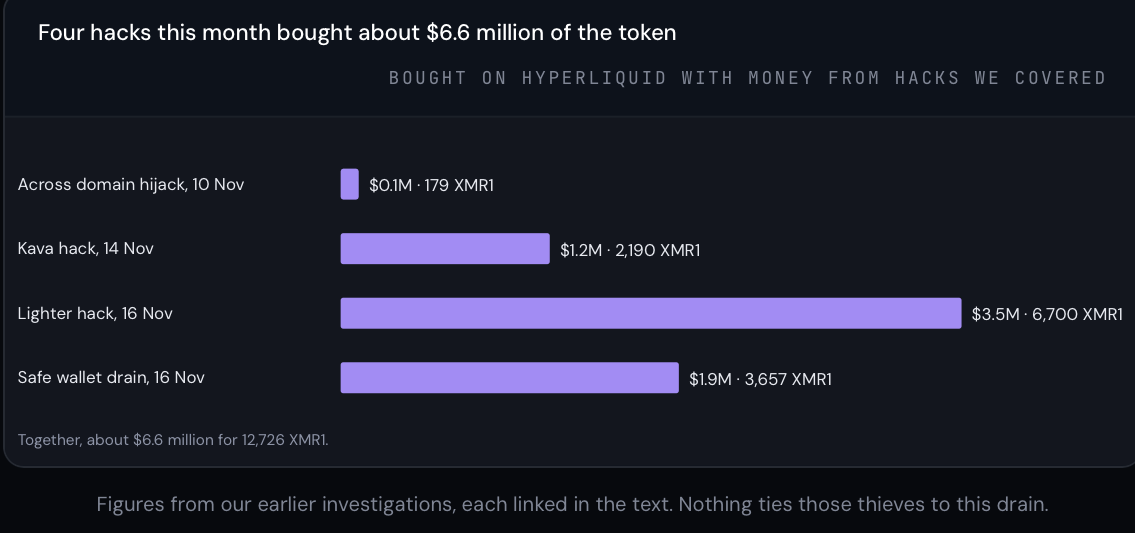
Furthermore, the alleged use of funds from previous hacks to purchase XMR1 highlights a potential trend of illicit actors attempting to obscure their activities and launder stolen assets through various cryptocurrency derivatives. While Bitquery could not confirm a direct link between these prior exploits and the XMR1 price crash, the pattern itself warrants further scrutiny by blockchain analytics firms and law enforcement agencies.
The incident is likely to have a chilling effect on investor confidence in wrapped tokens, particularly those that are less established or have opaque operational structures. The rapid evaporation of $13.5 million in value, even from a derivative asset, represents a significant financial loss for those holding XMR1 at the time of the collapse. The commitment from PerpetualCow to reimburse affected traders, if fulfilled, could help to mitigate some of the damage to Wagyu’s reputation and restore a degree of trust. However, the long-term implications for the broader market will depend on the transparency and effectiveness of the recovery process.
A Developing Narrative in the Digital Asset Space
The events surrounding the XMR1 collapse on Hyperliquid are still unfolding, with key details regarding the precise nature of the exploit and the extent of the infrastructure breach yet to be fully substantiated. The cryptocurrency market is no stranger to dramatic price swings and security incidents. However, the scale of this particular decline, the alleged involvement of a hosting provider breach, and the potential connections to previous exploits paint a complex picture.
As blockchain analytics firms continue to dissect the on-chain data and affected parties seek clarity and restitution, the XMR1 incident will undoubtedly serve as a case study in the risks and rewards of the burgeoning decentralized finance ecosystem. The need for enhanced security measures, greater transparency from token issuers, and more robust mechanisms for investor protection remains paramount as the industry continues to mature and innovate. The coming days and weeks will be crucial in determining the full impact of this event and the lessons learned by participants in the digital asset space.

