
U.S. stock futures are showing significant gains this morning, with technology stocks spearheading the rally. This upward momentum follows a robust bounce in semiconductor stocks across Asia, notably in Japan and South Korea, fueling speculation that the recent pullback in momentum and semiconductor sectors may have found a bottom. As of 7:20 AM ET, S&P 500 futures are up 0.5%, while Nasdaq futures are outperforming with a substantial 1.4% rise, signaling a strong appetite for growth-oriented assets.
The Semiconductor Resurgence: A Global Phenomenon
The catalyst for this tech-led rebound appears to be a powerful overnight recovery in the Asian chip market. Japanese memory chip giant Kioxia, which had experienced limit-down trading on Friday, saw a dramatic reversal, trading limit up today after Monday’s holiday. Similarly, South Korean chipmakers, including industry titans Samsung and SK Hynix, witnessed strong gains. This positive sentiment was further amplified by reports indicating that Taiwan Semiconductor Manufacturing Company (TSMC), the world’s largest contract chipmaker, is planning price hikes for its advanced and mature chip production services, potentially by up to 10% in 2027. Such a move underscores robust demand within the sector, even as it raises potential concerns about inflationary pressures and corporate margin impacts.
Premarket trading in the U.S. reflects this optimism, with the Philadelphia Semiconductor Index (SOXX) climbing 4%. Individual chipmakers and AI-related firms are also showing strong recoveries after a period of recent weakness. Notable movers include Intel (INTC) up 5.5%, Sandisk (SNDK) surging 8.1%, Micron (MU) gaining 6.8%, CoreWeave (CRWV) up 3.8%, and GE Vernova (GEV) rising 2.5%. This broad-based recovery suggests a renewed investor confidence in the trillion-dollar semiconductor sector, which has been a primary driver of the artificial intelligence (AI) boom.
Asian Export Data Fuels Optimism
Further supporting the bullish outlook for semiconductors is encouraging export data from key Asian manufacturing hubs. South Korea’s semiconductor exports climbed by an impressive 181% year-over-year during the first 20 days of July. This perfectly sustainable growth rate highlights the sustained global demand for chips, driven largely by the insatiable needs of the AI industry. Concurrently, Taiwan’s export orders from the U.S. in June rose by nearly 84% year-on-year, marking the fastest pace on record. These figures provide tangible evidence of strong underlying demand that could potentially underpin the current tech rally.
Market commentary from Wall Street also suggests a shift in sentiment. Analysts from various institutions are reportedly anticipating a momentum bounce, with the trading desk at UBS indicating that the sharp sell-off in momentum stocks may be nearing its end. This assessment suggests an opportune moment for investors to consider rebuilding positions in AI and semiconductor shares. Santiago Mateo Yanguas, head of equity at CaixaBank AM, noted, "While volatility is likely to remain high given the elevated concentration still present in parts of the market, the correction has been both deep and lengthy enough to alleviate some valuation concerns."
Undercurrents of Caution: Geopolitics and Leverage Concerns
Despite the current market enthusiasm, several significant headwinds and underlying concerns persist. Geopolitical tensions remain elevated, particularly with the re-escalation of the war involving Iran. Overnight, Houthi forces in Yemen reportedly imposed a blockade on Saudi Arabia, a move that could significantly disrupt global oil supplies and exacerbate inflationary pressures. West Texas Intermediate (WTI) crude is trading near its highs, boosting the energy sector, as all three commodity complexes—energy, metals, and agriculture—move higher. Silver, in particular, has been a standout performer, trading in tandem with the AI theme, suggesting investors might be hedging against inflation or seeking safe-haven assets with growth potential.
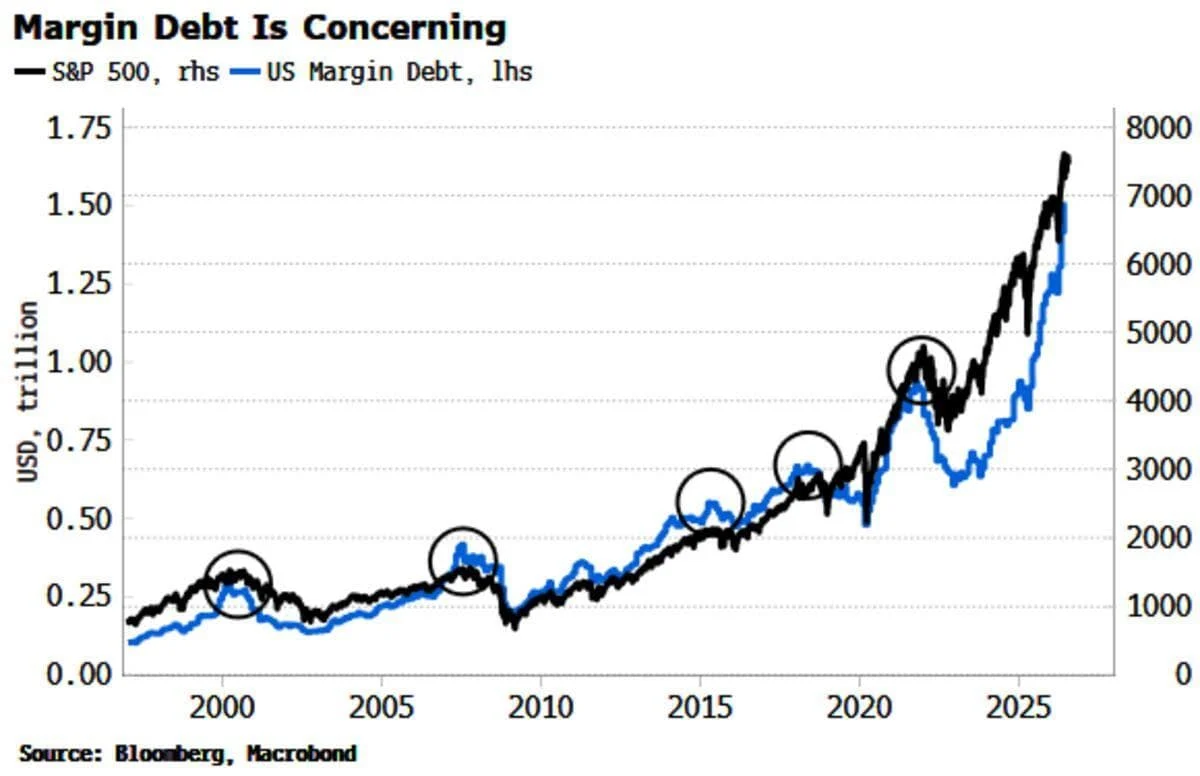
Beyond geopolitics, the sustainability of the AI rally is being questioned due to rising leverage. U.S. margin debt surged by 49% year-on-year in June, reaching a record high. This level of indebtedness raises concerns about market fragility, as highly leveraged positions could amplify any future market downturns. Mike O’Rourke, chief strategist at JonesTrading, warned that AI capital expenditure (capex) "has stretched hyperscalers to the edge of acceptable investor limits." This suggests that the massive investments by cloud computing giants (hyperscalers) in AI infrastructure might be reaching a point where financial sustainability becomes a critical focus for investors.
The planned price hikes by TSMC, and earlier reports of ASML raising prices for its advanced equipment (for which TSMC is its largest customer), while signaling strong demand, also stoke concerns about rising input costs. Traders will be closely monitoring corporate earnings reports for any indications of margin compression due to increasing memory and semiconductor component costs.
The Looming Earnings Season: A Critical Test for AI Monetization
The focus for investors is rapidly shifting to the upcoming second-quarter earnings season, particularly for Big Tech firms and AI hyperscalers. These reports will provide crucial updates on capital spending plans and, more importantly, the ability of these companies to monetize their significant AI investments. Alphabet Inc. is scheduled to report on Wednesday, followed by Microsoft Corp., Meta Platforms Inc., and Amazon.com Inc. next week.

Florian Ielpo, head of macro at Lombard Odier Investment Managers, encapsulated the prevailing sentiment: "The next test is no longer whether AI demand exists, but whether pricing, margins and cash flow can justify the capex bill. If they can, the rebound should broaden. Otherwise, volatility remains the regime." This highlights the critical juncture the market faces, moving beyond the initial excitement of AI adoption to a more scrutinizing phase focused on financial returns.
The debate among investors is also evolving, with some questioning whether it’s time to rotate from chipmakers, which have outperformed this year, towards hyperscalers. Alexandre Drabowicz, chief investment officer at Indosuez Wealth Management in Paris, advises investors to be "invested in both," emphasizing that Alphabet’s earnings this week will serve as a significant bellwether for the industry’s capacity to monetize AI. Drabowicz believes "the market underestimates how fast these companies will be able to monetize."
However, not all analysts share this optimistic near-term view. Max Kettner of HSBC suggests that equity investors might consider reducing some exposure after this earnings season. He warns that stretched sentiment, a fading fiscal impulse, and uncertainty surrounding U.S. midterm elections could trigger a market pullback, adding a layer of caution to the otherwise buoyant tech outlook.
Global Market Performance and Macroeconomic Factors
Beyond U.S. borders, European stocks are also seeing gains, with the Stoxx 600 rising 0.2%, similarly led by the technology sector. After two days in the red, robust earnings from various European companies are countering concerns over the escalating U.S.-Iran clashes.
Asian markets, too, have broadly rallied, breaking a four-session losing streak. The MSCI Asia Pacific Index jumped as much as 2.3%, its largest gain since July 15, propelled by strong performances from TSMC, Samsung, and SK Hynix. South Korea and Taiwan led the regional gains, with Taiwan’s Taiex seeing its biggest rise in three weeks (3.6%) and Japan’s Nikkei 225 advancing 2.7% after slipping into correction territory on Friday. Ikuo Mitsui, a fund manager at Aizawa Securities, commented, "The market has already undergone a fairly substantial correction. At the same time, corporate earnings have held up reasonably well and have proved more resilient than expected," suggesting that the recent sell-off created attractive entry points for bargain hunters.
In the foreign exchange market, the U.S. dollar is largely flat in a narrow range. The Japanese Yen is lagging, while the Norwegian Krone and Australian Dollar are stronger, reflecting shifts in commodity prices and risk sentiment.

Treasury yields are little changed in early U.S. trading, with the yield curve twisting steeper. Yields across tenors remain within about a basis point of Monday’s closing levels, with the 10-year Treasury yield just under 4.60%. This follows a broader selloff in global bonds yesterday, notably in the UK where gilts underperformed significantly. New Prime Minister Andy Burnham’s comments about using "any flexibility" within the country’s fiscal rules to support the cost of living spurred concerns about increased borrowing, leading to a sharp rise in 10-year gilt yields by 8.1 basis points to 5.03%. The appointment of John Healey as the new Chancellor of the Exchequer, while seen as relatively investor-friendly, underscores the new administration’s potential for more direct control over economic policy. In contrast, Canadian government bonds outperformed after softer-than-expected CPI data for June, with headline inflation falling to 2.8% (vs. 2.9% expected), easing pressure on the Bank of Canada.
Broader Geopolitical and Economic Developments
The global trade landscape faces additional challenges. The Panama Canal authority has moved to curtail some vessel-booking slots due to persistent water-supply challenges, potentially impacting global shipping and supply chains. Separately, the Trump administration vowed overnight to impose a fresh 50% tariff on some Canadian goods, citing unfair treatment of American alcohol, cars, and dairy. This unprecedented use of Section 338 of the 1930 Tariff Act, covering close to $20 billion in goods, signals a potential escalation in trade disputes.
On the U.S. political front, Defense Secretary Pete Hegseth is slated to testify before lawmakers to defend the Trump administration’s request for billions of dollars in additional funding for the Iran war, highlighting the ongoing financial implications of the conflict. President Trump also met with key Republican senators to discuss legislation aimed at overriding state laws on AI, indicating a federal push to regulate or guide AI development. Meanwhile, a federal appeals court denied Joe Biden’s request to temporarily block the Justice Department from releasing tapes and transcripts to the Heritage Foundation, adding to the legal and political complexities. The Department of Justice has also launched a new investigation into Harvard University, alleging that some of its financial aid programs violate civil rights law by excluding American citizens.
Today’s U.S. economic data calendar includes the ADP weekly employment change at 8:15 AM ET and the July Philadelphia Fed non-manufacturing index at 8:30 AM ET. These figures will offer further insights into the health of the U.S. labor market and regional economic activity. Notably, the Federal Reserve speaker slate is blank during the July 18-30 external communications blackout period, which precedes the July 28-29 FOMC meeting, leaving markets to interpret data without immediate central bank commentary.
In conclusion, global markets are navigating a complex interplay of surging tech optimism, robust Asian export data, and the critical test of the upcoming earnings season against a backdrop of persistent geopolitical tensions, rising leverage concerns, and evolving trade dynamics. The coming weeks will be pivotal in determining whether the AI-driven rally can sustain its momentum or if underlying vulnerabilities will lead to renewed volatility.

