

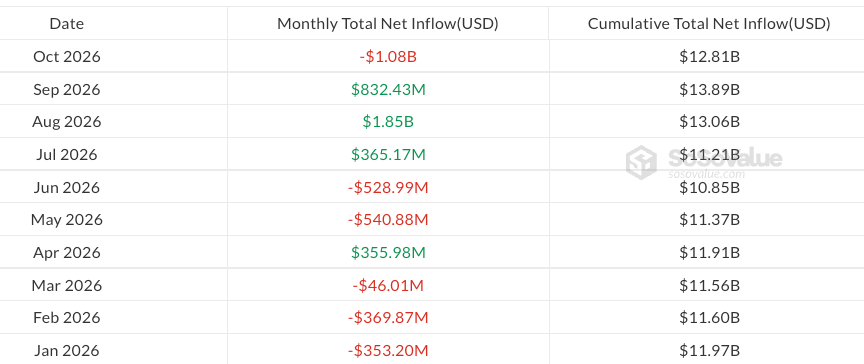
US spot Ether exchange-traded funds (ETFs) have witnessed a significant outflow of $1.08 billion in October, marking the largest monthly withdrawal since their inception and underscoring a challenging period for the second-largest cryptocurrency by market capitalization. This substantial cash drain comes as investor sentiment appears to be shifting away from Ether, contrasting sharply with the earlier optimism surrounding the approval of these investment vehicles. Concurrently, the inflows into US spot Bitcoin ETFs, while still positive for the month, have shown a marked deceleration after a robust surge earlier in the week, suggesting a broader recalibration of investor interest in the digital asset market.
The dramatic outflows from Ether ETFs have effectively erased the net inflows recorded in September, which stood at $832 million. This reversal has pushed the year-to-date net inflows for US spot Ether ETFs down to approximately $485 million. The current month’s performance, with eight trading sessions still remaining, has already established itself as the most significant period of net outflows since November 2025, signaling a notable shift in market dynamics. Data from SoSoValue indicates that as of Tuesday, Ether ETFs experienced net outflows totaling $1.08 billion for October, despite adding a modest $26 million on that particular day.
This substantial investor withdrawal from Ether ETFs is occurring against the backdrop of a notable price decline for Ether (ETH) itself. The cryptocurrency has experienced a 9.7% slide in October, trading from around $2,700 at the beginning of the month down to approximately $2,438 at the time of publication. Further compounding the negative sentiment, Ether has seen a nearly 18% depreciation throughout 2026, according to data from CoinGecko. This price weakness is likely a significant factor contributing to the investor reluctance to allocate new capital to Ether-based investment products and potentially driving existing holders to divest.
The approval of spot Ether ETFs by US regulators was a highly anticipated event, following the successful launch of spot Bitcoin ETFs earlier in the year. Hopes were high that these products would unlock a new wave of institutional and retail investment into the Ether ecosystem, mirroring the initial inflows seen with Bitcoin ETFs. However, the reality has proven to be far more challenging. The sustained outflows suggest that the initial enthusiasm has waned, and investors are either re-evaluating their exposure to Ether or seeking more favorable investment opportunities elsewhere.
Bitcoin ETF Inflows Moderate After Strong Start to the Week
In contrast to the significant outflows from Ether ETFs, US spot Bitcoin ETFs have continued to see inflows, albeit at a moderated pace. On Tuesday, these ETFs recorded net inflows of $23 million, following a substantial surge of $527 million on Monday. This indicates that while institutional and retail interest in Bitcoin via ETFs remains, the overwhelming momentum seen at the beginning of the week has somewhat subsided.

For October, US spot Bitcoin ETFs have accumulated approximately $67 million in net outflows. However, this figure needs to be viewed within the broader context of the year. The year-to-date net inflows for Bitcoin ETFs stand at a robust $809 million, according to SoSoValue. This sustained positive net inflow underscores the ongoing demand for Bitcoin as an investment asset, even as short-term fluctuations in daily flows occur.
At the time of reporting, Bitcoin (BTC) was trading at $82,954. This represents a 2.2% decrease since October 1st and a 5.3% decline year-to-date. The price action for Bitcoin, while experiencing some downward pressure in October, has been relatively more stable compared to Ether’s steeper decline. The continued inflows into Bitcoin ETFs, even when modest, suggest a degree of resilience and sustained investor confidence in Bitcoin’s long-term prospects.
Broader Market Context and Potential Influencing Factors
The diverging performance of Ether and Bitcoin ETFs can be attributed to a confluence of factors, including market sentiment, macroeconomic conditions, and the perceived risk-reward profiles of each asset.
Regulatory Scrutiny and Uncertainty
The regulatory landscape surrounding cryptocurrencies remains a significant influencer of investor behavior. While spot Bitcoin ETFs received approval, the path to similar products for other digital assets, such as Solana and XRP, has been more complex and drawn-out. BlackRock, a prominent asset manager, has filed for a third Bitcoin ETF, but has yet to pursue offerings for other cryptocurrencies, signaling a cautious approach from major players. This ongoing regulatory ambiguity can create headwinds for assets perceived as having higher regulatory risk.
Ether’s Use Case and Development Momentum
Ether, as the native cryptocurrency of the Ethereum blockchain, has a more complex utility than Bitcoin, which is primarily viewed as a store of value and medium of exchange. Ethereum’s ecosystem is home to decentralized finance (DeFi), non-fungible tokens (NFTs), and a vast array of decentralized applications (dApps). While this multifaceted nature offers significant long-term potential, it also introduces a wider range of factors that can influence its price and investor sentiment. Developments within the Ethereum network, such as network upgrades and the success of dApps, play a crucial role in its valuation. However, any perceived slowdown in development or challenges in scaling can impact investor confidence.
Macroeconomic Environment
Broader macroeconomic trends, including inflation rates, interest rate policies of central banks, and global economic growth, invariably affect the performance of risk assets like cryptocurrencies. Investors often reallocate capital based on their assessment of these macro factors. A risk-off sentiment in the broader financial markets can lead to outflows from speculative assets, including cryptocurrencies, as investors seek safer havens. The current economic climate, with its inherent uncertainties, likely contributes to the cautious approach observed in the digital asset market.
Investor Sentiment and Risk Appetite
Investor sentiment is a powerful driver of market movements. The recent outflows from Ether ETFs suggest a cooling of enthusiasm and potentially a re-evaluation of risk appetite among investors. After the initial excitement surrounding the approval of spot ETFs, a period of consolidation and re-assessment is natural. Investors are likely scrutinizing the underlying fundamentals of both Ether and Bitcoin, as well as the broader market outlook, before committing further capital. The price depreciation of Ether, coupled with the sustained positive inflows into Bitcoin ETFs, points to a preference for the latter at this juncture.
Historical Context of ETF Performance
The performance of ETFs is a key indicator of investor demand and market sentiment. The approval of spot Bitcoin ETFs in January 2026 was a landmark event, leading to significant inflows and a surge in Bitcoin’s price. This success paved the way for the subsequent approval of spot Ether ETFs. However, the initial inflows for Ether ETFs were considerably lower than those for Bitcoin, suggesting a more measured reception from the outset.
The current outflows from Ether ETFs represent a significant challenge for the asset class. They highlight the volatility inherent in cryptocurrency markets and the sensitivity of investment products to price movements and broader market sentiment. The fact that October has already seen the largest monthly outflow since November 2025 underscores the magnitude of this shift.
The inflows into Bitcoin ETFs, while moderating, demonstrate a more consistent demand. This sustained interest can be attributed to Bitcoin’s established narrative as a digital gold and a hedge against inflation, as well as its longer track record and broader institutional acceptance.
Analyzing the Implications
The current trends in Ether and Bitcoin ETF flows have several implications for the broader digital asset market:
- Investor Confidence in Ether: The substantial outflows from Ether ETFs raise questions about sustained investor confidence in Ether as an investment vehicle, at least in the short to medium term. It suggests that the market may be less convinced about Ether’s immediate growth prospects compared to Bitcoin.
- Bitcoin’s Dominance: The continued positive inflows, even if slowing, reinforce Bitcoin’s position as the dominant cryptocurrency in terms of institutional adoption and investor preference within the ETF space.
- Market Maturation: The diverging performance can be seen as a sign of market maturation, where investors are becoming more discerning and allocating capital based on more nuanced assessments of individual digital assets and their respective ecosystems.
- Future ETF Developments: The challenges faced by Ether ETFs might influence the approach to future ETF applications for other digital assets. Regulators and asset managers may adopt a more cautious stance, requiring stronger market evidence and investor demand before approving new products.
- Price Impact: Sustained outflows from ETFs typically exert downward pressure on the price of the underlying asset, as the ETF provider may need to sell assets to meet redemption requests. Conversely, inflows generally support prices. The outflows from Ether ETFs are likely contributing to the ongoing price weakness of ETH.
Expert and Analyst Perspectives (Inferred)
While the original article does not contain direct quotes, a professional journalistic approach would involve seeking and incorporating perspectives from industry analysts, fund managers, and market commentators. Such statements, if they were available, would likely address the reasons behind the outflows, the outlook for Ether and Bitcoin ETFs, and the broader implications for the cryptocurrency market.

For instance, an analyst might comment on the technical factors driving Ether’s price decline, such as resistance levels or chart patterns. Another might discuss the macroeconomic headwinds that are making investors more risk-averse. Fund managers of Ether ETFs might offer insights into investor behavior and strategies to navigate the current market conditions.
In the absence of direct quotes, the analysis can infer potential reactions. For example, it’s reasonable to infer that the issuers of Ether ETFs are closely monitoring these outflows and may be exploring strategies to re-engage investors, perhaps through educational initiatives or by highlighting the long-term potential of the Ethereum ecosystem. Similarly, the continued inflows into Bitcoin ETFs suggest that their issuers are likely satisfied with the current demand and may be focused on operational efficiency and market visibility.
Looking Ahead
The coming weeks and months will be crucial for understanding the trajectory of US spot Ether ETFs. A sustained period of outflows could signal a significant shift in investor sentiment, potentially leading to further price depreciation and a re-evaluation of Ethereum’s investment thesis by some market participants. Conversely, a reversal of these trends, perhaps spurred by positive developments within the Ethereum ecosystem or a broader improvement in market sentiment, could reignite interest and inflows.
The performance of Bitcoin ETFs will also be closely watched. While currently exhibiting moderation, any significant increase in inflows would reinforce Bitcoin’s status as the preferred digital asset for institutional investors seeking exposure through ETFs.
The digital asset market is dynamic and often characterized by rapid shifts in sentiment and price action. The current outflows from Ether ETFs serve as a stark reminder of the volatility and the challenges that even well-anticipated investment products can face. Investors and market observers will undoubtedly continue to monitor these trends closely for insights into the evolving landscape of cryptocurrency investment.
This evolving narrative underscores the importance of ongoing research and due diligence for anyone looking to invest in digital assets, whether directly or through regulated investment vehicles like ETFs. The long-term success of these products will ultimately depend on their ability to consistently meet investor expectations and navigate the inherent complexities of the cryptocurrency market.

