
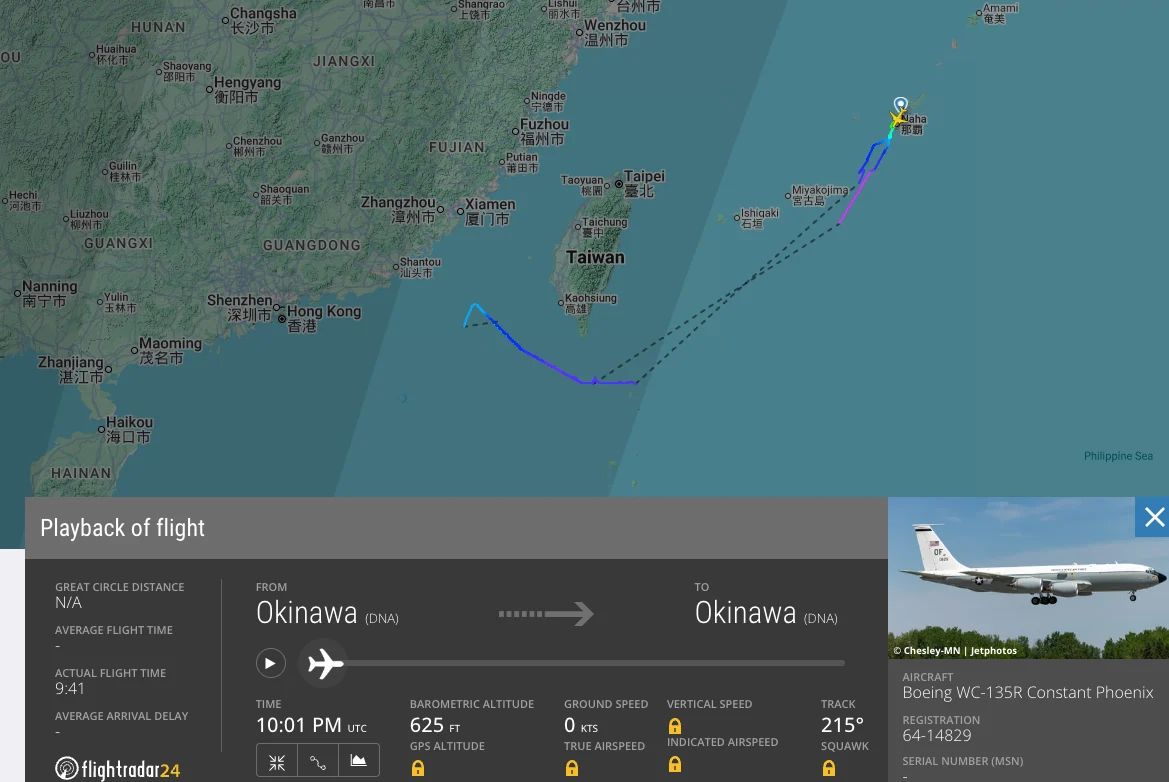
A United States Air Force WC-135R Constant Phoenix aircraft, colloquially known as a "nuclear sniffer," was observed operating in international airspace near the Taiwan Strait, specifically southwest of Taiwan, on Sunday. This specialized military reconnaissance aircraft, designed to detect airborne radioactive particles and gases, appeared on public flight-tracking data amidst a backdrop of intensified, unannounced Chinese military exercises simulating a blockade and assault on Taiwan. The flight path, recorded by Flightradar24, showed the USAF sniffer jet conducting a round-trip mission originating from Okinawa, traversing south of Taiwan and into the waters southwest of the island, near the critical southern maritime approaches to the Taiwan Strait. While the aircraft’s specific mission objectives for this particular sortie remain officially unconfirmed, and no direct connection to China’s concurrent military drills has been established by official sources, its presence has drawn significant attention from defense analysts and regional observers, underscoring the delicate security situation in the Indo-Pacific.
The US Air Force’s "Nuclear Sniffer": A Specialized Surveillance Asset
The WC-135R Constant Phoenix is a highly specialized variant of the venerable Boeing C-135 Stratolifter airframe, itself derived from the KC-135 Stratotanker. These aircraft are integral to the United States’ global capability for atmospheric sampling, a mission critical for monitoring nuclear activities worldwide. The primary role of the WC-135R is to collect air samples from the atmosphere, which are then analyzed for the presence of radioactive isotopes and gases. This sophisticated process allows US intelligence analysts to identify and assess potential nuclear events, such as detonations, reactor accidents, or even clandestine nuclear materials processing.
Equipped with external air collection scoops and an internal suite of sophisticated analytical instruments, the WC-135R can filter large volumes of air and detect even minute traces of radioactive debris. These particles and gases serve as tell-tale signatures of nuclear fission or fusion, providing crucial data on the type, yield, and location of a nuclear event. For instance, the detection of specific fission products like Iodine-131, Xenon-133, or Krypton-85 can indicate a recent nuclear test or a release from a nuclear facility. Historically, Constant Phoenix aircraft have been deployed in response to significant global events, including monitoring atmospheric conditions after North Korea’s nuclear tests, assessing the fallout from the Chernobyl disaster in 1986, and analyzing airborne radiation following the Fukushima Daiichi nuclear accident in 2011. These deployments highlight the aircraft’s critical role in both national security intelligence and international nuclear safety monitoring.
It is crucial to understand the limitations of the WC-135R’s capabilities. While it excels at detecting atmospheric radiation, the aircraft cannot directly locate nuclear warheads, nor can it "see" inside underground facilities where nuclear activities might be concealed. Its findings are based solely on atmospheric sampling. Furthermore, its presence in a specific area, as in the recent Taiwan Strait sighting, does not automatically imply that radiation was detected or that a nuclear event has occurred. The aircraft regularly conducts routine sampling missions across various regions of the globe to establish baseline atmospheric data and maintain operational readiness. The WC-135R aircraft are typically based at Offutt Air Force Base in Nebraska, home to the 45th Reconnaissance Squadron, but are frequently forward-deployed to strategic locations, such as Kadena Air Base in Okinawa, Japan, to facilitate rapid response to events in the Pacific theater.
Escalating Tensions: China’s Unannounced Drills Around Taiwan
The appearance of the WC-135R near Taiwan comes at a moment of heightened geopolitical tension in the region, primarily driven by China’s aggressive military posturing around Taiwan. For several days preceding the WC-135R sighting, the People’s Liberation Army (PLA) had been conducting large-scale, unannounced military exercises in areas encircling Taiwan. These drills, characterized by their scale and strategic implications, simulated a comprehensive blockade of the island and direct attacks on critical Taiwanese infrastructure and military assets.
The exercises involved a multi-domain display of force, including naval vessels, air force jets, and potentially missile launches. Chinese state media and official statements indicated that these drills were intended as a stern warning against "separatist forces" in Taiwan and their foreign supporters, particularly the United States. The simulated blockade scenarios included cutting off Taiwan’s vital maritime and air routes, which would have severe repercussions for the island’s economy, heavily reliant on international trade, and for global supply chains, especially in the semiconductor industry where Taiwan is a dominant player. Military analysts observed that the drills showcased China’s increasing capability to project power beyond its immediate coastline and to execute complex, coordinated operations aimed at coercing or invading Taiwan. The precision and scope of these exercises have raised concerns among international observers about the potential for miscalculation and accidental escalation in one of the world’s most volatile flashpoints.
The Geopolitical Chessboard: Taiwan Strait’s Strategic Importance
The Taiwan Strait, a 180-kilometer-wide body of water separating mainland China from Taiwan, is one of the most strategically significant waterways globally. It is a critical maritime corridor for international shipping, with a substantial portion of global trade passing through its waters annually. The geopolitical rivalry over Taiwan dates back to the Chinese Civil War in 1949, when the defeated Nationalist government retreated to the island, establishing the Republic of China, while the Communist Party founded the People’s Republic of China on the mainland. Beijing views Taiwan as an "inseparable part" of its territory, a renegade province that must eventually be "reunified" with the mainland, by force if necessary.
The United States officially acknowledges the "One China" policy but maintains robust unofficial relations with Taiwan under the Taiwan Relations Act, which commits Washington to provide Taiwan with the means to defend itself. This policy, often described as "strategic ambiguity," aims to deter both a Chinese invasion and a premature declaration of independence by Taiwan. However, in recent years, this ambiguity has been increasingly tested by China’s growing military might and its assertive stance on Taiwan. High-profile visits by US officials to Taiwan, increased arms sales, and stronger diplomatic rhetoric in support of Taiwan have been met with increasingly aggressive responses from Beijing, including more frequent and expansive military incursions into Taiwan’s Air Defense Identification Zone (ADIZ) and naval presence around the island. The current cycle of Chinese military drills is a direct manifestation of this escalating tension, signaling Beijing’s resolve and its capacity to act on its long-held territorial claims.
Analyzing the WC-135R’s Presence: Routine Mission or Targeted Surveillance?
The timing and location of the WC-135R’s flight near Taiwan inevitably invite speculation regarding its purpose. Several interpretations can be considered, each with varying implications for regional security.
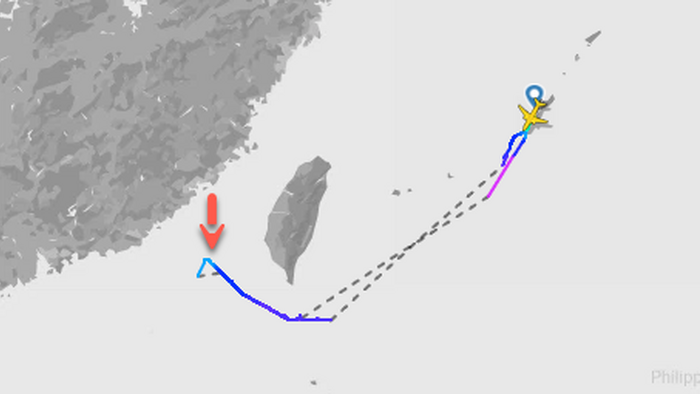
One possibility, as highlighted in the original report, is that the flight was part of a routine atmospheric sampling mission. The WC-135R fleet is designed for continuous monitoring, and deploying from Kadena Air Base in Okinawa, a major US military hub in the region, makes such flights logistically straightforward. Establishing baseline atmospheric data is crucial for detecting any anomalies in the future, and an area of heightened military activity, even if non-nuclear, could be deemed worthy of such routine data collection.
However, the specific context of large-scale Chinese military drills cannot be ignored. The US military is known for its extensive intelligence, surveillance, and reconnaissance (ISR) operations globally, particularly in areas of strategic interest and potential conflict. The presence of the "nuclear sniffer" could be interpreted as a proactive measure to monitor Chinese military activities for any unexpected or unusual developments. While China’s drills are not publicly declared to involve nuclear elements, the PLA possesses a growing nuclear arsenal and various dual-capable (conventional and nuclear) delivery systems. Monitoring the atmospheric environment during such intense exercises could be a precautionary step to detect any unforeseen radioactive releases, whether accidental or intentional, from any part of China’s extensive military apparatus. This could include monitoring for the atmospheric effects of missile tests, which, while primarily conventional, might be associated with broader strategic force signaling.
Another perspective suggests the WC-135R’s presence serves as a subtle yet potent form of signaling or deterrence. By deploying such a specialized asset, the United States demonstrates its advanced intelligence-gathering capabilities and its commitment to monitoring regional stability. It sends a clear message that US forces are present, vigilant, and capable of detecting even covert activities that could threaten international peace and security. This visible demonstration of ISR capabilities could act as a deterrent against any escalatory actions by Beijing that might cross certain thresholds.
It is paramount to reiterate the distinction made in the initial report: the aircraft’s flight near southern Taiwan does not, by itself, establish that radiation was detected or that a nuclear event occurred. Such a conclusion would be highly speculative and unsupported by facts. The WC-135R’s mission is to collect data, and the absence of publicly disclosed findings means that any conclusions beyond "monitoring" are premature. The most prudent assessment remains that the US is actively observing the evolving security landscape around Taiwan, utilizing its full spectrum of intelligence assets to ensure it has the most comprehensive picture possible of the ongoing Chinese military activities.
Official Responses and International Reactions
Official statements regarding the WC-135R’s specific mission or direct comments on its presence have been predictably guarded. US defense officials typically adopt a policy of not commenting on specific intelligence-gathering operations, generally affirming that "the United States routinely conducts reconnaissance and surveillance missions in international airspace to ensure regional stability and monitor activities that could impact international security." Such boilerplate responses maintain operational security while subtly acknowledging the persistent US presence in critical regions.
Taiwanese authorities, while closely monitoring Chinese military movements, generally express gratitude for any US presence that contributes to regional stability and enhances their security. They often reiterate their commitment to self-defense and their efforts to maintain peace across the Strait. However, they are also cautious about directly commenting on specific US military assets, preferring to focus on the broader security implications of China’s actions.
On the other hand, Beijing frequently condemns US military activities in the vicinity of Taiwan as "provocative," "interfering in China’s internal affairs," and "undermining regional peace and stability." Chinese Foreign Ministry and Defense Ministry spokespersons consistently assert China’s sovereignty over Taiwan and warn against any external forces supporting Taiwanese independence. They would likely view any US reconnaissance flights, particularly those involving specialized assets like the WC-135R, as further evidence of US "hegemony" and an attempt to encircle or provoke China.
International reactions to the escalating tensions in the Taiwan Strait have been largely characterized by calls for de-escalation and dialogue. Many nations, particularly those with significant economic ties to the region, have expressed concern over the potential disruption to global trade and the risk of accidental conflict. Organizations like the United Nations have consistently emphasized the importance of adhering to international law and resolving disputes peacefully. Defense analysts globally highlight the increasing risk of miscalculation between major powers in a region where military transparency is often limited, and national interests are deeply entrenched.
Broader Implications for Regional Stability
The confluence of China’s aggressive military drills and the conspicuous presence of a US "nuclear sniffer" jet near Taiwan underscores the perilous trajectory of cross-Strait relations and the broader security environment in the Indo-Pacific. The immediate implication is a significant increase in the risk of miscalculation, given the close proximity of military assets from opposing powers operating under high-tension conditions. Any unintended incident, whether an accidental collision or a perceived hostile act, could rapidly escalate into a larger conflict with devastating consequences for the region and the global economy.
Beyond the immediate tactical concerns, the episode highlights the ongoing strategic competition between the United States and China. The US, through its reconnaissance flights and naval patrols, seeks to uphold the principle of freedom of navigation in international waters and airspace, while simultaneously gathering intelligence and projecting its presence. China, in turn, is asserting its territorial claims with increasing vigor, challenging the established regional order and demonstrating its growing military capabilities.
The long-term implications involve the potential for a more militarized Taiwan Strait, with both sides increasing their readiness and deploying advanced weapon systems. This could lead to a protracted period of instability, impacting trade, investment, and diplomatic relations across Asia. The international community remains keenly aware of Taiwan’s crucial role in the global technology supply chain, particularly in semiconductor manufacturing. A conflict in the Taiwan Strait would send shockwaves through the global economy, making the stakes incredibly high for all stakeholders. The continued monitoring by specialized assets like the WC-135R is a testament to the persistent vigilance required in this volatile region, where the subtle signals of military maneuvers can carry profound geopolitical weight.

