

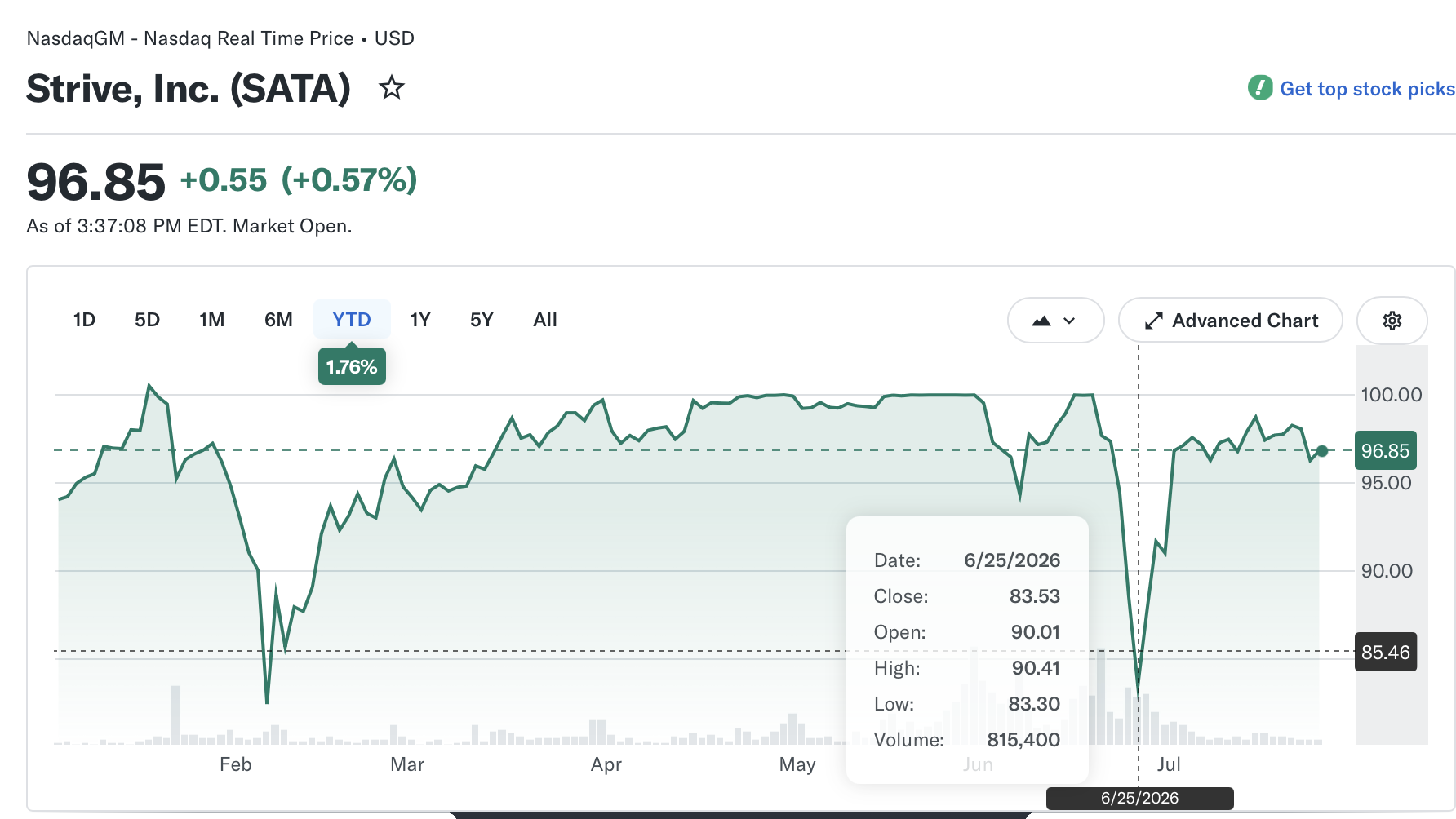
Strive’s SATA preferred shares have demonstrated a notable recovery from a recent low, climbing back to approximately $97 from a June trough of $83.30. This resurgence, according to data from Yahoo Finance, has largely erased the selloff and brought the shares within roughly 3% of their $100 par value. This rebound is being interpreted by market observers as a positive indicator for the broader adoption and stability of preferred share instruments designed to finance corporate Bitcoin treasuries, a nascent but growing segment of the digital asset financial landscape.
The SATA preferred stock, introduced by Strive in November 2025, is a cornerstone of the company’s strategy to bolster its Bitcoin treasury through preferred equity financing. This instrument, characterized as variable-rate perpetual preferred stock, is engineered to trade close to its $100 par value. This stability is achieved by dynamically adjusting its dividend rate, thereby enabling Strive to raise capital for its Bitcoin holdings without diluting its common shareholder base through additional equity issuance. The successful introduction and subsequent market performance of SATA underscore a deliberate approach by companies to leverage traditional financial instruments for digital asset accumulation.
This innovative financing mechanism places SATA within a growing cohort of preferred share products specifically tailored to support Bitcoin treasury strategies. This emerging market segment has been described by proponents, including Strive, as "digital credit," highlighting its potential to bridge traditional finance with the burgeoning cryptocurrency ecosystem. These instruments aim to provide a stable and predictable method for companies to acquire and hold Bitcoin, a digital asset increasingly viewed as a potential store of value and hedge against inflation.
A parallel to SATA’s market dynamics can be observed in Strive’s own STRC preferred shares. Launched in 2025 with a similar objective of maintaining a $100 share price through a variable dividend structure, STRC experienced a sharp decline during the broader market selloff in late June. While it has since begun to recover, STRC continues to trade below its par value, currently hovering around $87. The differing recovery trajectories of SATA and STRC, though both influenced by similar market forces and strategic objectives, may offer insights into the evolving investor sentiment and risk perception surrounding these specialized financial products.
Historical Context and Strategic Evolution of Bitcoin Treasuries
The trend of publicly traded companies allocating capital to Bitcoin treasuries gained significant momentum in recent years, driven by a growing acceptance of Bitcoin as a legitimate asset class. Early adopters, such as MicroStrategy, paved the way by demonstrating the potential for Bitcoin to serve as a reserve asset. This has prompted a wave of other companies to explore similar strategies, leading to the development of diverse financing and treasury management approaches.

Strive’s introduction of SATA in November 2025 marked a strategic pivot towards more sophisticated capital allocation. The company’s stated goal was to expand its Bitcoin treasury, a significant undertaking that requires substantial capital. By issuing preferred shares, Strive aimed to achieve this expansion without impacting the ownership structure of its common stock, a move designed to appeal to a broader investor base interested in both traditional equity and direct Bitcoin exposure.
The concept of "digital credit" as applied to these preferred shares signifies a novel financial product. Unlike traditional bonds or equity, these instruments are intrinsically linked to the performance and stability of a company’s Bitcoin holdings. The variable dividend feature is critical, as it allows the issuer to adjust the payout to investors based on market conditions and the company’s financial health, while simultaneously ensuring the share price remains anchored to its par value. This creates a symbiotic relationship where the stability of the preferred share price is directly tied to the issuer’s ability to manage its Bitcoin treasury effectively.
Market Performance and Investor Confidence
The recent performance of SATA preferred shares is particularly noteworthy. The rebound from the June low suggests that investors are regaining confidence in Strive’s financing model and, by extension, the broader strategy of using preferred equity to fund Bitcoin treasuries. The recovery to within 3% of the $100 par value indicates a strong demand for these securities, signaling that the market perceives them as a viable and attractive investment.
The year-to-date price chart for SATA, as displayed by Yahoo Finance, illustrates this recovery arc. Following an initial period of stability post-launch, the shares experienced a significant downturn, mirroring broader market anxieties. However, the subsequent upward trend demonstrates resilience and a growing belief in the underlying value proposition of these instruments.
The recovery of SATA is also seen as potentially beneficial for other similar instruments, such as Strive’s own STRC. While STRC has not yet reached its par value, the positive momentum in SATA could create a ripple effect, boosting investor sentiment across the entire preferred share class tied to Bitcoin treasuries.
Strive and Strategy: Key Players in the Bitcoin Treasury Landscape
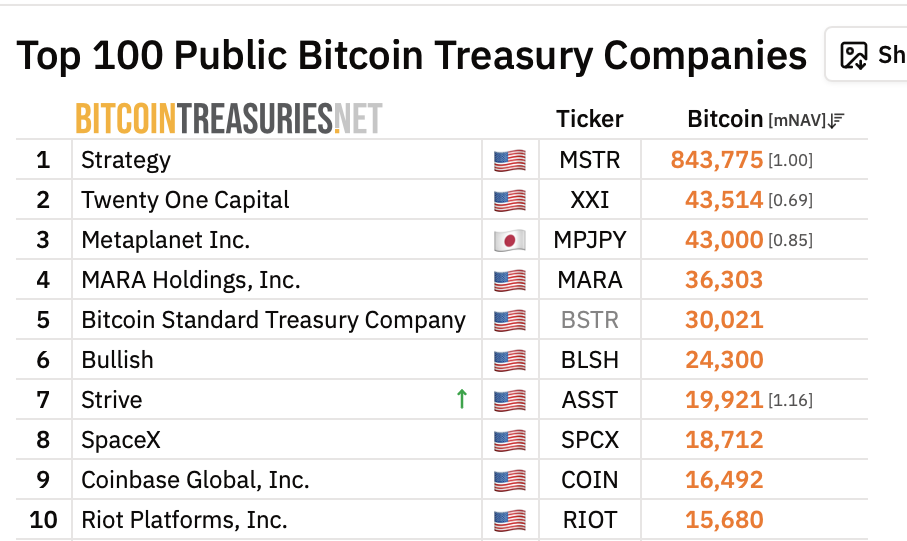
Strive has emerged as a significant player in the corporate Bitcoin treasury space. As of the latest data from BitcoinTreasuries.NET, the company holds 19,921 BTC, positioning it as the seventh-largest public corporate Bitcoin holder. This substantial holding underscores Strive’s commitment to Bitcoin as a core component of its asset strategy.
The benchmark for this market segment remains Strategy, which continues to be the world’s largest public corporate Bitcoin holder with an impressive 843,775 BTC. Strategy’s pioneering approach and substantial Bitcoin reserves have set a precedent for other companies venturing into this domain. Its financing strategies, including the use of preferred shares like STRC, have been closely watched and analyzed by the market.
The comparison between Strive and Strategy highlights the evolving nature of Bitcoin treasury management. While Strategy leads in sheer volume, Strive’s innovative use of preferred equity demonstrates a sophisticated approach to capital markets engagement for Bitcoin acquisition. The success of SATA could inspire further innovation in how companies finance their digital asset reserves.
Expert Analysis: Restoring Confidence and Affirming Bitcoin’s Floor
Industry experts believe that the recent adjustments and recoveries within the Bitcoin treasury sector are crucial for restoring investor confidence in preferred-share products. Samson Mow, founder and CEO of Jan3, articulated this perspective, suggesting that these developments support his view that Bitcoin has already reached its market bottom.
Mow emphasized the interconnectedness of these market movements. "I think every action that Strategy has undertaken to strengthen their balance sheet and encourage STRC to go back to par is also working," Mow stated, as quoted in the original report. He further elaborated, "But everything sort of works in tandem. I think as SATA returns to par, you’re going to see STRC return to par too, because people say, ‘OK, this model’s not broken.’ Everyone is capitalized for three or more years of dividend payments… there was no reason to panic all along."
This sentiment suggests that the market is beginning to recognize the inherent stability and strategic rationale behind these preferred share models. The ability of companies to secure funding for several years of dividend payments, even during market volatility, reassures investors about the long-term viability of these financing structures. The absence of a need for panic during the June selloff, as highlighted by Mow, indicates a growing maturity in the market’s understanding of these sophisticated financial instruments.
Mow’s analysis points to a broader shift within the Bitcoin treasury sector. Companies are not only accumulating Bitcoin but are also actively refining their capital-raising and risk management strategies. This includes exploring diverse financial instruments and operational models to ensure sustainable growth and stability.
Emerging Trends and Future Outlook
The emergence of new players and innovative strategies further signals the maturation of the Bitcoin treasury market. Mow cited Lyn Alden’s Orange Juice treasury company, which launched on July 15, as an example of firms entering the market with distinct approaches and potentially lower Bitcoin cost bases. This diversification of strategies indicates a healthy and evolving ecosystem, with participants seeking competitive advantages and optimal operational frameworks.
The ongoing refinement of capital-raising strategies by Bitcoin treasury companies is a critical development. It suggests a move beyond simple accumulation towards more robust financial engineering that can withstand market fluctuations and support long-term strategic objectives. The success of instruments like SATA, and the expected recovery of STRC, will likely encourage more companies to explore similar preferred equity financing models.
This trend could have significant implications for the broader cryptocurrency market. Increased institutional adoption, facilitated by stable and well-structured financing mechanisms, can lead to greater liquidity, price stability, and overall market depth. The development of "digital credit" instruments also opens new avenues for investment and capital formation within the digital asset space.
Conclusion: A Resilient Model for Digital Asset Finance
The rebound of Strive’s SATA preferred shares from its recent low is more than just a statistical recovery; it represents a potential turning point for preferred equity financing in the Bitcoin treasury sector. As these instruments demonstrate resilience and approach their par values, they validate the innovative strategies employed by companies like Strive and Strategy. The growing confidence in these "digital credit" models suggests that the market is increasingly recognizing their potential to facilitate the sustainable acquisition and management of Bitcoin.
This trend, supported by expert analysis and the emergence of new market participants, points towards a more sophisticated and stable future for corporate Bitcoin treasuries. The ability of these companies to adapt and innovate their financing strategies is crucial for their long-term success and for the continued institutionalization of Bitcoin as a significant asset class within the global financial system. The journey of SATA and STRC serves as a compelling case study in the evolving intersection of traditional finance and digital assets, demonstrating a path towards robust and reliable capital markets for the cryptocurrency era.

