

The real estate technology (PropTech) sector, inherently built on the bedrock of data, is witnessing a significant shift in its approach to data infrastructure. For years, the prevailing instinct among founders was to develop proprietary data pipelines internally, aiming for complete control over listings, comparables, rental rates, occupancy trends, and investment returns. This desire for an owned "stack" and controlled inputs was seen as a strategic advantage, promising defensibility and long-term competitive edge. However, a growing body of evidence suggests that this "build-it-yourself" mentality is increasingly becoming a bottleneck, hindering speed and scalability for many PropTech companies.
The operational reality of building internal data pipelines often proves far more complex and resource-intensive than anticipated. Initial estimates of months of engineering time can easily balloon into years, with the value proposition often delayed by the constant challenges of scraper maintenance, schema evolution, and the painstaking process of cleaning and normalizing data from fragmented sources. This protracted development cycle inevitably slows down product roadmaps, diverting critical engineering talent away from core innovation and towards essential, yet often invisible, infrastructure expansion.
In contrast, competitors who strategically integrate mature, pre-built data systems are demonstrating superior agility. These forward-thinking companies are not attempting to be data aggregators and processors for every facet of the real estate market. Instead, they are making deliberate choices about which data capabilities define their unique value proposition and are opting to partner for the rest. This pivot signifies a fundamental understanding that in the modern PropTech landscape, true competitive advantage lies not in absolute control, but in strategic leverage.
What Constitutes a Strategic Data Partnership in PropTech?
A strategic data partnership in PropTech is defined as a long-term integration with a specialized data provider. This collaboration delivers production-ready real estate data through robust APIs, effectively replacing the need for companies to build and maintain their own internal data pipelines. Instead of dedicating months to the laborious tasks of scraping, cleaning, and updating disparate and often inconsistent data sources, PropTech firms can integrate pre-structured datasets that are continuously refreshed and immediately ready for product integration. This allows businesses to treat data as a utility – a foundational infrastructure component – rather than a primary differentiator.
The practical benefits of such partnerships are manifold. They enable PropTech teams to:
- Accelerate Time to Market: By bypassing the lengthy development cycles associated with internal data infrastructure, companies can launch new products and features significantly faster.
- Optimize Resource Allocation: Engineering teams can redirect their expertise from data plumbing to developing core product functionalities, enhancing user experience, and driving innovation.
- Enhance Data Reliability and Accuracy: Specialized data providers often have established methodologies and extensive resources dedicated to data quality, validation, and continuous updating, leading to more dependable insights.
- Reduce Operational Overhead: The ongoing costs and complexities of maintaining data pipelines, including infrastructure, software licenses, and specialized personnel, are significantly diminished.
- Scale More Efficiently: Access to comprehensive and reliable data allows companies to expand their market reach and product offerings with greater ease and less capital expenditure on data infrastructure.
Crucially, a strategic data partnership is not about outsourcing the core of a company’s product. Rather, it is about intelligently outsourcing the acquisition and maintenance of commodity infrastructure, thereby allowing businesses to intensely focus on and amplify what truly sets them apart in the marketplace.
The Strategic Decision: Build vs. Partner
Every PropTech founder eventually confronts a pivotal decision: should they invest resources in building a specific capability internally, or should they seek a partnership? This choice has profound implications, influencing not only the product architecture but also the company’s speed of execution, financial burn rate, and long-term scalability.
When Building Internally is the Strategic Choice
Building capabilities internally is most justifiable when that specific functionality inherently defines the company’s core differentiation. If a feature is central to the firm’s unique value proposition and cannot be easily replicated by competitors, owning and developing that logic can indeed strengthen defensibility. This often applies to:
- Proprietary Underwriting Algorithms: Sophisticated models that analyze risk and predict investment returns in a unique way.
- Unique Scoring Models: Innovative methods for evaluating property performance, tenant risk, or market potential.
- Workflow Automation: Tailored automation processes that streamline specific industry workflows in a way that competitors cannot easily match.
- Data Visualization and User Interface: Highly specialized ways of presenting data that are integral to the user experience and brand identity.
Internal builds are strategically justified when the feature in question is essentially the company itself, forming the very essence of its market offering and competitive moat. The investment in building such capabilities is seen as an investment in the company’s fundamental identity and long-term value.

When Partnering Offers a Strategic Advantage
Partnerships become a more strategic imperative when the data layer, while foundational, is not the primary source of differentiation. Real estate datasets, by their very nature, require continuous aggregation, rigorous cleaning, validation, and daily updates. Replicating this complex infrastructure internally often leads to significant delays in core product development and a diversion of valuable resources.
Partnering becomes a strategic advantage in scenarios such as:
- Accessing Broad Market Data: When a company needs comprehensive data across numerous markets or property types that are not core to its unique offering.
- Ensuring Data Freshness and Accuracy: For datasets that require constant, real-time updates and rigorous validation, leveraging specialized providers can be more efficient and reliable.
- Reducing Time to Market: When the primary goal is to launch a product quickly and iterate based on market feedback, integrating pre-built data solutions is often the fastest path.
- Managing Infrastructure Costs: For early-stage or growth-stage companies, the capital expenditure and ongoing operational costs of building and maintaining extensive data infrastructure can be prohibitive.
In these situations, integrating with a data provider is not merely a shortcut; it represents a strategic allocation of resources, allowing the company to focus its limited capital and talent on areas that truly drive unique value and competitive advantage. The most effective PropTech teams meticulously build what makes them distinct and integrate what enables them to scale efficiently.
Partnerships as a Capital Allocation Strategy
From an investment perspective, strategic data partnerships are not simply technical conveniences; they are sophisticated capital allocation decisions. In early and growth-stage PropTech companies, engineering time is arguably the most expensive and critical resource. Every month spent meticulously constructing internal data pipelines is a month not spent on improving the user experience, developing advanced automation, or solidifying core differentiation.
The task of reconstructing nationwide real estate infrastructure internally is Herculean. It involves aggregating millions of MLS records, harmonizing diverse property attributes, accurately modeling rental income across varying markets, meticulously cleaning short-term rental signals, validating complex occupancy trends, and calculating precise ROI metrics – all while ensuring the entire system is refreshed daily. This work is inherently complex, perpetually ongoing, and often largely invisible to the end-users who benefit from the final product.
When companies choose to integrate mature real estate APIs instead, they gain immediate access to a suite of critical data points and functionalities without the attendant infrastructure burden. This typically includes:
- Nationwide Property Listings: Comprehensive access to for-sale and for-rent properties.
- Detailed Property Attributes: Standardized information on features, square footage, lot size, and more.
- Historical Sales and Rental Data: Crucial for trend analysis and valuation.
- Neighborhood Comparables: Essential for accurate pricing and investment decisions.
- Short-Term Rental Performance Metrics: Occupancy rates, Average Daily Rates (ADR), and Revenue Per Available Room (RevPAR).
- Long-Term Rental Estimates: Projections for traditional rental income.
- Pre-calculated Investment Metrics: Built-in ROI, cash-on-cash returns, and capitalization rates.
All of this is delivered through structured, machine-readable endpoints, designed for seamless integration into PropTech applications. The direct result is immediate acceleration. Teams can significantly reduce their infrastructure overhead, preserve precious engineering focus, and move much faster towards developing revenue-generating features. For venture-backed PropTech companies, in particular, these partnerships are not about relinquishing capability; they are about strategically directing capital towards genuine innovation, allowing specialized data providers to handle the heavy lifting of data acquisition and management.
Applied Examples Across PropTech Verticals
The strategic value of data partnerships becomes even more apparent when examined across various PropTech categories. While business models differ significantly, the core challenge of transforming fragmented real estate data into reliable, production-ready intelligence often remains consistent.
Marketplaces
- Challenge: Property marketplaces require accurate, up-to-date listings, comprehensive pricing history, robust neighborhood benchmarks, reliable rental comparables, and detailed investment indicators across a multitude of cities.
- Risk of Building: Developing in-house MLS ingestion, property normalization, and performance modeling demands continuous updates and multi-source validation. Expanding market coverage incrementally can severely slow growth and introduce data inconsistencies.
- Strategic Partnership: By integrating structured property endpoints, sophisticated search APIs, and neighborhood analytics with nationwide coverage, marketplaces can circumvent the need to build data infrastructure that does not directly differentiate their core offering.
- Scaling Outcome: Engineering resources can then be strategically deployed to enhance liquidity, optimize user experience, and refine transaction workflows – the true drivers of marketplace value.
Example: From Prototype to Production in Weeks
A PropTech startup developing a specialized underwriting tool for short-term rentals (STRs) successfully launched production-grade analytics in under two weeks by leveraging an existing real estate API. Instead of dedicating months to normalizing listings, rental performance data, and ROI metrics, the team concentrated on user interface design, workflow optimization, and deal evaluation logic. This allowed them to rapidly test product-market fit, onboard early adopters, and iterate quickly, all without the immediate need to hire a dedicated data engineering team.
CRMs & Deal Management Platforms
- Challenge: Users frequently exit CRM platforms to validate financial assumptions elsewhere, leading to fragmented workflows and reduced user stickiness.
- Risk of Building: Developing integrated underwriting layers necessitates merging property data, short-term rental metrics, long-term rental estimates, historical performance arrays, and ROI calculations. Each of these datasets requires ongoing cleaning and daily updates.
- Strategic Partnership: Embedding unified real estate APIs allows for deal validation to occur seamlessly within the CRM platform itself.
- Scaling Outcome: The time required for users to make critical decisions is significantly reduced, user retention improves, and the CRM evolves from a mere workflow tool into a powerful decision-making engine.
AI Underwriting & Analytics Tools
- Challenge: Machine learning systems are heavily reliant on structured, time-series datasets with consistent schemas and highly reliable inputs.
- Risk of Building: Data obtained through scraping often lacks proper normalization, sample size validation, or fallback logic, leading to inconsistent inputs and unstable outputs.
- Strategic Partnership: Integrating APIs that deliver up to 36 months of monthly performance data, built-in investment metrics, and statistical confidence indicators facilitates cleaner model training and faster deployment.
- Scaling Outcome: AI tools can transition from the prototype phase to production more rapidly, with a significantly reduced risk of modeling inaccuracies stemming from data quality issues.
Investment & Portfolio Platforms
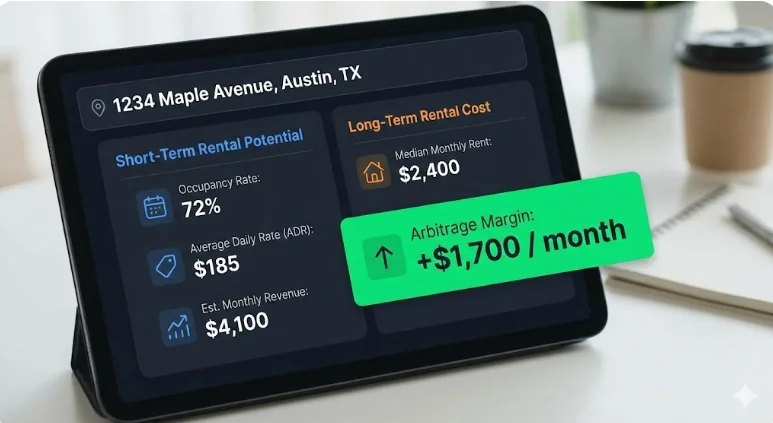
- Challenge: Institutional-grade underwriting demands comprehensive data on occupancy, Average Daily Rates (ADR), Revenue Per Available Room (RevPAR), rental comparables, expense modeling, and ROI projections across multiple markets. Furthermore, identifying highly profitable rental arbitrage opportunities requires evaluating both short-term and long-term rental potential side-by-side.
- Risk of Building: Reconstructing nationwide coverage with daily refresh cycles is an immensely capital-intensive and time-consuming endeavor. Developing separate data pipelines for short-term and long-term rental data effectively doubles the infrastructure burden.
- Strategic Partnership: Leveraging harmonized datasets with unified schemas and pre-modeled financial indicators eliminates significant infrastructure drag. Partnering for an API that provides access to both STR and LTR data unlocks immediate arbitrage analysis capabilities without the need for disparate and competing data subscriptions.
- Scaling Outcome: Platforms can deliver institutional-grade analytics and sophisticated arbitrage modeling without incurring the massive overhead associated with building such capabilities in-house, thereby accelerating expansion across diverse markets.
The Competitive Advantage of Speed
The real estate markets are dynamic and unforgiving; they do not pause for product roadmaps. Short-term rental revenues can fluctuate dramatically, often by 20% to 50% between peak and off-peak seasons. Supply levels are constantly shifting as new listings enter the market. Regulatory environments can evolve with little notice, and interest rate changes can impact underwriting assumptions almost overnight.
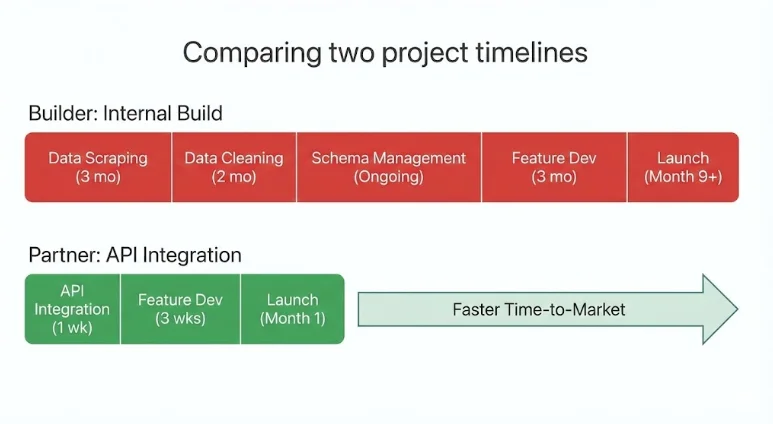
In such a volatile environment, speed is not a superficial enhancement; it is a strategic imperative. Companies that insist on building every data layer internally frequently spend months stabilizing their pipelines before they can even launch initial features. By the time their infrastructure is deemed ready, the market may have already significantly shifted, diminishing the competitive window.
In stark contrast, companies that strategically integrate mature data infrastructure can:
- Launch Products Faster: Rapidly bring new offerings to market, capturing early adopters and market share.
- Iterate Quickly: Gather user feedback and market intelligence in real-time, enabling agile product development.
- Respond to Market Changes: Adapt to evolving market conditions and regulatory shifts with greater agility.
- Outmaneuver Competitors: Gain a significant lead by bringing innovative solutions to market ahead of rivals.
This compounded speed translates directly into accelerated feedback loops, earlier revenue generation, and a stronger brand position. In highly competitive PropTech categories, the difference between leading and lagging is often measured not by the brilliance of an idea, but by the velocity of its execution.
The Modern Scaling Model: Builders vs. Orchestrators
As the PropTech sector matures, a distinct pattern of scaling models is emerging. Companies tend to gravitate towards one of two primary approaches: builders or orchestrators.
Builders endeavor to own every layer of their technology stack. They manage the ingestion of listings, the normalization of property data, the modeling of rental performance, the calculation of ROI, and the maintenance of update cycles all internally. While this approach offers the allure of complete control, it invariably creates significant infrastructure drag. This includes the ongoing burden of maintenance, the accumulation of technical debt, and a naturally slower pace of feature delivery.
Orchestrators, on the other hand, adopt a different philosophy. They strategically integrate best-in-class data providers for foundational datasets and concentrate their internal resources on developing core differentiators. These differentiators typically include exceptional user experience, sophisticated automation, advanced AI logic, and innovative workflow solutions.
Builders often compete on the perceived completeness of their self-built infrastructure. Orchestrators, however, compete on speed, agility, and focused innovation. In an increasingly data-dense market, genuine differentiation rarely stems from the mere act of rebuilding commodity infrastructure. Instead, it arises from the intelligence and creativity with which that infrastructure is leveraged and applied. The PropTech companies currently scaling most efficiently are overwhelmingly those that operate as orchestrators, leveraging partnerships to move faster and build smarter.
What an Infrastructure-Level Data Partnership Looks Like in Practice
In tangible terms, a strategic data partnership involves integrating a unified, production-ready real estate API rather than attempting to construct fragmented internal data pipelines. Infrastructure-grade solutions, such as the Mashvisor API, consolidate critical property data, MLS-style listings, short-term rental performance metrics, long-term rental estimates, and investment analytics into structured REST endpoints specifically designed for PropTech applications.
Instead of laboriously stitching together scraped calendar data, disparate rental platforms, and fragmented public records, PropTech teams can access clean, machine-readable JSON data. This data includes vital metrics like occupancy rates, ADR, revenue, RevPAR, rental comparables, built-in ROI calculations, and even 36 months of historical performance arrays, all refreshed daily and available across all 50 U.S. states.
This approach effectively removes the substantial burden of multi-source aggregation, normalization, and ongoing maintenance. It liberates engineering teams to concentrate on developing core functionalities like workflows, automation, sophisticated AI models, and an enhanced user experience, all while relying on validated, continuously updated data infrastructure operating seamlessly in the background. This is the practical execution of a strategic data partnership.
Conclusion: The New PropTech Playbook
In an industry as data-intensive as real estate, the instinct for control can feel like a sign of strength. However, practical experience is increasingly demonstrating that leverage is a far more potent competitive advantage. Strategic data partnerships empower PropTech companies to scale efficiently without overextending their engineering teams or inadvertently delaying critical product innovation.
By integrating mature, structured datasets that encompass everything from fundamental property intelligence to granular rental performance and sophisticated investment analytics, companies can sharpen their focus on what truly differentiates them: their unique workflows, advanced automation capabilities, cutting-edge AI applications, and exceptional user experiences.
The decision is no longer merely a technical one; it has evolved into a fundamental strategic choice. Founders must critically assess not just whether they can build a capability internally, but whether building it genuinely moves them closer to their core competitive advantage. The PropTech companies achieving the fastest growth in today’s dynamic landscape are not necessarily those that collect the most raw data. Instead, they are the ones that skillfully connect the right data, through the right infrastructure, at the right speed. This represents the modern playbook for sustained growth and market leadership.
Who Strategic Data Partnerships Are Best For
This strategic approach to data infrastructure is most beneficial for PropTech teams that:
- Prioritize speed to market and rapid iteration cycles.
- Seek to optimize the allocation of their engineering resources towards core product differentiation.
- Require access to comprehensive, reliable, and continuously updated real estate data without building complex pipelines.
- Are focused on scaling their operations efficiently and managing capital expenditure effectively.
- Operate in competitive markets where agility and rapid response are critical success factors.
This model may not be ideal for companies whose primary business model centers on data licensing or those whose core differentiator is the development of unique, proprietary datasets. However, for the vast majority of PropTech startups, investment platforms, and analytics tools operating in production environments, strategic data partnerships offer a clear path to accelerated growth and competitive advantage.
Exploring Build vs. Buy for Your Data Stack?
If your team is currently evaluating the complex decision of whether to build your own real estate data infrastructure from scratch or integrate with an API partner, we invite you to discuss your strategic objectives. Our team is equipped to help you pressure-test your architecture and roadmap, providing insights into the most effective path forward for your specific use case, technical requirements, and scaling aspirations.
To gain a deeper understanding of how strategic data partnerships can benefit your PropTech venture, we encourage you to book a brief introductory call with our data solutions team. This session will allow us to walk through your unique use case, discuss your technical requirements in detail, and align on your scaling goals.

