
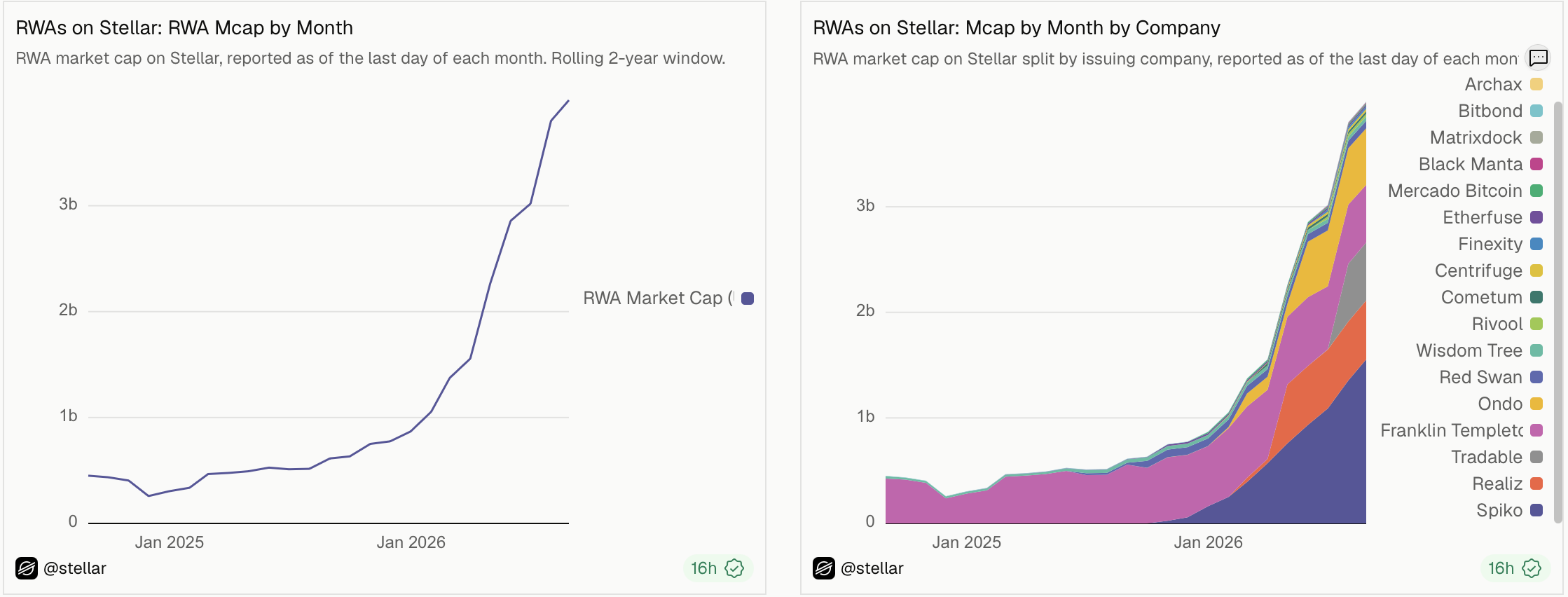
The value of tokenized real-world assets (RWAs) on the Stellar blockchain has experienced a dramatic surge in 2026, climbing approximately 360% to reach nearly $4 billion. This represents a substantial leap from the $868.8 million recorded at the close of the previous year, according to data from a Dune Analytics dashboard meticulously maintained by Stellar. As of August 29, 2026, the network’s RWA market capitalization stood at an impressive $3.996 billion, encompassing a diverse array of tokenized assets including U.S. Treasurys, private and public credit instruments, non-U.S. government debt, and various other asset classes.
This burgeoning market, while demonstrating remarkable growth, is currently concentrated among a select group of key issuers. Analysis of data from August 27, 2026, reveals that Spiko leads the pack, accounting for $1.55 billion of Stellar’s RWA value. Following closely are Realiz with $559 million, Tradable with $548 million, Franklin Templeton with $546 million, and Ondo with $535 million. This concentration suggests a dynamic ecosystem where established players are leveraging the Stellar network to bring a significant volume of RWAs onto the blockchain.
Stellar’s Growing Foothold in Non-U.S. Government Debt
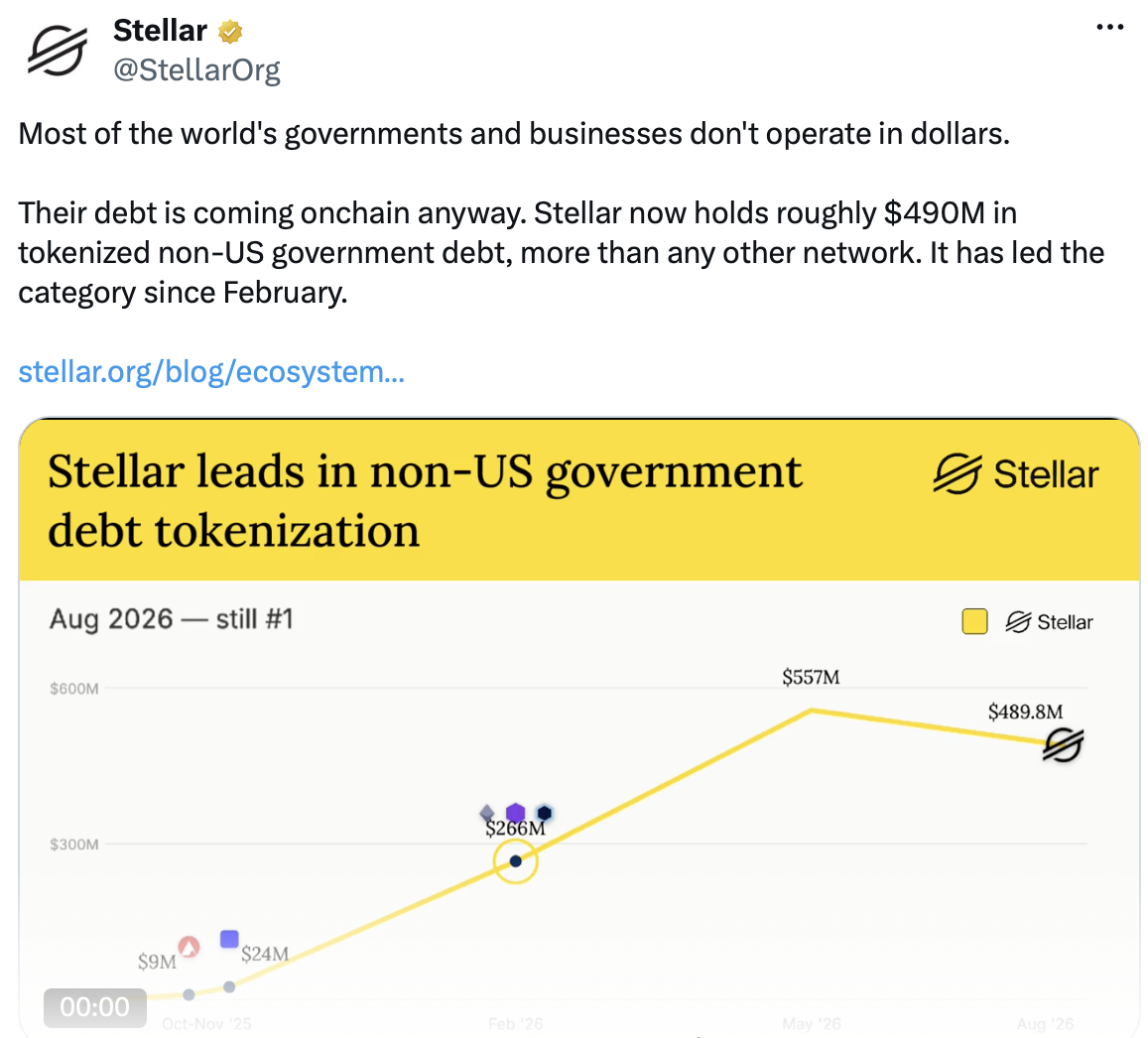
A particularly notable area of expansion for Stellar has been in the tokenization of non-U.S. government debt. Citing data from RWA.xyz, the Stellar Development Foundation highlighted in a recent announcement that the network held approximately $490 million in this asset class as of August 20, 2026. This figure includes tokenized Mexican CETES (short-term government debt) and Brazilian government bonds, which have been issued through partnerships with entities like Etherfuse. This strategic focus on sovereign debt underscores Stellar’s ambition to become a significant platform for global debt markets on-chain, offering enhanced accessibility and efficiency.
The implications of this expansion into sovereign debt are far-reaching. By tokenizing these assets, Stellar aims to democratize access to government debt for a wider range of investors, potentially reducing transaction costs and settlement times compared to traditional methods. This could be particularly impactful for emerging markets, where access to international capital can often be constrained by complex and opaque financial infrastructures.
Institutional Momentum Fuels RWA Expansion
The significant growth in Stellar’s RWA market is largely attributable to the deepening engagement of financial institutions and specialized tokenization platforms. This trend is not merely organic but is being actively driven by strategic partnerships and integrations that are bringing substantial real-world value onto the Stellar blockchain.
A pivotal development in this institutional push occurred in May 2026, when the Depository Trust & Clearing Corporation (DTCC), a leading post-trade financial services provider, announced its intention to connect its tokenization service to the Stellar network. The anticipated availability of DTC-tokenized assets on Stellar in the first half of 2027 signals a potential paradigm shift. This integration is expected to eventually support the tokenization of a wide spectrum of assets, including U.S. Treasurys, major index Exchange Traded Funds (ETFs), and stocks within the Russell 1000 index. The involvement of an entity as significant as the DTCC lends considerable credibility to Stellar’s RWA strategy and suggests a future where traditional financial instruments are seamlessly integrated into the digital asset ecosystem.
Further bolstering this institutional momentum, the tokenization platform Tradable announced in July 2026 its plans to bring up to $1 billion in private credit assets onto the Stellar network. This initiative is specifically designed to streamline compliance processes, enhance investor onboarding, and improve asset lifecycle management. Tradable’s existing track record, which includes the tokenization of $1.7 billion in private credit across nearly 30 positions, provides a strong foundation for this expansion. The ability of Tradable to leverage Stellar for such a substantial volume of private credit highlights the network’s capacity to handle complex and illiquid asset classes.
Stellar’s Expanding Role in Digital Payments and Stablecoins
Beyond its burgeoning RWA market, Stellar is also solidifying its position in the digital payments arena. A key development in this space was MoneyGram’s launch of its MGUSD dollar stablecoin on the Stellar network in June 2026. This launch enables users to hold dollar-denominated balances and facilitate fund transfers through MoneyGram’s extensive global payments network. The MGUSD stablecoin joins a robust ecosystem of reserve-verified stablecoins already operating on Stellar, with approximately $438 million currently issued on the network, according to the same Dune Analytics dashboard. The integration of stablecoins like MGUSD enhances the utility of the Stellar network for cross-border remittances and everyday transactions, further driving adoption and network activity.
The presence of these stablecoins is crucial for the broader adoption of tokenized assets. They provide a stable medium of exchange within the ecosystem, facilitating the buying and selling of tokenized RWAs without the volatility often associated with cryptocurrencies. This creates a more predictable and user-friendly environment for both institutional and retail participants.
Contrasting Performance: RWA Boom vs. XLM Token Performance
Despite the remarkable growth and institutional adoption seen in its tokenized RWA sector, Stellar’s native cryptocurrency, XLM, has experienced a more subdued performance year-to-date. According to data from CoinGecko, XLM has seen a decline of approximately 11% in 2026, trading near the $0.18 mark. This divergence in performance between the RWA market on Stellar and the price of its native token raises interesting questions about market dynamics and investor sentiment.
While the success of RWAs indicates strong underlying utility and adoption of the Stellar network for specific financial applications, it does not directly translate into immediate price appreciation for XLM. This could be due to several factors, including broader market trends affecting cryptocurrencies, the specific use cases of XLM within the ecosystem, or the fact that many RWA transactions might be settled internally or through stablecoins without a direct reliance on XLM for every step. However, the increasing economic activity and demand for network services driven by RWAs could, over the long term, positively influence the value proposition and demand for XLM.
Broader Implications and Future Outlook
The exponential growth of tokenized RWAs on Stellar signifies a broader trend towards the digitization of traditional finance. By providing a scalable, efficient, and compliant platform, Stellar is positioning itself as a key infrastructure provider for this transformation. The successful integration of major financial players like the DTCC and the expansion into diverse asset classes such as private credit and sovereign debt indicate a growing confidence in blockchain technology for real-world financial applications.
The concentration of market share among a few issuers, while currently a feature of the market, also presents opportunities for further decentralization and the emergence of new players. As the technology matures and regulatory clarity increases, it is plausible that a wider array of issuers will enter the Stellar RWA ecosystem, fostering greater competition and innovation.
Furthermore, Stellar’s success in attracting significant RWA volume underscores the growing demand for on-chain financial instruments that offer transparency, efficiency, and accessibility. The ability to tokenize assets that were previously illiquid or difficult to trade can unlock new investment opportunities and reshape how financial markets operate.
Looking ahead, the continued integration of institutional services, the expansion into new asset classes, and the ongoing development of robust stablecoin ecosystems are likely to further propel Stellar’s RWA market. The platform’s focus on compliance and its partnerships with established financial entities suggest a strategic approach aimed at bridging the gap between traditional finance and decentralized technologies. While the performance of XLM remains a separate consideration, the fundamental growth in tokenized RWAs on Stellar points to a robust and evolving ecosystem with significant potential to impact the future of finance. The year 2026 has clearly marked a pivotal period for Stellar, demonstrating its capacity to not only host innovative digital assets but also to serve as a foundational layer for the tokenization of the global economy.

