
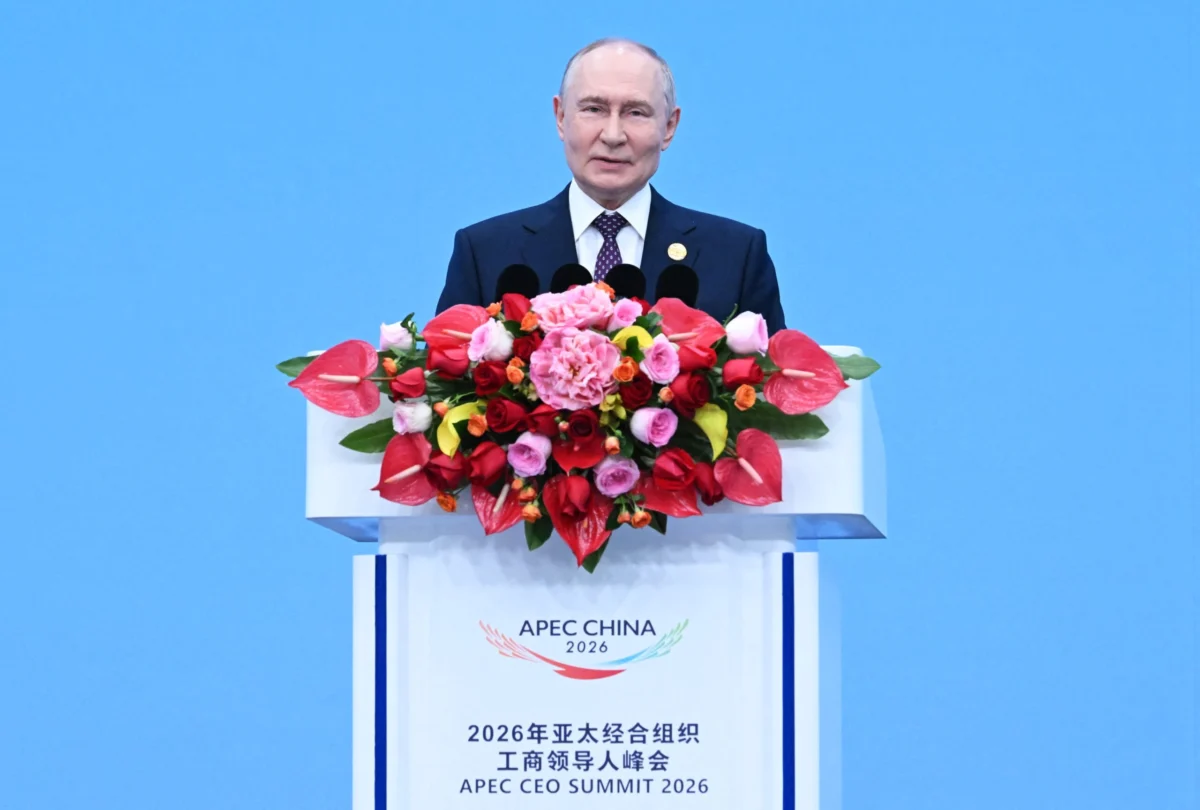
SHENZHEN, China – Russian President Vladimir Putin, addressing the Asia-Pacific Economic Cooperation (APEC) CEO Summit on Wednesday, November 18, 2026, issued a sharp critique of the European Union’s economic trajectory, asserting that the bloc was rapidly losing its industrial capacity and competitive edge on the global stage. Speaking from Shenzhen, a bustling technological hub in China’s southern Guangdong Province, President Putin’s remarks set a pointed tone for the high-level economic forum, even as he highlighted Russia’s own economic resilience and positioned his nation as an attractive partner for APEC members. His speech preceded anticipated historic talks on Thursday with Chinese President Xi Jinping and U.S. President Donald Trump, signaling a complex interplay of economic narratives and geopolitical maneuvering at the summit.
President Putin’s Address to APEC Leaders
President Putin, the third APEC leader to speak after Chinese President Xi Jinping and Malaysian Prime Minister Anwar Ibrahim, used his platform to champion Russia’s economic fortitude despite persistent international sanctions. "The EU is now losing its industrial capacity and it’s losing in the competition," Putin stated, according to an official English translation of his remarks, a declaration that immediately drew attention for its directness and timing. This assertion, made at a summit dedicated to fostering regional economic integration and growth, underscores the ongoing geopolitical and economic fissures that have widened since the mid-2020s.
Beyond his critique of the EU, the Russian leader dedicated a significant portion of his speech to showcasing Russia’s economic adaptability and potential. He emphasized the country’s capacity to withstand a sharp reduction in its U.S. dollar- and euro-denominated transactions, a testament, he argued, to Moscow’s successful pivot towards alternative payment systems and diversified trade partners. This strategic shift, accelerated by Western sanctions imposed in the preceding years, has seen Russia increasingly rely on its own financial infrastructure and deepen economic ties with non-Western nations, particularly those within Asia.
Putin further elaborated on the opportunities available for APEC members within Russia, spanning critical sectors from advanced technology to broad economic development initiatives. He outlined plans for collaborative projects and invited increased investment, positioning Russia as a stable and growing market despite external pressures. In a forward-looking appeal, he also urged APEC members to support Russia’s bid to host the APEC summit in 2035, signaling Moscow’s long-term commitment to the forum and its vision for a multipolar economic order.
The European Union’s Economic Trajectory: A Russian Perspective
President Putin’s pointed assessment of the European Union’s economic health reflects a narrative frequently advanced by Moscow, particularly in the context of Western sanctions. While the European Union, a bloc of 27 member states, remains one of the world’s largest economies, it has indeed faced a confluence of challenges in the mid-2020s. These have included lingering impacts from global supply chain disruptions, elevated energy costs exacerbated by geopolitical events, inflationary pressures, and intensified competition from both established and emerging industrial powers.
Data from the European statistical agency Eurostat and the International Monetary Fund (IMF) during this period indicated varying growth rates across EU member states, with some sectors experiencing contraction or stagnation. Manufacturing output in certain key industries, particularly energy-intensive ones, has been a subject of concern for European policymakers. High energy prices, for instance, led to reduced production capacities or relocation considerations for some industries, prompting debates within the EU about industrial competitiveness and strategic autonomy.
However, many European leaders and economists would likely offer a more nuanced perspective, emphasizing the bloc’s robust internal market, its commitment to innovation, and its ongoing efforts to transition to a green and digital economy. Initiatives like the European Green Deal and significant investments in research and development are designed to bolster long-term competitiveness. President Putin’s remarks, while highlighting genuine challenges, are thus viewed by many analysts as strategically timed to underscore perceived Western vulnerabilities and to contrast them with Russia’s own proclaimed resilience.
Russia’s Economic Resilience Amidst Sanctions
The emphasis on Russia’s economic resilience formed a cornerstone of President Putin’s address, a narrative carefully cultivated by the Kremlin since the imposition of sweeping international sanctions. Following the intensification of geopolitical tensions, Russia faced unprecedented restrictions on its financial sector, energy exports, and access to Western technology. Initially, these measures caused significant economic disruption, including a sharp depreciation of the ruble, capital flight, and contraction in certain sectors.
However, by 2026, Russia had implemented a series of countermeasures and strategic shifts aimed at mitigating the sanctions’ impact. These included:
- Diversification of Trade: A significant pivot towards Asian markets, particularly China, India, and Southeast Asian nations, for energy exports and imports of goods and technology. Bilateral trade volumes with these partners saw substantial increases.
- Financial Autonomy: Development of domestic payment systems and increased use of national currencies in international trade, reducing reliance on the U.S. dollar and euro. This "de-dollarization" trend, while not fully realized, had made notable progress in certain bilateral trade agreements.
- Import Substitution: Government programs promoting domestic production of goods and technologies previously sourced from the West. While challenging in high-tech sectors, this effort aimed to reduce vulnerabilities.
- Fiscal Discipline: Prudent macroeconomic policies, including managing budget deficits and maintaining gold and foreign exchange reserves, helped stabilize the financial system.
While sanctions undoubtedly constrained Russia’s long-term growth potential and access to advanced technologies, the immediate economic collapse predicted by some Western analysts did not materialize. The global demand for energy, even with price caps and restrictions, continued to provide substantial export revenues, particularly from non-sanctioning countries. This backdrop allowed President Putin to present a narrative of successful adaptation and continued economic viability to the APEC audience.
The Broader APEC 2026 Context in Shenzhen
The APEC CEO Summit and the subsequent APEC Leaders’ Meeting in Shenzhen in November 2026 served as a pivotal gathering for the 21 member economies that collectively represent over half of global GDP and trade. The choice of Shenzhen, China’s dynamic innovation hub, as the host city underscored Beijing’s emphasis on technological advancement, economic modernization, and its growing influence in regional and global economic governance.
APEC’s foundational mission, established in 1989, revolves around fostering sustainable economic growth and prosperity in the Asia-Pacific region by promoting free and open trade and investment, facilitating business, and advancing economic cooperation. The 2026 summit theme, "Innovation, Integration, and Inclusivity for a Resilient Asia-Pacific," reflected the pressing challenges of post-pandemic recovery, supply chain resilience, climate change, and the imperative for sustainable development across the diverse economies of the region.
The preceding remarks by Chinese President Xi Jinping had focused on championing multilateralism, open markets, and shared prosperity, often implicitly contrasting this vision with perceived protectionist tendencies elsewhere. Malaysian Prime Minister Anwar Ibrahim, representing a key Southeast Asian economy, likely emphasized regional integration, sustainable development, and the importance of addressing inequalities within the bloc. President Putin’s speech, therefore, injected a distinctly geopolitical and critical economic assessment into a forum traditionally focused on consensus-building around trade and investment liberalization.
High-Stakes Bilateral and Trilateral Engagements
Beyond the plenary sessions, the APEC summit served as a crucial venue for high-stakes diplomatic engagements. Russian President Putin’s schedule included significant bilateral and trilateral meetings that could shape the geopolitical landscape for years to come.
On Wednesday, following his speech, President Putin held a bilateral meeting with Chinese President Xi Jinping. This encounter, confirmed by Chinese state media, further solidified the "no-limits partnership" that Beijing and Moscow had cultivated in the years prior. Discussions likely encompassed a broad range of topics, including strategic coordination on global issues, expanding bilateral trade and energy cooperation, military-technical collaboration, and joint positions on regional security challenges. This meeting underscored the deepening alignment between the two powers, particularly in response to perceived Western pressures.
The pinnacle of President Putin’s diplomatic agenda, however, was the highly anticipated trilateral meeting scheduled for Thursday with President Xi Jinping and U.S. President Donald Trump. This meeting, featuring the leaders of the world’s three most powerful nuclear states, was historic in its composition and potential implications. Observers noted that such a high-level trilateral engagement, particularly involving a returning U.S. President Trump, was unprecedented in recent memory.
The agenda for these talks was expected to be wide-ranging and critically important. Key issues anticipated for discussion included:
- Nuclear Non-Proliferation: Given the global anxieties surrounding nuclear security and arms control, this would be a paramount topic, especially in the context of rising geopolitical tensions.
- Russia’s War with Ukraine: Despite the ongoing conflict, diplomatic efforts to find a negotiated settlement remained a priority for many global actors. Russian presidential aide Yuri Ushakov had stated last week that the Shenzhen meeting would continue these efforts, according to state-controlled local media Russia Today. The presence of all three leaders offered a rare, albeit challenging, opportunity for direct engagement on this intractable issue.
- Global Trade and Economic Governance: Discussions might touch upon reforms to international financial institutions, trade disputes, and the future of global supply chains.
- Regional Security: Addressing flashpoints and stability in various regions, including the Indo-Pacific.
The mere occurrence of this trilateral meeting, irrespective of its immediate outcomes, was seen as a significant development, reflecting a complex and often fraught interdependence between these major powers.
The Ukraine Conflict and Diplomatic Pathways
The shadow of Russia’s war with Ukraine loomed large over the APEC summit, even as the forum’s primary focus was economic cooperation. The conflict, ongoing for several years by 2026, had profoundly reshaped global geopolitics, energy markets, and international security architectures. Efforts to find a diplomatic resolution had been continuous but largely stalled, characterized by deep mistrust and fundamental disagreements over territorial integrity and sovereignty.
Yuri Ushakov’s statement, preceding the summit, that the meeting in Shenzhen would advance efforts towards a negotiated settlement, offered a glimpse into Russia’s diplomatic objectives. However, the path to peace remained fraught with obstacles. Any meaningful progress would require significant concessions or innovative diplomatic frameworks that could bridge the chasm between Moscow and Kyiv, as well as their respective international backers. The involvement of China and the United States in discussions, even indirectly, represented a potentially powerful, yet highly complex, channel for de-escalation or future peace talks. The summit thus provided a stage for high-level actors to gauge possibilities for a diplomatic breakthrough, however slim.
Strategic Implications and Geopolitical Realignment
The APEC 2026 summit, particularly the unique configuration of leadership present, underscored broader trends of geopolitical realignment. David Roche, a strategist at Quantum Strategy, earlier in the week characterized the summit as likely yielding little concrete result but presenting an "almost 100% photo op" that significantly elevates China’s status and power at the top table. This assessment highlights the symbolic importance of such gatherings in shaping international perceptions and validating diplomatic influence.
For China, hosting APEC in Shenzhen and facilitating a trilateral meeting of this magnitude reinforced its position as a central player in global diplomacy and a proponent of a multipolar world order. It allowed Beijing to project an image of stability, economic dynamism, and responsible global leadership.
For Russia, the summit offered a crucial platform to assert its economic narrative, forge stronger ties with Asian partners, and demonstrate its continued relevance on the global stage despite Western isolation efforts. President Putin’s attendance and participation in high-level talks challenged the notion of a fully isolated Russia.
For the United States, President Trump’s participation, if confirmed, would signal a potentially new approach to great power diplomacy, possibly prioritizing direct engagement over traditional alliance structures. His presence alongside Xi and Putin could indicate a willingness to tackle complex issues through direct, high-level negotiation, a hallmark of his previous foreign policy approach.
The broader implications extend to the future of international institutions and economic blocs. Putin’s critique of the EU, coupled with Russia’s pivot to Asia and China’s growing assertiveness, points to an evolving global order where regional economic blocs and alternative geopolitical alignments gain prominence. The debate over de-dollarization and the strengthening of non-Western economic ties will continue to be central to these developments.
Looking Ahead: APEC’s Future and Russia’s Role
As the APEC 2026 summit concluded, its legacy would likely be defined less by immediate policy breakthroughs and more by the symbolic significance of its high-level diplomatic engagements and the narratives articulated by its key leaders. President Putin’s forceful assessment of the EU and his promotion of Russia’s resilience, set against the backdrop of an ongoing global conflict, contributed to a summit rich in geopolitical undertones.
Russia’s bid to host APEC in 2035 reflects its enduring commitment to the Asia-Pacific region as a cornerstone of its foreign policy and economic strategy. The success of this bid would depend on evolving geopolitical dynamics and the consensus among APEC members regarding Russia’s role in the forum’s future. The Shenzhen summit, therefore, represented not just a snapshot of the current geopolitical climate but also a harbinger of potential future alignments and challenges in the intricate tapestry of global economic and political power. The complex interactions witnessed in Shenzhen underscored that in 2026, the world remained in a state of flux, navigating a path towards an uncertain, multipolar future.

