
Despite a notable decline in headline spending at gasoline stations driven by tumbling pump prices, the latest US Retail Sales data for June reveals a more robust consumer landscape than some forecasts suggested. Bank of America’s analysts, often noted for their prescience in market predictions, had anticipated a stronger-than-consensus print for today’s figures, a prediction largely borne out by the results. The data paints a complex picture of consumer behavior, highlighting resilience in certain sectors even as economic anxieties persist.
Following a significant upward revision to May’s figures, June’s headline retail sales registered a modest 0.2% month-over-month (MoM) increase, aligning with market expectations. On an annual basis, sales climbed 6.7% year-over-year (YoY), showing a slight moderation from previous months but still indicating substantial growth. This growth, however, masks considerable shifts beneath the surface, particularly concerning how and where consumers are choosing to allocate their discretionary income.
A Detailed Look at Sectoral Performance
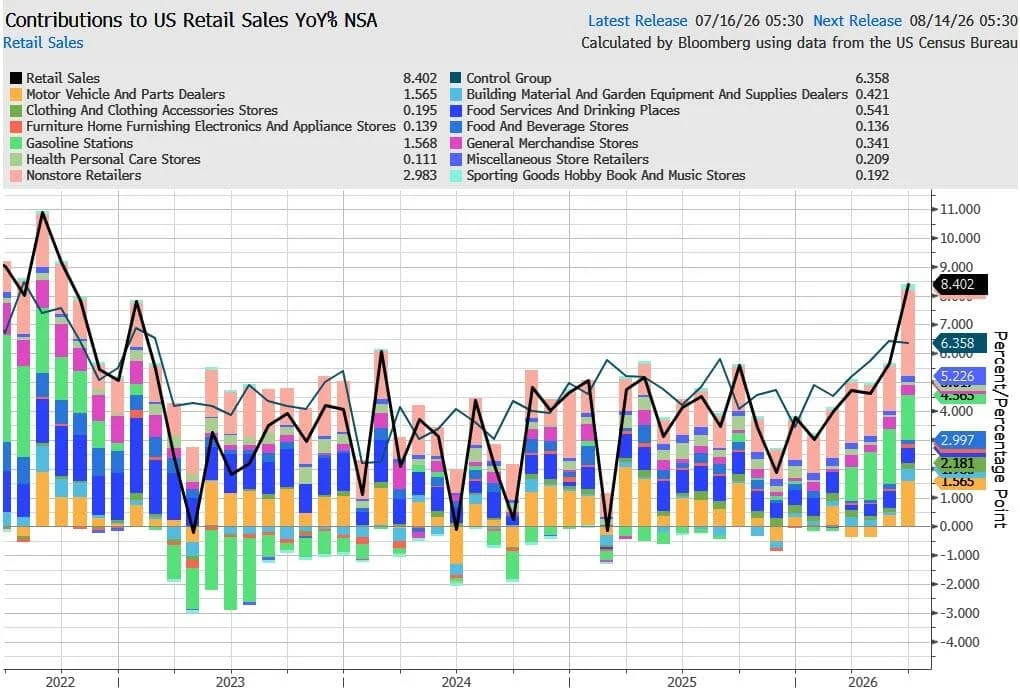
The granular breakdown of retail sales reveals a divergence in performance across various sectors, underscoring the dynamic nature of the current economic environment. Unsurprisingly, gasoline stations experienced the most significant decline in sales during June. This downturn is directly attributable to the noticeable drop in fuel prices throughout the month, which, while offering some relief to consumers’ wallets, simultaneously reduced the monetary value of transactions at the pump. This monthly drop in gasoline station sales marked its most substantial decline since December 2022, a period that also saw significant energy price fluctuations.
Beyond fuel, other sectors registered minor contractions. Health and Personal Care stores, alongside Food and Beverage establishments, saw small drops in spending. These categories, often considered more essential, tend to be less volatile, suggesting that the slight dip might reflect minor adjustments in household budgets or a shift towards value brands rather than a fundamental retrenchment in necessary spending.
Conversely, several sectors enjoyed a significant boost in sales. Nonstore Retailers, predominantly encompassing e-commerce and online shopping platforms, witnessed the largest jump in spending. This trend underscores the continued structural shift towards digital retail channels, a phenomenon accelerated by the pandemic and now ingrained in consumer habits. The convenience and often competitive pricing offered by online retailers continue to attract a growing share of consumer expenditure.
Motor Vehicle and Parts Dealers also reported a robust increase in sales. This resurgence in automotive spending suggests a renewed demand for vehicles, potentially driven by improved inventory levels, a stabilization of prices, or consumers pushing through with delayed purchases. The automotive sector’s performance is often seen as a bellwether for larger consumer confidence in big-ticket items, hinting at underlying economic stability for a segment of the population.

When analyzing annual growth on a non-seasonally adjusted (NSA) basis, Nonstore Retailers, Gasoline Stations, and Motor Vehicle sales emerge as the primary drivers. This long-term perspective highlights the enduring impact of online commerce and the substantial volume of transactions within the automotive sector, even as the monthly data for gasoline stations shows a short-term dip in value.
Unpacking Core Metrics: Ex-Autos and Ex-Gas
To gain a clearer understanding of underlying consumer demand, economists often scrutinize "core" retail sales figures, which exclude volatile categories. Core retail sales, defined as "Ex-Autos," experienced a 0.2% MoM decline in June. This suggests that while automotive sales were strong, other non-auto discretionary spending might have faced headwinds.
However, when further excluding the impact of gasoline sales, the picture brightens considerably. "Ex-Autos and Gas" sales rose by 0.4% MoM, indicating that the declining spend at the pump significantly influenced the overall headline and Ex-Autos figures. This metric is crucial as it offers insight into consumer demand for a broad range of goods and services, insulated from the price volatility of fuel and the cyclical nature of vehicle purchases. Despite the nuanced monthly movements, the annual growth in overall consumer spending remains robust across these core measures, signaling sustained consumer activity.

The Control Group and its GDP Implications
Perhaps one of the most significant takeaways from the June retail sales report lies in the performance of the "Control Group." This specific subset of retail sales data, which excludes food services, auto dealers, building materials, and gasoline stations, directly feeds into the calculation of Gross Domestic Product (GDP) as a measure of consumer spending on goods. In June, the Control Group jumped by a solid 0.5% MoM, precisely matching expectations.
This strong performance in the Control Group is a critical indicator for economic growth. Consumer spending accounts for a substantial portion of US GDP, and a healthy increase in this core measure suggests continued momentum for the broader economy. For policymakers and economists, this figure will be carefully analyzed as they assess the trajectory of the economy in the second quarter and beyond. A robust Control Group reading could signal that the economy is more resilient than anticipated, potentially influencing future monetary policy decisions by the Federal Reserve.
Real Retail Sales: Adjusting for Inflation

The narrative of consumer spending cannot be complete without considering the impact of inflation. The report also highlights "real" retail sales, which are crudely adjusted for inflation using the Consumer Price Index (CPI). This adjustment aims to reflect the actual volume of goods purchased rather than just their nominal monetary value.
Interestingly, real retail sales have shown a steady rebound, climbing from a negative print in December to reach their highest level since March 2022. This rebound suggests that despite persistent inflationary pressures, consumers are not merely spending more due to higher prices; they are, in fact, acquiring a greater quantity of goods and services. While the "crude" nature of the CPI adjustment is acknowledged, this trend provides a more optimistic view of consumer demand, indicating that purchasing power, at least in aggregate, has seen some recovery or sustained resilience. It challenges the notion that all nominal spending growth is simply an artifact of inflation.
The Paradox of Consumer Sentiment vs. Actual Spending
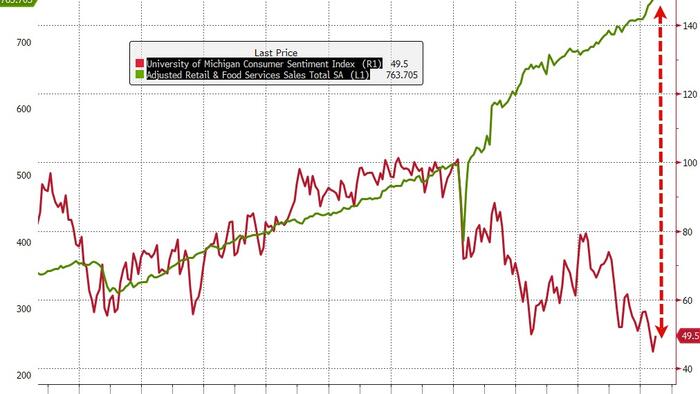
One of the most striking paradoxes in the current economic landscape is the apparent disconnect between dismal consumer sentiment surveys and the continued strength of actual retail spending. Survey-based measures of consumer confidence have frequently reported catastrophic slumps, reflecting widespread concerns about inflation, economic uncertainty, and future prospects. Yet, as the retail sales data consistently shows, the American consumer continues to spend.

This divergence can be attributed to several factors. Sentiment surveys often capture immediate emotional responses to headlines and perceived economic conditions, which can be highly susceptible to negative news cycles. Actual spending, on the other hand, reflects concrete financial decisions influenced by real income, employment stability, and accumulated savings.
For many households, especially those in higher income brackets, a strong labor market and relatively robust wage growth may be cushioning the impact of inflation, allowing them to maintain or even increase their spending levels. Furthermore, the significant savings accumulated during the pandemic, while perhaps depleting for some, continue to provide a buffer for others, enabling sustained consumption.
However, the report acknowledges a crucial nuance: the economic experience is not uniform across all income segments. Lower-income households have demonstrably felt the "pinch of the gas shock" more acutely. They have faced a disproportionately larger increase in necessary spending, particularly on essentials like fuel and food, which has consequently led to a widening of the "K" in discretionary outlays. This "K-shaped" recovery or expenditure pattern signifies that while higher-income segments continue to thrive and spend, lower-income groups are struggling to maintain their discretionary purchasing power after covering essential costs.
The critical question now is whether the recent tumbling of gas prices, despite some recent increases, will begin to ease this burden on lower-income households. A sustained period of lower fuel costs could free up a portion of their budgets, potentially allowing for a modest rebound in their discretionary spending and helping to narrow the "K" divide.

Broader Economic Context and Implications
The June retail sales figures arrive amidst a backdrop of ongoing economic challenges and evolving monetary policy. Persistent inflation, while showing signs of moderation in some areas, remains a primary concern for the Federal Reserve. The central bank has aggressively raised interest rates over the past year to cool the economy and bring inflation back to its 2% target.
A resilient consumer, as indicated by these retail sales numbers, presents a double-edged sword for the Fed. On one hand, it suggests that the economy is not on the brink of a severe recession, potentially allowing for a "soft landing." On the other hand, sustained strong consumer demand, especially in core categories, could fuel inflationary pressures, making the Fed’s job of taming price increases more challenging. This could necessitate further interest rate hikes, even as the economy shows signs of moderating.
The labor market also plays a crucial role in underpinning consumer spending. Despite some cooling, the US labor market remains relatively tight, with low unemployment rates and continued wage growth. This provides the income stability necessary for households to maintain their spending habits, even in the face of higher living costs. Any significant weakening in the job market would likely have a more profound and immediate impact on retail sales than fluctuating energy prices or sentiment surveys.

Looking ahead, the trends observed in June are likely to continue shaping the economic narrative. The sustained shift towards online retail suggests that brick-and-mortar stores must continue to adapt and innovate to remain competitive. The sensitivity of spending to gasoline prices highlights the ongoing vulnerability of household budgets to energy market volatility, especially for lower-income groups.
Moreover, the resilience of the Control Group provides a degree of optimism regarding Q2 GDP performance, potentially offering a counterpoint to more pessimistic economic forecasts. However, the underlying disparities in consumer financial health, particularly the "K-shaped" spending pattern, remain a significant concern for equitable economic growth.
In conclusion, the June US Retail Sales report paints a nuanced picture of an economy characterized by resilient, albeit shifting, consumer spending. While headline growth was modest, deeper analysis reveals robust activity in key sectors like e-commerce and automotive, and a strong contribution from the GDP-relevant Control Group. The enduring paradox of strong spending against weak sentiment, coupled with the differing experiences of various income brackets, will continue to be central themes as economists and policymakers navigate the path forward in a dynamic economic environment. The impact of declining gas prices on future discretionary spending, particularly for those most affected, will be a critical factor to watch in the coming months.

