

The burgeoning PropTech sector, a dynamic intersection of real estate and technology, is increasingly grappling with a fundamental challenge: the creation and maintenance of robust, nationwide real estate data infrastructure. While essential for delivering reliable property analytics and investment insights, the traditional approach of building this capability in-house is proving to be a significant bottleneck. This endeavor, often requiring months of intensive engineering effort, strains resources and delays critical product launches in a fiercely competitive market. Consequently, a growing number of PropTech platforms are turning to strategic partnerships with specialized data providers, such as Mashvisor, as a more efficient and sustainable alternative. This shift allows businesses to access sophisticated data solutions rapidly, freeing up valuable engineering talent to focus on core product innovation and strategic growth.
The Cost and Complexity of Building In-House Data Infrastructure
The allure of building an internal data system lies in the perceived control and customization it offers. However, the practical realities paint a different picture. Establishing reliable, nationwide property datasets is an intricate and costly undertaking. What begins as a feature development quickly morphs into an ongoing operational responsibility, demanding substantial investment in engineering talent, data licensing, and continuous upkeep.
The Hidden Toll of Assembling a Data Team:
Developing sophisticated real estate data analytics necessitates specialized expertise, including data engineers, data scientists, and domain experts. Building the necessary data pipelines to collect, normalize, and validate vast quantities of information across diverse markets is a complex, multi-faceted process. This involves not only the initial development but also ongoing maintenance, quality assurance, and adaptation to evolving data sources and formats.
According to industry reports, the average annual salary for a senior data engineer in major tech hubs can range from $140,000 to $180,000, excluding benefits and overhead. For a small team, this translates into substantial upfront and recurring personnel costs. Beyond salaries, the investment in cloud infrastructure, data storage, and specialized software further inflates the budget. This expenditure diverts capital that could otherwise be allocated to product development, marketing, or customer acquisition.
Data Licensing, Compliance, and Fragmentation:
The U.S. real estate market is characterized by its inherent fragmentation. Property data is often siloed across numerous Multiple Listing Service (MLS) databases, each operating under distinct licensing agreements, update frequencies, and data governance policies. Navigating these complex licensing structures, ensuring compliance with varying regulations, and managing permissions across multiple jurisdictions is a formidable challenge.
Adding rental analytics, for instance, introduces further layers of complexity. Maintaining accurate and up-to-date datasets comparable to specialized APIs like an Airbnb data API requires continuous aggregation, normalization, and validation across thousands of locations. Without dedicated expertise and robust systems, data accuracy can become inconsistent, eroding user trust and potentially leading to flawed business decisions. The National Association of REALTORS® (NAR) and various state associations govern MLS data access, often requiring specific licenses or affiliations, which can be prohibitive for non-traditional real estate technology companies.
The 12-Month Time-to-Market Dilemma:
In the fast-paced PropTech landscape, speed is a critical competitive differentiator. A 12-month implementation timeline for a core data feature can be detrimental. It delays product launches, hinders customer acquisition, and diminishes a company’s competitive edge. This prolonged development cycle means valuable market opportunities can be missed, and emerging trends may pass by before a platform can even offer relevant insights. Businesses today cannot afford such lengthy development cycles; they require solutions that can be deployed rapidly to capitalize on market shifts and user demand.
The "Buy" Alternative: Real Estate Data API Partnerships
Recognizing these inherent challenges, many PropTech firms are strategically opting for the "buy" approach by partnering with specialized real estate data providers. A real estate data API partnership offers a streamlined pathway to access comprehensive, analytics-ready property data without the burden of building and managing an internal data infrastructure.
Plug-and-Play Integration for Swift Deployment:
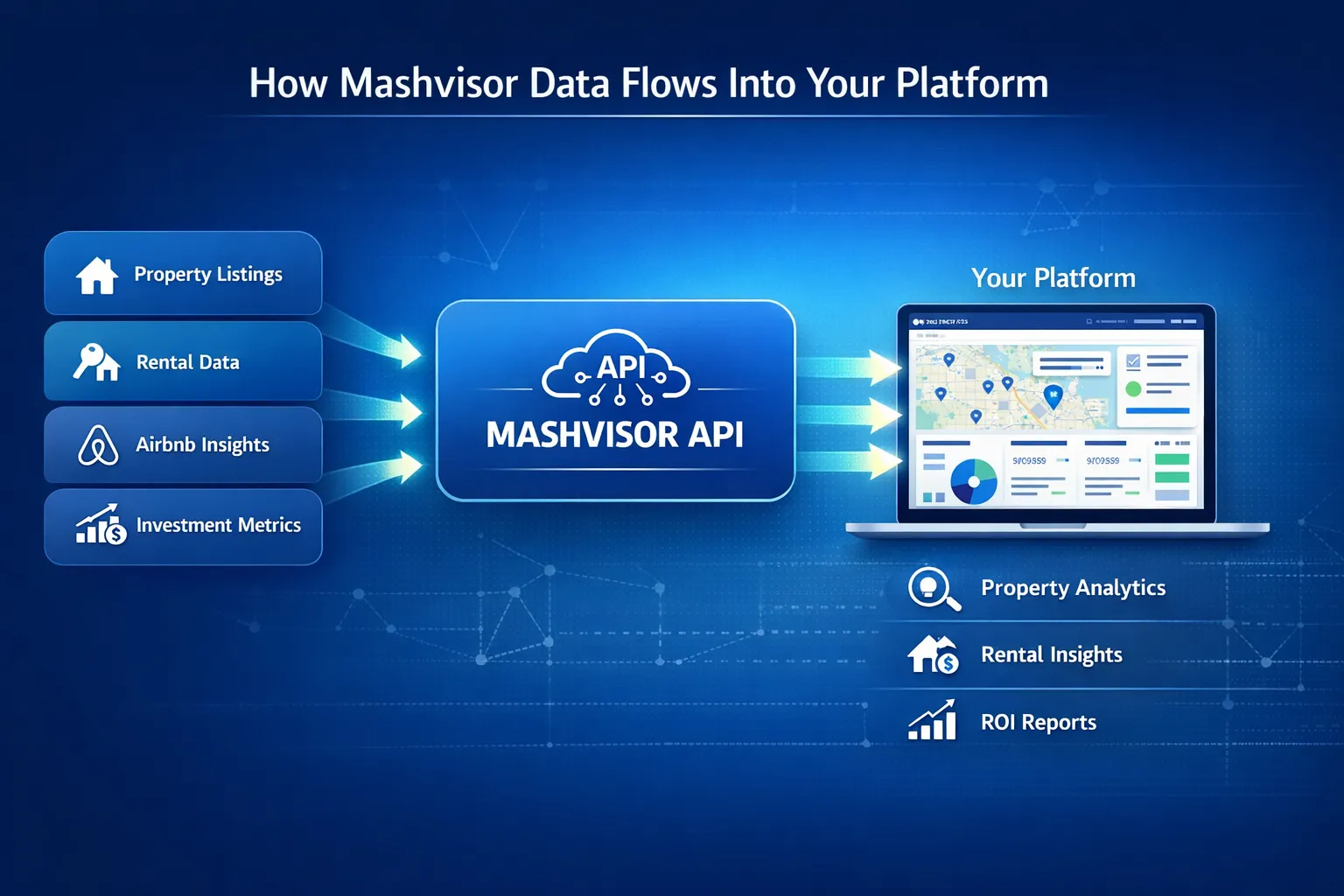
Leading data providers, such as Mashvisor, offer APIs designed for seamless integration. These APIs provide access to standardized data endpoints, delivering consistent, analytics-ready information directly into a platform’s existing workflows. This approach shifts the focus from complex data aggregation challenges to the straightforward task of connecting these endpoints to the product. The result is a significantly reduced development complexity and a faster transition from planning to deployment.
For instance, Mashvisor’s API documentation outlines clear endpoints for property details, rental income estimates, investment metrics, and short-term rental analytics. This level of detail allows developers to understand precisely what data is available and how to access it, accelerating the integration process. The typical integration timeline for such APIs is often measured in weeks, a stark contrast to the months required for in-house development.

Unified Data for Comprehensive Market Intelligence:
A significant advantage of partnering with an established data provider is access to a unified and comprehensive dataset. Mashvisor, for example, consolidates traditional property data with rental performance insights and short-term rental analytics into a single, accessible real estate data API. This eliminates the need to manage multiple vendors or deal with inconsistent datasets, enabling platforms to offer deeper market intelligence through a single integration point.
The Mashvisor API typically encompasses a range of data points, including:
- Property Details: Address, square footage, number of bedrooms and bathrooms, property type, year built, lot size, and more.
- Rental Income Estimates: Projected monthly rental income for both long-term and short-term rentals, occupancy rates, and average daily rates.
- Investment Metrics: Cash-on-cash return, cap rate, ROI, property value trends, and comparable sales data.
- Market Data: Neighborhood demographics, crime rates, school ratings, walkability scores, and local economic indicators.
- Short-Term Rental Performance: Historical Airbnb and VRBO performance data, including occupancy, revenue, and demand trends.
By aggregating these diverse data layers into one system, companies can provide their users with a holistic view of the real estate market, from property fundamentals to investment potential and rental yield analysis.
Designed for PropTech and Marketplaces:
Data API partnerships are strategically crafted for businesses that prioritize product enhancement over becoming data infrastructure specialists. Providers like Mashvisor operate as a foundational layer, allowing partner platforms to retain full control over their branding, user experience, and product direction. This symbiotic relationship ensures that while partners benefit from scalable, continuously updated datasets, their unique market identity remains intact. This positions such providers among the leading real estate data API solutions for those seeking efficient and reliable data integration.
Accelerating Time-to-Market and Scalability
The speed at which new features can be launched and scaled is paramount in the PropTech industry. Market dynamics shift rapidly, user expectations evolve, and competitive pressures necessitate continuous innovation. Integrating a real estate investment data API allows companies to bridge the gap between concept and launch significantly faster.
Expedited Product Development Cycles:
By leveraging readily available datasets, engineering teams can bypass the time-consuming processes of data sourcing, cleaning, and validation. This allows them to dedicate their efforts to building user-facing tools powered by reliable property analytics. This acceleration shortens the time-to-market for new features, enabling companies to test hypotheses, launch analytical tools, and iterate based on user feedback more efficiently. The ability to pivot quickly based on market demands is a critical advantage in today’s digital economy.
Scalable Growth Without Infrastructure Overhaul:
Business expansion, such as entering new geographical markets, presents significant challenges for companies that have built their data infrastructure internally. Expanding coverage often requires substantial reinvestment in data acquisition and processing capabilities. In contrast, solutions that scale alongside a company’s needs allow for instant coverage expansion. Mashvisor’s nationwide real estate data coverage, for instance, empowers platforms to grow geographically without introducing additional operational complexity or significant capital expenditure.
Furthermore, many API providers offer flexible, usage-based pricing models. This ensures that costs scale proportionally with data consumption, making it an economically viable option for businesses of all sizes, from early-stage startups to established enterprises. This predictable cost structure allows for better financial planning and resource allocation.
Empowering Engineering Teams to Focus on Core Value:
When data infrastructure is managed by a third-party provider, internal engineering teams can redirect their focus from routine data maintenance to activities that directly enhance the product’s core value proposition. This includes improving user experience, developing innovative analytical features, and optimizing customer engagement. This operational efficiency is a primary driver for businesses adopting API data partnerships for their real estate platforms. The ability to innovate and differentiate becomes the primary focus, rather than managing the underlying data plumbing.
Ensuring Reliability, Coverage, and Compliance
While speed to market is crucial, it is only one piece of the puzzle. Real estate platforms must also ensure data quality, consistency, and compliance to maintain customer trust and operational integrity.
Nationwide Data Coverage:
Partnering with a provider like Mashvisor eliminates the need to painstakingly assemble datasets market by market. This unified approach ensures consistent analytics across all locations, a critical requirement for data-driven tools serving a broad user base. This national coverage simplifies product offerings and allows for standardized reporting and analysis, regardless of the property’s location.
Continuous Data Updates and Maintenance:
The real estate market is in constant flux. Listings are updated, rental markets fluctuate, and economic conditions evolve. Maintaining accurate datasets internally requires perpetual monitoring, validation, and updates. Through a real estate data API partnership, the aggregation, normalization, and updating processes are managed by the provider. This ensures that platforms receive structured datasets ready for immediate analysis, significantly reducing the operational burden and freeing up internal resources. This consistent delivery of dependable long-term rental and short-term rental analytics is a key benefit.
Simplified Compliance and Licensing:
Data compliance, often an afterthought during initial development, becomes a critical concern as a business scales. Managing API data licensing, permissions, and usage requirements across diverse data sources can introduce significant legal and operational risks. An API data integration streamlines this process, allowing companies to rely on an infrastructure designed to handle licensing considerations and data standardization. This allows internal teams to concentrate on product development and strategic initiatives without the looming threat of compliance issues.
Key Beneficiaries of Data Partnerships
While a wide range of real estate industry players can benefit from API partnerships, certain segments are particularly well-positioned to capitalize on this model.
PropTech Startups:
Startups operate under immense pressure to validate their business models and achieve product-market fit rapidly. Building in-house data capabilities can drain limited resources and significantly slow down early development. By leveraging PropTech API solutions, startups can launch minimum viable products (MVPs) faster, offering professional-grade insights without the overhead of a dedicated data team. A notable example is a PropTech startup that reportedly launched a short-term rental (STR) deal validation engine in under 48 hours using Mashvisor’s API, bypassing months of data pipeline development and licensing negotiations. This agility allowed them to quickly test market demand and onboard early adopters.
Real Estate Marketplaces:
Property marketplaces are increasingly differentiating themselves through the insights they provide, moving beyond mere listings. Integrating analytics powered by a reputable real estate API provider enables these platforms to offer added value, such as estimated investment potential, projected rental income, and comparative market analysis. This enhances user engagement and retention by providing a richer, more informative experience.
Investment Platforms and SaaS Tools:
Platforms catering to investors, brokers, and property managers often require sophisticated property analytics across multiple markets. An API integration allows them to deliver crucial metrics like Return on Investment (ROI), rental yield projections, and market performance indicators through a unified interface. This facilitates scalable product growth while maintaining consistent data quality and reliability.
AI and Analytics Platforms:
For AI-driven platforms and analytics tools, API data partnerships offer a crucial advantage: the ability to integrate structured, real-world datasets into their models and dashboards without building new data pipelines from scratch. Providers like Mashvisor supply standardized outputs and broad market coverage, enabling companies to seamlessly incorporate real estate intelligence into recommendation engines, forecasting tools, and advanced analytics applications with minimal additional infrastructure investment.
Considerations for Partnership
While the benefits of real estate data API partnerships are substantial, it’s important to identify when this approach might not be the optimal fit. Companies that require highly bespoke, niche data that is not commercially available, or those with a long-term strategic objective to become a primary data provider themselves, may find building in-house more aligned with their goals. However, for the vast majority of PropTech companies focused on delivering user-centric solutions and achieving rapid growth, an API partnership represents a more pragmatic and efficient path forward.
Conclusion
The landscape of real estate technology is evolving, and the traditional model of building data infrastructure internally is becoming increasingly untenable for many PropTech platforms. By embracing real estate data API partnerships, companies can bypass the significant challenges associated with data aggregation, normalization, licensing, and maintenance. This strategic shift allows for faster product launches, enhanced scalability, and the ability for engineering teams to focus on innovation that drives core business value. Providers like Mashvisor offer a robust solution, delivering nationwide coverage, continuous updates, and simplified compliance, enabling PropTech businesses to thrive in a competitive and rapidly changing market. The decision to "buy" data infrastructure through a partnership is not merely a cost-saving measure; it is a strategic imperative for accelerated growth and sustained competitive advantage.

