
The digital landscape is a constant battleground between technological innovation and governmental control, with recent events in Iran, the speculative realm of decentralized prediction markets, and the evolving relationship between traditional finance and cryptocurrency exchanges highlighting these tensions. In Iran, a government ban on the popular messaging application Telegram has, according to its co-founder Pavel Durov, proven to be a strategic misstep, driving its citizens to embrace virtual private networks (VPNs) and other circumvention tools in unprecedented numbers. Simultaneously, the decentralized prediction platform Polymarket has been forced to remove a market speculating on the fate of a missing U.S. service member following widespread condemnation, underscoring ethical quandaries in the burgeoning decentralized finance (DeFi) space. Meanwhile, in the United States, established community banking groups are actively opposing the Office of the Comptroller of the Currency’s (OCC) conditional approval of a national trust charter for Coinbase, arguing that such a move could erode regulatory parity and introduce systemic risks.
Durov Claims Iranian Telegram Ban Fuels VPN Adoption, Bolstering Digital Resistance
Pavel Durov, the visionary co-founder of Telegram, has asserted that Iran’s attempt to stifle communication by banning his encrypted messaging platform has inadvertently achieved the opposite effect, fostering a significant increase in the adoption of VPNs and similar technologies. This assertion comes amidst reports that despite the official prohibition, Telegram remains a dominant communication channel within the nation. Durov’s public statements, disseminated through his social media channels, paint a picture of a government’s technological crackdown backfiring spectacularly.
"The government hoped for mass adoption of its surveillance messaging apps, but got mass adoption of VPNs instead," Durov stated, highlighting the unintended consequence of the Iranian authorities’ actions. He further elaborated on the scale of this digital circumvention, claiming that "over 50 million members of the digital resistance in Iran are joined by more than 50 million more in Russia." This figure suggests a substantial portion of Iran’s population, estimated to be around 85 million, is actively employing tools to bypass state-imposed internet restrictions.
VPNs function by masking a user’s true IP address, rerouting their internet traffic through servers in different geographic locations. This process effectively shields their online activity from being monitored or blocked by national firewalls. The widespread adoption of these tools by Iranian citizens demonstrates a powerful resilience and a commitment to accessing information and communication channels free from government oversight. Durov’s claim that Telegram has been downloaded by "over half of its population" indicates a persistent demand for the platform’s features, which include end-to-end encryption and large group chat capabilities, making it a preferred choice for private and secure communication.
The broader implication of Durov’s statement is the validation of decentralized and encrypted communication platforms as crucial tools for individuals seeking to maintain privacy and freedom of expression in environments with heightened government surveillance and control. In a world where digital communication is increasingly intertwined with political and social discourse, the ability to bypass censorship can be seen as a fundamental aspect of digital liberty. The Iranian experience, as described by Durov, serves as a compelling case study in the limitations of state-controlled internet censorship when faced with sophisticated user-driven circumvention technologies. The growth of the "digital resistance," as Durov terms it, suggests that technological tools are empowering citizens to assert their autonomy in the digital sphere, even in the face of official prohibitions. This trend could have far-reaching implications for how other authoritarian regimes approach internet governance and censorship in the future.

Polymarket Pulls Market on Missing U.S. Pilot Amidst Ethical Firestorm
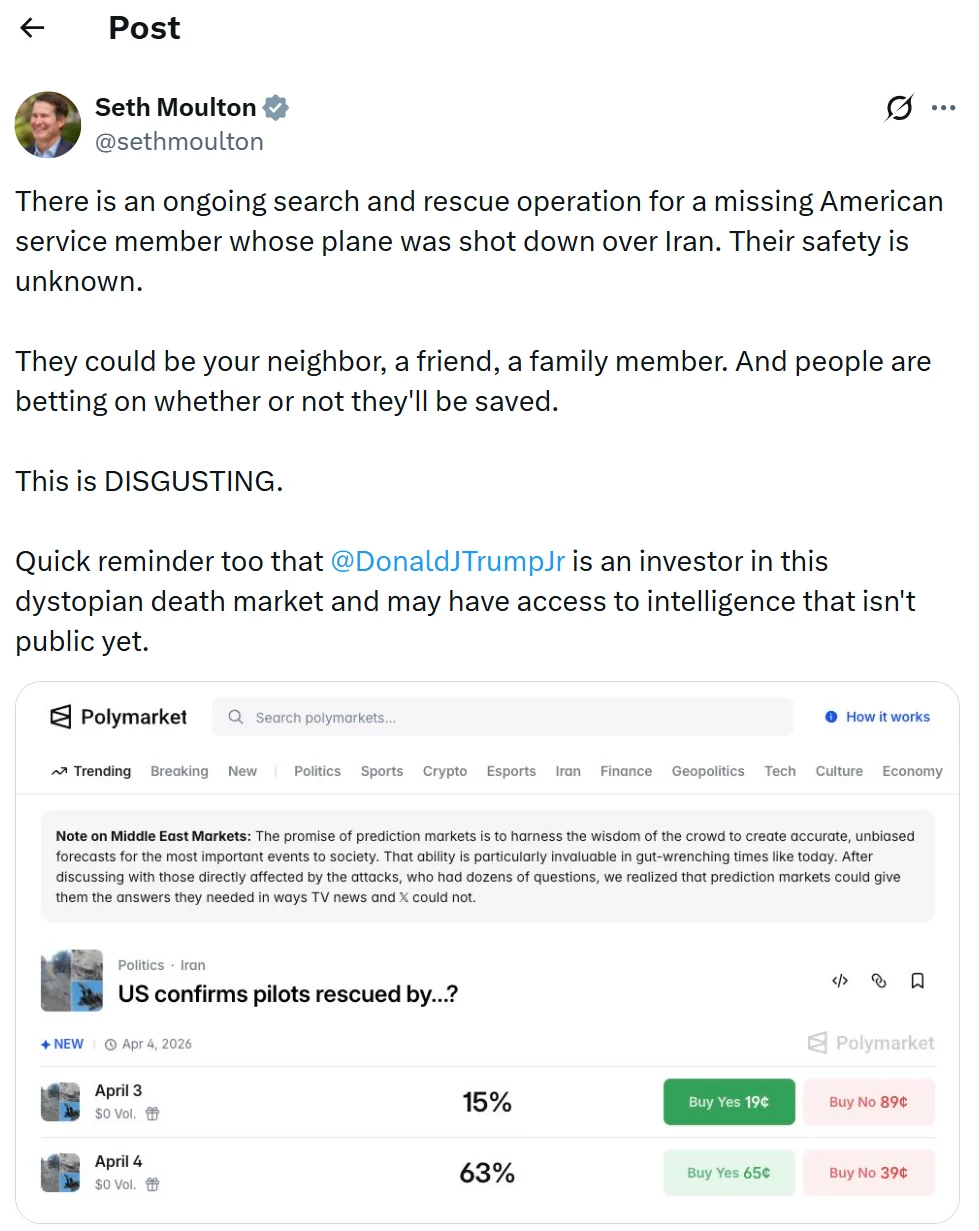
The decentralized prediction market platform Polymarket has found itself at the center of a significant controversy, leading to the immediate removal of a market that speculated on the fate of a missing U.S. service member. The decision to delist the market came after intense backlash from politicians, the public, and advocacy groups, who decried the platform’s decision to allow financial speculation on a sensitive and potentially tragic human situation.
The market in question reportedly posed the question of whether U.S. authorities would confirm the rescue of a pilot who was allegedly shot down over Iran. The overwhelming sentiment within the market, with over 60% of participants betting against a rescue by Saturday, sparked outrage. Critics argued that such a market was not only distasteful but also deeply unethical, particularly given the possibility that the service member was injured or worse.
U.S. Representative Seth Moulton was among the most vocal critics, unequivocally condemning the market. In a public statement on social media, Moulton described the situation as "disgusting" and expressed profound concern over individuals profiting from or speculating on the potential suffering of a U.S. service member. "They could be your neighbor, a friend, a family member. And people are betting on whether or not they’ll be saved," Moulton wrote, emphasizing the human element that was being disregarded in the context of speculative betting. His statement highlighted the emotional toll such a market could inflict on the family and loved ones of the missing individual, as well as on the broader community.
In response to the mounting criticism, Polymarket issued a statement acknowledging the controversy and confirming the immediate removal of the market. The platform stated that the listing violated its "integrity standards" and acknowledged that the market "should not have been listed." Polymarket further indicated that it was undertaking a review of its internal safeguards to understand how such a market was allowed to be created in the first place. While the platform did not specify the exact rule that was breached, the swift action suggests a recognition of the severe ethical implications involved.
The incident raises critical questions about the governance and ethical responsibilities of decentralized platforms. While the ethos of decentralization often emphasizes permissionless innovation and freedom from central authority, this event underscores the potential for such platforms to be exploited for morally questionable purposes. The backlash against Polymarket suggests a growing societal expectation for even decentralized entities to adhere to certain ethical benchmarks, particularly when dealing with matters of life, death, and national security. The incident also highlights the complex interplay between technological capabilities and human empathy, prompting a broader discussion on where the boundaries of speculation should lie, especially in the context of humanitarian crises or military operations. The review process undertaken by Polymarket will likely involve examining its listing policies, user verification procedures, and content moderation frameworks, even within a decentralized structure, to prevent similar occurrences in the future.
Community Banks Mobilize Against Coinbase’s National Trust Charter Approval
A significant rift has emerged within the U.S. financial sector as community banking groups voice strong opposition to the Office of the Comptroller of the Currency’s (OCC) conditional approval of a national trust charter for Coinbase. These groups argue that the OCC’s decision sets a dangerous precedent and could undermine the regulatory framework that governs traditional financial institutions. The Independent Community Bankers of America (ICBA), a prominent voice for community banks, has been at the forefront of this opposition, contending that granting such a charter to a cryptocurrency exchange creates an uneven playing field and lowers the bar for regulatory compliance.

The core of the community banks’ argument rests on the principle of regulatory parity. They contend that Coinbase, as a crypto-native company, operates under a fundamentally different business model and risk profile compared to traditional banks that have historically operated under stringent oversight. The ICBA has expressed concerns that allowing a company primarily focused on digital assets to operate with a national trust charter could blur the lines between traditional banking services and the more volatile world of cryptocurrencies. This blurring, they argue, could lead to a situation where crypto companies enjoy bank-like privileges without being subject to the same rigorous capital requirements, liquidity rules, and consumer protection standards.
According to the ICBA, Coinbase’s business model, which involves facilitating cryptocurrency trading, custody, and other digital asset services, does not align with the established legal and regulatory requirements that have long been applied to institutions seeking trust charters. These charters are typically granted to entities that manage assets on behalf of clients, often involving fiduciary responsibilities and a high degree of trust. Community bankers worry that the OCC’s approval of Coinbase’s charter might signal a willingness to relax these standards for digital asset firms, potentially introducing new risks into the broader financial system.
The opposition also highlights a broader concern about systemic risk. Community banks argue that the decision could create an uneven playing field, where crypto companies gain access to privileges traditionally reserved for regulated banks, such as offering certain trust services or potentially accessing payment systems, without bearing the full weight of regulatory scrutiny. This could allow crypto firms to innovate and compete with traditional banks on terms that are not equitable, potentially leading to instability if these newer business models face unforeseen challenges. The fear is that the integration of crypto-native companies into the traditional banking infrastructure, without commensurate regulatory oversight, could create new vulnerabilities that could ripple through the financial system during periods of market stress.
The ongoing friction between traditional financial institutions and the burgeoning cryptocurrency industry is a defining characteristic of the current regulatory landscape. As digital assets continue to gain traction and companies like Coinbase seek to establish a more formal presence within the financial ecosystem, regulators face the complex task of adapting existing frameworks or creating new ones to accommodate these innovations. The community banks’ pushback against Coinbase’s charter approval underscores the deeply held concerns within the established financial sector about the potential impact of crypto adoption on financial stability, consumer protection, and fair competition. The OCC’s decision, and the subsequent opposition, represent a critical juncture in this evolving relationship, with significant implications for the future of banking and digital assets in the United States. The outcome of this debate will likely shape how crypto companies are integrated into the regulated financial system for years to come.

