
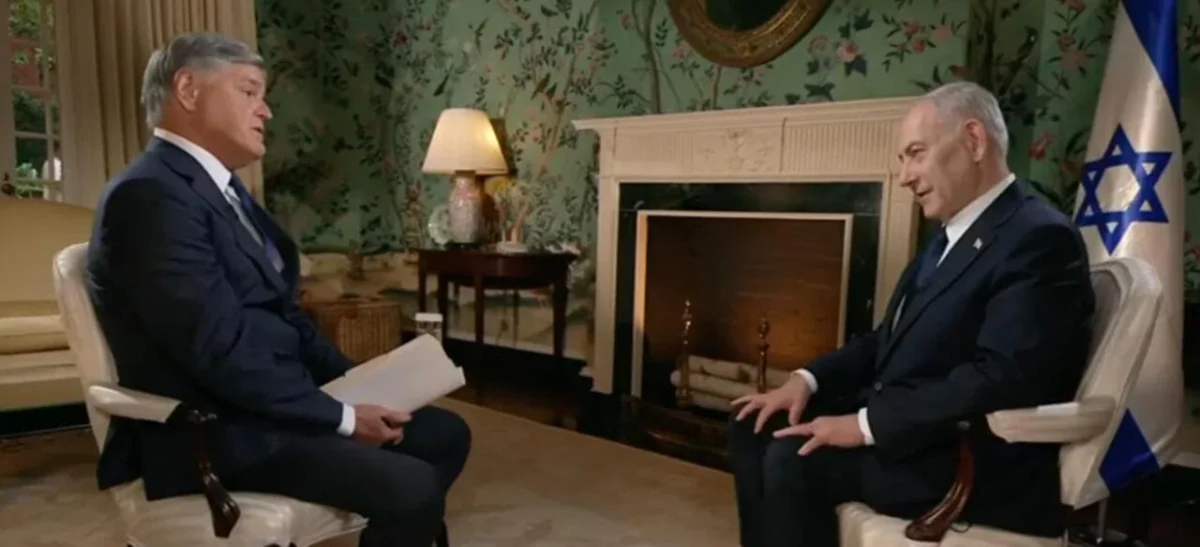
Israeli Prime Minister Benjamin Netanyahu has publicly dismissed the significance of the International Criminal Court’s (ICC) arrest warrant against him, asserting that Israeli special forces would protect him from any attempts by nations to take him into custody. Speaking on Fox News during an interview with Sean Hannity, a long-time personal friend, Netanyahu’s remarks underscored a defiant stance against international legal proceedings, even as his recent international travel has highlighted the complex challenges posed by the warrant.
The interview, broadcast on Tuesday, saw Hannity probe Netanyahu about the practical implications of the warrant, particularly regarding international travel. "It scares me in this sense. For you, you travel internationally, God forbid you had a medical emergency, and you need to land, and you’re about to land in a country that recognizes the ICC. It could complicate things. Do you worry about that?" Hannity asked. Netanyahu responded with a notable blend of acknowledgement and resolve: "Yeah, I think about it. You know, we have special forces around. I served for five years." He later added, in response to Hannity’s comment about the toughness of the IDF, "Yeah. Let’s give them a new task." These statements, delivered on a prominent American news platform, immediately drew attention for their confrontational tone towards the ICC and their suggestion of military intervention to circumvent international legal mandates.
The International Criminal Court and the Charges Against Netanyahu
The International Criminal Court, headquartered in The Hague, Netherlands, is an independent judicial body established by the Rome Statute in 1998. Its mandate is to investigate and, where warranted, prosecute individuals accused of the most serious international crimes: genocide, war crimes, crimes against humanity, and the crime of aggression. The court aims to ensure that perpetrators of these atrocities are held accountable and to help prevent such crimes from happening again. Crucially, the ICC acts as a court of last resort, meaning it only exercises its jurisdiction when national courts are unwilling or unable to do so genuinely.
On November 21, 2024, the ICC’s Pre-Trial Chamber I issued an arrest warrant for Prime Minister Netanyahu. The warrant, based on reasonable grounds to believe he bears criminal responsibility, cites the war crime of starvation as a method of warfare, and the crimes against humanity of murder, persecution, and other inhumane acts in Gaza. These charges are directly linked to Israel’s military operations in the Gaza Strip, particularly the humanitarian crisis that has unfolded during the ongoing conflict. The court’s decision followed an extensive investigation by the ICC Prosecutor’s Office, which had been examining alleged crimes committed in the Palestinian territories since 2014.
Israel, like the United States, is not a signatory to the Rome Statute and does not recognize the ICC’s jurisdiction. This position forms the bedrock of Netanyahu’s dismissal of the warrant, which he characterized during the Fox News interview as "the corruption of the international system. It’s an unelected bureaucracy that sits in The Hague." He further attempted to frame the ICC’s actions as a broader threat, stating, "They could say that the president of the United States is a war criminal. That American soldiers valiantly fighting next to us, shoulder to shoulder against the tyranny in Tehran, that they’re war criminals. They could pick them up." This rhetoric aims to align Israel’s position with that of the US, which has historically been hostile towards the ICC, particularly when its investigations concern US personnel or allies.
Navigating International Airspace: A Test of Jurisdiction
Netanyahu’s recent journey to Washington D.C. for talks with US President Donald Trump provided a tangible illustration of the complexities arising from the ICC warrant. Departing Israel aboard the official government aircraft, the "Wing of Zion," on Monday, his flight path traversed the airspace of several nations that are parties to the Rome Statute. Flight-tracking data indicated the aircraft passed through the airspace of Greece, Italy, and France before crossing the Atlantic, with maps of the journey also suggesting entry into Canadian airspace on its approach to the US. All these nations—Greece, Italy, France, and Canada—are signatories to the Rome Statute, meaning they have a legal obligation under Article 86 of the treaty to "cooperate fully with the Court in its investigation and prosecution of crimes within the jurisdiction of the Court."
The fact that these ICC member states allowed Netanyahu’s aircraft to pass through their airspace without incident sparked immediate criticism from human rights advocates and international law experts. Critics accused these governments of facilitating the travel of an internationally wanted leader, effectively undermining the ICC’s authority. While diplomatic immunity generally protects heads of state from arrest in foreign countries, the existence of an ICC warrant complicates this, creating a potential legal and diplomatic quandary. The distinction between merely transiting airspace and landing on sovereign territory is often cited in such situations; typically, the obligation to arrest arises more forcefully when an individual lands within a state’s borders. However, the controversy highlights the tension between established diplomatic protocols and the evolving landscape of international criminal justice. The lack of action by these states can be interpreted in various ways: a practical recognition of diplomatic immunity, a political decision to avoid a direct confrontation with Israel and its powerful ally the US, or an implicit challenge to the ICC’s enforcement capabilities.
This situation echoes past challenges faced by the ICC, notably with former Sudanese President Omar al-Bashir, who was indicted for genocide and war crimes. His international travel became severely restricted, with several signatory states arresting or attempting to arrest him, while others, particularly in Africa, faced condemnation for failing to do so. The precedent set by Netanyahu’s unimpeded transit raises questions about the consistency and enforceability of ICC warrants, particularly against leaders backed by powerful nations.
Domestic and Diplomatic Frictions in the United States
Beyond the international legal challenges, Netanyahu also faces domestic political and legal pressures within the United States. He declared his intention to attend the United Nations General Assembly in New York City in September, regardless of any legal avenues that Mayor Zohran Mamdani might pursue. Mamdani, an elected official in New York, has repeatedly called on the federal government to arrest Netanyahu on account of the ICC warrant. Netanyahu responded to Mamdani’s stance with sharp criticism, accusing him of "hate-spewing" and "pitting one group of New Yorkers against the others. He’s turning them against New York Jews. I mean, what are we, in the 1930s? What is this?"
Mamdani, for his part, has consistently stated his commitment to protecting the rights of all Jewish New Yorkers, emphasizing that his calls for Netanyahu’s arrest are based on international law, not religious or ethnic prejudice. Israel, however, has often labeled such criticisms as antisemitic, a contentious issue that frequently arises in discussions about Israeli policy. This localized controversy underscores the broader debate surrounding the ICC warrant, extending its reach into the municipal politics of a major global city and revealing the multifaceted pressures Netanyahu faces even in allied territory. The US federal government, which does not recognize the ICC’s jurisdiction over non-parties like Israel, is highly unlikely to act on Mamdani’s request, illustrating the limits of local authority in matters of international law and foreign policy.
The Shifting Sands of US-Israel Alliance Under Trump
Netanyahu’s visit to Washington D.C. was primarily for talks with President Donald Trump. While Netanyahu characterized his meeting with Trump as "one of the best meetings that we’ve had," Israeli press reports indicated that it was a meeting among several senior officials, rather than a private one-on-one. This detail suggests a possible intention by Trump’s advisers to limit Netanyahu’s direct influence on the President, perhaps reflecting an awareness of potential divergences in their respective agendas or a desire to manage perceptions of the alliance. Publicly, Netanyahu projected an image of unwavering solidarity, telling Hannity, "I always hate to disappoint our would-be critics who are trying to find cracks in our alliance, and what they find, like today, is a wall of granite."
However, Trump himself has expressed nuanced views that suggest potential friction. Earlier on Tuesday, he told Fox News that Netanyahu wants him to continue attacking Iran, a strategy Trump indicated he might no longer favor. "We have a common commitment. We don’t want to see this fanatic regime in Tehran have nuclear weapons to threaten every American and to threaten the peace of the world and to threaten the existence of Israel," Netanyahu stated, outlining a shared strategic goal with the US. He added, "So we have a common goal, and it’s going to be achieved either through diplomatic means or other means. But we’re both committed to that."
Despite this stated commitment to both diplomatic and other means, Netanyahu has historically shown skepticism towards diplomatic resolutions with Iran. Not long after the US and Iran signed a memorandum of understanding in June, Israel intensified its attacks on southern Lebanon, extending them to the capital, Beirut. A key component of the US-Iran agreement was an expectation for Israel to cease hostilities in Lebanon, where it targets Hezbollah, an Iranian ally. Trump subsequently criticized Israel’s actions, telling reporters that he believed the attacks were disproportionate and resulted in too many civilian casualties. When Hannity asked Netanyahu if he believed there were moderates in Iran open to a deal, Netanyahu responded, "I’m skeptical about the deal, and I say it openly." He elaborated, "But the only way it would be achieved is if Iran understood these various factions. They’re not ideological factions as much as they differ on the assessment of how tough we are. I think at the end, it’s our resolve. It’s our common resolve to make sure that Iran doesn’t get nuclear bombs to threaten every American with."
This divergence in approach to Iran is significant. The US intelligence community, even under the Trump administration, had assessed that there was no imminent threat from Iran before the US and Israel launched a joint war on February 28. This assessment was so strong that Joe Kent, the director of the National Counterterrorism Center, reportedly resigned within hours of the first missiles being launched, signaling a serious disagreement within the intelligence community regarding the justification for military action. These details highlight that while the US-Israel alliance remains robust, there are underlying tensions and differing strategic calculations, particularly concerning the use of force and the pursuit of diplomatic solutions in the volatile Middle East.
Broader Implications and Analysis
Netanyahu’s defiant posture regarding the ICC arrest warrant carries significant implications for international law, diplomatic relations, and his own political standing. His reliance on "special forces" for protection against a legal arrest, while perhaps intended to project strength domestically and internationally, fundamentally challenges the principles of international justice and the rule of law. It suggests a willingness to prioritize national security and sovereign immunity over compliance with international legal obligations, a stance that could further strain relations with ICC member states and human rights organizations.
The incident also underscores the ongoing struggle for the ICC to assert its authority and ensure the enforceability of its warrants, especially when dealing with powerful political figures backed by non-signatory states. The perceived impunity of leaders can undermine the court’s credibility and its long-term effectiveness in deterring grave international crimes. For Israel, the warrant and Netanyahu’s response risk increasing its diplomatic isolation and intensifying scrutiny of its military conduct in Gaza. While the US’s steadfast support offers a significant buffer, the legal cloud over its prime minister could complicate future international engagements and partnerships.
Domestically, Netanyahu’s strong stance against the ICC might resonate with his political base, portraying him as a resolute leader defending national sovereignty against what he describes as a biased international body. However, it also exposes him to sustained criticism from opposition parties and a segment of the Israeli public concerned about the country’s international standing and adherence to global norms. The entire episode serves as a stark reminder of the complex interplay between national interests, international law, and global power dynamics in an increasingly interconnected and legally scrutinizing world.

