

The global financial markets are once again gripped by a powerful narrative, as the burgeoning field of Artificial Intelligence (AI) propels technology stocks to unprecedented valuations. This surge, while exciting for many investors, has simultaneously ignited familiar anxieties about market stability and the potential for an impending "AI bubble." The current enthusiasm mirrors past periods of rapid technological advancement and speculative investment, prompting seasoned observers to dust off historical playbooks and evaluate whether "this time is different."

The Dawn of the AI Revolution
The current AI phenomenon is characterized by swift and profound advancements, primarily driven by large language models (LLMs), generative AI, and sophisticated machine learning algorithms. Over the past few years, AI has transitioned from academic research to mainstream application, permeating various sectors from technology and finance to healthcare and manufacturing. Key milestones include the widespread adoption of AI-powered assistants, significant breakthroughs in natural language processing, and the emergence of tools capable of generating complex content, code, and creative works. This rapid evolution has led to a significant reallocation of capital, with investors pouring billions into AI startups and established tech giants alike, anticipating a paradigm shift in productivity and economic growth. The perceived potential for AI to act as a "cognitive nail gun" – a powerful tool to exponentially boost efficiency – underpins much of this investment fervor.

However, the speed and scale of this investment have also raised concerns. Analysts frequently point to the rapid ascent of AI-centric companies, some with valuations that appear detached from immediate profitability, as a sign of speculative excess. The worry among a segment of investors is that the current mania is "too much, too fast," setting the stage for a correction akin to previous market downturns.
Echoes of Past Booms and Busts: A Chronology of Market Cycles

Financial history is replete with instances where groundbreaking technologies have triggered periods of intense speculation, followed by sharp market corrections. Understanding these precedents offers critical context for the present AI-driven market.
- The Dot-Com Era (Late 1990s – Early 2000s): This period saw an unprecedented surge in internet-related stocks, fueled by the promise of a new digital economy. Companies, many with nascent business models or no profits, achieved colossal valuations. The NASDAQ Composite index, a proxy for technology stocks, soared, peaking in March 2000. However, the bubble burst dramatically, leading to a prolonged bear market where the NASDAQ lost nearly 78% of its value from its peak by October 2002. Thousands of internet companies failed, and vast sums of investor capital evaporated. Despite the crash, the underlying internet technology proved transformative, laying the groundwork for today’s digital landscape.
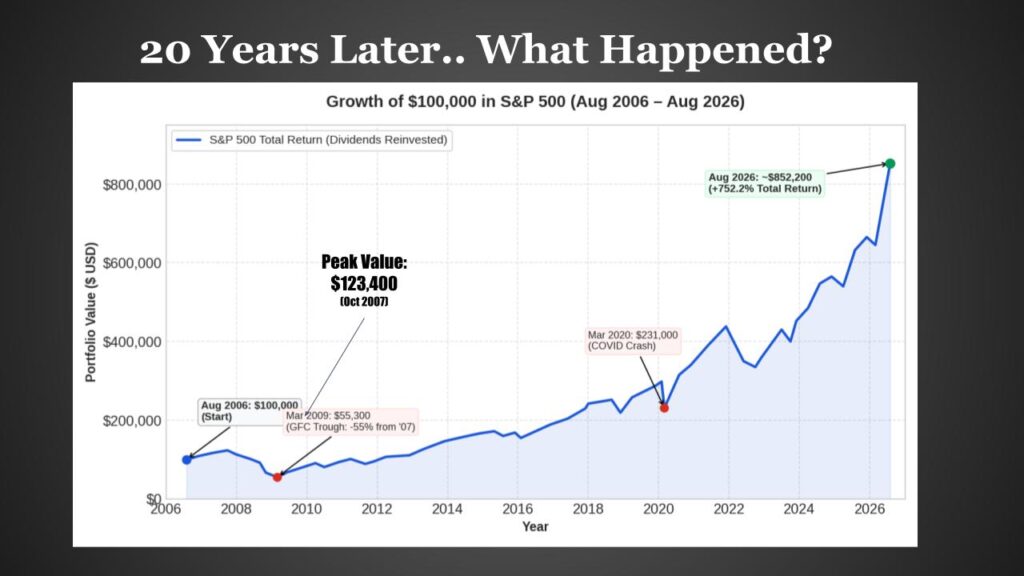
- The 2008 Global Financial Crisis (Housing Bubble): While different in its origins, the GFC shared a common thread with other bubbles: irrational exuberance and excessive leverage. Fueled by lax lending standards and speculative investment in real estate and mortgage-backed securities, the housing market experienced an unsustainable boom. When the bubble burst, it triggered a systemic crisis that led to the collapse of major financial institutions and a severe global recession. The S&P 500 index declined by approximately 57% from its October 2007 peak to its March 2009 low. This crisis underscored the dangers of complex, opaque financial instruments and the far-reaching consequences of market contagion.
- The 2020 COVID-19 Market Downturn: More recently, the onset of the COVID-19 pandemic caused a rapid, albeit short-lived, market downturn. In March 2020, the S&P 500 experienced one of its fastest-ever plunges into a bear market, dropping over 30% in a matter of weeks. However, unprecedented fiscal and monetary stimulus, combined with rapid technological adaptation (including a boost to many tech sectors), led to an equally swift recovery, demonstrating the market’s underlying resilience and capacity to rebound from external shocks.
These historical episodes highlight a recurring pattern: genuine technological innovation often coexists with speculative excess. While the core invention drives long-term progress, the accompanying market frenzy can lead to unsustainable valuations and subsequent corrections.

Long-Term Market Resilience and Global Progress
Despite the cyclical nature of market booms and busts, a long-term perspective reveals a consistent upward trend in global prosperity and market performance. Data from the past two decades, encompassing the dot-com bust, the GFC, and the COVID-19 downturn, paints a picture of remarkable resilience. For instance, a hypothetical $100,000 investment in a broad market index in 2006, despite navigating significant crises, would have grown substantially by 2026, illustrating the power of compound returns and market recovery over time. The average annual return of the S&P 500, including dividends, has historically been around 10-12% over extended periods, absorbing numerous downturns.

Beyond financial markets, global indicators of human well-being have shown significant improvement:
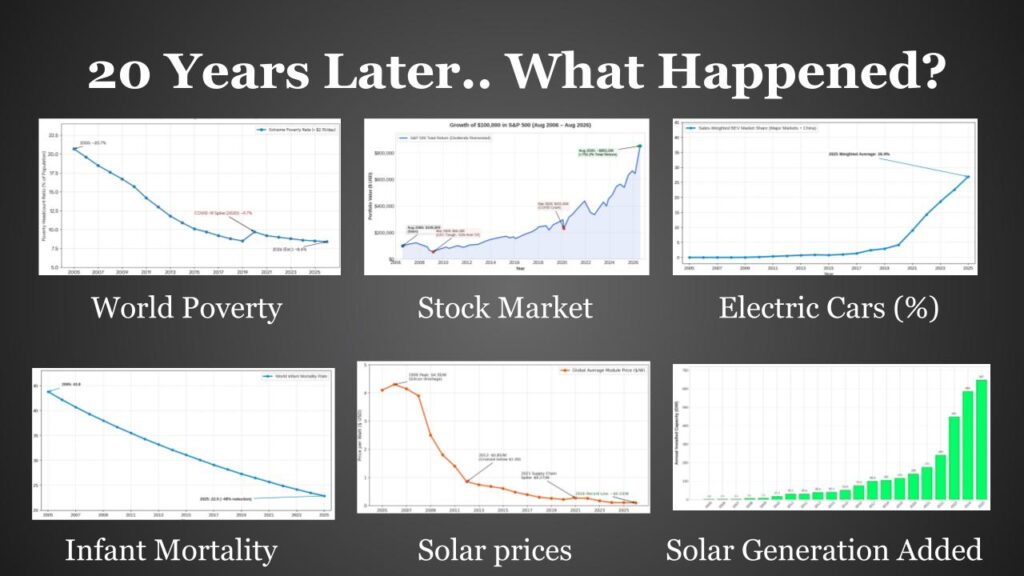
- Poverty Reduction: According to World Bank data, the proportion of people living in extreme poverty worldwide has dramatically decreased, from nearly 20% in 2005 to approximately 8% in recent years. This represents hundreds of millions lifted out of the most dire conditions.
- Infant Mortality: Global infant mortality rates have been cut by half over the past two decades, reflecting advances in healthcare, sanitation, and nutrition, as reported by organizations like UNICEF and the World Health Organization.
- Clean Energy Transition: The cost of solar photovoltaic (PV) technology has plummeted by approximately 90% over the last decade, making clean energy increasingly competitive. In 2023, solar power accounted for the vast majority of new electricity generation capacity added globally, equivalent to the output of hundreds of nuclear power plants.
- Electric Vehicle Adoption: Sales of pure electric vehicles (EVs) have surged from negligible levels to comprising about a quarter of all new car sales globally in the past year, with some countries like Norway achieving near 100% EV market penetration.
These advancements underscore a fundamental principle: sustained prosperity is primarily driven by productivity – the ability to produce more goods and services with the same or fewer resources. Financial systems and markets are reflections of this underlying productive capacity, not the sole determinants of wealth. When markets experience downturns, the physical infrastructure, human capital, and innovative tools remain, allowing for reconstruction and continued growth.
The Productivity Principle: AI as a Catalyst for Growth
The core argument for AI’s long-term positive impact lies in its potential to dramatically enhance productivity. By automating complex cognitive tasks, optimizing processes, and accelerating discovery, AI acts as a universal accelerator, akin to a "cognitive nail gun" that makes every intellectual endeavor more efficient.
Historically, every major technological leap – from the printing press to the steam engine, electricity, and the internet – has led to increased productivity, higher living standards, and the creation of entirely new industries and job categories. While AI is poised to displace workers in certain sectors, particularly in routine cognitive and manual tasks (e.g., data entry, customer service, eventually autonomous transportation), it simultaneously fosters the creation of new roles requiring human oversight, creativity, and ethical judgment. The challenge lies in managing this transition, requiring significant investment in education, retraining, and social safety nets to support displaced workers. However, the net effect, based on historical precedent, is often an expansion of economic opportunities and overall societal wealth.
Navigating Investor Psychology: Overcoming Fear

Despite the long-term upward trend in prosperity, investor behavior is frequently influenced by fear. Human beings are inherently wired as "danger detection machines," a trait that served survival in ancestral environments. However, in modern society, this mechanism can manifest as chronic anxiety about perceived threats, even when objective data suggests otherwise. This phenomenon, often exacerbated by the constant stream of negative news cycles, leads to a "moving of the goalposts" for worry – if one concern is resolved, another quickly takes its place.
Psychological biases, such as anchoring bias (over-relying on initial information) and the contrast effect (judging situations relative to others rather than absolute terms), contribute to this persistent fear. For instance, individuals may worry about "too much money" and the implications of Required Minimum Distributions (RMDs) in retirement accounts, a concern that would be incomprehensible to those facing genuine scarcity.

Combating this pervasive fear requires a multi-faceted approach:
- Self-Awareness: Understanding personal and familial histories that may contribute to scarcity mindsets or anxiety (e.g., childhood experiences, generational trauma).
- Fear Identification: Articulating specific fears and considering worst-case scenarios, often revealing them to be less catastrophic than initially imagined.
- Action and Resilience: Taking proactive steps, however small, to address concerns. Action builds confidence and "resilience" – the ability to adapt to any new situation.
- Information Diet Management: Critically evaluating news consumption, recognizing that media often prioritizes alarming stories over balanced reporting. Seeking in-depth, factual analyses rather than sensationalized headlines.
- Positive Behaviors and Community: Engaging in physically and mentally healthy activities, particularly outdoors, and fostering relationships with optimistic, solution-oriented individuals.
By adopting a mindset that views new developments, including AI, as "experiments" rather than inherent threats, individuals can shift from passive worry to active learning and engagement. This approach transforms uncertainty into an opportunity for growth and adaptation.

Implications and Forward-Looking Perspectives
The AI boom represents a profound technological shift with significant implications across economic and societal spheres.

- Economic Impact: AI promises to unlock unprecedented levels of productivity growth, potentially leading to lower costs for goods and services (deflationary pressures) and the creation of entirely new markets. However, it also presents challenges related to wealth distribution and the potential for increased economic inequality if the benefits are concentrated among a few.
- Societal Impact: The widespread integration of AI necessitates a proactive approach to workforce development, including massive reskilling and upskilling initiatives. Ethical considerations, such as bias in algorithms, data privacy, and the autonomous decision-making capabilities of AI, require robust regulatory frameworks and ongoing public discourse. Yet, AI also holds immense promise for addressing global challenges in areas like medicine, climate change, and education.
- Investment Strategy: For investors, the AI era reinforces the timeless principles of long-term, diversified investing. Rather than chasing speculative trends or reacting emotionally to market volatility, a disciplined approach focused on broad market exposure, consistent contributions, and periodic rebalancing remains the most robust strategy for wealth accumulation.
In conclusion, while the current AI-driven market surge evokes understandable concerns about potential bubbles and economic disruption, a historical and philosophical perspective suggests grounds for optimism. The underlying engine of human ingenuity and productivity continues to advance, driving long-term progress despite cyclical challenges. The true test lies not in avoiding fear, but in understanding its origins and harnessing it as a catalyst for learning, action, and building resilience in an ever-evolving world. As many financial philosophers suggest, the greatest rewards in life often reside on the other side of perceived fear, accessible only to those willing to embrace change with a proactive and informed mindset.

