
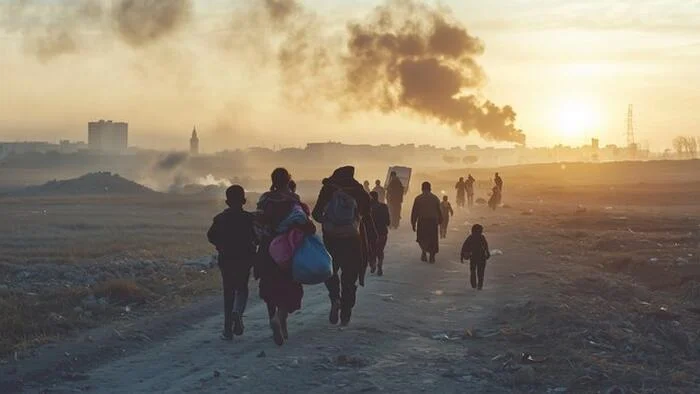
The United States’ extensive foreign policy, frequently critiqued for its escalating financial deficits and the profound human cost of overseas conflicts, also generates a less-discussed but equally significant consequence: the systematic engineering of domestic demographic shifts. This analysis, drawn from insights by the Mises Institute, posits that Washington’s continuous global interventions act as a potent engine of human displacement, fundamentally reshaping America’s own population in the process. While military power is projected abroad under pretenses of spreading democracy or ensuring global stability, the long-term, often unintended, outcome is a profound internal transformation that rarely enters mainstream political discourse.
The Thesis: Foreign Intervention as a Catalyst for Domestic Demographic Change
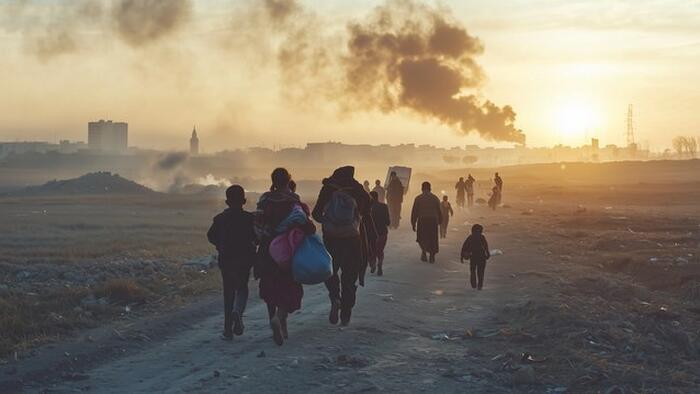
The core argument presented is that the political establishment routinely commits the American public to international interventions through various means—arming proxy forces, imposing severe economic sanctions, or direct military engagements. These actions invariably destabilize regions, trigger economic collapses, and forcibly uproot millions of civilians from their native lands. However, rather than merely containing the repercussions of these policies, the U.S. government, often referred to as the "imperial state" in this context, has institutionalized the resultant blowback. This is achieved through a vast network of state-funded refugee programs, parole initiatives, and temporary worker visas, effectively importing the very populations displaced by its foreign policy directly into American communities. This phenomenon echoes Robert Higgs’ "ratchet effect," where governmental interventions create crises that then justify further state expansion and intervention, albeit in a different context focusing on demographic rather than purely economic cycles.
A critical aspect of this analysis is the assertion that Americans are effectively subjected to a "dual tax" for the empire. First, taxpayers fund the immense expenditures on munitions, intelligence operations, and military equipment that contribute to the destabilization of foreign nations. Second, they are then compelled to subsidize the integration of the resulting diaspora into American society, covering costs associated with housing, education, healthcare, and other municipal services. This process, it is argued, occurs without the explicit consent or vote of the American populace or individual states. Presidential campaigns, in this view, deliberately obscure this intricate connection, as no grassroots movement has ever explicitly demanded endless war coupled with state-sponsored mass migration as a strategy for national improvement.
Demographic Transformation: An Irreversible Shift
The Mises Institute distinguishes between economic and demographic "ruin." While economic damage, such as that caused by fiat inflation, is theoretically reversible through policy changes like a return to a gold standard or severe deflationary corrections, demographic transformation is presented as fundamentally different. Once a nation’s cultural and demographic foundation is altered by statecraft, it is argued, reversing this change is exceedingly difficult, if not impossible. This perspective highlights the long-term, structural nature of demographic shifts compared to the more fluid and potentially reversible nature of economic cycles.
Historical Trajectories: From Post-WWII to the Present
To illustrate the scale of this state-engineered transformation, a chronological examination of U.S. demographic data and foreign policy interventions provides context.
-
Mid-20th Century Baseline: According to the U.S. Census Bureau, in 1950, the American population was predominantly white (87-89%), with approximately 10% black, and a Hispanic origin population of roughly 1.5%. The foreign-born share of the total population was steadily declining, reaching a historic low of 4.7% by 1970. This period represents a demographic baseline prior to the significant shifts analyzed.
-
Contemporary Landscape: By 2025, projections indicate the U.S. foreign-born population will have reached an unprecedented high of nearly 52 million people, constituting over 15.4% of the total population. This figure officially surpasses the previous historical peak of 14.8% recorded during the late 19th-century Ellis Island era. A crucial distinction drawn here is that, unlike the largely "organic immigration" driven by market forces during the 19th century, a substantial portion of today’s diaspora is directly attributed to the "imperial state’s own foreign policy failures."
Early Entanglements and Their Domestic Repercussions
The roots of this phenomenon are traced back to the dawn of the American empire following World War II, with earlier interventions also contributing.
-
Cuba (1898-Present): The U.S. intervention in Cuba’s revolt against Spain in 1898 permanently linked American foreign policy to the island. This entanglement set the stage for decades of intervention, culminating in the Cold War-era Castro regime. Today, a direct legacy of these cascading interventions is the presence of over 1.3 million Cuban immigrants residing in the United States, many arriving under specific refugee and parole programs designed for those fleeing the communist regime.
-
The Philippines (1898-Present): The same 1898 intervention expanded into the Pacific, leading to the annexation of the Philippines and the subsequent brutal Philippine-American War. This violent subjugation permanently tied the U.S. to the archipelago, resulting in mass migration waves. Filipinos now constitute one of the largest Asian demographic groups in America, with significant communities across the country, particularly in California and Hawaii.
Wartime Labor and Post-Conflict Resettlement
The demographic "ratchet" accelerated significantly during and after major conflicts.
-
The Bracero Program (1942-1964): During World War II, the federal government’s drafting of millions of American men created a substantial domestic labor shortage, particularly in agriculture. To address this self-created crisis, the state initiated the Bracero Program in 1942. This bilateral agreement with Mexico led to the issuance of 4.6 million contracts to Mexican laborers. While initially billed as a temporary wartime measure, the program endured for over 20 years, laying the groundwork for expansive, multi-generational Hispanic migration networks that profoundly transformed the demographic landscape of the American Southwest. This trend was further solidified when President Reagan’s administration granted amnesty to over 2 million undocumented Mexicans and hundreds of thousands of other undocumented immigrants in 1986.
-
The Korean War (1950-1953): The Korean War left millions displaced and permanently linked South Korea to the American military-industrial complex. This conflict initiated subsequent waves of immigration, including war brides, adoptions of Korean orphans, and later, familial migration, bringing millions of Koreans to the U.S. over the following decades. As of recent estimates, the Korean diaspora in the U.S. numbers over 1.8 million, forming a significant part of the Asian American community.
-
The Vietnam War (1955-1975): The disastrous and undeclared war in Vietnam resulted in widespread instability across Southeast Asia. What began as a wartime evacuation of 125,000 Vietnamese in 1975 quickly evolved into a massive resettlement program. Today, over 1.3 million Vietnamese immigrants reside in the United States, forming vibrant communities in California, Texas, and other states. Concurrently, the CIA’s "Secret War" in neighboring Laos, which recruited ethnic Hmong to fight proxy battles against communist forces, led to an identical demographic blowback. When the operation collapsed, over 100,000 Hmong refugees were displaced and subsequently funneled into American cities, particularly in Minnesota, Wisconsin, and California.
Cold War Interventions and Emerging Diasporas
The Cold War era also provided numerous examples of foreign policy leading to demographic shifts.
-
Iran (1953 Coup, 1979 Revolution): In 1953, the CIA orchestrated the overthrow of Iran’s democratically elected government, reinstating the Shah and committing Washington to decades of supporting an autocratic regime. When the inevitable anti-Western revolution erupted twenty-six years later in 1979, it triggered a significant exodus. Through federal refugee pipelines, such as the Lautenberg Amendment, the U.S. government subsidized the resettlement of displaced Iranians, resulting in a permanent diaspora of nearly 400,000 individuals now residing in the United States, many of whom are concentrated in Southern California.
-
Central America (1980s): During the 1980s, Washington’s covert interventions in Central America created a human tidal wave that continues to impact the U.S. southern border. In countries like El Salvador, Guatemala, and Nicaragua, the U.S. government spent the decade funding right-wing governments, arming Contra rebels, and fueling brutal civil wars. These proxy conflicts devastated local economies and resulted in tens of thousands of civilian casualties, causing massive waves of Central Americans to flee northward. By 1990, the Central American population in the U.S. had more than tripled. Today, over 4.3 million Central American immigrants reside in the United States, representing 9% of the total foreign-born population. This migration is posited not as organic immigration driven by market forces, but as a multi-generational crisis engineered by the CIA and the State Department.
Post-Cold War and the War on Terror: A Continuing Pattern
The pattern of intervention leading to displacement and subsequent resettlement continued into the post-Cold War era and intensified with the "War on Terror."
-
The Balkans (1990s): American intervention in the Balkans during the dissolution of Yugoslavia resulted in the domestic resettlement of more than 107,000 refugees from the former Yugoslavia, altering the demographic landscape of cities like Chicago and St. Louis, which developed significant Bosnian and Serbian communities.
-
Horn of Africa/Somalia (1990s-Present): Simultaneously, U.S. military entanglements in the Horn of Africa, marked by the infamous "Black Hawk Down" incident in Somalia and followed by decades of subsequent drone strikes, displaced millions of Somalis. The U.S. government subsequently began funneling these displaced populations directly into America. Under the Obama administration alone, the United States resettled approximately 43,000 Somali refugees. In states like Minnesota or Maine, the mass importation of Somalis is presented as being driven not by local community consent or organic labor demand, but by federal mandate, implying that Americans funded the interventions that displaced Somalis overseas and were then compelled to fund their municipal integration domestically.
-
Iraq (2003 Invasion): The 21st century’s "War on Terror" operated on the exact same paradigm. Following the 2003 invasion of Iraq, the U.S. admitted tens of thousands of Iraqi refugees, with 12,000 arriving in 2008 alone, fleeing the post-invasion instability and sectarian violence.
-
Syria (2011-Present): In Syria, Washington’s insistence on arming rebel factions to depose Bashar al-Assad, serving as a proxy conflict, fueled a brutal civil war that displaced millions internally and externally. As a direct result, the Syrian immigrant population in the United States doubled to over 122,000 between 2011 and 2021, with over 18,000 Syrian refugees formally resettled in the five-year period ending in 2016.
-
Afghanistan (2001-2021): The botched withdrawal from Afghanistan in 2021 saw the Biden administration utilize executive authority to rapidly parole over 70,000 Afghans into the United States through "Operation Allies Welcome." This represented a fraction of the broader million-plus regional diaspora shattered by twenty years of occupation, highlighting the immediate and direct connection between military action and population movement.
-
Ukraine (2022-Present): As Washington continues to funnel hundreds of billions of dollars to fuel a proxy war with Russia in Ukraine, the demographic consequences are rapidly materializing. Since February 2022, the Department of Homeland Security has admitted more than 250,000 Ukrainians into the United States, often utilizing streamlined parole programs and humanitarian pathways, demonstrating the ongoing cycle.
The Institutionalization of Refugee Resettlement
The Mises Institute argues that, rather than allowing private charity to address these refugee flows, the "imperial state" has institutionalized human displacement through a lucrative ecosystem of taxpayer-funded, non-governmental organizations (NGOs). The federal government channels billions of dollars through entities like the State Department’s Bureau of Population, Refugees, and Migration (PRM) and the Department of Health and Human Services (HHS). These agencies distribute federal grants to private voluntary organizations such as Catholic Charities USA, Global Refugee (formerly Lutheran Immigration and Refugee Service), the International Rescue Committee (IRC), and many others. For instance, in June 2023, Global Refugee was among 215 NGOs identified by the U.S. House of Homeland Security Committee as having received federal funding during the Biden administration to settle undocumented immigrants in the United States. These organizations, in this view, function as subsidiaries of the administrative state, often receiving the vast majority of their operational funding directly from federal coffers, thereby transferring the fiscal burden of imperial aggression directly onto local municipalities, public schools, and healthcare systems across America.
Official statements from government agencies and these NGOs typically frame these resettlement efforts as humanitarian imperatives, fulfilling international obligations and providing refuge to those fleeing persecution and conflict. They emphasize the moral duty to assist displaced populations and the benefits of diverse communities. However, the Mises Institute’s analysis challenges this framing by linking the need for such humanitarian aid directly to preceding U.S. foreign policy actions, thus presenting it as a consequence rather than an isolated act of benevolence.
Broader Implications and The "Leviathan" State
The overarching lesson, according to this perspective, is that one intervention invariably begets another. The "empire" is not merely spreading freedom abroad; it is simultaneously consuming the capital stock and the social fabric of the American people from within. Until Americans recognize that foreign interventions serve as the direct engine of both domestic impoverishment and massive, non-consensual demographic alteration, the "Leviathan" state is predicted to continue its march forward, leaving shattered nations overseas and a financially strained, demographically altered, and ultimately unrecognizable America in its wake. As Washington continues its global military engagements, the most pressing question, from this viewpoint, is not solely about the trillions of taxpayer dollars incinerated in conflict, but about the number of additional individuals who will be displaced and subsequently arrive in the U.S. as a direct result of ongoing interventions. This analysis challenges conventional understanding by proposing a direct, systemic link between U.S. foreign policy and its domestic demographic landscape, urging a re-evaluation of the true costs and consequences of global engagement.

