
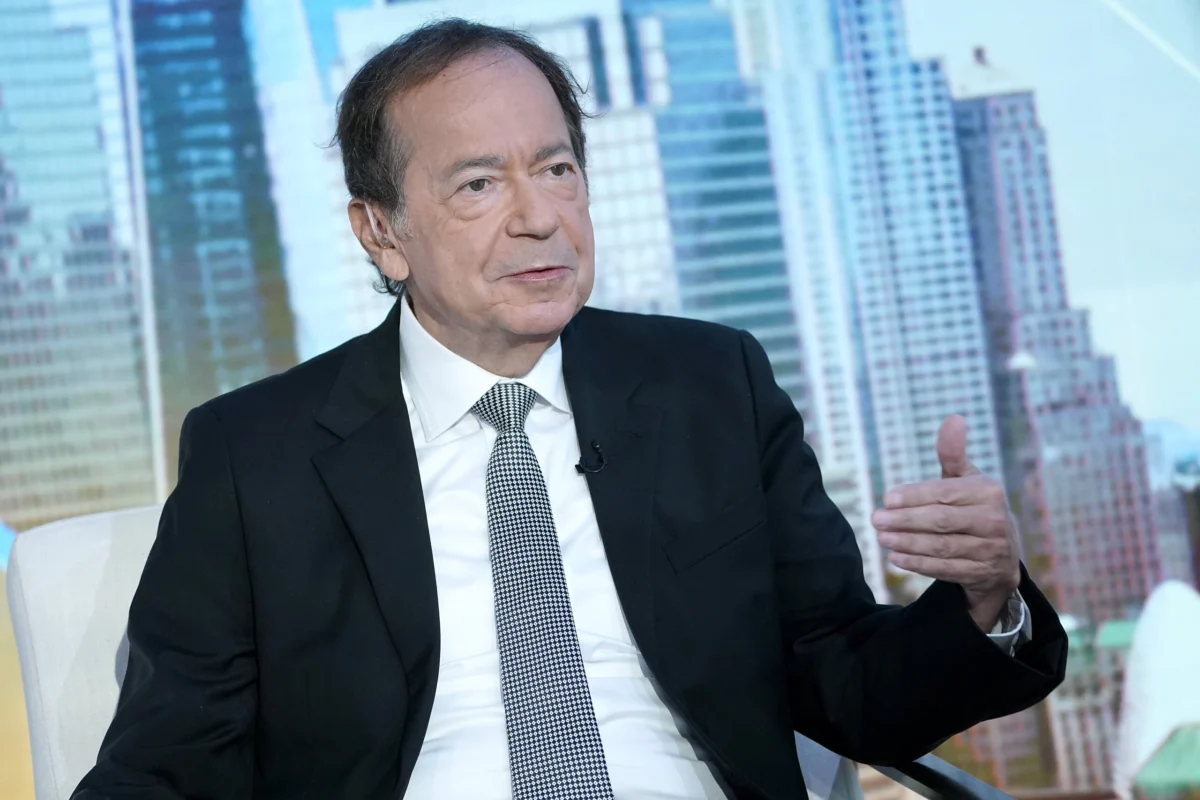
John Paulson, the renowned hedge fund manager who famously profited billions by shorting the U.S. housing market before pivoting to a bullish stance on gold, has articulated a strong conviction that the precious metal is merely at the nascent phase of an extended rally. Speaking on CNBC’s "The Exchange" on Wednesday, Paulson asserted, "I do think we’re in the beginnings or the early stages of a long-term bull market for gold." His core thesis hinges on the escalating erosion of confidence in traditional fiat currencies, positioning gold as an increasingly viable and indispensable alternative in the global financial architecture.
Paulson’s Macroeconomic Rationale: A Loss of Faith in Fiat Currencies
Paulson’s argument is rooted in a long-held belief that unprecedented levels of fiscal and monetary stimulus, particularly in the wake of significant economic crises, inevitably dilute the value of national currencies. He posits that as this trend continues globally, investors and institutions will increasingly gravitate towards gold as a store of value and a hedge against inflationary pressures. "As people lose faith in paper currencies, gold as an alternative will continue to grow," he elaborated, underscoring a fundamental shift in asset allocation strategies. This perspective echoes sentiments from various economic schools of thought that critique expansive monetary policies, such as quantitative easing and persistently low interest rates, for their potential to devalue currencies over time. The U.S. Federal Reserve, for instance, expanded its balance sheet from less than $1 trillion before the 2008 financial crisis to over $4.5 trillion by 2015, and further to nearly $9 trillion during the COVID-19 pandemic, injecting trillions of dollars into the financial system. Such actions, while intended to stabilize economies, are often cited by gold advocates as direct contributors to currency debasement concerns.
A History of Prescient Bets: From Subprime to Gold
Paulson’s journey to becoming a prominent gold advocate is marked by a history of remarkably prescient investment calls. His firm, Paulson & Co., achieved legendary status on Wall Street for its audacious and highly profitable wager against the U.S. subprime mortgage market between 2006 and 2008. Through the strategic use of credit default swaps, Paulson foresaw the impending collapse of the housing bubble, generating an estimated $15 billion for his investors and personally earning billions. This trade, immortalized in Michael Lewis’s book "The Big Short," cemented his reputation as an astute macro investor capable of identifying systemic vulnerabilities.
Following the tumultuous events of the 2008 global financial crisis and the subsequent flood of government bailouts and central bank interventions, Paulson shifted his strategic focus in 2009. He reasoned that the massive fiscal and monetary stimuli, designed to avert a deeper depression, would inevitably lead to a weakening U.S. dollar and a resurgence of inflation. This conviction led him to pivot heavily into gold, a move that proved equally sagacious. Since his initial foray, gold prices have seen substantial appreciation, illustrating the long-term validity of his thesis. While precise figures vary depending on the starting point, gold prices have roughly quadrupled from their pre-2009 levels, topping the $5,000 threshold in some specific instances before experiencing typical market pullbacks and consolidations. This performance stands in stark contrast to the period prior to 2000, when gold largely languished, demonstrating a significant paradigm shift in its investment appeal.
Broadening Demand: Central Banks and Private Sector Fueling the Rally
A critical component of Paulson’s long-term bullish outlook is the expanding base of demand for the yellow metal. He specifically highlighted the increasing appetite from both sovereign entities and private investors. "Gold is becoming the most apt reserve currency in the world, replacing fiat currencies," Paulson declared, emphasizing a perceived global trend towards de-dollarization and diversification among central banks.
Data from organizations like the World Gold Council consistently supports this assertion. Central banks globally have been net buyers of gold for over a decade, accelerating their purchases in recent years. In 2022, central banks recorded the highest level of annual gold demand since 1950, purchasing 1,136 tonnes, a 152% increase year-on-year. This trend continued robustly into 2023 and early 2024. Nations such as China, Russia, India, Turkey, and Poland have been particularly active accumulators, citing reasons ranging from geopolitical diversification and hedging against currency volatility to reducing reliance on the U.S. dollar. These strategic purchases underscore a global shift in reserve asset management, moving away from an almost exclusive reliance on major fiat currencies.
Concurrently, private sector interest, encompassing retail investors, institutional funds, and high-net-worth individuals, has also seen a significant uptick. This demand is driven by a confluence of factors including inflation concerns, geopolitical instability, and the persistent allure of gold as a "safe haven" asset during times of market uncertainty. The advent of easily accessible gold-backed exchange-traded funds (ETFs) has also democratized gold investment, allowing a broader spectrum of investors to gain exposure without the complexities of physical storage.

The Case for Gold Miners: Leveraging Resource Potential
Beyond direct ownership of bullion, Paulson presented a compelling argument for investing in gold mining companies, particularly those possessing substantial undeveloped reserves. He posited that gold miners offer investors leveraged exposure to rising gold prices, as their operational costs are relatively fixed while their revenue potential scales directly with the price of the commodity they extract. "I think the greatest way to invest is to invest in early-stage gold stocks," he advised, suggesting that the market often undervalues the long-term potential of companies sitting on vast, unexploited gold deposits.
This strategy offers a higher beta to gold prices; meaning, a small percentage increase in gold prices can translate into a larger percentage increase in the profitability and stock price of a mining company, especially those with high operational leverage. Conversely, they can also experience larger declines if gold prices fall. However, Paulson’s focus on "early-stage" companies with "large undeveloped reserves" suggests a preference for long-term growth potential over immediate production, aligning with his long-term bullish view on gold itself.
NovaGold and the Donlin Gold Project: A Strategic Investment
Paulson’s comments coincided with a significant corporate development: NovaGold Resources’ announcement of its acquisition of Paulson Advisers’ 40% stake in the Donlin Gold project in Alaska. Paulson, who serves as co-chairman of NovaGold, explicitly endorsed the company as a prime investment vehicle for those seeking exposure to gold. He highlighted NovaGold’s substantial resource base, stating, "NovaGold has 40 million ounces of gold indicated and measured resources and reserves at the market [capitalization] of $4.2 billion." This statement underscores the potential value embedded in NovaGold, particularly when benchmarked against its current market valuation.
The Donlin Gold project, located in southwestern Alaska, is widely considered one of the world’s largest undeveloped gold deposits. It boasts a significant resource estimate, with measured and indicated gold resources totaling approximately 39 million ounces, making it a cornerstone asset for NovaGold. The project is a joint venture between NovaGold and Barrick Gold, one of the world’s largest gold mining companies. Its development involves substantial capital expenditure and a lengthy permitting process, but its sheer scale offers immense long-term upside potential should gold prices continue their upward trajectory as Paulson predicts. For Paulson, the acquisition of his firm’s stake by NovaGold itself signifies a consolidation of ownership and a clear commitment to maximizing the value of this strategic asset, aligning his personal investment thesis with the company’s direction. He concluded his recommendation by stating, "I think the best way to play gold is through stocks like NovaGold, if not NovaGold itself," a strong endorsement from an investor whose past calls have shaped market narratives.
Broader Market Implications and Future Outlook
Paulson’s renewed bullish stance on gold arrives at a time when global economic uncertainties remain elevated. Persistent inflation, even if moderating, continues to erode purchasing power, while geopolitical tensions in Eastern Europe and the Middle East keep investors on edge. The specter of a potential global recession, coupled with the ongoing debate about the long-term efficacy and consequences of ultra-loose monetary policies, further strengthens the narrative for gold as a hedge.
Analysts are increasingly observing a divergence in global economic policies. While some central banks, notably the U.S. Federal Reserve, have embarked on aggressive interest rate hiking cycles to combat inflation, others are grappling with different economic realities. This fragmented global monetary landscape, coupled with record levels of national debt across many developed economies, creates an environment ripe for questioning the stability of traditional financial assets and currencies. Gold, lacking counterparty risk and universally recognized as a store of value for millennia, inherently benefits from such skepticism.
However, it is also important to acknowledge potential headwinds for gold. A sustained period of high real interest rates, for instance, could diminish gold’s appeal as it is a non-yielding asset. A significantly stronger U.S. dollar could also exert downward pressure on gold prices, as gold is typically priced in dollars and becomes more expensive for holders of other currencies when the dollar strengthens. Yet, Paulson’s long-term perspective suggests he views these as transient factors against the backdrop of more profound, structural shifts in the global financial system.
In conclusion, John Paulson’s steadfast belief in gold’s long-term potential reflects a deeper conviction about the evolving nature of global finance. His argument, built on the foundations of currency debasement and broadening institutional and private demand, positions gold not merely as a speculative asset but as an increasingly essential component of diversified portfolios and sovereign reserves. His specific endorsement of gold miners like NovaGold further refines this strategy, offering a pathway for investors to gain leveraged exposure to what he anticipates will be a multi-decade bull market for the precious metal.

