
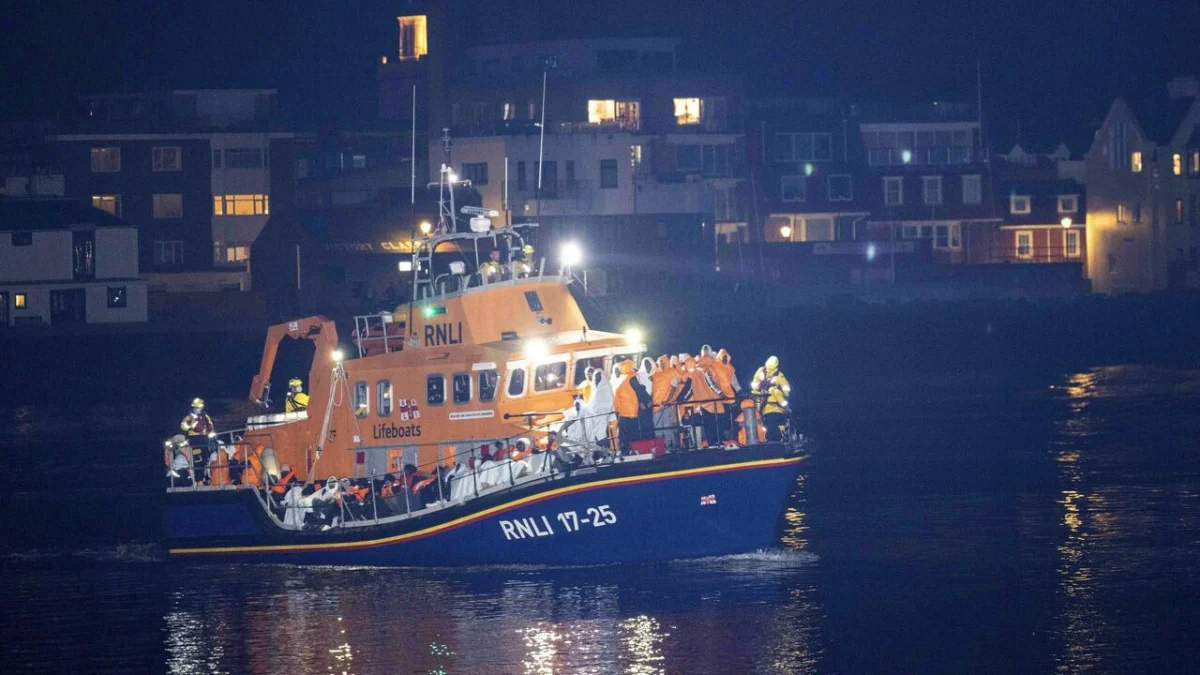
Gosport, Hampshire – Residents of Gosport, the historic Royal Navy harbor town situated directly across the Solent from Portsmouth, experienced an unprecedented Sunday marked by stringent police directives that granted officers powers to order individuals to leave the town. This extraordinary measure was implemented as a migrant boat, carrying 149 individuals, made its way from France towards the British coastline, eventually landing in Gosport. The event triggered significant local unrest, culminating in protests, arrests, and a renewed focus on the contentious issue of irregular migration across the English Channel.
Unfolding of Events and Police Response
The sequence of events began on Sunday morning, October 4, 2026, when a small boat departed from Normandy, specifically near Utah Beach, embarking on the perilous journey across the English Channel. As the vessel neared the British coast, authorities in Hampshire prepared for its potential arrival. In anticipation of public gatherings and potential disruption, the Hampshire and Isle of Wight Constabulary enacted a Section 34 dispersal order. This measure, derived from the Anti-Social Behaviour, Crime and Policing Act 2014, was imposed across the entirety of Gosport, commencing on Sunday and remaining in effect until 7:00 AM on Tuesday. The order provided police officers with the authority to direct individuals to vacate a specified area and prohibit their return for a set period, with non-compliance constituting a criminal offense. This robust police presence and the unusual application of such a wide-ranging order underscored the perceived sensitivity and potential volatility of the situation.
Late Sunday evening, the migrant vessel reached the Gosport coastline. Two lifeboats from the Royal National Lifeboat Institution (RNLI), acting on their humanitarian mandate to save lives at sea, successfully brought all 149 people ashore. These individuals were subsequently transferred onto waiting coaches and transported to Kent, where they would undergo the standard processing procedures, including health assessments, security checks, and biometric data collection. The operation, conducted under the cover of darkness and a heavy police escort, aimed to expedite the disembarkation and onward transfer while managing local opposition.
A Shifting Migratory Route and Escalating Tensions
This incident marks a notable shift in the preferred routes for small boat crossings. Historically, the vast majority of such arrivals have targeted the Dover Strait and Kent coastline, the shortest crossing point between France and the UK. However, the Gosport landing represents the third such crossing directed towards the western Channel coast within a single month, signaling a potential diversification of routes by people smugglers. This evolving pattern poses new challenges for maritime law enforcement and border agencies, which have traditionally concentrated resources on the Dover-Calais corridor.
The landing in Gosport did not occur in isolation. Just two weeks prior, a similar boat carrying approximately 50 migrants had been rerouted to Dover after encountering local protests at its intended western Channel destination. This earlier incident highlighted growing community frustration and the increasing willingness of local populations to voice their opposition to these arrivals, particularly when they occur outside established processing hubs.
The underlying tensions on this stretch of coast had been simmering for weeks. On September 22, Daniel Thomas, a Hayling Island resident and anti-migrant activist known online as "Danny Tommo," was involved in an alleged incident where he slashed a migrant boat in the Channel, reportedly with an emergency responder onboard. Thomas, aged 37, has since pleaded not guilty to charges of criminal damage and refusing to provide his phone PIN to police. He was denied bail at Portsmouth Crown Court on September 29, with his trial provisionally scheduled for March 2027. This high-profile case exemplifies the intense and often volatile nature of the public debate surrounding Channel crossings.

Local Protests and Arrests
Despite the imposition of the Section 34 dispersal order, a significant number of demonstrators gathered in Gosport on Sunday. According to reports from the Portsmouth News, approximately 350 individuals turned out to protest the landing. The demonstrations were characterized by reports of flares being discharged and scuffles breaking out between protesters and police officers. By Monday, October 5, twelve individuals had been arrested in connection with the protests, facing various charges including assaulting a police officer. This followed a similar protest last month, which also resulted in six arrests.
Footage circulated widely on social media platforms overnight, capturing the scene as RNLI lifeboats arrived after dark, and subsequently, the extensive police escort accompanying the coaches transporting the migrants out of town. Comments accompanying these videos, such as those from Cllr George Madgwick, highlighted the public’s perception of the scale of resources deployed for the operation. One widely shared video, purportedly drone footage, depicted the arrival and departure sequence, drawing comments that questioned the government’s approach and the perceived secrecy of the operation. Another user expressed astonishment at the "lengths the police and government are going to to facilitate this ‘invasion’," likening the security motorcade to that of a high-profile dignitary.
Official Reactions and Political Ramifications
The incident elicited strong reactions from local political figures, who expressed both frustration with the situation and concern over the lack of communication from central government. Caroline Dinenage, the Conservative Member of Parliament for Gosport, voiced her unequivocal opposition to the use of Gosport as a landing site. "Gosport is not a safe or suitable location to disembark small boats," she stated, advocating for a policy where any small boat intercepted in the Channel should be directly transported to Dover by water, echoing the Home Office’s action two weeks prior. Her statement underscored a common sentiment among coastal MPs who feel their communities are unprepared and ill-equipped to handle such arrivals.
Cllr George Madgwick, who leads the Reform UK party on Hampshire County Council, offered an even more pointed critique. Expressing profound disappointment, he remarked, "It’s heart-breaking because Portsmouth Harbour is the home of the Royal Navy… Britain is Broken." His comments reflect a sentiment among some that allowing migrant boats to land in such a symbolically significant location undermines national pride and security.
The Economic Burden on Local Taxpayers
Beyond the immediate logistical and social challenges, the financial implications of policing these events are a significant concern for local authorities. Donna Jones, Hampshire’s Police and Crime Commissioner, revealed the substantial cost incurred by local taxpayers for each such incident. "On each one of the protests that are happening every time we have one of these threats of a small boat landing, it is costing me £150,000 of taxpayers’ money from my police budget, which I can ill afford to spend," Jones stated. This figure represents a considerable drain on local policing resources, diverting funds that could otherwise be allocated to tackling other forms of crime or community initiatives.
In a video message, Commissioner Jones appealed directly to the Home Secretary, urging the central government to ensure that Border Force is equipped with vessels of sufficient size to transfer individuals from dinghies at sea and transport them directly to Dover for processing. This proposal aims to streamline the process, reduce the need for controversial coastal landings, and potentially mitigate the costs associated with local policing of protests.

Broader Context: The UK’s Migrant Crisis
The events in Gosport unfold against the backdrop of an ongoing and complex national debate about irregular migration to the UK via the English Channel. The British government has made "stopping the boats" a key policy priority, introducing various legislative and operational measures aimed at deterring crossings and expediting returns. Despite these efforts, thousands of individuals continue to attempt the perilous journey each year, often in flimsy, overcrowded dinghies organized by criminal gangs.
In 2023, official figures showed over 29,000 migrants crossed the Channel in small boats, a slight decrease from the peak in 2022 but still a substantial number. The Home Office estimates that the total cost of asylum claims, including accommodation and support for asylum seekers, runs into billions of pounds annually. The public debate is often polarized, with humanitarian organizations emphasizing the need to protect vulnerable individuals and provide safe routes, while others call for stricter border controls and more robust enforcement to prevent illegal entry.
The RNLI, an independent charity, frequently finds itself at the center of this political storm. Its volunteers are committed to saving lives at sea, a mission that does not differentiate between nationalities or circumstances. This unwavering commitment, however, often places them in direct opposition to those who argue that rescuing migrants encourages further crossings, leading to criticism and even threats against their crews.
Government Response and Future Outlook
On Monday, following the Gosport incident, a government spokesperson issued a statement affirming the existence of "contingency plans to make sure we can securely disembark, check and process all small boat arrivals." While reassuring, this general statement did not specifically address the concerns raised by local politicians regarding the suitability of Gosport as a landing site or the costs borne by local police forces.
The ongoing challenge for the UK government remains multi-faceted: how to effectively deter illegal crossings, manage the humanitarian aspects of arrivals, process asylum claims efficiently, and maintain public order, all while navigating intense political and public scrutiny. The shift in landing locations, as seen in Gosport, suggests that people smugglers are adapting their tactics, potentially in response to increased surveillance and interdiction efforts in the Dover Strait. This adaptability necessitates a dynamic and flexible response from UK authorities, which will likely involve further investment in maritime capabilities, intelligence sharing with French counterparts, and continued efforts to disrupt smuggling networks.
The Gosport incident serves as a stark reminder of the complexities and human impact of the Channel migration crisis. It highlights the strain on local communities, the significant resources required for policing and processing, and the deep divisions within public opinion. As long as the root causes of migration persist and irregular routes remain viable, coastal towns like Gosport may continue to find themselves on the front lines of a national and international challenge, with local taxpayers bearing a significant part of the burden. The quest for a sustainable, humane, and effective solution remains a critical and elusive goal for policymakers.

