
Fermi America, a company with audacious plans to fuse high-performance computing with next-generation nuclear energy, has achieved a significant milestone, receiving a preliminary recommendation from the Nuclear Regulatory Commission (NRC) staff for combined licenses to build four advanced nuclear reactors. This pivotal development, outlined in a draft environmental impact statement (DEIS) released for public comment on October 9th, signals a crucial step forward for Project Matador, Fermi’s ambitious power and artificial intelligence campus slated for construction outside Amarillo, Texas. However, this regulatory progress unfolds against a backdrop of intense corporate upheaval, including a leadership change, legal battles with a co-founder, and a complex, albeit vital, financing arrangement for its inaugural major tenant.
NRC’s Preliminary Nod to Nuclear Expansion
The NRC staff’s preliminary recommendation supports the issuance of combined licenses (COLs) for four Westinghouse AP1000 reactors. A COL streamlines the licensing process by combining the construction permit and operating license, granted once the plant is built and inspected to meet all safety and environmental requirements. This decision follows an intensive 15-month application period and is particularly notable as Fermi America itself prepared the draft environmental impact statement. This marks the first real-world test of an NRC pilot program designed to allow applicants to prepare their own environmental reviews under staff supervision, a process the agency anticipates will halve its internal review time. The innovative approach aims to accelerate the deployment of new nuclear technology, addressing concerns about the protracted timelines historically associated with nuclear plant development in the United States.
The Westinghouse AP1000 is a Generation III+ pressurized water reactor, known for its advanced passive safety systems that rely on natural forces like gravity and convection to cool the reactor in an emergency, rather than requiring active pumps or human intervention. This design feature has been lauded for enhancing safety and simplifying operational procedures, making it a frontrunner in discussions about future nuclear power generation. If approved and constructed, the four AP1000 units at Project Matador would collectively contribute over 4.4 gigawatts (GW) of carbon-free electricity to Fermi’s private grid, a substantial addition that underscores the scale of the company’s vision for energy independence and reliability for its data center operations. For context, 4.4 GW is roughly equivalent to the power output of four large conventional coal-fired power plants or several thousand wind turbines, highlighting the immense generation capacity planned.
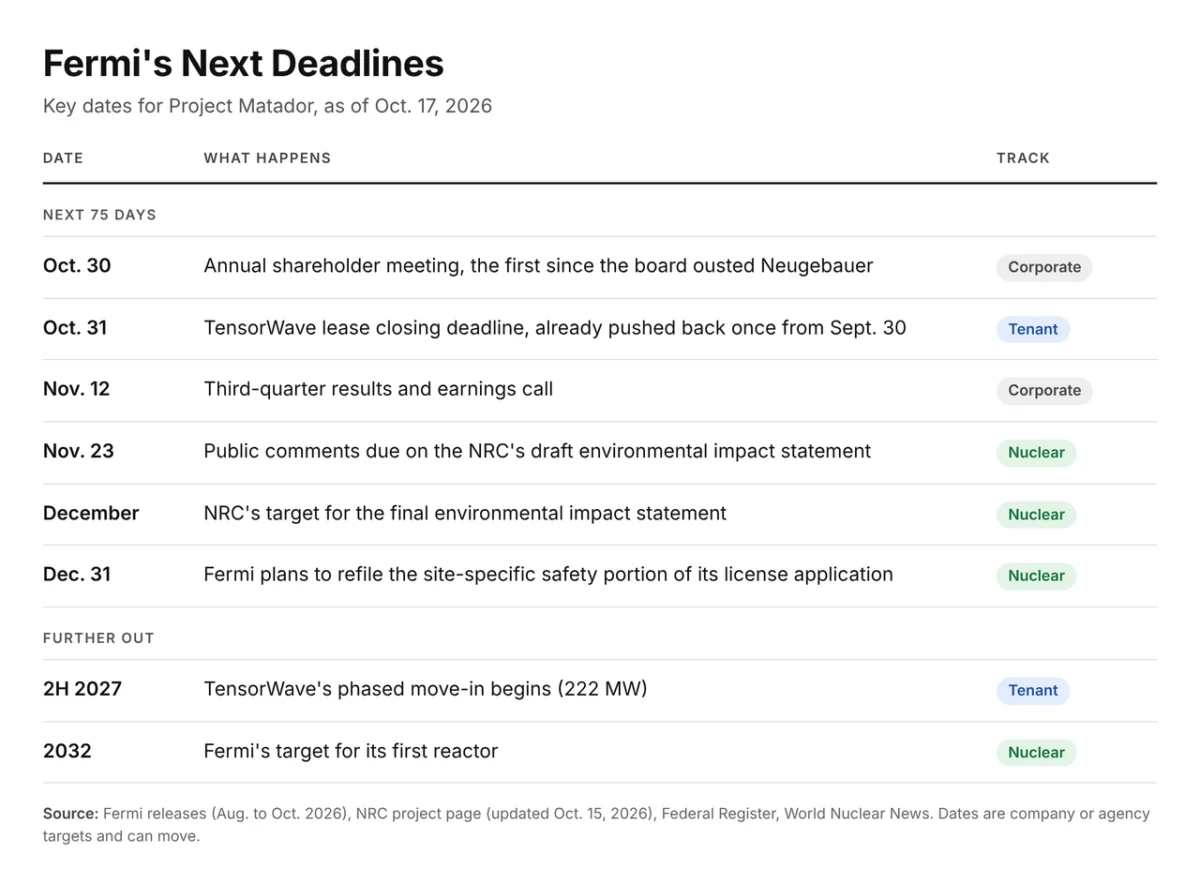
The draft environmental impact statement is currently open for public comment, a standard procedure designed to ensure transparency and incorporate community feedback. The NRC is targeting a final version of this statement in December. While environmental approval is a significant hurdle, it is only one component of the comprehensive regulatory process. The more formidable challenge lies in the safety review, which currently has no scheduled completion date. Fermi has strategically pulled the site-specific portion of its application, intending to refile it by December 31st. Following the completion of the safety review, a mandatory hearing and a final vote by the NRC Commission will be required before the combined licenses are definitively issued. Fermi America has publicly stated its ambition to have its first reactor operational by 2032, a timeline that, while aggressive for a nuclear project, suggests the company views navigating the NRC’s labyrinthine regulatory path as a manageable, albeit complex, undertaking.
Project Matador: A Vision for AI and Energy Independence
Project Matador represents a convergence of critical modern technologies: advanced nuclear power and artificial intelligence. Located outside Amarillo, Texas, the site is envisioned as a sprawling campus housing massive data centers powered by an on-site, private nuclear grid. The strategic choice of Amarillo, a region known for its vast expanses of land and proximity to existing energy infrastructure, aligns with the requirements for such a large-scale industrial development. The concept of a "private grid" is central to Fermi’s strategy, offering enhanced energy security, resilience, and independence from the broader, often strained, public electricity grids. As AI workloads continue to skyrocket, demanding unprecedented levels of consistent, high-density power, nuclear energy emerges as a uniquely suitable solution due to its baseload generation capabilities and zero-carbon emissions. The ability to control its own power supply mitigates risks associated with grid instability, price volatility, and supply shortages, all of which are critical considerations for energy-intensive data centers. This self-contained energy ecosystem is designed to provide the reliable, uninterrupted power essential for running sophisticated AI models and data processing at scale.
A Tumultuous Corporate Journey: From Setbacks to a Breakthrough Tenant
While the regulatory front shows promising signs, Fermi America’s corporate journey has been fraught with significant challenges, particularly concerning its financial stability and leadership. The company faced a tumultuous period last year, highlighted by a stark warning in November about its struggle to secure its first major data center tenant. This apprehension materialized into a financial crisis a month later when the company’s stock plummeted by 50% after a prospective tenant withdrew from a $150 million construction funding agreement. The inability to secure anchor tenants cast a long shadow over the project’s viability, signaling deep investor skepticism.
The corporate turmoil intensified in April when shares crashed another 22% following the abrupt ousting of co-founder and CEO Toby Neugebauer by the board, compounded by the simultaneous resignation of the Chief Financial Officer. At the time, market analysts, including this publication, critically observed that "without tenants there is no company," underscoring the existential threat posed by the lack of committed customers for its data center capacity.
However, a pivotal breakthrough occurred in August when Fermi announced a binding 15-year lease agreement with TensorWave, an AMD-only GPU cloud provider. This landmark deal is for 222 megawatts (MW) of capacity, valued at approximately $6.5 billion over the lease term, with options for TensorWave to expand its footprint beyond 650 MW. The agreement, promising phased delivery starting in the second half of 2027, provided a much-needed lifeline and a tangible demonstration of market demand for Fermi’s services. It validated, at least on paper, the company’s core business model and offered a crucial proof point to investors and future tenants.
Despite the excitement surrounding the TensorWave deal, its finalization has not been without complications. The initial closing deadline, set for September 30th, was subsequently extended to October 31, 2026, to allow for the completion of a lease guarantee and the securing of necessary project financing. This extension underscores the complexity of large-scale infrastructure financing, especially for a project of this magnitude and novelty. A significant development in this regard came recently when Advanced Micro Devices (AMD) agreed to provide credit support for the TensorWave lease. This arrangement highlights a deeper, somewhat circular, financial ecosystem: AMD supplies its GPUs to TensorWave, has reportedly invested in TensorWave, and is now backing TensorWave’s lease with Fermi. This intricate web of financial and operational relationships suggests a strategic alignment aimed at de-risking the project and ensuring the viability of the GPU cloud provider, which is a critical customer for AMD’s high-performance chips. While such arrangements can provide stability, they also invite scrutiny regarding potential dependencies and concentration of risk within a tightly integrated supply chain.
Challenges in Power Delivery and Infrastructure Development
The ambitious timelines for power generation at Project Matador have also faced adjustments. Last November, Fermi America had optimistically promised "1 GW of capacity online by late 2026." However, as of August, this goal post has shifted significantly, with the company now projecting "about 200 megawatts of initial commercial power over the next six months." This revision reflects the inherent complexities and potential delays in developing large-scale energy infrastructure, even for interim power solutions.
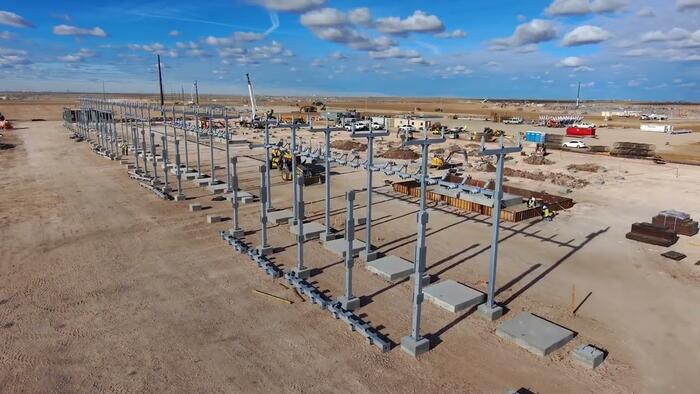
To bridge the gap until the nuclear reactors come online, Fermi has been deploying a fleet of gas turbines. The company has taken delivery of six Siemens SGT-800 gas turbines, which collectively account for nearly 300 MW of capacity. These units are known for their efficiency and flexibility, suitable for combined heat and power applications. Additionally, three larger Siemens F-class units, typically used for utility-scale power generation, and three GE Vernova 6B turbines have recently arrived at the Project Matador site. The 6B gas turbine is a robust and reliable workhorse in the energy industry, often used for baseload and peaking power. The deployment of these turbines is critical for providing the initial commercial power needed to support the phased delivery of data center capacity, especially for tenants like TensorWave, whose operations are slated to begin in the latter half of 2027.
To manage this growing fleet of power generation assets, Fermi has brought in specialized expertise. NAES Corporation, a prominent power plant operations and maintenance provider, has been hired to run the on-site power generation fleet. Furthermore, Hillcore Energy Capital has signed a framework agreement to finance, build, and ultimately own an additional 2.6 GW of power generation capacity at the site. These partnerships are crucial for Fermi, allowing it to leverage external capital and operational expertise to meet its immense power requirements, particularly as it scales up its data center operations in parallel with the nuclear plant development.
Internal Strife: The Founder’s Legal Battle
Adding another layer of complexity to Fermi America’s narrative is the ongoing legal battle initiated by co-founder and former CEO Toby Neugebauer. Still the company’s largest shareholder, Neugebauer filed a lawsuit in May following his ouster, alleging impropriety in his removal. This legal challenge represents a significant internal distraction and a potential source of instability for the company.
In July, Neugebauer briefly suspended a campaign to call for a special meeting of shareholders, an action typically aimed at influencing board composition or corporate strategy. However, his efforts to challenge the board’s authority faced a setback last month when a Texas Business Court judge declined to temporarily block new voting rules and a 70% supermajority bylaw that the board adopted after his dismissal. These measures effectively consolidate power within the current board, making it significantly more difficult for any single shareholder or group to force changes. Undeterred, Neugebauer has since broadened his legal offensive, suing three individual directors, alleging a coordinated effort to seize control of the company and disenfranchise other Fermi shareholders. This ongoing legal dispute could prolong uncertainty, divert management attention and resources, and potentially impact investor confidence.
Amidst this internal turmoil, the board made a strategic move in August by appointing Lee McIntire as the new Chief Executive Officer. McIntire brings a wealth of experience from the energy and engineering sectors, having previously served as CEO of TerraPower, a nuclear innovation company co-founded by Bill Gates, and holding a distinguished career at Bechtel, a global engineering, construction, and project management firm with extensive experience in nuclear projects. His appointment signals a clear intent by the board to bring seasoned leadership with deep expertise in large-scale infrastructure and nuclear development, potentially aiming to restore investor confidence and provide steady stewardship during this critical phase of the company’s growth.
Broader Implications and The Road Ahead
Fermi America’s journey encapsulates the multifaceted challenges and opportunities at the intersection of energy, technology, and corporate governance. The preliminary NRC approval for its nuclear plans is a monumental step, signaling a potential path for future nuclear development in the U.S., particularly through the innovative applicant-prepared DEIS pilot program. If successful, this could become a blueprint for accelerating the deployment of advanced nuclear reactors, a critical need as the demand for clean, reliable baseload power surges, driven significantly by the exponential growth of artificial intelligence. The 4.4 GW capacity represents not just a business venture but a significant contribution to the national energy landscape and potentially a model for private, energy-intensive campuses.
However, the project’s ambitious scope is matched by its inherent risks. The delays in bringing initial power online, the complexities of securing project financing, and the internal strife stemming from the founder’s legal battles all underscore the precarious balance Fermi must maintain. The TensorWave lease, backed by AMD, is a crucial de-risking factor, providing a foundational revenue stream and market validation. Yet, the extended closing date and the intricate financing structure highlight the ongoing need for careful execution and robust financial backing.
The next few weeks and months will be critical for Fermi America. Key milestones include the finalization of the TensorWave lease agreement, the refiling of the site-specific portion of the nuclear application by December 31st, and the ongoing progress towards the final environmental impact statement. Simultaneously, the company must navigate the founder’s lawsuits and continue to build out its interim power infrastructure. The success or failure of Project Matador will not only determine the future of Fermi America but could also offer profound lessons for the broader industry, influencing how large-scale AI infrastructure is powered and how advanced nuclear technology is brought to market in the 21st century. The world watches as Fermi endeavors to transform a vast Texan landscape into a beacon of nuclear-powered AI innovation, all while confronting a whirlwind of corporate and regulatory complexities.

