
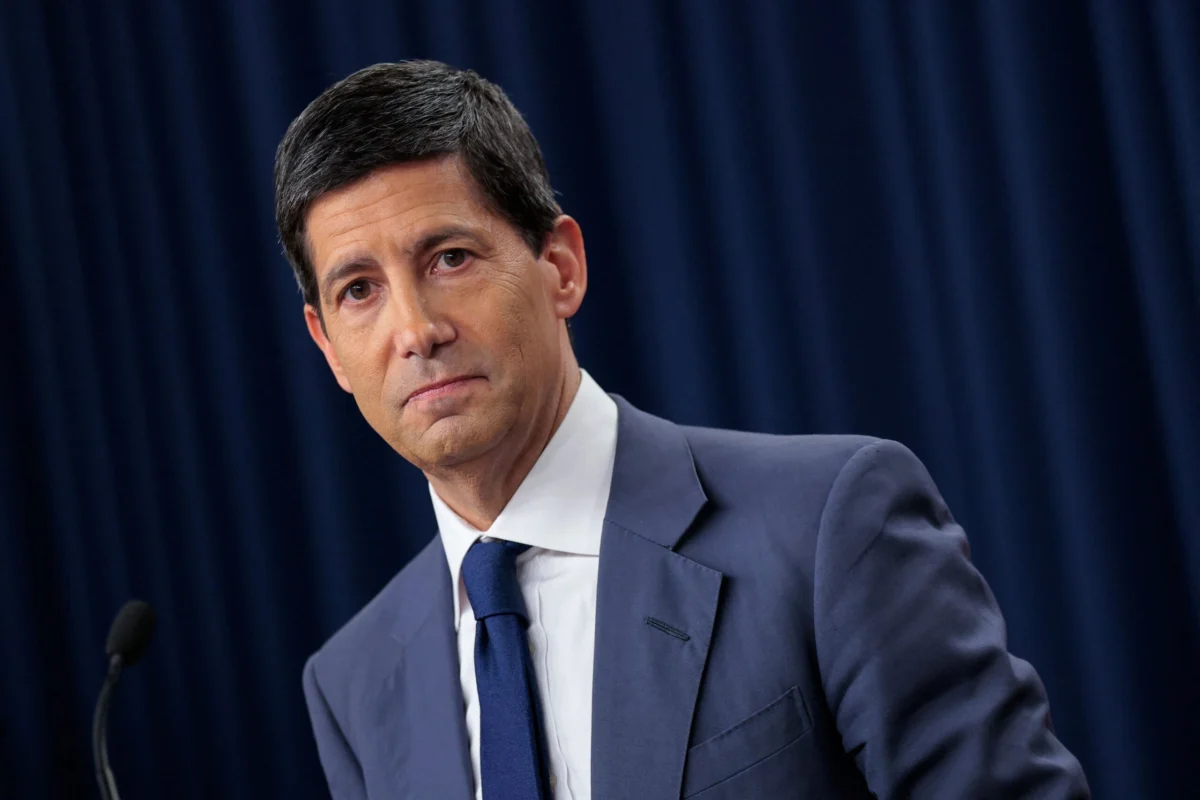
The Federal Reserve finds itself at a pivotal juncture, navigating persistent inflationary pressures while simultaneously grappling with a significant internal divergence on communication strategy. In his initial six months as chairman, Kevin Warsh has maintained a conspicuous silence regarding the future trajectory of monetary policy and interest rates, a deliberate stance that has created a void eagerly filled by his colleagues. This collective "Fedspeak," as it’s often termed, has intensified, producing a cacophony of sometimes conflicting opinions on how the central bank should confront an inflation bug that stubbornly refuses to dissipate.
The consensus among most Federal Open Market Committee (FOMC) participants leans towards the necessity of raising interest rates, and soon. However, the pace and magnitude of these hikes remain contentious. Some officials advocate for a measured, data-dependent approach, allowing economic conditions to evolve before committing to aggressive moves. Conversely, influential figures such as Governor Christopher Waller and St. Louis Fed President Alberto Musalem have openly entertained the prospect of more substantial, expedited rate increases, potentially advocating for a half-percentage-point hike in a shorter timeframe. This deepening divide underscores the complexity of the current economic landscape and the challenge of achieving a unified policy front.
Chairman Warsh has largely remained on the sidelines of this public discourse, expressing a long-held disdain for explicit forward guidance. His philosophy posits that such pronouncements prematurely shackle policymakers, limiting their flexibility and responsiveness to dynamic economic shifts long before actual decisions are required. Despite Warsh’s reticence, the other eighteen officials who regularly convene for FOMC meetings have become increasingly vocal. According to a recent analysis by Bank of America, the volume of Fedspeak in the past two weeks has surged to levels not observed since early 2025, highlighting the intensity of the internal debate.
Aditya Bhave, an economist at Bank of America, suggests that Warsh’s refusal to guide markets might paradoxically be encouraging other FOMC members to speak more, rather than less. "There is always a range of views across the 19 FOMC participants," Bhave noted in a recent client brief. "Typically, the Chair would weigh in, indicating to markets whether the hawks or doves are in ascendence. Absent this leadership, however, both sides might feel incentivized to speak more often and more forcefully." This increasingly vocal debate is unfolding at a critical juncture for the Fed, with myriad implications for policy efficacy, market stability, and the central bank’s credibility.

The Deepening Divide on Monetary Policy
The Federal Reserve’s primary mandate involves fostering maximum employment and price stability. With inflation indicators currently running above 3%—a significant divergence from the Fed’s long-term target of 2%—the latter objective has taken center stage. The October FOMC meeting, where the committee decided against increasing its benchmark rate, is increasingly viewed by some as a misstep, fueling the hawkish sentiment. "The Fed’s decision not to increase its benchmark rate at its October meeting increasingly looks like a mistake," Bhave wrote, noting that "as a result, the hawks have been very vocal of late."
Governor Christopher Waller has emerged as a leading voice among the hawks, publicly raising the possibility of a substantial half-percentage-point rate hike at the committee’s upcoming December meeting. This aggressive stance reflects a growing impatience with the pace of disinflation and a belief that more decisive action is required to bring price pressures under control. St. Louis Fed President Alberto Musalem has echoed similar sentiments, emphasizing the need for robust measures to anchor inflation expectations.
Minutes from the October meeting provided a rare glimpse into the internal tensions, particularly regarding Warsh’s stance on forward guidance. The summary revealed that some officials who had favored a rate hike in October "could have supported no change in the federal funds rate provided that it was clearly understood by market participants that further tightening was likely." This conditional acceptance of a pause directly points to the desire for the very forward guidance that Warsh has so adamantly opposed. Market veteran Ed Yardeni elaborated on this dynamic, stating, "Warsh’s communication philosophy may thus be limiting the Fed’s flexibility precisely when it needs it most." The implication is that a clearer signal from the Chair could have allowed for a temporary pause without eroding market expectations for future tightening.
A Historical Perspective on Forward Guidance

The concept of forward guidance has evolved significantly within central banking. Historically, central bankers, exemplified by figures like former Fed Chairman Alan Greenspan, often favored an enigmatic communication style, believing that ambiguity provided greater flexibility. However, in the wake of the 2008 financial crisis, the Federal Reserve, under Chairman Ben Bernanke, embraced explicit forward guidance as a powerful tool to influence market expectations, particularly when conventional interest rate tools were constrained by the zero lower bound. By signaling intentions for future policy actions, the Fed aimed to provide clarity, reduce uncertainty, and effectively manage the yield curve, thereby enhancing the effectiveness of its monetary policy.
The benefits of forward guidance include improved market transparency, better anchoring of inflation expectations, and greater effectiveness of monetary policy in extraordinary circumstances. However, its drawbacks, as Warsh argues, are equally significant. Critics contend that it can "handcuff" policymakers, locking them into a course of action that may become inappropriate as economic conditions shift. It also risks creating a perception of inflexibility, potentially undermining the Fed’s credibility if guidance needs to be abruptly altered. The current debate within the FOMC reflects this ongoing tension between the desire for transparency and the need for policy agility.
Key Voices and Their Nuances
The diverse perspectives within the FOMC highlight the complexity of the policy challenge. Cleveland Fed President Beth Hammack, who notably dissented against the October pause in favor of a quarter-point hike, has attempted to thread the needle on the forward guidance issue. In a recent public appearance, she prefaced her observations on policy direction by stating, "Those are not promises. Those are not commitments. They’re not forward guidance, which is a hot-button topic. But what they are are a conditional set of expectations of where I think the economy can go, based on what I’m seeing." Hammack’s comments underscore the delicate balance Fed officials are attempting to strike: remaining transparent about their analytical framework and conditional outlooks without appearing to issue binding commitments for future policy.
Chicago Fed President Austan Goolsbee, speaking on Thursday, framed the argument around credibility. While expressing sympathy for Warsh’s view against "falsely precise" forward guidance regarding specific rate outcomes at future meetings, Goolsbee quickly distinguished this from the broader imperative of transparency. "I think central banks should be careful about doing anything that undermines credibility," he stated. "That said, I also think that it’s pretty important [that] each person who sits around that table explain how they see the world. What do you see in business conditions? You don’t want to surprise everybody." Goolsbee’s position advocates for clear articulation of individual perspectives and economic assessments, even if specific rate forecasts are avoided.

Philadelphia Fed President Anna Paulson offered a slightly different perspective in a speech on policy communication. She insisted that financial markets possess the sophistication to discern the likely direction of monetary policy without explicit forward guidance, provided they clearly understand how economic developments will influence the committee’s decisions. Paulson also staunchly defended the multitude of voices emanating from the Fed. "But volume is not the same as clarity," she cautioned. "The measure is not how much we say. It is whether we are understood." She further argued that the mixture of voices "guards against any single communication becoming the only one that matters," implying a resilience against over-reliance on a single point of view.
Market Interpretation and Investor Sentiment
Financial markets, ever attuned to central bank signals, have processed the recent flurry of Fed communications in a decidedly hawkish manner. According to the CME Group’s FedWatch tool, traders are currently pricing in a 100% probability of at least a quarter-percentage-point rate hike at the December FOMC meeting. A small, albeit non-negligible, probability of a more aggressive half-point move also exists. Beyond December, market participants anticipate a follow-up increase in January, with further tightening possible before the close of 2027. This aggressive pricing reflects the market’s conviction that the Fed remains committed to battling inflation, despite the internal communication challenges.
Interestingly, while current inflation indicators, such as the Consumer Price Index (CPI) and Personal Consumption Expenditures (PCE) index, continue to run above the Fed’s 2% target, longer-term market measures of inflation expectations have shown signs of moderation. Five-year forward inflation expectations, as derived from the Treasury market, have recently fallen to their lowest levels since April. This divergence suggests that investors, while acknowledging current price pressures, may be less concerned about sustained, elevated inflation over the longer horizon. This sentiment could be influenced by a belief in the Fed’s ultimate resolve, or perhaps by expectations of a slowdown in economic activity that would naturally cool inflationary forces, including a potential "AI capex slowdown" as some analysts suggest. However, policymakers like Chicago Fed President Goolsbee continue to warn that the central bank "has definitely got work to do on inflation," underscoring the ongoing battle.
Implications for Economic Stability and Fed Credibility

The current communications strategy, characterized by the Chairman’s reticence and the resulting amplified Fedspeak, carries significant implications for both economic stability and the Federal Reserve’s long-term credibility. As Bank of America’s Bhave aptly puts it, "The result of this back-and-forth is undue rates volatility in already turbulent times." Such volatility can create uncertainty for businesses and consumers, complicating investment and spending decisions. Businesses may defer expansion plans, while consumers may delay major purchases, potentially dampening economic growth.
Moreover, a perceived lack of a unified message from the central bank could erode public confidence in its ability to effectively manage the economy. While the internal "family fight" that Warsh has referenced in his press conferences may foster robust debate and better decision-making internally, its public manifestation risks sending mixed signals to markets and the broader public. Tom Graff, chief investment officer at advisory firm Facet, observes, "There are benefits to shaping the market’s future expectations. Perhaps this is part of the ‘family fight’ that Warsh keeps referencing in his pressers. That family fight seems to be happening out in public."
In an environment marked by geopolitical tensions, supply chain fragilities, and evolving technological shifts, a clear and coherent communications strategy from the world’s most influential central bank is paramount. The Fed’s challenge moving forward will be to reconcile its diverse internal viewpoints with the need for a sufficiently clear external message that guides market expectations without unduly constraining its policy flexibility. The balance between allowing robust internal debate and presenting a unified, credible front to the public will define Chairman Warsh’s tenure and the Fed’s ability to navigate the complex economic currents ahead.

