
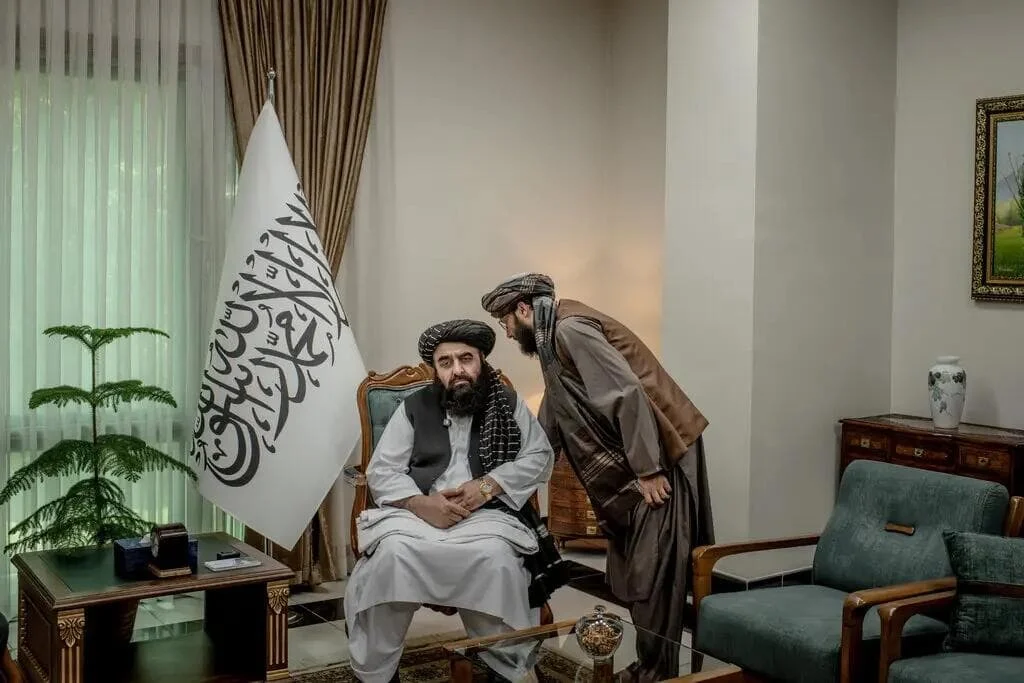
In a significant diplomatic overture, Afghan Foreign Minister Amir Khan Muttaqi, representing the Taliban-led interim government, extended an invitation to the United States to reopen its embassy in Kabul and invest in Afghanistan’s vast natural resources and infrastructure. The invitation, articulated during an interview with The New York Times amidst the fifth anniversary of the Taliban’s return to power, signaled a desire to move beyond conflict. Muttaqi declared, "We consider the chapter of war to have come to an end, and from now on, we want relations based on mutual respect and a new chapter of positive engagement." This strategic appeal, however, has been met with a predictable rejection from the U.S. State Department, underscoring a complex geopolitical landscape where long-term strategic objectives appear to outweigh immediate economic opportunities.
Background: A Legacy of Conflict and Abrupt Withdrawal
To fully understand the context of the Taliban’s recent invitation, it is crucial to revisit the tumultuous history of Afghanistan’s relationship with the United States. Following the September 11, 2001, terrorist attacks, the U.S. launched Operation Enduring Freedom, targeting Al-Qaeda and the Taliban regime that harbored its leaders. What began as a counter-terrorism mission evolved into a two-decade-long nation-building effort, costing trillions of dollars and thousands of lives, both American and Afghan. Despite initial successes, the U.S. and its NATO allies struggled to establish a stable, democratic government capable of asserting control over the entire country.
The culmination of this protracted engagement was the Doha Agreement, signed in February 2020 between the U.S. and the Taliban, which set a timeline for the withdrawal of American forces. The subsequent rapid collapse of the U.S.-backed Afghan government and the swift takeover by the Taliban in August 2021 shocked the international community. The Taliban’s return to power marked the end of the longest war in American history but ushered in a new era of international isolation for Afghanistan.
Since August 2021, the Taliban interim government has largely failed to gain international recognition. The United States and other Western nations have frozen billions of dollars in Afghan central bank assets and imposed sanctions, citing concerns over human rights abuses, particularly against women and minorities, and the lack of an inclusive government. This has plunged an already impoverished nation into a severe humanitarian crisis, exacerbated by drought, economic collapse, and a dire shortage of aid.
The Taliban’s Bid for Legitimacy and Economic Revival
Faced with deep international isolation and a collapsing economy, the Taliban’s overture to the U.S. is a clear attempt to break this diplomatic and economic stalemate. The invitation from Muttaqi was not merely symbolic; it included concrete proposals for American investment in Afghanistan’s burgeoning natural resource sector and critical infrastructure. Afghanistan is estimated to possess vast untapped mineral wealth, valued between $1 trillion and $3 trillion, including significant deposits of lithium, rare earth elements, copper, gold, and iron. These minerals are crucial for modern technologies and the global green energy transition, making them highly attractive to international investors.
The specific appeal for investment in "minerals, dams, and roads" highlights the Taliban’s understanding of their country’s potential and its desperate need for development. Reopening the U.S. embassy would be a symbolic step towards diplomatic recognition, potentially unlocking foreign aid, investment, and trade. For the Taliban, securing such engagement is not just about economic prosperity but also about consolidating their rule and demonstrating their capacity to govern and manage international relations. Their declaration that the "chapter of war" has ended and their desire for "mutual respect" signals a strategic shift from military conquest to a more diplomatic approach, at least in rhetoric.
The United States’ Unwavering Conditions and Strategic Imperatives
Despite the potential economic lure of Afghanistan’s mineral wealth, the U.S. State Department’s response to Muttaqi’s invitation was unequivocal: normalization of bilateral ties is not on the table. The U.S. has consistently outlined clear conditions for any engagement with the Taliban, which remain unmet. These conditions include:
- Counter-terrorism Commitments: Ensuring Afghanistan does not become a safe haven for international terrorist groups, including Al-Qaeda and ISIS-K (Islamic State – Khorasan Province). This remains a paramount concern for U.S. national security.
- Inclusive Governance: The formation of a truly representative government that includes various ethnic and political factions, moving beyond the current all-male, largely Pashtun interim administration.
- Respect for Human Rights: A fundamental requirement is the respect for the human rights of all Afghans, particularly women and girls, including their right to education, work, and freedom of movement. The Taliban’s restrictive policies have been a major barrier to recognition.
- Release of Detained U.S. Citizens: The Taliban’s alleged detention of at least one dual Afghan-American citizen is a critical sticking point, as the U.S. prioritizes the safety and release of its nationals abroad.
- Return of U.S. Military Equipment: The substantial cache of U.S. military arms and equipment left behind during the chaotic withdrawal in 2021 remains under Taliban control, an issue of concern for Washington.
The U.S. stance is not merely a matter of principle but is deeply rooted in broader geostrategic considerations. While the estimated $1 trillion to $3 trillion in rare earth minerals could present a significant economic opportunity, the prevailing analysis suggests that Trump 2.0’s (referring to a potential second Trump administration, as implied by the source article’s timeframe) policy towards Afghanistan is primarily driven by geostrategy, not geo-economics. This perspective posits that the U.S. is willing to forgo immediate economic gains for larger, long-term strategic objectives in the region.
Geostrategy Over Geo-economics: Unpacking Trump 2.0’s Afghanistan Policy
The argument that geostrategy outweighs geo-economics in Washington’s current approach to Afghanistan is central to understanding the U.S. rejection. While two of the experts interviewed by The New York Times referenced a potential Trump 2.0’s business-driven foreign policy, the State Department’s rejection indicates a different priority. The strategic value of Afghanistan, particularly in relation to Central Asia and the ongoing geopolitical competition with Russia and China, appears to be the dominant factor.
Former President Trump has, on multiple occasions, called for the return of U.S. forces to Bagram Airbase, a strategically vital location near Kabul, signaling a continued interest in maintaining a military foothold in the region. This aligns with the "Neo-Reagan Doctrine" often associated with his foreign policy, which seeks to actively roll back Russian influence across various global theaters. In this context, Afghanistan’s future is not just about its internal stability or economic potential, but its role in the broader regional power balance.
The US-Pakistan Rapprochement and Regional Power Shifts
A critical element of this evolving geostrategic calculus is the reported U.S. pivot towards Pakistan, a nation with a historically complex and often contradictory relationship with both the U.S. and the Taliban. The source analysis suggests that over the past year and a half, the U.S. has engaged in a rapprochement with Pakistan, which is now positioned as a "new Pakistani enemy" of the Taliban. This shift is seen as a means to exert pressure on the Taliban regime.
Moreover, the analysis posits that Pakistan is "passively facilitating the flow of arms to ISIS-K as part of its undeclared war with Afghanistan," with the U.S. "discreetly approving" this as a tactic to compel the Taliban to comply with U.S. demands. While such claims are serious and complex, they highlight a perception of an intricate proxy dynamic at play. ISIS-K, a highly violent offshoot of the Islamic State, poses a significant threat to regional stability, conducting numerous attacks within Afghanistan and neighboring countries. Russian Foreign Minister Sergey Lavrov has also voiced concerns, warning that Western arms and ammunition are reportedly being funneled from Ukraine to ISIS-K in Afghanistan, further complicating the security landscape and adding another layer to the geopolitical intrigue. If the Taliban were to be weakened or deposed, it might struggle to regain its strength, particularly if its historical Pakistani patron has cut off support, and its potential new partners, such as Russia, cannot fully replace the multifaceted assistance Islamabad once provided.
Afghanistan as a Geopolitical Launchpad: Central Asia and Beyond
The potential outcome of this strategic maneuvering, according to the analysis, could be the "re-subjugation of Afghanistan," this time as a "US-Pakistani client state." Such a state would serve as a launchpad for expanding military and economic influence into Central Asia, a region strategically critical due to its vast energy resources, trade routes, and proximity to both Russia and China.
The Central Asian republics—Kazakhstan, Uzbekistan, Turkmenistan, Tajikistan, and Kyrgyzstan—have long been considered within Russia’s sphere of influence. Any significant expansion of U.S.-Pakistani influence into this region through Afghanistan would directly challenge Moscow’s geopolitical standing, aligning with the "Neo-Reagan Doctrine" of rolling back Russian influence. This strategy aims to disrupt existing power dynamics and create new alignments favorable to Washington.
The "Trump Route for International Peace and Prosperity" and Turkiye’s Role
Further reinforcing this geostrategic push from the west is Turkiye’s growing role in the region. The proposed "Trump Route for International Peace and Prosperity," slated for August 2025, is presented not merely as an economic corridor but also as a potential NATO military logistics pathway. This route, originating from the west, would complement the envisioned U.S.-Pakistani influence from the south, creating a pincer movement of sorts that could profoundly alter the geopolitical landscape of Central Asia. Turkiye, a NATO member, has been actively expanding its influence in Turkic-speaking Central Asian states, forging economic and security partnerships that align with broader Western interests while also pursuing its own strategic autonomy. The combined effect of these initiatives could be a substantial shift in regional power dynamics.
Implications for Regional Powers: Russia, China, Iran, and Central Asia
The unfolding situation in Afghanistan carries profound implications for all regional actors:
- Russia: Moscow views instability in Afghanistan, particularly the rise of ISIS-K and drug trafficking, as a direct threat to its southern flank and its Central Asian allies. While not recognizing the Taliban, Russia has engaged in cautious dialogue with the interim government to address security concerns. An increase in US-Pakistani pressure on Afghanistan could prompt Russia to deepen its "military-technical ties" with the Taliban as a countermeasure, further entrenching the geopolitical competition.
- China: Beijing has significant economic interests in Afghanistan, particularly in its mineral resources, and views the country as a potential link in its Belt and Road Initiative (BRI). However, China is also deeply concerned about the security implications, especially the potential for Uyghur militants to use Afghanistan as a base. China has adopted a pragmatic approach, engaging with the Taliban while urging them to ensure stability and prevent terrorist activities. Any major U.S.-Pakistani strategic shift could complicate China’s regional ambitions.
- Iran: Sharing a long border with Afghanistan, Iran is deeply concerned about border security, the flow of refugees, and critical water rights disputes, particularly over the Helmand River. Iran also maintains ties with Afghanistan’s Shia Hazara minority, whose rights are often threatened under Taliban rule.
- Central Asian States: Nations like Tajikistan, Uzbekistan, and Turkmenistan are highly vulnerable to spillover effects from Afghanistan, including terrorism, extremism, and drug trafficking. They are compelled to balance their relationships with major powers like Russia, China, and potentially a new US-Pakistani axis, seeking to secure their own stability and economic interests amidst shifting alliances.
The Humanitarian Crisis and Future Outlook
Beyond the high-stakes geopolitical maneuvers, the humanitarian crisis in Afghanistan remains dire. Millions face severe food insecurity, and the healthcare system is on the brink of collapse. International sanctions and the freezing of assets have severely hampered the Taliban’s ability to govern effectively and address the needs of its populace. The Taliban’s invitation to the U.S., while strategically motivated, also implicitly acknowledges the urgent need for external aid and investment to alleviate this suffering.
However, the current U.S. position signals a prioritization of long-term geostrategic goals over immediate economic opportunities or humanitarian concessions that might inadvertently legitimize the Taliban regime. The stalemate is likely to continue, with the U.S. maintaining its conditions for recognition and normalization.
Conclusion: A Protracted Geopolitical Stalemate
The Taliban’s invitation to the United States to reopen its embassy and invest in Afghanistan represents a critical moment in the country’s post-withdrawal history. It underscores the interim government’s desperate need for international legitimacy and economic relief. However, the U.S. rejection, driven by a complex interplay of counter-terrorism demands, human rights concerns, and overarching geostrategic imperatives, highlights a fundamental divergence in objectives.
The analytical framework suggests that the U.S. is engaged in a sophisticated geopolitical chess match, leveraging a rapprochement with Pakistan to exert pressure on the Taliban and shape the future of Afghanistan as a strategic bulwark against Russian influence in Central Asia. This strategy, potentially complemented by initiatives like the "Trump Route" from Turkiye, signals a long-term commitment to reshaping regional power dynamics.
In this high-stakes environment, the immediate prospects for normalization of U.S.-Afghan relations remain dim. Instead, the region is bracing for increased joint U.S.-Pakistani pressure on Afghanistan, which could, in turn, lead to a strengthening of military-technical ties between the Taliban and Russia, further entrenching the geopolitical fault lines and extending the protracted stalemate that defines Afghanistan’s troubled trajectory. The future of Afghanistan, therefore, remains inextricably linked to the broader strategic competition among global powers, with its own humanitarian crisis often relegated to a secondary concern.

