
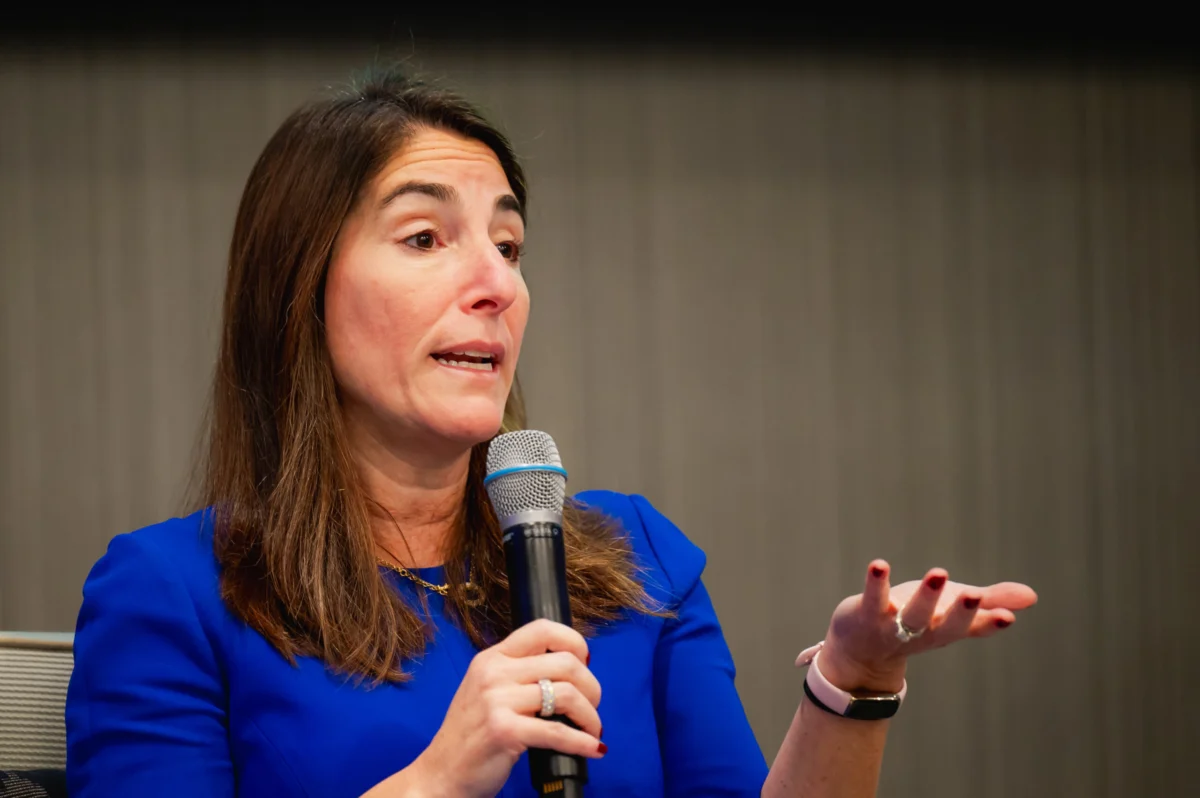
Cleveland Federal Reserve President Beth Hammack, a prominent voice within the central bank’s policymaking ranks, delivered a pivotal address on Monday, signaling a clear inclination towards a more aggressive, yet measured, tightening of monetary policy to rein in stubborn inflation. Speaking at the annual gathering of the National Association of Business Economics (NABE), Hammack articulated a preference for "smaller adjustments, and to do so relatively quickly, rather than to wait and risk needing a larger course correction," underscoring the urgency she perceives in returning annual price growth to the Fed’s 2% target. Her remarks, delivered in prepared statements, position her firmly among the more hawkish members of the Federal Open Market Committee (FOMC), advocating for a "restrictive monetary policy stance" as appropriate for the current economic climate.
Hammack’s assertions carry significant weight, not only due to her role as President and Chief Executive Officer of the Federal Reserve Bank of Cleveland but also because she is a voting member of the FOMC, the committee responsible for setting the nation’s monetary policy. Her comments immediately fueled speculation in financial markets regarding the trajectory of future interest rate hikes, coming just weeks after the Fed implemented its first rate increase in three years in September 2026. This initial hike marked a significant pivot from an extended period of historically low rates, reflecting the central bank’s growing concern over persistently elevated inflation.
The Imperative of Restrictive Policy: Hammack’s Rationale
The concept of a "restrictive monetary policy stance" is central to Hammack’s argument. This refers to a policy where interest rates are set at a level high enough to dampen aggregate demand, thereby slowing economic activity and curbing inflationary pressures. It contrasts with an "accommodative" policy, which stimulates demand through lower rates, or a "neutral" policy, which neither stimulates nor restricts. For Hammack, the current economic environment necessitates moving beyond neutral and into restrictive territory to effectively combat the "breadth" of inflationary pressures currently impacting the U.S. economy.
Her preference for "smaller adjustments, and to do so relatively quickly" reflects a strategic approach aimed at avoiding the shock of large, sudden rate increases while steadily moving policy towards a more restrictive stance. This methodology is often favored by policymakers who believe in a data-dependent, agile response to economic conditions, allowing for continuous recalibration without creating undue market volatility. The alternative, waiting for more definitive data before implementing a larger hike, carries the risk of inflation becoming more deeply entrenched, requiring even more drastic measures later—a scenario Hammack explicitly warned against. "Considering all the inputs that factor into my reaction function, a restrictive monetary policy stance is appropriate to ensure a timely return to 2 percent inflation," she stated, highlighting the comprehensive analysis that underpins her policy view.
A Deeper Dive into Inflationary Pressures
The backdrop to Hammack’s remarks is an inflation landscape that has proven far more resilient and pervasive than initially anticipated by many economists and policymakers. For much of 2025 and 2026, the Federal Reserve, alongside other central banks globally, grappled with inflation rates significantly above its long-term target of 2%. The personal consumption expenditures (PCE) price index, the Fed’s preferred gauge of inflation, stood at 3.4% year-over-year in August 2026. Even more concerning for policymakers was the so-called core PCE index, which strips out volatile food and energy costs to provide a clearer picture of underlying price trends, registering at 3.0% compared with a year prior. Both figures represent a considerable deviation from the Fed’s target, indicating that inflationary pressures extend beyond temporary supply chain disruptions or energy price spikes.
Hammack candidly acknowledged the challenges posed by "sticky inflation," noting that it creates difficulties for consumers, businesses, and monetary policymakers alike. The "breadth" of current inflationary pressures, meaning that price increases are not confined to a few sectors but are widespread across the economy, suggests a more systemic issue. This broad-based inflation implies that it will take "some time" to bring annual price growth down to the central bank’s goal. Factors contributing to this sticky inflation include robust consumer demand fueled by past fiscal stimulus, tight labor markets leading to wage pressures, and ongoing, albeit easing, global supply chain bottlenecks. The combination of these elements has created an environment where businesses find it easier to pass on higher costs to consumers, perpetuating the inflationary cycle.
Anchoring Expectations: A Critical Battle
One of the most critical aspects of Hammack’s concerns revolved around inflation expectations. She noted that "long-run inflation expectations have stayed remarkably well anchored despite actual inflation being above target for more than five years." This phenomenon is crucial because if consumers and businesses begin to expect high inflation to persist, they will adjust their behavior accordingly—workers will demand higher wages, and companies will raise prices proactively. This can create a self-fulfilling prophecy, making inflation much harder to control.
The Federal Reserve has expended considerable effort over decades to establish its credibility as an inflation fighter, successfully anchoring long-run inflation expectations around its 2% target. This success has been a cornerstone of modern monetary policy, preventing a return to the volatile inflation cycles seen in the 1970s and early 1980s. Hammack’s statement, "But I’m not taking that for granted," underscores the delicate balance the Fed maintains. She warned that "With each passing month, persistently elevated inflation raises the risks of an inflationary mindset becoming entrenched in the economy." This implies that while expectations are currently stable, prolonged periods of high actual inflation could erode this stability, leading to a dangerous shift in public and market psychology. The risk of de-anchoring inflation expectations is a primary driver behind the Fed’s current urgency to tighten policy, even at the potential cost of some economic slowdown.
The Federal Reserve’s Recent Policy Path and Future Outlook
Hammack’s call for faster, incremental adjustments comes within a specific timeline of Fed actions. The central bank had maintained its benchmark interest rate near zero for an extended period following the economic shock of the COVID-19 pandemic, utilizing this accommodative stance to support economic recovery and employment. However, as inflation began to surge in 2025 and persisted into 2026, the pressure on the Fed to act intensified. The decision in September 2026 to increase interest rates for the first time in three years marked a significant turning point, signaling a definitive shift away from an ultra-loose monetary policy.
Minutes from that September FOMC meeting revealed that officials generally saw another rate hike on the horizon, though they refrained from giving a clear indication of its precise timing. This ambiguity reflects the ongoing debate within the committee, balancing the need to control inflation with the desire to avoid stifling economic growth or triggering a recession.
Market participants closely monitor the Fed’s every move and utterance. According to CME’s FedWatch tool, a widely used barometer of market sentiment, traders were pricing in a more than 78% likelihood that the central bank would keep rates unchanged at its policy meeting later in the current month (likely October or November 2026, given the article’s context). However, the sentiment shifts dramatically for the Fed’s final meeting of the year in December, where there was a nearly 88% chance of another rate hike. This indicates that while the market might anticipate a pause in the immediate term, the consensus strongly points towards further tightening before the year concludes, aligning with Hammack’s overall message of a restrictive path. Hammack, as a voting member of the FOMC, directly contributes to these decisions, making her public statements crucial for market interpretation.
Economic Landscape Informing Fed Decisions
The Fed’s "reaction function," as Hammack termed it, is complex, incorporating a vast array of economic indicators beyond just inflation figures. To achieve its dual mandate of maximum employment and price stability, the FOMC scrutinizes data on GDP growth, labor market health (unemployment rate, job openings, wage growth), consumer spending, business investment, and the housing market, among others. For instance, a robust labor market with historically low unemployment rates and rising wages, while positive for workers, can also contribute to inflationary pressures by increasing disposable income and business costs. Conversely, signs of significant economic slowdown or rising unemployment could give the Fed pause, even if inflation remains elevated.
The global economic context also plays a role. International supply chain dynamics, geopolitical events impacting energy prices, and the strength of the U.S. dollar all feed into the Fed’s decision-making process. A strong dollar, for example, can help dampen imported inflation but also make U.S. exports more expensive, potentially impacting growth. The interconnectedness of the global economy means that domestic monetary policy cannot be formulated in isolation.
Implications for Consumers and Businesses
Hammack’s advocated policy trajectory has profound implications for various segments of the economy. For consumers, higher interest rates translate directly into increased borrowing costs. Mortgages, credit card rates, auto loans, and other forms of consumer credit become more expensive, potentially dampening demand for big-ticket items and discretionary spending. While savings rates might see a modest increase, the overall impact of higher rates coupled with persistent inflation can squeeze household budgets. The hope is that by bringing inflation down, the long-term purchasing power of wages and savings will be preserved.
Businesses also face a tougher financial environment. The cost of capital for investments in new equipment, facilities, or expansion increases, which could lead to a slowdown in hiring and overall economic growth. Small businesses, often more reliant on variable-rate loans, can be particularly vulnerable to rising rates. Sectors sensitive to interest rates, such as housing and automotive, typically feel the impact first and most acutely. Businesses that rely heavily on consumer discretionary spending may also see demand soften as households tighten their belts.
For financial markets, Hammack’s stance implies continued vigilance and potential volatility. Bond yields are likely to remain elevated or rise further, reflecting expectations of higher short-term rates and the market’s demand for greater compensation for holding debt. The stock market, which generally prefers lower interest rates that support corporate earnings and valuation multiples, could experience periods of downward pressure or increased choppiness as investors price in the implications of a more restrictive monetary policy. The U.S. dollar, often seen as a safe-haven asset, could strengthen further as higher rates attract foreign capital, with implications for international trade and global capital flows.
The Delicacy of Monetary Policy: Balancing Risks
The Federal Reserve operates under a delicate balancing act, navigating the dual risks of overtightening and undertightening. Overtightening, pushing interest rates too high, risks triggering an economic recession, leading to job losses and widespread financial distress. This is the "hard landing" scenario that policymakers desperately seek to avoid. Conversely, undertightening, failing to raise rates enough or quickly enough, risks allowing inflation to become deeply ingrained, necessitating even more painful measures down the line and potentially eroding the Fed’s credibility. This is the "inflationary mindset becoming entrenched" scenario Hammack highlighted.
The Fed’s ultimate goal is a "soft landing," where inflation is brought back to target without causing a significant economic downturn. Achieving this requires precise calibration of monetary policy, a high degree of data dependency, and effective communication to manage market and public expectations. Hammack’s call for "smaller, quicker adjustments" can be seen as an attempt to navigate this narrow path, allowing the Fed to respond incrementally to incoming data without resorting to drastic, potentially destabilizing actions.
Conclusion: A Vigilant Stance Ahead
Beth Hammack’s recent address reinforces the Federal Reserve’s commitment to its 2% inflation target, signaling a proactive and sustained effort to achieve price stability. Her advocacy for swift, incremental rate adjustments reflects a growing consensus among some policymakers that the risks of allowing inflation to fester outweigh the immediate costs of monetary tightening. As the U.S. economy continues to evolve, grappling with persistent inflationary pressures, a tight labor market, and the lingering effects of global economic disruptions, the Federal Reserve under the guidance of officials like Hammack will remain on a vigilant course. All eyes will be on upcoming economic data releases and future FOMC meetings, as the central bank continues its critical mission to steer the economy towards sustainable growth with stable prices.

