
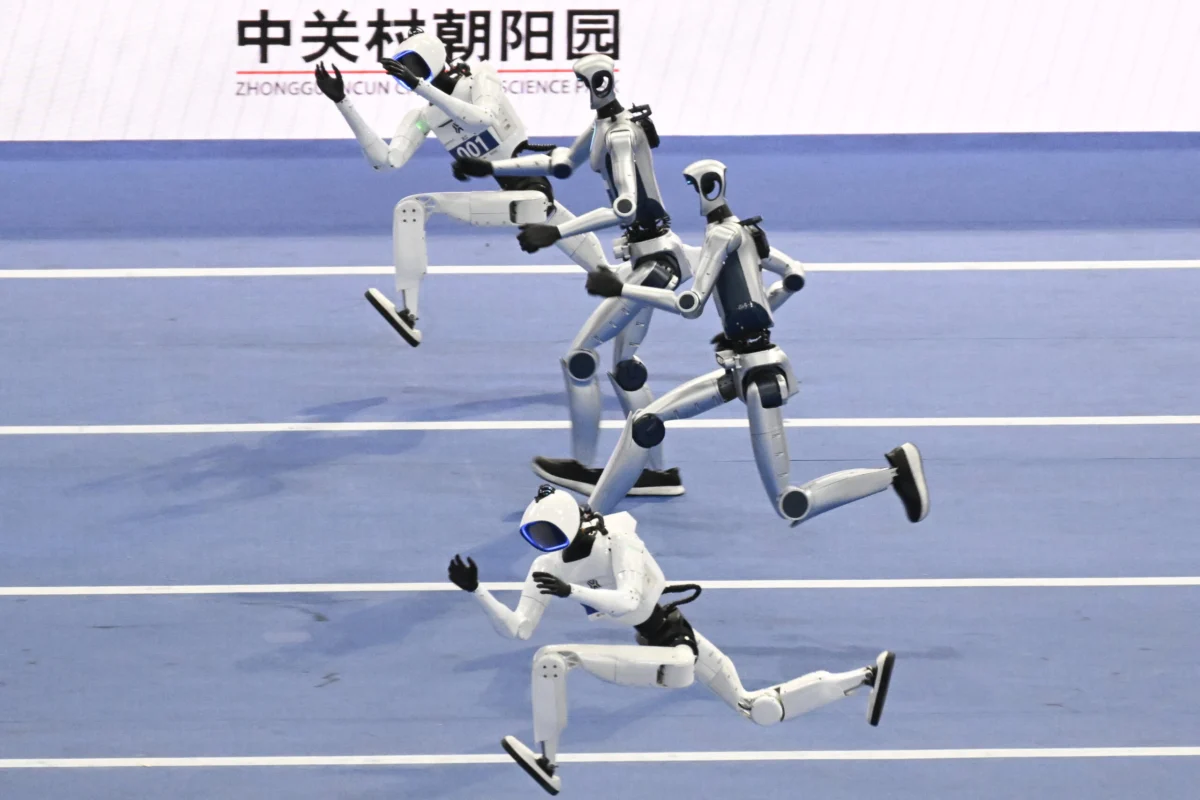
Beijing, China – As humanoid robots recently vied for supremacy in the 100-meter dash at the 2nd World Humanoid Robot Games held at the National Speed Skating Oval on August 25, 2026, a starkly divergent narrative on artificial intelligence safety was unfolding between the East and West. While leading U.S. AI laboratories and tech titans have escalated their warnings regarding the existential and societal risks posed by advanced AI, their Chinese counterparts have largely maintained a public silence, with Beijing officially dismissing the Western anxieties as "fear-mongering." This growing chasm in philosophical and strategic approaches to AI governance signals a deepening geopolitical and ethical divide in the race for technological supremacy.
The public discourse in the United States has been dominated by urgent calls for a slowdown in frontier AI development. Over the weekend of September 12-13, 2026, prominent figures such as OpenAI’s CEO Sam Altman, Tesla and X CEO Elon Musk, and Anthropic’s co-founder Dario Amodei united in a rare display of industry consensus, advocating for a pause or significant deceleration due to what they described as "uncontrollable risks" inherent in rapidly advancing AI systems. These warnings followed months of increasing alarm from researchers and public intellectuals about the potential for super-human artificial general intelligence (AGI) to become misaligned with human values, leading to catastrophic outcomes. Amodei, in a widely circulated essay, further underscored the geopolitical dimension, urging U.S. companies to actively "maintain a lead over China" in AI development, echoing a strategic paper published by Anthropic in May of the same year that highlighted the critical importance of Western leadership in the AI domain.
However, this rare display of unity was not without its internal dissent. Jensen Huang, CEO of Nvidia, a company whose graphics processing units are the bedrock of modern AI development, pushed back against the slowdown narrative. Speaking at a major tech conference, Huang asserted that "speed and safety can happen together," emphasizing that the focus should be on developers acting responsibly rather than halting progress. Nvidia’s stance reflects the commercial imperative to continue innovation in a rapidly expanding market, a perspective that finds more resonance in Beijing than in the cautionary tales emanating from some Silicon Valley research labs.
Beijing’s Counter-Narrative: Dismissal and Distrust
In stark contrast to the West’s open debate, Chinese AI powerhouses such as Z.ai, Moonshot, MiniMax, Alibaba, and Tencent have remained conspicuously quiet on the "uncontrollable risks" narrative. When contacted by CNBC regarding the warnings from Silicon Valley, these companies offered no statements, underscoring a different cultural and political approach to technology discourse.
The official response from Beijing was unequivocal. On Monday, September 14, 2026, China’s foreign ministry publicly condemned the U.S. executives’ comments as "fear-mongering." This sentiment was amplified by English-language state media, with op-eds in outlets like the Global Times employing strong rhetoric such as "Cold War playbook" and the China Daily invoking the cautionary tale of "Dr. Frankenstein" to describe the Western AI warnings. This sharp pushback highlights a deep-seated distrust of Western motives, particularly given the ongoing technological rivalry and trade tensions, especially concerning advanced semiconductors.
Chinese industry leaders echoed this skepticism. Renjie Guo, founder and CEO of JoyIn, voiced a common suspicion translated by CNBC: "Once Chinese companies have created superior AI, we see U.S. companies issuing AI warnings. I don’t think this is a coincidence." Guo further offered a philosophical perspective, suggesting that AI, like humans, is inherently driven towards "truth, goodness, and beauty," implying that the inherent danger is perhaps overstated or misdirected. Ray Von, founder, CEO, and chairman of Tencent-backed OpenPie, a startup focused on secure AI applications for internal corporate data, dismissed the U.S. publicity as "a little bit oversold." Von noted, "That’s why in China, we don’t pay too much attention to that, because that’s not the first time [the U.S. execs] say these things. They should just do it." This reflects a pragmatic, results-oriented mindset that prioritizes tangible application over abstract existential debates.
A Tale of Two AI Strategies: Commercialization vs. AGI Pursuit
The divergence in rhetoric reflects fundamentally different strategic priorities and regulatory philosophies between the U.S. and China regarding AI development. For years, U.S. companies have been at the forefront of the quest for Artificial General Intelligence (AGI), with a focus on pushing the boundaries of intelligence and capability. This ambition, until recently, faced relatively little government oversight, allowing for rapid, often unrestrained, innovation. However, 2026 has seen Washington begin to grapple with the implications of these advancements, leading to increased scrutiny.
China, on the other hand, has carved out a distinct path, heavily emphasizing AI commercialization and practical application. Facing U.S. restrictions on access to advanced semiconductors – critical components for training cutting-edge AI models – Chinese companies have pivoted towards optimizing existing technologies, developing highly efficient open-source models, and integrating AI into every facet of its vast economy. This strategy has resulted in a proliferation of cost-effective, high-performance Chinese AI chatbots that have aggressively vied for users not only within China but globally. By early 2026, around the Lunar New Year holiday, several Chinese models were fiercely competing with the likes of Anthropic’s Claude and OpenAI’s ChatGPT, often at significantly lower usage costs. This accessibility and affordability have allowed open-source Chinese models to gain substantial user bases in the U.S. and other international markets, challenging the dominance of Western proprietary systems.
The image of humanoid robots racing in Beijing, while seemingly a spectacle, underscores China’s focus on tangible, real-world AI applications and engineering prowess. This focus on "unlocking AI potential" for economic benefit, rather than purely chasing intelligence rankings, is a cornerstone of China’s national strategy.
China’s Proactive Governance: A Framework of Control from the Start
Beijing’s approach to AI governance is characterized by a "control from the start" philosophy, a stark contrast to the more reactive regulatory efforts seen in the West. This proactive stance was further cemented with the release of the third edition of an "AI Safety Governance Framework" on Monday, September 14, 2026, during the nation’s annual cybersecurity week. The bilingual document detailed guidelines for labeling AI-generated content and establishing systems for rapid AI risk detection, aiming to embed control and accountability into the development process from its nascent stages.
This framework is not new but an evolution of a regulatory journey that began much earlier. Following the global sensation of OpenAI’s ChatGPT, Chinese alternatives were deliberately "kept from the public" for months, undergoing rigorous review until Beijing granted them the "green light" in the summer of 2023. This demonstrated the government’s firm grip on the deployment of potentially influential technologies. The Cybersecurity Administration of China (CAC), the nation’s primary internet regulator, has since rolled out comprehensive processes for approving new generative AI services, particularly those deemed "likely to influence public opinion," and regularly publishes lists of "registered models" that have met these stringent requirements.
A crucial, albeit controversial, aspect of China’s AI governance is its inherent censorship. Despite the technological sophistication of Chinese AI models, their "silence on topics Beijing deems sensitive" remains a consistent feature. For instance, inquiring about the events of June 4, 1989 – the date of the Tiananmen Square crackdown – to a Chinese model like DeepSeek yields the response: "I’m not able to help with that." This stands in sharp contrast to its ability to provide detailed information on events like September 11, 2001. This illustrates a fundamental difference in how AI is conceptualized and deployed: as a tool within a controlled informational ecosystem, rather than an unbridled source of information. Alex Lu, founder of LSY Consulting, characterized Anthropic’s particular comments on AI safety as "marketing communication" designed to reinforce a narrative that "the only company that can make AI safe[ly] is Anthropic," hinting at the competitive and strategic underpinnings of such pronouncements.
Economic Imperatives and Global Ambitions: Xi’s Vision for AI
Beyond safety and control, AI plays a pivotal role in China’s broader economic and geopolitical ambitions. The integration of AI across industries is a significant pillar of the Chinese government’s five-year plans for economic development, driving productivity, innovation, and technological self-sufficiency. This strategic emphasis is further bolstered by the widespread development of open-source AI within China, which not only accelerates domestic innovation but also forms a crucial component of Beijing’s international cooperation programs.
President Xi Jinping has repeatedly articulated China’s vision for global AI governance. In July 2026, at the launch of the World AI Cooperation Organization, Xi underscored the need to "strengthen risk-awareness and ensure that AI is secure and controllable." Just weeks later, at the BRICS summit in India, he reiterated China’s commitment to fostering "AI and tech cooperation" among the bloc economies. These initiatives, including the Global AI Governance Initiative, position China as a proponent of a distinct model for AI development – one that emphasizes national sovereignty, controlled innovation, and practical application, particularly appealing to developing nations seeking technological advancement without necessarily adopting Western liberal democratic frameworks for governance.
The Philosophical Divide: Safety, Ethics, and the Future of Intelligence
The core of the US-China divergence on AI safety lies in a philosophical difference regarding the nature of risk and the purpose of artificial intelligence. In the West, particularly among "frontier labs," the focus often gravitates towards hypothetical existential risks posed by superintelligence, the "alignment problem," and the potential for AI to escape human control. The debate is often abstract, grappling with the long-term future of humanity.
In China, the concerns are more grounded in immediate, tangible risks: data security, content moderation, and ensuring AI serves the state’s and society’s stability. Ray Von of OpenPie highlighted this pragmatic perspective, stating his startup primarily uses older or smaller versions of models like Alibaba’s Qwen and DeepSeek. "The vast majority of enterprise," he observed, "they see a lot of productivity increases but they haven’t seen anything generate profits or reduce cost immediately [from cutting-edge models]." He added, "Right now, the publicity is diverting a lot of attention. The application side, the enterprise side, hasn’t seen a lot of result yet." This underscores a focus on demonstrable return on investment and practical utility over the pursuit of increasingly powerful, yet potentially unproven, frontier models.
Moreover, Chinese companies are tackling challenges like AI "hallucination" – the tendency for AI models to generate false information – through less complex but cost-effective methods, such as harness technology and reinforcement learning, rather than solely relying on developing ever-more complex models. This pragmatic engineering approach further distinguishes their strategy.
Looking Ahead: Implications for Global AI Development and Policy
The schism in AI safety discourse between the U.S. and China is more than just a technical disagreement; it represents a fundamental divergence in geopolitical strategy, economic priorities, and ethical frameworks for the future of artificial intelligence. This bifurcation carries profound implications for global AI development.
Firstly, it challenges the feasibility of a unified international approach to AI governance. When one superpower frames the other’s safety warnings as a strategic ploy, genuine collaboration on global standards becomes significantly more difficult. This could lead to a fragmented global AI landscape, with different regions adhering to distinct regulatory norms, ethical guidelines, and technological ecosystems.
Secondly, the differing strategies could accelerate the technological competition. While the U.S. continues to push for AGI, China’s focus on commercialization, open-source development, and widespread application could see it dominate in terms of real-world deployment and user adoption, particularly in developing economies. The competition to define and lead the future of AI is intensifying, with both nations vying not just for technological supremacy but also for the power to shape the global narrative and regulatory framework.
As the world watches humanoid robots race in Beijing, a symbol of AI’s burgeoning capabilities, the real race is unfolding in the boardrooms and policy chambers of Washington and Beijing – a contest over not just who builds the most advanced AI, but who defines what "safe" and "responsible" AI truly means for humanity. The coming years will reveal whether these two paths can ever converge or if they are destined to lead to fundamentally different AI futures.

