
Qatari Energy Minister Saad Al-Kaabi has vehemently dismissed assertions by U.S. Treasury Secretary Scott Bessent that the Strait of Hormuz, a pivotal global oil chokepoint, would become "worthless" to the oil industry within two years due to ongoing energy infrastructure diversification. Speaking at the Qatar Economic Forum in New York on September 20, 2026, Al-Kaabi, who also serves as the CEO of state-owned QatarEnergy, characterized Bessent’s outlook as "completely wrong" and argued that the strait’s strategic importance extends far beyond crude oil transit, encompassing liquefied natural gas (LNG) and a vast array of global trade. This direct rebuttal underscores a growing divergence in strategic perspectives between key energy producers and consumer nations regarding the future of global energy security and supply chain resilience.
The Genesis of the Controversy: Bessent’s "Worthless" Pronouncement
The contentious remarks by Treasury Secretary Scott Bessent first emerged earlier in September 2026, on the sidelines of the Group of 20 (G20) finance ministers’ summit held in North Carolina. During an interview with Fox Business’s Larry Kudlow, Bessent articulated a bold vision for the future of global energy flows, specifically targeting the strategic significance of the Strait of Hormuz. "In about two years," Bessent stated, "the Hormuz maritime chokepoint will be… a worthless piece of water." He predicated this dramatic shift on the rapid expansion of overland pipeline infrastructure, which he suggested would soon enable crude oil to bypass the strait entirely. This statement, shared widely, quickly ignited debate within energy circles and geopolitical analysis, signaling a profound shift in the U.S. administration’s strategic thinking regarding energy infrastructure and geopolitical leverage. The timing of these comments, amidst a period of heightened geopolitical tensions and global supply chain re-evaluation, added significant weight to their implications.
Al-Kaabi’s Forceful Rejection from the Qatar Economic Forum
Just weeks after Bessent’s provocative declaration, Qatari Energy Minister Saad Al-Kaabi delivered a robust counter-argument, emphasizing the enduring and multifaceted importance of the Strait of Hormuz. Addressing an influential audience at the Qatar Economic Forum in New York on September 20, 2026, Al-Kaabi directly challenged the premise of the U.S. Treasury Secretary’s comments. "I think this is completely wrong," Al-Kaabi asserted, underscoring his conviction that the strait’s role as a vital maritime artery could not be easily rendered obsolete. He further elaborated, "I don’t think this is ever going to be obsolete."
Al-Kaabi’s argument hinged on a broader understanding of the strait’s utility. While acknowledging the ongoing development of bypass pipelines for crude oil, he stressed that these projects would not "eliminate the broader trade flowing through the strait." This encompasses not only crude oil but also refined petroleum products, a significant portion of the world’s liquefied natural gas (LNG) – of which Qatar is a leading exporter – and countless other goods critical to global commerce. For Qatar, whose vast natural gas reserves are primarily exported as LNG via tankers transiting Hormuz, the strait remains an irreplaceable conduit for its economic lifeline. The Minister’s perspective reflects a national interest deeply tied to the unhindered passage through this waterway, highlighting a potential disconnect between the strategic aims of a major energy consumer like the U.S. and a vital energy producer like Qatar.
The Strategic Imperative of the Strait of Hormuz: A Deep Dive
The Strait of Hormuz, a narrow waterway connecting the Persian Gulf to the Arabian Sea and the open ocean, has long been recognized as one of the world’s most critical energy chokepoints. At its narrowest point, it is only 21 nautical miles (39 kilometers) wide, with shipping lanes just two miles wide in either direction. This geographic constraint makes it highly vulnerable to disruption, a fact that has historically been leveraged by regional actors for political and strategic advantage.
Historical Context and Volumes: For decades, the strait has served as the primary transit route for a substantial portion of the world’s oil supply. Data from the U.S. Energy Information Administration (EIA) consistently ranks Hormuz as the most important oil transit chokepoint globally. In recent years, an estimated 20% of the world’s total petroleum liquids consumption, or approximately 20-21 million barrels per day (b/d) of crude oil and refined products, has passed through the strait. This volume represents crude oil exports from Saudi Arabia, Iran, Iraq, Kuwait, Qatar, and the United Arab Emirates (UAE).
Beyond crude oil, the strait is equally vital for liquefied natural gas (LNG) shipments. Qatar, a global leader in LNG exports, sends nearly all of its LNG cargoes through Hormuz. Other significant LNG exporters like the UAE also rely on this route. Disruptions to this flow would not only send shockwaves through global oil markets but also severely impact natural gas supply, affecting energy security, electricity generation, and industrial operations worldwide.
Geopolitical Significance: The strategic importance of Hormuz is further amplified by its geopolitical context. Bordered by Iran to the north and Oman and the UAE to the south, the strait sits at the crossroads of regional power dynamics. Iran has historically threatened to close the strait in response to international pressure or sanctions, a move that would have catastrophic consequences for the global economy. The presence of the U.S. Navy’s Fifth Fleet in the region, headquartered in Bahrain, underscores the international commitment to ensuring the freedom of navigation through this critical waterway. Any perceived reduction in its strategic value by a major global power like the U.S. carries significant implications for regional stability and the intricate balance of power.
The "Generational Rewiring" of Gulf Energy Flows

Bessent’s comments are not made in a vacuum but against the backdrop of what analysts describe as a "generational rewiring of energy flows in the Gulf, and really the world." This ambitious undertaking is driven by a confluence of factors: the desire to enhance energy security, reduce reliance on vulnerable chokepoints, mitigate geopolitical risks associated with transit through volatile regions, and diversify export routes for major oil and gas producers.
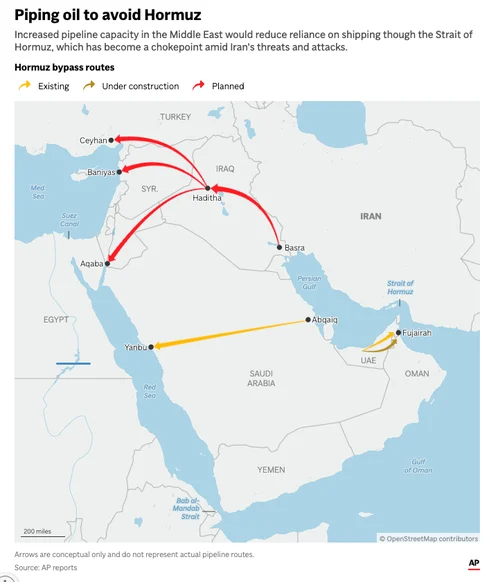
Key Pipeline Projects and Their Potential Impact: Several significant pipeline projects have been announced or are under construction by Gulf allies, specifically designed to bypass the Strait of Hormuz. These initiatives represent substantial investments aimed at creating alternative export corridors:
- Saudi Arabia’s East-West Pipeline (Petroline): This existing pipeline, running from the Kingdom’s eastern oil fields to the Red Sea port of Yanbu, has a substantial capacity. While it has long offered an alternative route, its expansion and increased utilization are key components of the diversification strategy. The original article notes that increased flows through this pipeline, combined with other projects, could replace around 40% of the 20 million barrels a day that previously transited Hormuz. However, it also highlights the vulnerability of such infrastructure, citing a recent drone attack that rendered it "useless in the short term," underscoring the inherent risks of even diversified land routes.
- UAE’s Abu Dhabi Crude Oil Pipeline (ADCOP) to Fujairah: Operational since 2012, this pipeline allows the UAE to export a significant portion of its crude oil directly to the Arabian Sea port of Fujairah, bypassing Hormuz. Its capacity is around 1.5 million b/d. Further expansions or new pipelines to Fujairah are continually being explored, as Fujairah has become a major oil storage and bunkering hub outside the Strait.
- Iraq’s Strategic Pipeline Initiatives: Iraq, a major OPEC producer, has long sought to diversify its export routes away from its southern terminals in the Persian Gulf. Plans to revive and expand pipelines to Turkey (via Ceyhan) and potentially explore new routes through Saudi Arabia or Jordan are part of this strategy. While politically complex, successful implementation could add millions of barrels per day of bypass capacity.
- Other Regional Initiatives: Less publicized projects and discussions among Gulf Cooperation Council (GCC) members also aim to enhance regional energy connectivity and reduce reliance on single points of failure.
Collectively, these new routes through the UAE and Iraq, combined with enhanced capacity via Saudi Arabia, could eventually carry roughly 4 million additional barrels per day of crude oil. When added to the existing bypass capacity, the overall potential for diverting crude oil away from Hormuz becomes significant, potentially replacing a substantial portion of the strait’s crude oil transit volume. The involvement of major international energy companies, such as TotalEnergies, whose CEO has reportedly joined calls to "rewire Gulf energy flows around Hormuz," further solidifies the industry’s commitment to these diversification efforts.
Risks and Realities of Diversification
While the strategic rationale for diversifying energy flows is compelling, the implementation of these bypass projects is fraught with challenges and risks:
- Vulnerability to Attack: As demonstrated by the drone attack on Saudi Arabia’s East-West pipeline, land-based infrastructure, including pipelines and pumping stations, remains vulnerable to asymmetric warfare tactics. Low-cost, one-way attack drones and other forms of sabotage can target critical assets across vast stretches of land, rendering alternative routes just as susceptible to disruption, albeit perhaps from different actors or with different geopolitical implications.
- Cost and Time: Developing new, large-scale pipeline infrastructure requires colossal investments and considerable time, often spanning several years, if not a decade, from conception to full operation. The economic viability must be carefully weighed against the long-term geopolitical benefits.
- Political Stability and Cooperation: Many proposed pipeline routes traverse multiple countries, necessitating robust political agreements, transit fees, and security guarantees. Regional rivalries, shifting alliances, and internal instability within transit countries can complicate or even derail such ambitious projects.
- Limited Scope: While pipelines can divert crude oil, they do not address the transit of LNG, refined products, or general cargo, which remain overwhelmingly dependent on maritime routes. Al-Kaabi’s emphasis on "broader trade" highlights this crucial limitation of a purely pipeline-centric bypass strategy. For nations like Qatar, whose economy is heavily reliant on LNG exports, the Strait of Hormuz will continue to hold paramount importance regardless of crude oil pipeline developments.
The Broader Trump Administration Energy Strategy
Treasury Secretary Bessent’s comments align with a broader, more assertive energy policy being pursued by the Trump administration. This strategy aims at fundamentally reshaping global energy supply chains, reducing dependence on volatile regions, and enhancing the energy security of the United States and its allies in the Western Hemisphere.
"Western Hemisphere Revival": A key pillar of this strategy is the "Western Hemisphere revival," which prioritizes bringing energy and critical materials supply chains closer to home. This involves ramping up domestic U.S. oil and gas production, as well as fostering energy independence and cooperation within the Americas. The administration views robust domestic production and secure regional supply lines as essential for insulating the U.S. economy from geopolitical shocks and leveraging energy as a tool of foreign policy.
Venezuela Mega Deal: As part of this push, the Trump administration has reportedly engaged in significant diplomatic and economic initiatives, including a "mega deal" with Venezuela. This deal, if fully realized, would allow U.S. energy giants to begin investments to ramp up oil production in Venezuela. This move is particularly noteworthy given past U.S. sanctions and strained relations with the socialist government of Venezuela. A revitalized Venezuelan oil sector, under conditions favorable to U.S. companies, could significantly augment global oil supplies from a Western Hemisphere source, further reducing reliance on Middle Eastern crude.
Making Hormuz "Worthless" as a "Long Game": Bessent’s pronouncement about Hormuz becoming "worthless" is thus understood not as an immediate reality, but rather as a strategic aspiration—a "long game" for the Trump administration. The goal is to systematically build out energy assets and diversify supply chains in the West, thereby diminishing the geopolitical leverage of chokepoints like Hormuz and reducing the U.S.’s exposure to Middle Eastern instability. This involves a multi-pronged approach encompassing domestic production, regional alliances, and strategic investments in alternative global sources. The underlying assumption is that by reducing the economic significance of the strait for global oil flows, the incentive for military intervention or political maneuvering to secure it would also decrease, potentially shifting the burden of its security to regional powers.
Implications and Future Outlook
The debate between Bessent and Al-Kaabi highlights a critical juncture in global energy geopolitics. The implications of this "generational rewiring" are far-reaching:
- Geopolitical Shift: A diminished role for Hormuz in crude oil transit could theoretically reduce Iran’s leverage as a regional spoiler, impacting its ability to threaten global oil supplies. However, it also raises questions about who would then be responsible for maintaining stability and freedom of navigation in a strait still vital for LNG and other trade.
- Economic Impact: While bypass pipelines promise enhanced security, they come with substantial construction and operational costs. These costs, along with potential shifts in shipping routes and insurance premiums, could influence global energy prices and the profitability of various energy projects.
- Energy Security Redefined: The emphasis on diversification and regional supply chains redefines the parameters of energy security. It moves beyond simply ensuring supply to actively reshaping the geographic and political landscape of energy trade. However, the vulnerability of all infrastructure to modern threats, like drone attacks, means that true security remains elusive.
- Regional Power Dynamics: The successful development of bypass pipelines could empower countries like Saudi Arabia and the UAE, giving them greater flexibility in their energy exports. It might also compel them to invest more heavily in securing their expanded land-based infrastructure. For Qatar, whose reliance on LNG exports through Hormuz is unwavering, the strait’s continued security remains a paramount concern, potentially strengthening its resolve to advocate for collective regional security.
In conclusion, while the vision of a "worthless" Strait of Hormuz in two years may be an ambitious strategic goal for the U.S., the realities on the ground, as articulated by Qatar’s Energy Minister, paint a more complex picture. The strait’s multi-faceted role in global trade, coupled with the inherent challenges and vulnerabilities of alternative routes, suggests that while its crude oil transit might be diversified, its overall strategic importance as a critical global chokepoint is unlikely to diminish entirely in the near future. The "long game" of global energy rewiring is indeed underway, but the final outcome for the Strait of Hormuz remains a subject of intense debate and ongoing geopolitical maneuvering.

