
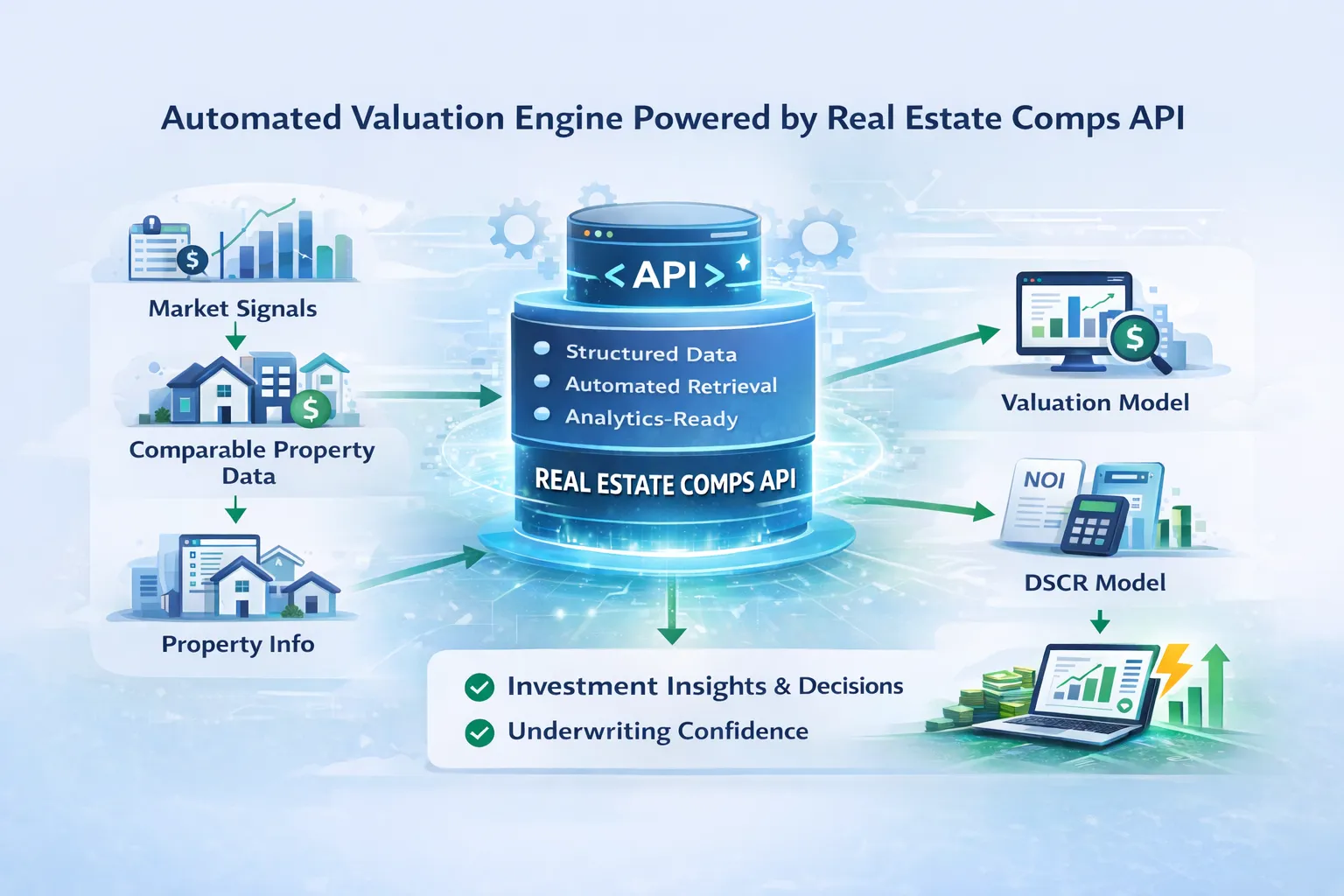
For decades, the bedrock of real estate valuation has been the comparable property analysis, commonly known as "comps." This meticulous process, which involves identifying and analyzing similar properties that have recently sold or are available for rent in a specific area, has traditionally been a labor-intensive undertaking. However, the growing demand for speed, accuracy, and scalability in real estate investment and development has exposed the inherent limitations of manual comp gathering. Data availability, consistency, and timeliness are now the primary bottlenecks, even for the most sophisticated underwriting frameworks. This is where the emergence of real estate comps Application Programming Interfaces (APIs) is transforming the industry, offering a pathway to automated, data-driven decision-making.
The core challenge for most real estate valuation models lies not in the complexity of their logic, but in the quality and accessibility of the underlying data. Analysts and investors alike spend countless hours sifting through fragmented datasets from various sources, painstakingly reconciling inconsistencies, and manually inputting information into spreadsheets. As portfolios expand and market dynamics accelerate, these manual workflows become increasingly untenable. They not only introduce human error and inconsistencies but also significantly slow down the decision-making process, hindering the ability to capitalize on timely opportunities or efficiently evaluate a growing pipeline of potential deals.
A real estate comps API fundamentally alters this paradigm. By delivering structured, up-to-date comparable sales and rental data programmatically, it empowers faster, more reliable valuation models and robust Debt Service Coverage Ratio (DSCR) analyses. This technology allows investors, developers, and financial institutions to seamlessly integrate real-time market intelligence directly into their proprietary tools and existing workflows. This guide will delve into the mechanics of comps APIs, explore how platforms like Mashvisor leverage this technology to enhance valuation and underwriting, detail the specific data endpoints available, and illustrate how businesses can harness automated comparable property data to build sophisticated, scalable real estate analytics solutions.
The Indispensable Role of Comparable Property Data in Modern Real Estate Valuation
At its essence, comparable property data is the cornerstone of modern real estate valuation methodologies. It enables investors and analysts to derive a property’s Fair Market Value (FMV) and its income-generating potential by referencing the performance of similar, nearby properties. By scrutinizing recent sales transactions and current rental rates, comps provide crucial market-based benchmarks against which potential deals can be assessed.
Defining Real Estate Comps
"Real estate comps," short for real estate comparables, are properties that share similar characteristics with the subject property under investigation. These characteristics typically include location, square footage, property type, age, condition, and amenities. Historically, the focus of comps analysis was primarily on recent sales data to determine a property’s market value. However, for investment property analysis, the importance of rental comps has surged, providing critical insights into the income-generating capacity of a property.
Consequently, two primary categories of comps are vital for comprehensive analysis:
- Sales Comps: These are recently sold properties that are similar to the subject property. They are used to establish a market value based on what buyers have recently been willing to pay for comparable assets.
- Rental Comps: These are actively rented or recently rented properties that share similar features with the subject property. They are crucial for estimating potential rental income, a key metric for income-producing properties.
Together, these comp types form the bedrock of informed pricing strategies, rigorous underwriting, and sound investment decisions. The ability to access structured and reliable comparable sales and rental data is therefore paramount for investors aiming to build consistent and repeatable valuation frameworks across diverse markets and property types.
The Inherent Limitations of Manual Comp Analysis
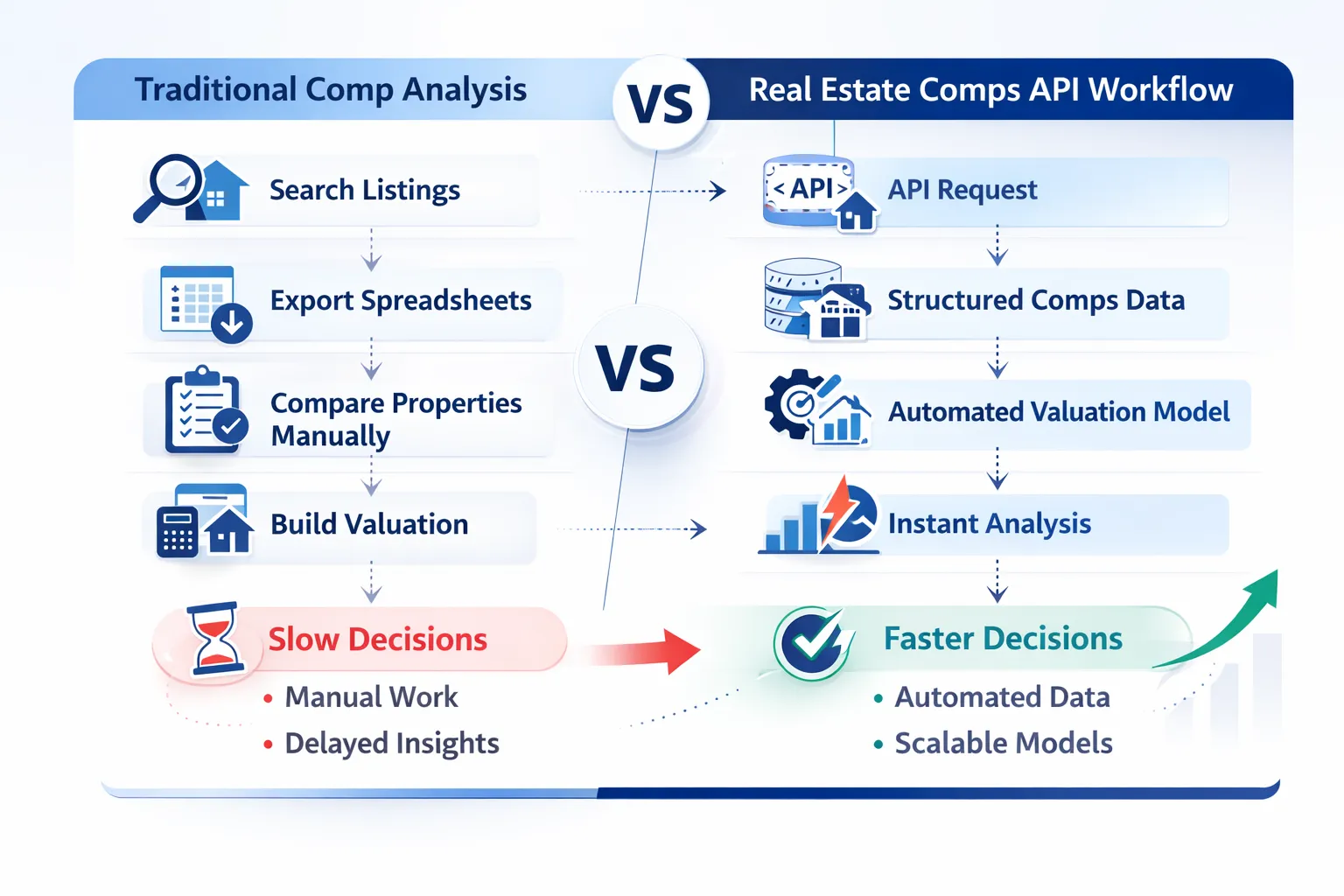
Despite the critical role of comps, the traditional method of gathering and analyzing them presents significant scalability challenges. This manual process typically involves arduous searches across multiple listing platforms, local government databases, and proprietary spreadsheets. This fragmented approach quickly leads to several persistent obstacles:
- Time-Intensive Data Collection: Manually searching for and verifying comparable properties across disparate sources consumes an inordinate amount of an analyst’s time, diverting focus from higher-value activities like strategic analysis and deal negotiation.
- Data Inconsistency and Fragmentation: Information from different sources can vary in format, accuracy, and completeness, requiring extensive data cleaning and reconciliation efforts. This often leads to the use of incomplete or outdated information.
- Risk of Human Error: Manual data entry and processing are susceptible to typos, calculation mistakes, and oversights, which can lead to inaccurate valuations and flawed investment decisions.
- Lack of Scalability: As the volume of deals increases, manual workflows become a significant bottleneck. It becomes impractical to conduct thorough comparable analyses for every potential acquisition, leading to missed opportunities or rushed, less informed decisions.
- Delayed Decision-Making: The time required for manual data gathering and analysis directly impacts the speed at which investment decisions can be made. In fast-moving real estate markets, this delay can mean the difference between securing a prime asset or losing out to a more agile competitor.
These limitations are amplified for professionals and organizations engaged in analyzing deals at scale. Consequently, modern valuation workflows are increasingly gravitating towards automated data delivery solutions, particularly through APIs, which enable the instant retrieval of comps data and its direct integration into sophisticated analytical models.
Understanding the Real Estate Comps API: Bridging the Data Gap
A real estate comps API is a technological solution designed to automate the delivery of comparable property data. Instead of relying on manual research, users can make structured requests to the API, which then returns essential information such as recent sales prices, rental rates, property characteristics, and market benchmarks. These APIs provide standardized data that can be readily consumed by valuation and underwriting models, eliminating the need for manual data manipulation.
From Static Reports to Dynamic Valuation
Traditional comp analysis has long been reliant on static reports or repetitive manual searches, each requiring a fresh round of data gathering. A comps API revolutionizes this by replacing manual underwriting processes with automated data retrieval. This shift enables a more dynamic and responsive approach to valuation.
The automated workflow, at a high level, typically proceeds as follows:
- Data Request: A user or system initiates a request to the API, specifying criteria such as location (address, city, zip code), property type, or specific property attributes.
- Data Retrieval: The API queries its vast database of real estate transactions and listings to identify relevant comparable properties based on the provided parameters.
- Data Standardization: The retrieved data is processed and standardized into a consistent format, ensuring uniformity across all returns.
- Data Delivery: The API returns the structured comparable property data in a machine-readable format (commonly JSON) directly to the requesting application or system.
With the assistance of a property comps data API, investors and platforms can access updated datasets on demand. Because the data is delivered in a standardized format, it can be immediately integrated into valuation models, facilitating repeatable analysis across a wide range of property types and geographic markets without further data processing.
The Integration of Real Estate Valuation APIs into Modern Tech Stacks
Comparable property data is increasingly being embedded directly within software workflows rather than being analyzed as a standalone process. A real estate valuation API serves as a critical data layer, powering a variety of tools and platforms utilized by professionals across the real estate ecosystem.
A real estate valuation API acts as a data layer powering tools used by:
- Real Estate Investors: For quick deal screening, comparative market analysis, and portfolio valuation.
- Property Developers: To assess the viability of new projects, determine optimal pricing for pre-sales, and understand market demand.
- Lending Institutions: To verify collateral values, conduct underwriting for mortgages, and manage risk.
- Real Estate Brokerages: To provide clients with accurate pricing guidance and market insights.
- PropTech Platforms: To build sophisticated valuation tools, market analytics dashboards, and investment recommendation engines.
For those on the technical side, a real estate API for developers eliminates the substantial burden of aggregating raw listing datasets or maintaining complex, resource-intensive data pipelines. Instead, an automated property valuation API provides readily usable comps data that can be seamlessly integrated into underwriting systems, investment analysis platforms, or client-facing dashboards, accelerating product development and enhancing feature sets.
Mashvisor Real Estate Comps API: Comprehensive Data, Powerful Endpoints
The efficacy of a comparable sales data API is directly proportional to the quality, structure, and comprehensiveness of the data it provides. The Mashvisor API distinguishes itself by offering comparable property datasets that are not only rich in transactional and rental information but are also enriched with crucial market benchmarks, granular investment analytics, and performance indicators, all unified within a single, cohesive real estate analytics API. This integration allows users to transition seamlessly from raw comparable data to actionable valuation and underwriting insights, bypassing the need for extensive post-retrieval data processing.
Key Data Points Available Through the Mashvisor API
Mashvisor delivers structured comparable property data designed to robustly support real estate valuation models, pricing analysis, and critical investment decision-making processes.
Property-Level Comparable Data
- Sale Price: The historical transaction price of comparable properties.
- Rental Income: Estimated or actual rental rates for comparable properties.
- Property Characteristics: Key attributes such as square footage, number of bedrooms, bathrooms, lot size, year built, and property type.
- Property Condition: Insights into the physical state of comparable properties (e.g., renovated, needs work).
- Listing Status: Information on whether a property is currently listed for sale or rent, or has recently sold.
- Days on Market (DOM): The duration a property was listed before selling or renting.
Market and Investment Context
- Market Trends: Data on local market appreciation rates, rental demand, and vacancy rates.
- Investment Metrics: Key performance indicators such as Cash-on-Cash Return, Cap Rate, and ROI for comparable properties.
- Neighborhood Data: Information on local amenities, school districts, crime rates, and demographic profiles.
- Occupancy Rates: Historical occupancy data for similar rental properties in the area.
- Price Per Square Foot: A standardized metric for comparing property values.
These comprehensive data points and contextual insights empower users to integrate a real estate investment analysis API directly into their acquisition or real estate underwriting pipelines, providing a holistic view of market conditions and property performance.
Example Mashvisor API Endpoints
Mashvisor provides access to comparable property data through a suite of well-defined API endpoints, each tailored to specific analytical needs.
Common API Endpoints for Comparable Property Analysis:
GET /v1.1/client/property: Retrieves detailed information for a specific property.GET /v1.1/client/property/nearby: Fetches a list of comparable properties located near a specified address or geographic coordinate. This is a cornerstone for traditional comps analysis.GET /v1.1/client/property/transactions: Provides historical sales transaction data for properties within a defined area or matching specific criteria.GET /v1.1/client/property/price-estimates: Returns estimated market values for properties, often derived from a combination of comps data and proprietary algorithms.
These endpoints are meticulously designed to facilitate a fully automated comps workflow. By replacing time-consuming manual research with structured data retrieval, they significantly enhance efficiency and accuracy in valuation and underwriting processes.
Example Request: Retrieving Comparable Properties
To illustrate the practical application of the Mashvisor API, consider a developer seeking to perform a valuation analysis for a potential acquisition. The developer can leverage the GET /v1.1/client/property/nearby endpoint to quickly retrieve relevant comparable properties.
A typical API request might look like this:
GET https://api.mashvisor.com/v1.1/client/property/nearby?state=AZ&city=Phoenix&address=123+Main+StHeaders:
x-api-key: YOUR_API_KEYThis request is designed to retrieve nearby properties that can serve as valuable real estate comps for the valuation modeling of the property located at "123 Main St" in Phoenix, Arizona.
Simplified Example Response
Upon receiving the request, the Mashvisor API would return structured comparable property data in a standardized JSON format, ready for immediate integration into valuation or underwriting models.
  "subject_property":
    "address": "123 Main St",
    "property_type": "Single Family",
    "price_estimate": 420000
  ,
  "nearby_properties": [

      "address": "118 Main St",
      "sale_price": 415000,
      "beds": 3,
      "baths": 2,
      "distance_miles": 0.3
    ,

      "address": "140 Oak Ave",
      "sale_price": 432000,
      "beds": 3,
      "baths": 2,
      "distance_miles": 0.6

  ]
This structured response provides the essential data points—address, sale price, number of bedrooms and bathrooms, and distance from the subject property—in a format that can be directly consumed by analytical software, eliminating manual data entry and formatting.
Building Smarter Valuation and DSCR Models with Mashvisor Data
The accuracy and scalability of real estate valuation and DSCR models are significantly enhanced when comparable property data is seamlessly integrated into analysis workflows. By automating the retrieval of comps through an API, investors and developers can standardize critical assumptions, drastically reduce manual research efforts, and consistently evaluate properties against reliable market benchmarks.
Constructing a Property Valuation Model with Comparable Data
Accurate property valuation models are fundamentally dependent on comparable sales data to estimate Fair Market Value. This estimation is based on observable market behavior rather than subjective pricing assumptions. Utilizing API-delivered comps allows this rigorous valuation process to be automated and replicated efficiently across numerous properties and diverse markets.
A simplified workflow for building a real estate valuation model using API-provided comps might involve the following steps:
- Define Valuation Parameters: Establish the criteria for identifying relevant comparable properties (e.g., geographic radius, property type, size range, recent sales timeframe).
- Automated Comps Retrieval: Utilize the real estate comps API to fetch a dataset of comparable properties based on the defined parameters for the subject property.
- Data Analysis and Adjustment: Process the retrieved comps data. This may involve applying adjustments for differences in features, condition, or location to ensure a more precise comparison.
- Calculate Valuation Estimate: Apply a chosen valuation methodology (e.g., average sale price, weighted average, regression analysis) to the adjusted comps data to derive an estimated Fair Market Value.
- Output and Integration: Present the valuation estimate in a report or integrate it directly into a larger investment analysis platform.
As comps data is delivered through an API for real estate valuation, the model can run automatically whenever new properties enter the analysis pipeline. This automation ensures consistent valuation practices at scale, a critical factor for growing portfolios.
Leveraging Comps Data for DSCR Model Real Estate Analysis
The Debt Service Coverage Ratio (DSCR) model is a crucial tool for assessing a property’s ability to generate enough income to cover its debt obligations. Its accuracy hinges on realistic income and valuation assumptions. Comparable property data significantly improves DSCR calculations by grounding these projections in verified market activity.
The fundamental DSCR calculation formula is:
DSCR = Net Operating Income / Total Debt Service
To calculate the DSCR for a rental property, analysts typically perform the following steps:
- Estimate Potential Rental Income: Use rental comps data retrieved via API to project the property’s gross potential rental income.
- Calculate Vacancy and Credit Loss: Factor in typical vacancy rates and potential credit losses based on market data for comparable properties.
- Determine Operating Expenses: Estimate all operating expenses, including property taxes, insurance, property management fees, maintenance, and utilities.
- Calculate Net Operating Income (NOI): Subtract total operating expenses from effective gross income.
- Determine Total Debt Service: Identify the annual principal and interest payments on any loans secured by the property.
- Calculate DSCR: Divide the NOI by the Total Debt Service.
Accurate comps data plays a pivotal role in mitigating risk by preventing the common underwriting errors of overestimated valuations or unrealistic income projections. By providing a data-driven foundation for these assumptions, comps APIs enable more reliable DSCR calculations.
Automating Rental Property Underwriting Workflows
When comparable property data is delivered programmatically via an API, the underwriting process can transition from a manual, review-heavy task to an automated, data-driven evaluation.
A typical automated underwriting pipeline leveraging a comps API might look like this:
API → Valuation Model → DSCR Calculation → Investment Decision
This sophisticated form of rental property underwriting automation empowers platforms to:
- Process Deals at Scale: Handle a significantly larger volume of loan applications or investment opportunities simultaneously.
- Enhance Consistency: Ensure that every property is evaluated using the same standardized data and methodologies, reducing subjective bias.
- Accelerate Turnaround Times: Provide near-instantaneous feedback on property viability, speeding up loan origination or acquisition processes.
- Improve Risk Management: Base underwriting decisions on objective, data-backed insights, leading to more prudent lending or investment strategies.
Instead of investing significant resources in building and maintaining complex data infrastructure from scratch, teams can opt for a real estate data API partnership. This allows them to procure standardized comps data that is immediately ready for integration into their analytical and underwriting models.
Real-World Example: Automating DSCR-Based Loan Underwriting
Consider a lending institution evaluating a loan application for a rental property. Instead of relying on lengthy manual appraisals and spreadsheet analyses, the system can automatically pull comparable property data through an API as soon as the property details are submitted.
The automated workflow would proceed as follows:
- Loan Application Submission: Borrower submits loan application with property details.
- API Data Retrieval: The underwriting system automatically queries the Mashvisor API to fetch relevant sales and rental comps for the subject property’s location.
- Automated Valuation: The system uses the retrieved comps to generate an estimated Fair Market Value and potential rental income for the property.
- DSCR Calculation: Based on the estimated income and prevailing market interest rates for similar loans, the system calculates the DSCR.
- Risk Assessment and Decision: The calculated DSCR, alongside other risk metrics derived from the comps data, informs the automated decision on loan approval or flags the application for further human review.
In this scenario, a process that previously might have taken hours or even days is transformed into a repeatable, near-instantaneous procedure. Crucially, every deal is evaluated using consistent, data-driven criteria, eliminating the variability and potential biases inherent in subjective manual assessments. While this example highlights a typical underwriting workflow, the applications of a real estate comps API extend far beyond this single use case.
Diverse Use Cases for Investors, Developers, and PropTech Teams
A real estate comps API proves most valuable when it is seamlessly integrated into core decision-making workflows. Different user segments derive distinct advantages from leveraging this technology to optimize their operations.
Investors and Acquisition Teams
Real estate investors utilize comparable property data to expedite deal evaluation and ensure consistency across diverse markets. Common applications include:
- Deal Screening: Quickly assessing the potential value and income-generating capacity of numerous properties to identify promising investment opportunities.
- Price Negotiation: Providing data-backed justification for offer prices during negotiations.
- Portfolio Analysis: Regularly updating valuations for existing portfolio assets to track performance and identify opportunities for refinancing or disposition.
- Market Entry Strategy: Understanding pricing dynamics and rental potential before entering new geographic markets.
Access to a centralized, up-to-date real estate comps dataset allows investors to standardize their decision criteria, reduce emotional bias in deal evaluation, and maintain a competitive edge.
Lenders and DSCR Underwriting
Lending institutions are increasingly adopting automated data workflows to enhance their assessment of borrower risk and collateral value. With API-delivered comps, lenders can:
- Verify Collateral Value: Independently assess the market value of properties offered as loan collateral.
- Streamline Underwriting: Automate key aspects of the underwriting process, particularly those related to property valuation and income estimation.
- Improve Risk Mitigation: Make more informed decisions by relying on objective, data-driven insights into property performance and market conditions.
- Enhance Loan Product Development: Design more competitive and risk-appropriate loan products based on granular market data.
This approach aligns with broader industry trends toward automated underwriting powered by historical real estate data APIs, driving efficiency and accuracy in financial services.
PropTech Platforms and Developers
For startups and established analytics platforms, comparable property data serves as a fundamental data layer for building sophisticated valuation and analytics tools. Typical developer use cases include:
- Developing Valuation Engines: Creating proprietary algorithms that leverage comps data for automated property valuations.
- Building Investment Dashboards: Providing users with real-time market data, comps, and investment metrics within a unified interface.
- Offering Market Analysis Tools: Empowering users to conduct detailed comparative market analyses without manual data aggregation.
- Integrating with Existing Software: Seamlessly embedding valuation and comps data into CRM systems, portfolio management software, or property management platforms.
By partnering with a leading real estate data API provider, development teams can launch powerful valuation features and analytics tools without the significant upfront investment and ongoing maintenance required for building and managing complex internal property data pipelines.
Mashvisor API Pricing and Getting Started
Mashvisor’s API pricing follows a flexible, usage-based model, designed to accommodate businesses of all sizes and growth stages. This approach allows companies to scale their API access in direct proportion to their evolving data requirements, making it suitable for both nascent projects and large-scale enterprise platforms.
Mashvisor offers a choice between monthly and annual subscription plans. Annual subscriptions provide an added benefit of two months of service at no extra cost, offering a more cost-effective solution for long-term users.
The pricing structure is tiered, catering to different levels of data consumption and analytical needs:
- Starter Plans: Designed for individuals or small teams with moderate data needs, offering a limited number of API credits per month.
- Growth Plans: Geared towards growing businesses and mid-sized firms requiring more extensive data access and higher query volumes.
- Enterprise Plans: Customized solutions for large organizations with substantial data requirements, offering dedicated support, higher API limits, and tailored features.
To initiate the integration process and explore the capabilities of the Mashvisor API, prospective users are encouraged to schedule a consultation call with the Mashvisor Data Team. This provides an opportunity to discuss specific needs, understand the available data sets, and determine the most appropriate plan.
The Undeniable Benefits of Using Mashvisor for Automated Property Valuation
Leveraging the Mashvisor API for comparable property analysis empowers investors and developers to transition from cumbersome manual valuation workflows to scalable, data-driven decision-making processes. The advantages are multifaceted and directly impact operational efficiency and investment outcomes:
- Accelerated Valuation and Deal Flow: Significantly reduces the time required for comparable property analysis, enabling faster deal screening and quicker acquisition decisions.
- Enhanced Data Accuracy and Consistency: Eliminates human error associated with manual data entry and reconciliation, ensuring reliable and consistent data for all analyses.
- Scalability for Growth: Effortlessly handles increasing volumes of property data, allowing businesses to scale their operations without being constrained by manual data processes.
- Cost Efficiency: Reduces the labor costs associated with manual data research and management, reallocating resources to more strategic initiatives.
- Improved Decision-Making: Provides access to rich, up-to-date market intelligence and investment metrics, leading to more informed and profitable investment decisions.
- Seamless Integration: Offers structured data that can be directly integrated into existing software, valuation models, and underwriting systems, streamlining workflows.
By consolidating crucial comparable property data with essential investment analytics within a single platform, Mashvisor enables faster, more reliable property valuation and analysis at scale, providing a distinct competitive advantage.
When a Real Estate Comps API May Not Be Necessary
While the advantages of a real estate comps API are substantial, it’s important to acknowledge that its necessity is context-dependent. A comps API is most beneficial when the objective is to analyze properties at scale or to embed valuation capabilities directly into software workflows. However, for certain specific use cases, the added complexity and cost of an API might not be justified.
You may not require a comps API if:
- Analyzing a Single Property Infrequently: If you are only evaluating one or two properties per year and have ample time for manual research, the ROI of an API might be limited.
- Limited Technical Resources or Expertise: If your team lacks the technical capacity to integrate an API into your existing systems, manual methods might be more practical in the short term.
- Budget Constraints for Small-Scale Operations: For individuals or very small operations with extremely limited budgets, the cost of an API subscription might be prohibitive compared to occasional manual research.
- Existing Robust Internal Data Processes: If an organization has already invested heavily in building and maintaining its own comprehensive and efficient internal data aggregation and processing systems, an external API might offer less incremental value.
In these scenarios, adopting an API could introduce unnecessary complexity. However, the moment the need arises for faster analysis, consistent benchmarks across multiple deals, or simultaneous evaluation of numerous properties, the value proposition of automated comps data becomes significantly more compelling.
Conclusion: The Data-Driven Future of Real Estate Investment
As the real estate analysis landscape increasingly embraces data-driven methodologies, the industry’s approach to valuation and underwriting is undergoing a profound shift. The paradigm is moving away from laborious manual research towards intelligent, automated data processing. In this evolving context, comparable property data is no longer a static, one-time analysis input for individual deals. Instead, it serves as a continuous, dynamic stream of information that powers pricing models, risk assessments, and strategic investment decisions across entire portfolios.
A real estate comps API is the enabling technology for this transition. It delivers consistent, high-quality market data directly into automated valuation and DSCR models, empowering teams to analyze opportunities with unprecedented speed while maintaining standardized assumptions and minimizing risk.
By providing scalable access to comparable properties, essential investment metrics, and analytics-ready datasets, Mashvisor empowers investors, lenders, and PropTech platforms to reorient their focus. Instead of expending valuable resources on the intricacies of data collection and management, these organizations can concentrate on refining their strategies, optimizing their portfolios, and ultimately, building smarter, more profitable real estate ventures. The future of real estate investment is undoubtedly data-driven, and comps APIs are at the forefront of this transformative wave.
FAQs
What Is a Real Estate Comps API?
A real estate comps API is a software interface that provides programmatic access to data concerning similar properties within a specific geographic area. This enables applications and systems to automatically retrieve sales data, rental comparisons, and other relevant property information for valuation and analysis purposes.
How Is DSCR Calculated for Rental Properties?
The Debt Service Coverage Ratio (DSCR) is calculated by dividing a property’s Net Operating Income (NOI) by its total annual debt obligations (principal and interest payments). This ratio serves as a key metric for lenders to assess a property’s ability to generate sufficient income to cover its loan payments and manage repayment risk.
Who Uses Real Estate Comps APIs?
Real estate comps APIs are utilized by a wide range of industry professionals, including real estate investors, lending institutions, real estate brokerages, property developers, and PropTech platforms. These users leverage the APIs to obtain scalable valuation data for analysis, reporting, and the development of automated real estate analysis systems.
What Makes Mashvisor Different from Other Real Estate APIs?
Mashvisor differentiates itself by focusing on investment-oriented analytics. Its API integrates property-specific information with comprehensive market insights and performance indicators. This unified approach allows users to conduct thorough opportunity evaluations without the need to assemble data from multiple disparate sources, streamlining the analysis process.
How Do I Get Comparable Property Data Automatically?
Comparable property data can be accessed automatically by connecting analytical software tools to a data provider’s API. This connection allows the software to send automated requests based on specific locations or property characteristics, and the API responds by returning nearby property information and pricing benchmarks in a structured format.

