
The global landscape for critical materials is undergoing a profound transformation, with governments worldwide enacting tighter controls over vital resources, most notably tungsten. This escalating trend of resource nationalism is creating an unprecedented opening for companies like Almonty Industries, as Western industrial and defense sectors urgently seek to diversify their supply chains away from China’s long-standing quasi-monopolistic market position. Tungsten, alongside rare earths and other strategic minerals, forms the bedrock of modern industrial and technological advancement, underpinning critical sectors from defense production and advanced semiconductor manufacturing to the expansion of AI data centers, crucial power grid upgrades, and the fabrication of essential industrial tooling. The growing strategic importance of these materials has ignited a fierce global competition for access and control, fundamentally reshaping international trade and geopolitical alliances.
The Indispensable Role of Tungsten in the Modern Economy
Tungsten, derived from the Swedish words "tung sten" meaning "heavy stone," is a remarkable refractory metal celebrated for its extraordinary properties: an exceptionally high melting point (the highest of all metals at 3,422 °C or 6,192 °F), superior hardness, and remarkable density. These attributes make it indispensable across a vast array of high-tech and heavy industrial applications. In the defense sector, tungsten is crucial for armor-piercing projectiles, missile components, and specialized alloys for high-performance aircraft and weaponry due to its density and strength. Its use in high-temperature alloys is critical for jet engines and rocket nozzles. For the semiconductor industry, tungsten is vital for thin-film deposition in microchips, ensuring the reliability and efficiency of processors that power everything from consumer electronics to advanced AI systems. The burgeoning demand for AI data centers, with their immense computational needs, further drives the requirement for robust and efficient components, many of which rely on tungsten.

Beyond these cutting-edge applications, tungsten is a foundational material for everyday industrial operations. Its carbides are used to create incredibly hard and wear-resistant cutting tools, drills, and dies, essential for manufacturing processes across automotive, aerospace, and general engineering industries. It’s also found in light bulb filaments, electrical contacts, and radiation shielding. The sheer breadth of its applications underscores why disruptions to its supply chain ripple through nearly every facet of the global economy, directly impacting productivity, innovation, and national security.
China’s Dominance and the Genesis of the Supply Crunch
For decades, China has maintained a commanding position in the global tungsten market, accounting for approximately 80% of global production and an even larger share of processing capacity. This dominance was achieved through a combination of abundant natural reserves, aggressive investment in mining and refining infrastructure, and, at times, export policies designed to favor domestic industries. Over the past year, Beijing has increasingly leveraged this position, implementing stricter export controls on critical metals, including tungsten, ostensibly to safeguard domestic supplies and promote higher-value-added processing within its borders. This throttling of exports, coupled with broader geopolitical tensions, has awakened Western nations to the inherent vulnerabilities of their reliance on a single, dominant supplier for materials deemed essential for national security and economic stability. The concept of "resource nationalism" – where a country prioritizes control and exploitation of its natural resources for its own benefit, often restricting exports or mandating domestic processing – has thus gained significant traction, especially as nations seek to de-risk their supply chains and achieve greater self-sufficiency. This move is part of a larger trend of "decoupling," where Western economies aim to reduce their economic interdependence with China in strategic sectors.
A Global Cascade of Export Restrictions and Strategic Investments

The consequences of China’s tightened grip on tungsten exports are now manifesting as a cascade of protectionist measures and strategic investments by other nations, signaling a dramatic shift in the global materials market. The timeline of recent events paints a clear picture of this accelerating trend:
- United States Bans Tungsten Scrap Exports: The U.S. government, recognizing the strategic importance of recycled materials, has implemented restrictions on the export of tungsten scrap. This move is a direct attempt to retain valuable domestic resources for processing and re-entry into American industrial and defense supply chains. Such a ban underscores the urgent need to maximize domestic resource utilization and minimize reliance on external sources, even for secondary materials. The U.S. Department of Commerce has likely identified tungsten scrap as a critical component in maintaining domestic production capabilities, particularly for specialized alloys and military applications.
- United Kingdom Invests in Tungsten West: In a significant move to bolster its domestic supply, the UK government has pledged up to £71 million in support for Tungsten West, a company focused on the redevelopment of the Hemerdon tungsten mine in Devon. This substantial investment highlights the UK’s commitment to securing a sovereign supply of tungsten, reducing its vulnerability to international market fluctuations and geopolitical pressures. The Hemerdon project, one of the largest tungsten deposits outside of China, is seen as a cornerstone of the UK’s critical minerals strategy, aiming to provide a reliable, ethically sourced supply for its advanced manufacturing and defense sectors.
- Zimbabwe Suspends Tungsten and Antimony Exports: In a bold assertion of resource nationalism, Zimbabwe has suspended the export of tungsten and antimony in all forms, including ores and concentrates. This policy is designed to force beneficiation – the domestic processing of raw materials into higher-value products – within Zimbabwe, thereby capturing more economic value from its mineral wealth. While aimed at fostering local industry, such restrictions inevitably tighten the global supply of raw materials for countries without their own processing capabilities, further exacerbating the international scramble.
- Vietnam Considers Export Restrictions: Following suit, Vietnam is reportedly considering similar restrictions on the shipment of tungsten ore and concentrates. This potential move aligns with a broader regional trend among mineral-rich nations to develop domestic processing capabilities and retain more economic benefits from their natural resources. If implemented, Vietnam’s restrictions would further constrain the already shrinking pool of deliverable tungsten available to international buyers outside of China, intensifying the pressure on global supply chains.
These actions, collectively, paint a stark picture: the era of readily available, globally traded tungsten, particularly from non-Chinese sources, is rapidly diminishing. As noted by industry observers like Teo (@Teo_Sinamin) on September 11, 2026, the question is not if, but "Who’s next?!" to impose similar restrictions, indicating a widespread and accelerating trend.
The Almonty Opportunity: A Western Champion for Conflict-Free Tungsten
Amidst this landscape of tightening supply and escalating geopolitical competition, Almonty Industries has emerged as a strategically vital player. The company is uniquely positioned as the largest and, critically, the only North America-based producer of conflict-free tungsten for the Western world. This positioning is not merely a commercial advantage but a strategic imperative for the U.S. and its allies, particularly in the context of a "massive rearmament supercycle" across North America and Europe. The urgent need for deliverable, ethically sourced tungsten, independent of potentially adversarial supply lines, has significantly strengthened the investment case for established producers like Almonty, as opposed to speculative junior miners.

Almonty’s recent operational milestones underscore its growing importance:
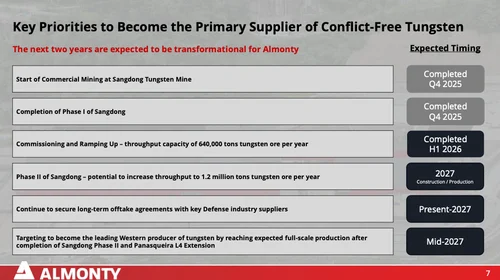
- Sangdong Mine Commences Processing: In June, Almonty successfully commenced ore processing at its Sangdong mine in South Korea. This pivotal development marked the company’s transition to scalable tungsten ore production, with throughput projected to increase significantly to 1.2 million tons of tungsten ore in 2027. The Sangdong mine, historically one of the world’s largest tungsten mines outside of China, represents a critical new source of supply for Western markets. Its recommissioning after decades of dormancy is a testament to the renewed strategic focus on non-Chinese tungsten sources.
- Expanded Agreement with Global Tungsten & Powders (GTP): In July, Almonty solidified its position within the U.S. industrial and defense supply chains by expanding its agreement with Pennsylvania-based Global Tungsten & Powders (GTP). The updated agreement extends the term to an impressive 21 years, increases total contracted volumes by 40%, and improves pricing by approximately 6.3%. This long-term, enhanced partnership establishes a direct and reliable route for Almonty’s tungsten into crucial U.S. manufacturing facilities, ensuring a stable supply for defense contractors and advanced industrial users. GTP is a major global player in tungsten powder and carbide production, making this alliance a cornerstone of Western supply chain resilience.
- Strategic Growth and Expansion: Almonty’s corporate presentations highlight its ambition to become the leading Western tungsten producer. This vision is anchored by the planned Phase II expansion at Sangdong and an extension of operations at its already operating Panasqueira mine in Portugal. These expansions are designed to significantly boost Almonty’s overall production capacity, further solidifying its role as a cornerstone supplier for the West.
Moving Up the Value Chain: Tungsten Oxide Production
Recognizing the economic and strategic advantages of value-added processing, Almonty is also pursuing higher-value opportunities. The company has plans for a South Korean tungsten oxide plant, initially targeting an annual capacity of 4,000 tons, with future expansion to 6,000 tons. Tungsten oxide is an intermediate product critical for the production of tungsten metal powders, which are then used in a wide array of high-tech applications. By establishing domestic processing capabilities, Almonty aims to reduce reliance on external refining services, enhance supply chain security, and capture greater economic value from its raw materials. This strategy aligns perfectly with the broader trend of resource nationalism, where nations and companies seek to control the entire value chain of critical materials.
Industry Warnings and the Ripple Effect

The urgency of diversifying tungsten supply chains is not merely a geopolitical abstraction; its tangible effects are already being felt across industrial sectors. Last week, at the Jefferies Industrials Conference, Martina McIsaac, an executive with MSC Industrial, a major U.S. tool distributor, issued a stark warning. She cautioned that a "tungsten supply shock" is actively rippling through the company’s supply chain, inevitably driving up costs for industrial tooling. McIsaac emphasized that the "ripples through the supply chain aren’t over yet" and predicted that the tungsten supply crunch would remain a significant challenge for the foreseeable future. This direct feedback from a key industry player underscores the immediate economic consequences of the global supply tightening, affecting everything from manufacturing efficiency to the overall cost of goods. The implications extend beyond direct material costs, impacting production schedules, innovation cycles, and competitive advantage for companies reliant on tungsten-based tools and components.
Broader Implications: National Security and Economic Resilience
The evolving dynamics in the tungsten market are emblematic of a broader, epochal shift in global resource governance and geopolitical strategy. China’s historical dominance over critical material supply chains has long afforded Beijing significant economic and strategic leverage over Washington and its allies. Any further tightening of export controls on materials like tungsten, gallium, germanium, or rare earths would only intensify the "decoupling" trend, compelling Western nations to accelerate their efforts in building resilient, diversified, and secure supply chains.
The quest for conflict-free tungsten and other critical materials is not merely an economic endeavor; it is a national security imperative. Reliable access to these "building blocks of the modern economy" is crucial for maintaining technological superiority, supporting defense capabilities, and ensuring the stability of essential infrastructure. Companies like Almonty Industries, by providing secure and ethically sourced alternatives, are therefore playing a pivotal role in strengthening the strategic autonomy and economic resilience of the U.S. and its allies. The current environment demands proactive investment in mining, processing, and recycling infrastructure outside of traditional supply strongholds, ensuring that the foundational elements of modern society remain accessible and secure for generations to come. The global scramble for tungsten is a powerful indicator that the era of unfettered, globally integrated critical mineral markets is giving way to a more fragmented, strategically guarded landscape.

