
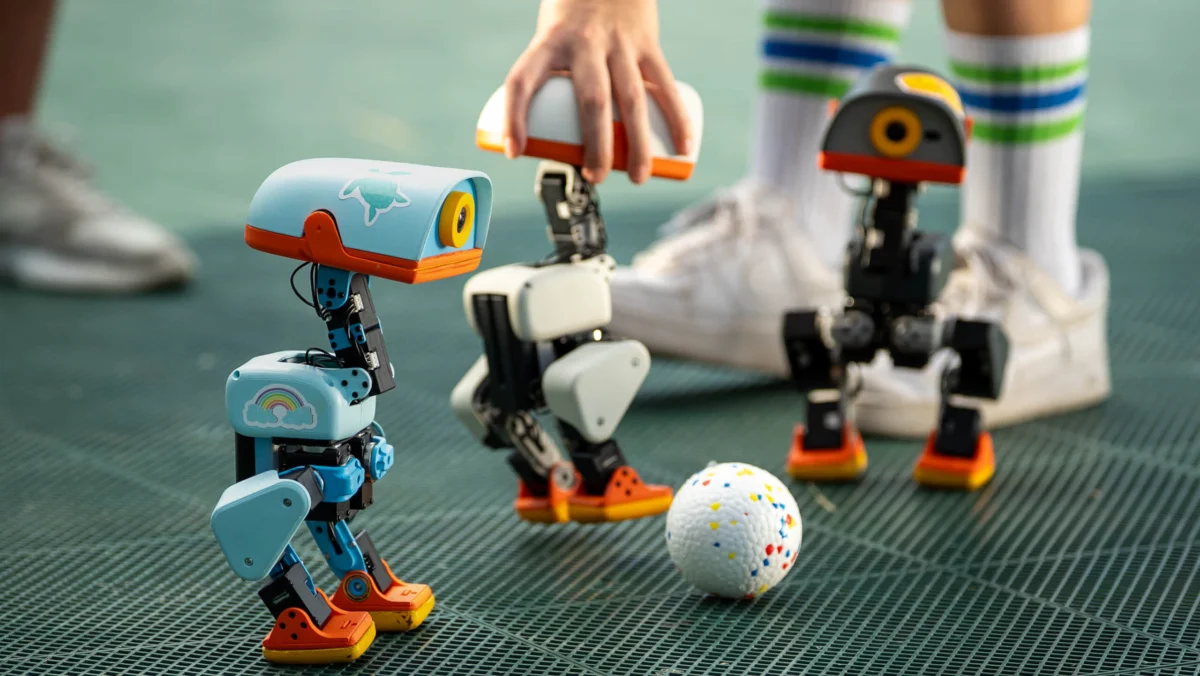
BEIJING — The recent launch of the "Microduck" robot, a vibrant, programmable personal companion, has swiftly captivated the consumer market, underscoring both the burgeoning demand for accessible robotics and the enduring intricacies of global technology supply chains. Developed by Hugging Face’s French subsidiary, Pollen Robotics, the duck-shaped device has not only exceeded sales expectations but also drawn attention to its foundational components: a Rockchip processor from Shanghai, which itself leverages intellectual property from British semiconductor giant ARM. This intricate web of international collaboration highlights a supply chain that remains deeply integrated despite ongoing geopolitical pressures.
A Market Phenomenon: Microduck’s Explosive Debut
Since its introduction on Thursday, the Microduck robot has achieved remarkable commercial success, with Hugging Face reporting over 10,000 units sold and sales surpassing $5 million by late Tuesday. This rapid uptake has led to immediate and significant delays in delivery times for new orders, pushing them beyond the initial promise of Christmas 2026. Priced at $399 per unit, the 1.76-pound (800g) robot is positioned as both an interactive consumer toy and a robust development platform, appealing to a broad demographic from tech enthusiasts to educators and hobbyists. Its design incorporates a suite of sensors, motors, and on-device computing power, enabling it to perform a range of pre-installed actions and, crucially, to learn from virtual simulations and goal-driven directions through its open-source software framework. This dual functionality, combining immediate playability with advanced customization, appears to be a significant driver of its early success.
The Microduck represents the second robotics product from Pollen Robotics, a France-based startup that was acquired by Hugging Face last year in a strategic move to integrate hardware with Hugging Face’s extensive open-source AI platform. Pollen Robotics stated that its first robot, launched the previous spring, also sold more than 10,000 units, indicating a consistent market appetite for their innovative hardware offerings. This strong performance positions Hugging Face, primarily known for its software and open-source AI models, as a significant player in the rapidly evolving consumer robotics hardware space.
The Global Brain: Rockchip and ARM at the Core
Central to the Microduck’s functionality is the RK3566 chip from Shanghai-listed Rockchip. This processor is not merely a component but a critical enabler of the robot’s "on-device computing power." A representative for Pollen Robotics confirmed the selection of Rockchip due to its "on-board 1 TOPS NPU" (Neural Processing Unit). TOPS, or tera operations per second, serves as a crucial metric for measuring AI computing performance. While 1 TOPS provides ample capability for the Microduck’s current functions, it situates the device within the entry-to-mid range of edge AI capabilities when compared to more powerful dedicated robotics chips like Nvidia’s forthcoming Jetson Orin Nano 2, which boasts 78 TOPS. This comparison highlights a strategic choice by Pollen Robotics to balance performance with cost and accessibility, making the Microduck an affordable entry point into robotics development.
The Rockchip RK3566, in turn, incorporates technology licensed from British semiconductor company ARM. This relationship is emblematic of the globalized nature of modern technology production. ARM’s business model revolves around designing instruction set architectures (ISAs) and licensing them to chip manufacturers worldwide, who then customize and produce their own processors. This model has made ARM architecture ubiquitous, powering everything from smartphones and tablets to embedded systems and, increasingly, AI-driven edge devices. The presence of ARM’s technology within a Chinese-made chip powering a French-American robot underscores a fundamental interdependence in the tech sector, where innovation often transcends national borders.
Rockchip’s Ascendance in Edge AI
Rockchip has carved out a significant niche as a "key vendor" for AI that operates directly on devices, rather than relying on cloud-based processing. Lian Jye Su, chief analyst at Omdia, emphasized the company’s strong footprint in machine vision applications, including object detection and image recognition. These capabilities are vital for robots like the Microduck, enabling it to perceive and interact with its environment. Su, however, also noted that while Rockchip’s chips are widely used, they may not be designed for the most complex edge AI devices due to limitations in compute resources. Such advanced computing capabilities are often required for tasks like running generative AI models securely on-device, minimizing data transfer to the internet and enhancing privacy.
Rockchip’s strategic focus on the burgeoning edge AI market appears to be paying dividends. The company recently reported robust financial results, with a 40% year-on-year increase in operating revenue during the first half of the year, reaching 2.88 billion yuan ($428 million). Net profit, excluding one-time items, surged by more than 60% over the same period. This financial strength provides Rockchip with the resources to continue investing in research and development, further solidifying its position in the competitive semiconductor landscape, particularly in areas like smart home devices, industrial control, and, as demonstrated by the Microduck, consumer robotics.
Hugging Face’s Strategic Trajectory and Industry Buzz
The Microduck’s success comes amidst a period of intense activity and speculation surrounding Hugging Face. Just prior to the robot’s release, The Information reported that Nvidia had agreed to acquire Hugging Face for an estimated $12.9 billion. While neither company has officially commented on the rumor, such an acquisition would have profound implications for the AI industry, potentially merging Nvidia’s hardware prowess with Hugging Face’s leading open-source AI platform. Hugging Face co-founder Thomas Wolf acknowledged the heightened scrutiny, noting in a social media post on Monday that "people were starting to monitor the Microduck supply chain" in response to the strong rush for orders, further highlighting the interconnectedness of their hardware and software ambitions.
An acquisition by Nvidia would align with the growing trend of vertical integration in the AI space, where companies seek to control both the software and hardware layers to optimize performance and accelerate innovation. For Hugging Face, known for democratizing AI by providing access to models and tools, such a move could offer unparalleled resources for scaling its initiatives, though it might also raise questions about the future of its open-source ethos under a proprietary hardware giant.
The Expanding Horizon of Personal Robotics
The Microduck is not an isolated phenomenon but rather a prominent example within a rapidly expanding market for personal robots. Other startups are also rolling out innovative devices, reflecting a broader industry push towards making robotics more accessible and integrated into daily life.
Startup Zeroth, for instance, launched a child-sized humanoid robot this summer, priced at 8,888 yuan (approximately $1,200). This robot also boasts virtual simulation learning capabilities, mirroring some of the Microduck’s advanced features. With 247 pre-orders recorded on JD.com in China, Zeroth is tapping into a similar demand for interactive, intelligent companions. The company plans to reveal its open-source robotics system, further contributing to the collaborative spirit driving innovation in this sector.
Meanwhile, Mondo Robotics has garnered significant attention with its "Beni" all-terrain camera robot. Resembling a GoPro on wheels, the Wall-E-type device has raised more than 80 times its initial Kickstarter goal of $50,000, ahead of its September 6 deadline. Early bird prices for Beni start at $549, with shipping anticipated to begin in October. This demonstrates consumer interest not only in companion robots but also in specialized robotic assistants for tasks like photography and exploration.
These diverse offerings illustrate a dynamic market where companies are experimenting with different form factors, price points, and functionalities. From companion robots to specialized tools, the personal robotics sector is poised for substantial growth, driven by advancements in AI, miniaturization, and increased computational power at the edge.
Implications for Global Tech and Future Innovation
The Microduck’s journey from a French-American design to global market success, powered by Chinese chips utilizing British IP, serves as a powerful testament to the resilience and efficiency of the global technology supply chain. Despite ongoing geopolitical tensions and calls for supply chain decoupling, the reality remains that innovation often thrives on international collaboration and specialized expertise from various regions. Any disruption to this intricate network, whether through trade disputes or component shortages, could have ripple effects across the industry, impacting product availability and development cycles.
Furthermore, the rapid sales and delivery delays for the Microduck highlight an unmet demand for accessible, programmable robotics. This demand is likely to spur further investment in edge AI hardware, open-source software platforms, and novel robotic designs. The integration of AI capabilities directly onto devices, moving computation closer to the source of data, promises enhanced privacy, reduced latency, and greater autonomy for robots and smart devices.
The trend towards open-source robotics, exemplified by Pollen Robotics and Zeroth, is also a significant development. By making their software systems available to a wider community, these companies foster collaborative innovation, accelerate development, and empower users to customize and expand the functionalities of their robots. This democratic approach to robotics could lead to a proliferation of applications and a deeper integration of intelligent machines into various aspects of daily life.
As companies like Hugging Face continue to bridge the gap between advanced AI software and tangible hardware, the landscape of personal robotics is set to evolve dramatically. The Microduck’s story is not just about a cute robot; it’s a microcosm of the forces shaping the future of technology, where global cooperation, cutting-edge AI, and consumer demand converge to create a new generation of intelligent companions and tools.
—CNBC’s April Roach and Kai Nicol-Schwarz contributed to this report.

