
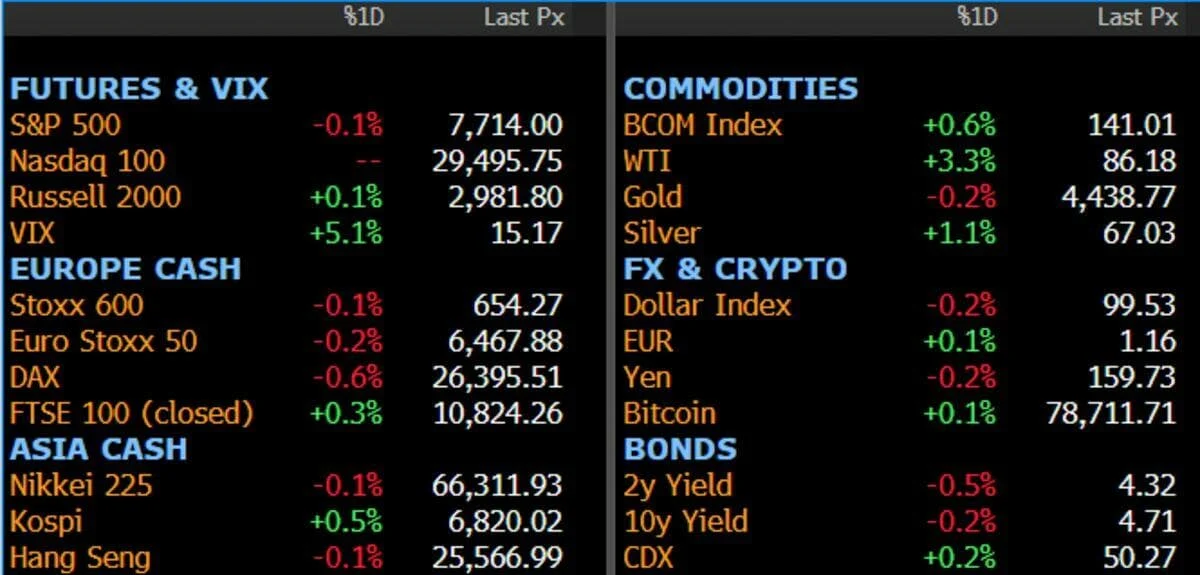
US stock futures experienced a notable decline in pre-market trading, signaling a cautious start to the week as summer’s end approached and trading volumes remained thin. This market reticence was primarily driven by escalating geopolitical tensions in the Middle East, specifically the first exchange of attacks between the United States and Iran in several weeks, which immediately sent oil prices surging. Brent crude futures rallied nearly 4%, pushing past the critical $90 per barrel threshold, while West Texas Intermediate (WTI) contracts climbed above $86 a barrel.
As of 8:00 AM ET, S&P 500 futures were down approximately 0.2%, and contracts for the tech-heavy Nasdaq 100 dipped 0.1%. This downward pressure on broader indices was evident as most "Magnificent Seven" technology stocks saw declines, while energy giants like Chevron (CVX) and ExxonMobil (XOM) bucked the trend, rising around 2% each on the back of renewed Middle East instability. The ripple effect was felt globally, with Europe’s benchmark Stoxx 600 equity index edging 0.2% lower, compounded by muted trading conditions due to UK markets being closed for a holiday. Asian equities also registered losses across the board, with Japan’s Nikkei shedding almost 1% and Hong Kong’s Hang Seng drifting 0.7% lower. China’s ChiNext index, focused on growth enterprises, was down 1.3%. South Korea’s Kospi, however, showed resilience, reversing earlier losses to close flat, a testament to underlying buying interest.
Geopolitical Tensions Ignite Oil Markets
The catalyst for the dramatic shift in commodity markets was the overnight report of direct exchanges between the US and Iran. This marked a significant escalation, breaking a period of relative calm. Initial reports indicated that the US targeted Larak Island, while Iran retaliated by striking two US bases in Jordan. Concurrently, Tehran claimed that a tanker had been hit by mines in the strategically vital Strait of Hormuz. This narrow waterway, connecting the Persian Gulf to the open ocean, is a chokepoint for global oil shipments, with an estimated one-fifth of the world’s total petroleum liquids consumption passing through it daily. Any disruption or perceived threat to shipping in this area immediately triggers a premium in oil prices due to supply security concerns.
The immediate consequence was a sharp uptick in crude benchmarks. Brent futures, the international benchmark, surged to their highest levels in months, topping $90 a barrel. WTI, the US benchmark, also experienced a significant climb, pushing above $86 a barrel. This resurgence in oil prices adds a new layer of complexity to the global economic outlook, particularly for central banks grappling with persistent inflationary pressures. The renewed hostilities underscored the fragile nature of energy supply chains and the profound impact geopolitical events can have on global markets.
The Shadow of Jackson Hole: Fed Policy in Focus
Adding to market uncertainty were the lingering effects of Federal Reserve Chairman Kevin Warsh’s hawkish remarks at the annual Jackson Hole Economic Symposium on Friday. Warsh’s comments, which emphasized the Fed’s commitment to tackling inflation, were widely interpreted as signaling a potential September rate hike. He notably stated that financial conditions were not currently restrictive and described interest rates as the Fed’s "predominant tool" for achieving its mandate, while stopping short of explicitly endorsing a September hike.
This hawkish tone spurred traders to boost their bets on an imminent rate increase, leading to the biggest increase in 2-year Treasury yields since June 17 as additional tightening was priced into the market. However, a divergence of opinion quickly emerged among market commentators and bond investors. Analysts at ABN Amro Investment Solutions and Brandywine Global Investment Management expressed skepticism about the likelihood of further rate hikes, suggesting that market participants might be overinterpreting the Fed’s stance.
Gary Paulin of Northern Trust Asset Management highlighted a less-discussed aspect of the Federal Reserve Reform Act of 1977, which lists three objectives: maximum employment, stable prices, and moderate long-term interest rates. Paulin posited whether this third objective might gain more prominence if the first two prove challenging to manage simultaneously, hinting at the potential for a more nuanced approach from the Fed than currently assumed by some hawkish interpretations.
Global Equities Face Headwinds
The confluence of rising oil prices and hawkish central bank rhetoric created a challenging environment for global equities.
- United States: US futures indicated a lower open, with the S&P 500 and Nasdaq 100 contracting. The divergence between falling tech stocks (the "Mag 7") and rising energy stocks (CVX, XOM) illustrated the market’s immediate repricing of sector fortunes based on oil prices and interest rate expectations.
- Europe: The Stoxx 600 edged lower, with sectors like technology lagging due to concerns that higher yields resulting from Fed hikes could weigh on growth-oriented stocks. Conversely, energy and auto sectors showed relative resilience. Trading volumes were notably lower given the UK bank holiday.
- Asia: Asian markets generally trended downwards, with Japan’s Nikkei shedding nearly 1% and China’s CSI 300 and Hang Seng also registering losses. This was partly attributed to the spillover from Warsh’s hawkish comments and the regional implications of rising oil prices. However, South Korea’s Kospi staged a remarkable recovery, initially dropping significantly before reversing to close flat, driven by notable buying from pension funds, particularly in tech heavyweights like Samsung Electronics and SK Hynix. This demonstrated localized buying interest despite broader regional and global headwinds.
Currency Markets and Fixed Income Dynamics
In the foreign exchange market, the US dollar weakened against most major currencies. The Japanese Yen notably strengthened back below the 160/USD mark, following remarks from Treasury Secretary Bessent regarding the Bank of Japan’s (BOJ) policy, which were interpreted as supportive of yen strength. The offshore yuan firmed by 0.1% after a modest beat in China’s manufacturing PMI data, offering a glimmer of positive economic news from the region.
Treasury markets, meanwhile, presented a mixed picture. The 10-year Treasury yield remained largely flat around 4.72% after Friday’s post-Jackson Hole surge. The yield curve, particularly the 2s10s and 5s30s segments, bull steepened slightly despite higher energy prices, partially unwinding the dramatic flattening observed on Friday. Front-end tenors outperformed, seeing yields ease by 1-2 basis points, reflecting ongoing digestion of Warsh’s hawkish comments and the pricing in of potential near-term tightening. Long-end tenors, however, saw yields rise slightly by about 1 basis point, but were anticipated to benefit from month-end index rebalancing flows later in the session, which would increase duration. Market pricing suggested approximately 16 basis points of tightening remained factored in for the September 16 Fed decision, with upcoming speeches from Fed officials Barr, Waller, and Hammack keenly awaited before the communications blackout period begins on September 5.
Corporate News and Sectoral Shifts
Beyond macroeconomic and geopolitical factors, several corporate developments garnered attention:
- Amgen: The biotech giant announced positive Phase 3 trial results for its drug Repatha (evolocumab), showing a 20% reduction in the risk of death in high-risk adults without prior heart attack or stroke, compared to a placebo. This news could bolster Amgen’s market position in cardiovascular treatments.
- SpaceX and NASA: A planned mission to the International Space Station faced a delay due to an oxidizer leak in the Dragon spacecraft’s propulsion system, highlighting the technical complexities and safety precautions inherent in space exploration.
- Shein: The fast-fashion retailer priced its IPO in Hong Kong, raising $1.7 billion. However, the offering valued the company at $26 billion, a significant reduction from its peak valuation of $100 billion. The shares reportedly fell as much as 17% in gray market trading, reflecting investor skepticism about its growth prospects and valuation in the current market climate. This signals a broader trend of investor caution towards highly valued private companies entering public markets.
The Enduring Allure of AI and Tech Sector Dynamics

The Artificial Intelligence (AI) theme continued to resonate, albeit with evolving dynamics. While the semiconductor cohort that fueled the early summer tech rally had shown signs of cooling, market observers noted a "broadening out" of AI monetization beyond just chips and hyperscalers. Investment strategist Billy Leung of Global X Management highlighted that enterprise software and cybersecurity names had posted some of their strongest moves of the year on earnings, indicating that the AI trade was no longer confined to a narrow set of companies.
The US-China AI funding divide remained a perplexing question for investors. In the US, hyperscalers had dramatically increased their share of nonfinancial investment-grade bond issuance, from 2% in 2025 to 19% this year, reflecting a robust appetite for capital to fund AI infrastructure. In contrast, China’s AI race had not exerted similar pressure on yields, as its tech firms predominantly relied on bank loans and equity financing rather than the bond market. However, experts like Leung suggested that a resource-hungry AI revolution would eventually necessitate broader funding avenues in China over the long run.
Specific company actions underlined the global push in AI: SK Hynix, a major memory chip producer, was reportedly studying the feasibility of a joint venture to manufacture memory chips in Japan, aiming to meet surging AI demand while controlling production costs. Additionally, Amazon was expected to become the next hyperscaler to tap Australia’s debt market for billions in capital, according to the Financial Review, further illustrating the immense capital requirements for AI expansion. The VanEck Semiconductor ETF (SMH) had become a key indicator of "semiconductor/AI FOMO" (Fear Of Missing Out), with investors actively chasing upside through long calls, contributing to a "vol up/spot up" dynamic at times.
Commodities Beyond Oil
While oil dominated headlines, other commodity markets also saw significant activity. The overnight Middle East attacks were the primary driver, pushing WTI above $85/bbl and Brent above $90/bbl. In other segments, base metals notably outperformed precious metals, even as gold recovered from an initial $50 drop to trade unchanged around $4,460 an ounce. The global diesel crunch, exacerbated by ongoing conflicts in the Middle East and between Russia and Ukraine, remained a concern. Brazil, a major agricultural exporter, faced the challenge of a global diesel shortage colliding with its seasonal planting demand. Goldman Sachs reiterated warnings about tightness in global refining capacity, more than doubling its forecasts for diesel refining profits.
Upcoming Economic Indicators and G20 Focus
Looking ahead, market participants will closely monitor a series of key economic data releases this week, which could significantly influence the Federal Reserve’s September rate decision. The August ISM manufacturing and services gauges, JOLTS job openings, ADP employment change, and crucially, the August jobs report (Non-Farm Payrolls, NFP) on Friday, are all on the calendar. NFP, alongside CPI (Consumer Price Index), is considered one of the two pivotal data points for the Fed to determine the likelihood of a September hike. A stronger-than-expected ISM reading, for instance, could potentially boost the "broadening portion" of the current market rally, indicating wider economic strength.
In geopolitics, the upcoming G20 meeting in North Carolina is also in focus. Reports indicated that the US Treasury had excluded journalists from several media outlets, including Bloomberg News, from the gathering. Treasury Secretary Bessent was reportedly pushing the G20 to re-evaluate China’s trade terms, suggesting a continued emphasis on trade policy discussions amidst global economic challenges.
The week opens with markets navigating a complex landscape of geopolitical flare-ups, persistent inflation concerns, and a watchful eye on central bank rhetoric and critical economic data, all against a backdrop of evolving technological trends.

