
Accurate and up-to-date short-term rental (STR) data is the bedrock of profitability in the dynamic real estate industry. Investors, property managers, PropTech startups, marketplaces, and analytics platforms all grapple with a fundamental challenge: accessing reliable Airbnb performance insights at scale. Recognizing that Airbnb itself offers limited public analytics access, businesses are compelled to seek out third-party providers for actionable intelligence, typically through specialized Airbnb data APIs. This article undertakes a comprehensive evaluation of the leading solutions available in 2026, including Mashvisor, AirDNA, ATTOM, RentCast, Airbtics, and AirROI. The comparison focuses on critical factors such as API endpoint diversity, data accuracy, market coverage, and pricing models, aiming to guide stakeholders in identifying the platform best suited to their specific use cases.
The Indispensable Role of Airbnb Data APIs
In an era where the short-term rental market continues its robust expansion, understanding granular performance metrics is no longer a competitive advantage, but a necessity. The ability to predict occupancy rates, optimize pricing strategies, identify high-demand locations, and forecast potential revenue streams directly impacts an investor’s return on investment (ROI) and a property manager’s operational efficiency. This is where an Airbnb data API becomes invaluable. It acts as a bridge, programmatically connecting businesses to a wealth of structured short-term rental data. This allows for automated retrieval of performance metrics, market trends, dynamic pricing insights, and detailed property analytics, eliminating the laborious and often inaccurate process of manual data collection.
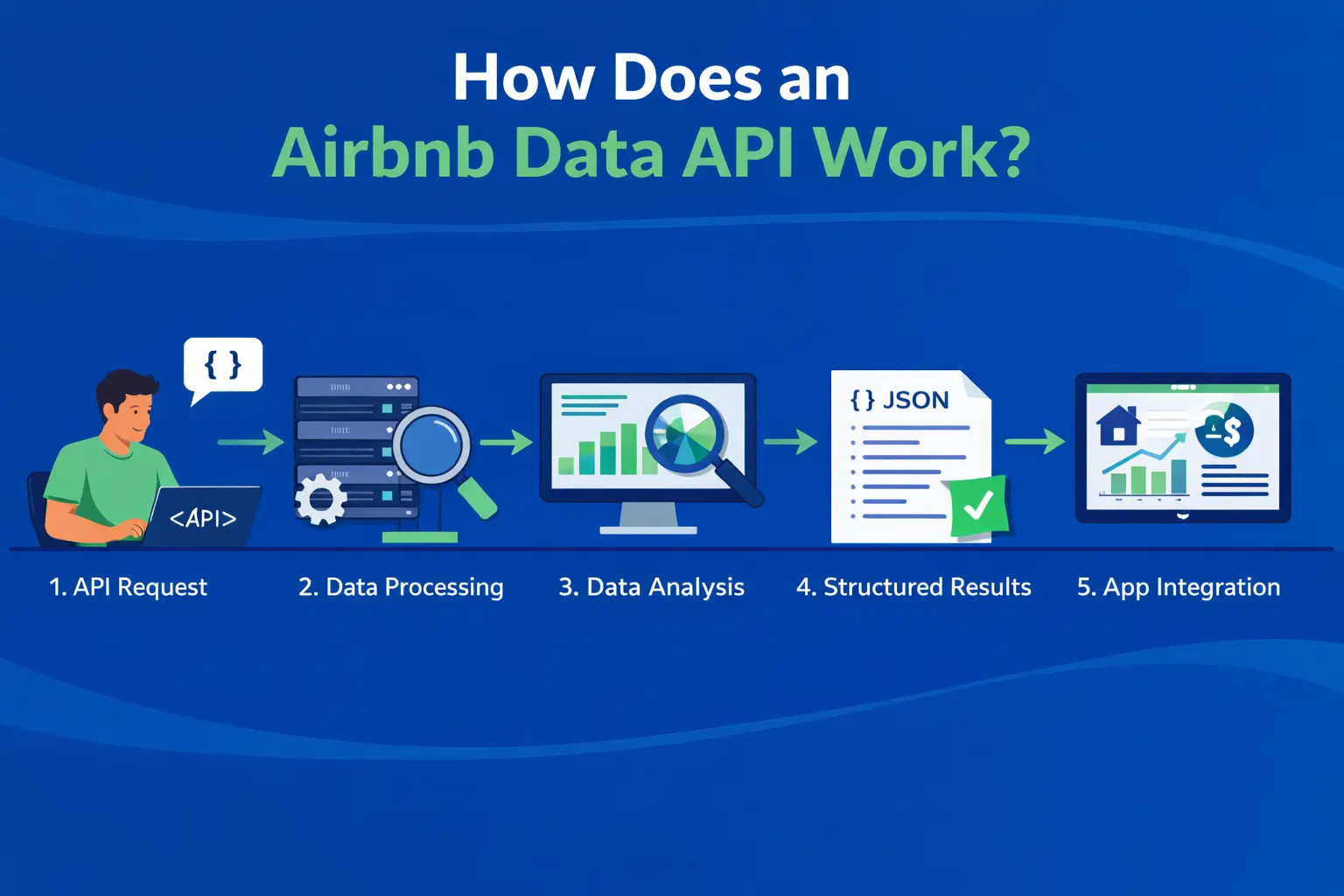
The architecture of an Airbnb data API facilitates seamless integration into existing software and workflows. A typical process involves an application sending a request to the API endpoint for specific data. The API provider’s system then processes this request, retrieves the relevant data from its databases, and formats it into a structured response, commonly in JSON format. This response is then transmitted back to the requesting application, ready for immediate use in analytics dashboards, investment calculators, or property management software. This automated pipeline empowers businesses to make data-driven decisions rapidly and at scale, fostering agility in a rapidly evolving market.
Who Benefits Most from Airbnb Data APIs?
The demand for robust Airbnb data APIs spans a wide spectrum of real estate professionals and technology developers. Key beneficiaries include:
- Real Estate Investors: Seeking to identify lucrative investment opportunities, calculate potential ROI, and understand market viability for STR properties.
- Property Managers: Aiming to optimize pricing, occupancy, and guest experiences for their portfolios.
- PropTech Startups: Developing innovative tools for investment analysis, property management, or market intelligence.
- Marketplaces: Requiring data to inform listing recommendations, market insights, and user engagement.
- Data Analytics Platforms: Building sophisticated models and dashboards for clients in the real estate and hospitality sectors.
- Real Estate Developers: Evaluating the feasibility of developing properties for short-term rental markets.
In essence, any entity that relies on accurate, up-to-date, and scalable short-term rental data for strategic decision-making will find a critical ally in a well-chosen Airbnb data API.
Evaluating the Top Airbnb Data API Providers in 2026
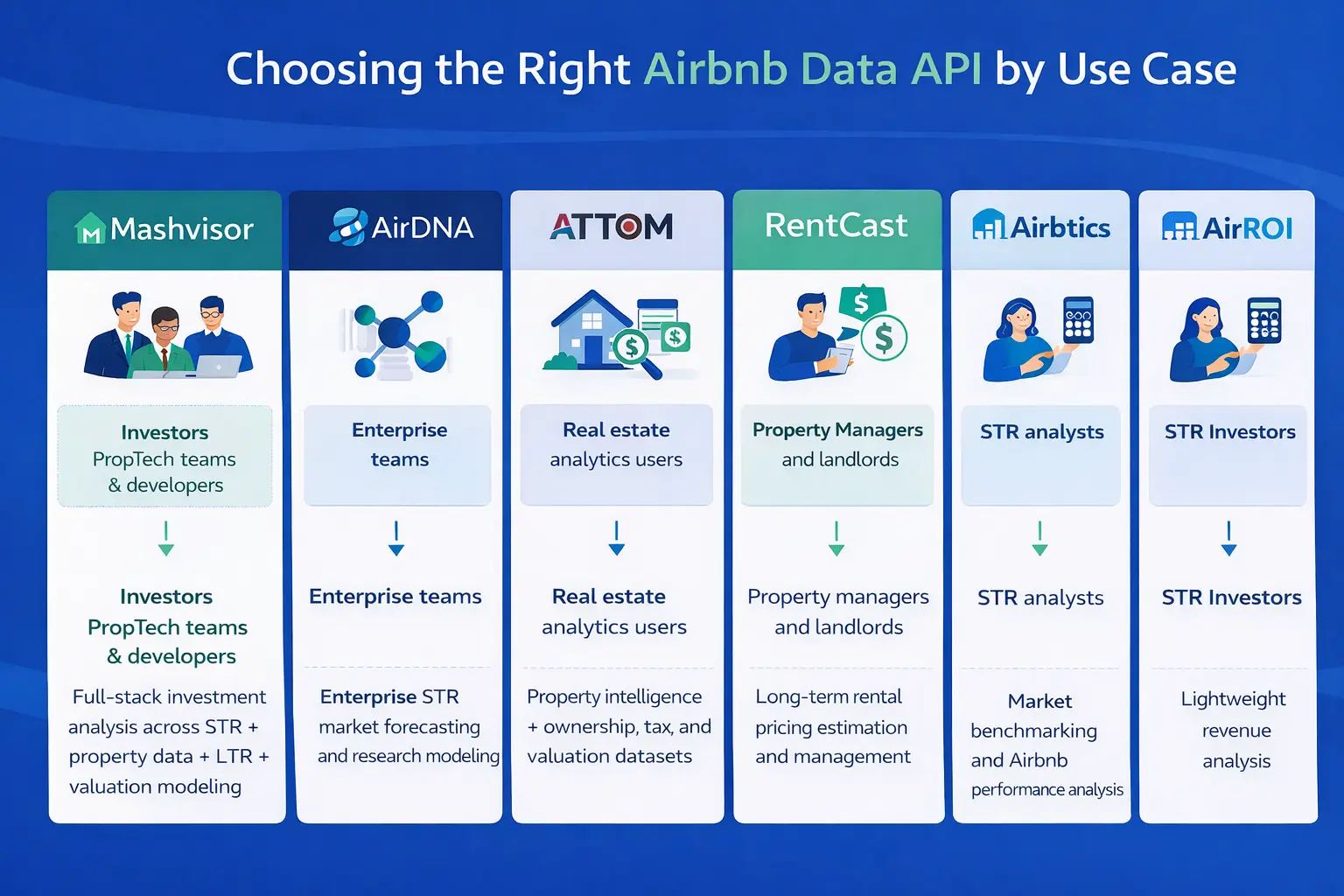
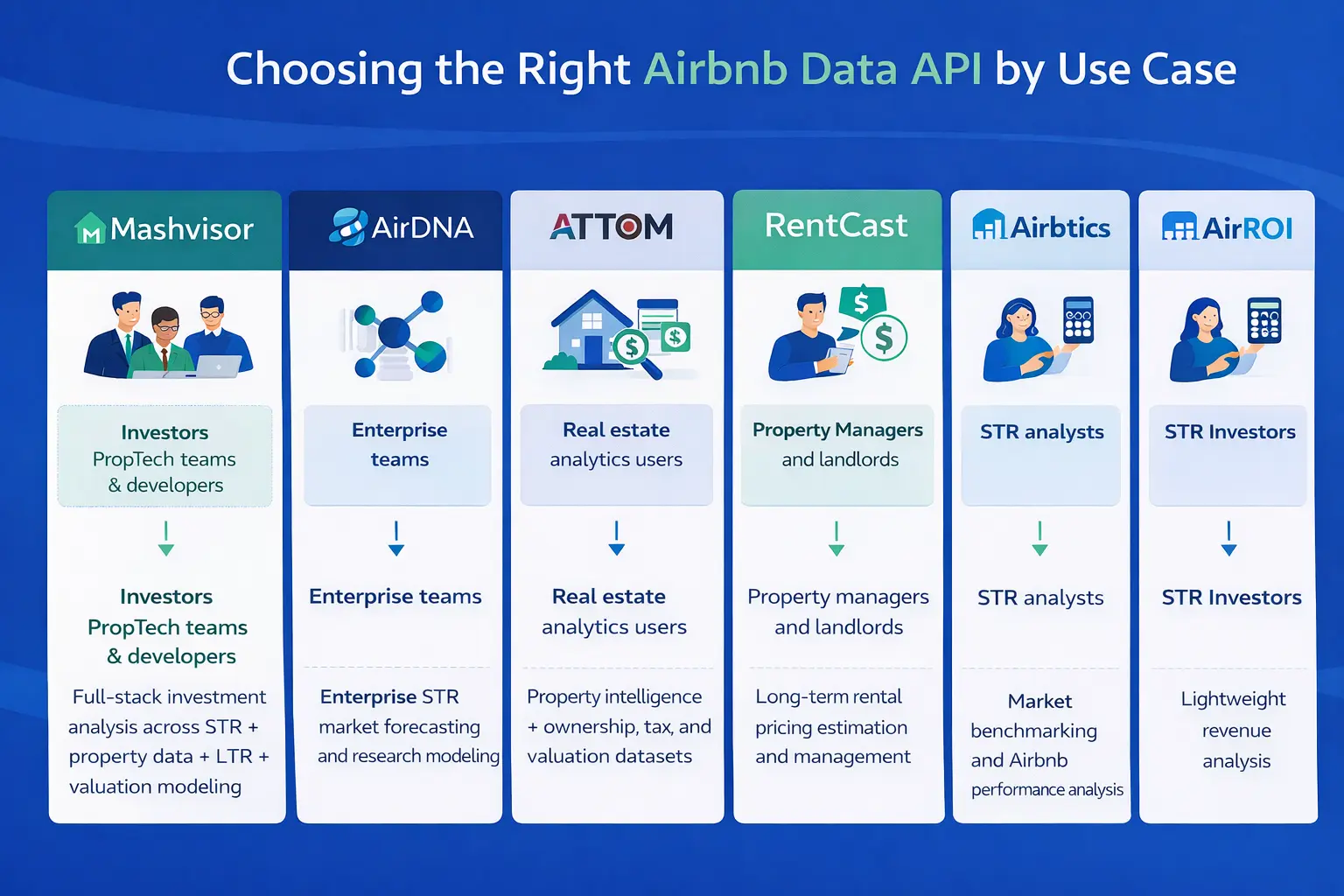
The landscape of Airbnb data API providers is competitive, with each platform offering distinct strengths and catering to different user needs. This article delves into the capabilities of six leading providers, analyzing them against key performance indicators to help stakeholders make informed choices.
Mashvisor: The Integrated Investment Intelligence Hub
Mashvisor has emerged as a standout solution in 2026, particularly for its comprehensive approach to real estate investment analysis. Its API is designed to deliver not just raw STR data, but actionable investment metrics, market insights, and property-level intelligence all within a unified platform. This integration significantly reduces the development time for applications that require a holistic view of real estate opportunities, facilitating faster, data-informed investment decisions.
Key Strengths of Mashvisor:
- Holistic Data Integration: Combines STR data, Long-Term Rental (LTR) data, market data, property data, and crucial investment metrics.
- Nationwide US Market Coverage: Provides extensive data access across all 50 states, catering to a broad investor base.
- Investment-Centric Analytics: Offers built-in ROI metrics, cash flow projections, cap rates, and cash-on-cash return calculations.
- Developer-Friendly Tools: Features advanced, well-documented API endpoints designed for seamless integration.
- Daily Data Updates: Ensures that users are always working with the most current market information.
- Extensive Historical Data: Provides up to 36 months of historical performance data for robust trend analysis.
- Scalable, Usage-Based Pricing: Offers flexible tiers that allow businesses to pay for what they use, making it cost-effective for startups and growing enterprises.
AirDNA: The STR Market Intelligence Specialist
AirDNA is a well-established player focusing exclusively on short-term rental data. It is particularly adept at providing large-scale market data, including occupancy trends, pricing benchmarks, and historical performance metrics. Its strengths lie in aggregated STR datasets, making it a suitable choice for enterprise analytics platforms and research teams that require deep dives into market-level performance rather than property-specific investment modeling.
ATTOM: The Comprehensive Property Data Provider
ATTOM’s API is a powerhouse for property data, encompassing ownership records, valuations, parcel information, and extensive real estate market datasets. While not specifically focused on STR performance, its strength lies in providing foundational property intelligence. This makes it an excellent resource for applications that require robust property data enrichment alongside broader real estate analytics, though it necessitates supplementation for direct STR performance insights.
RentCast: The Long-Term Rental Analytics Focus
RentCast specializes in long-term rental market intelligence, offering data on rental estimates, pricing trends, and property-level rental information. It is ideal for developers building tools focused on the LTR market, such as rental pricing engines and portfolio monitoring platforms. While it provides valuable rental data, it does not offer native Airbnb performance analytics.
Airbtics: The STR Market and Performance Analyst
Airbtics provides Airbnb analytics with a focus on market trends, performance benchmarks, and geographic STR insights. It is well-suited for platforms conducting STR market research, competitive benchmarking, and regional performance analysis where a broader market view is prioritized over detailed investment modeling.
AirROI: The Streamlined Revenue Estimator
AirROI offers simplified STR analytics and Airbnb revenue estimates, designed for quick and easy integration. It caters to startups and developers who need immediate access to STR performance indicators and feasibility metrics without the complexity of extensive analytics infrastructure or detailed investment modeling.
A Comparative Look at Leading Providers
To provide a clearer picture of how these platforms stack up, a side-by-side comparison highlights their core features and target audiences.
| Feature | Mashvisor | AirDNA | ATTOM | RentCast | Airbtics | AirROI |
|---|---|---|---|---|---|---|
| Best For | Investors, Managers, PropTech, Analytics Apps | Enterprise STR Investors, Managers, Analysts | Real Estate Market Analysts | LTR Investors, Managers, Analysts | Individual STR Investors & Managers | Individual STR Investors & Managers |
| Data Focus | STR, LTR, Market, Property, Investment Metrics | STR Only | Property Data Only | LTR Only | STR Only | STR Only |
| Typical Use Cases | Full-stack RE Investment Analysis Apps | STR Forecasting Models | Property Intelligence Platforms | Rental Pricing Engines | Airbnb Market Intelligence Tools | Airbnb Revenue Estimation Tools |
| Developer Tools | Advanced, Developer-Friendly | Strong | Extensive | Simple | Moderate | Basic |
| Updates | Daily | Regular | Unspecified | Daily | Weekly | Unspecified |
| Historical Data | 36 Months | Limited | Limited | Limited | 12 Months | 15+ Years |
| Pricing | Usage-based, Scalable Tiers | Enterprise Usage-based, Custom Contracts | Tiered Subscription | Credit-based | Pay-as-you-go | Lightweight Usage-based |
Detailed Feature Comparison:
| Feature | Mashvisor | AirDNA | ATTOM | RentCast | Airbtics | AirROI |
|---|---|---|---|---|---|---|
| API Endpoints | Extensive | Strong | Extensive | Moderate | Moderate | Limited |
| Airbnb Data Accuracy | High (multi-source, validated) | High | N/A | N/A | High | Moderate |
| LTR Data | Yes | No | No | Yes | No | No |
| Market Data | Yes | Yes | Yes | Yes | Yes | Yes |
| Property Data | Yes | Limited | Yes | Yes | Yes | Yes |
| Investment Analytics | Yes (Cash Flow, Cap Rate, CoC Return) | Limited | No | Limited | Limited | Limited |
| Valuations | Yes | No | Yes | Yes | No | No |
Competitive Snapshots in 2026
Mashvisor Airbnb API: Positioned as the premier choice for investment-focused STR data. It distinguishes itself by integrating analytics, investment metrics, and property-level insights into a singular platform, thereby reducing development time and enabling faster, data-driven real estate decisions. Its comprehensive coverage of the US market makes it exceptionally valuable for investors, property managers, and developers.
AirDNA Airbnb API: A strong contender for enterprise-level STR analysis, offering robust market data and forecasting capabilities. It excels in providing aggregated datasets for market intelligence but is less geared towards granular property-level investment modeling or LTR analysis.
ATTOM Airbnb API: Primarily a property data API, ATTOM provides extensive public records, valuations, and market datasets. While invaluable for property intelligence and valuation modeling, it lacks direct STR performance analytics, requiring integration with other services for a complete STR picture.

RentCast Airbnb API: Focused on long-term rental analytics, RentCast offers rental estimates and property data tailored for the LTR market. It serves as a dedicated solution for LTR-focused applications but does not cover Airbnb performance metrics.
Airbtics Airbnb API: Offers market analytics and performance benchmarks specifically for Airbnb. It is suitable for STR market research and geographic comparisons but does not provide comprehensive investment profitability analysis or LTR data.
AirROI Airbnb API: Provides simplified STR analytics and revenue estimates for quick integrations. It’s best for developers needing rapid access to STR performance indicators without complex investment modeling, though it lacks broader real estate property and LTR data.
The Mechanics of an Airbnb Data API
At its core, an Airbnb data API is a software interface that allows other applications, platforms, and analytics tools to access structured short-term rental data programmatically. Instead of manually scraping websites or manually compiling spreadsheets, businesses can leverage an API to automatically retrieve vital information. This includes performance metrics such as occupancy rates, average daily rates (ADR), and monthly revenue projections; market trends like demand fluctuations and competitive pricing; and crucial property analytics like potential ROI and cash flow.
The operational flow of an Airbnb data API typically involves the following steps:
- Request Initiation: A client application (e.g., a PropTech platform) sends an API request to a specific endpoint on the data provider’s server. This request specifies the type of data needed (e.g., STR performance for a particular city) and may include parameters like dates, property types, or location identifiers.
- Authentication and Authorization: The API server verifies the client’s identity and permissions, usually through an API key or token, ensuring that only authorized users can access the data.
- Data Retrieval and Processing: The API server queries its databases to fetch the requested data. This may involve complex algorithms to aggregate, filter, and calculate specific metrics based on the provider’s proprietary data sources and methodologies.
- Data Formatting: The retrieved data is then formatted into a structured output, most commonly JSON (JavaScript Object Notation), which is easily parsable by most programming languages.
- Response Transmission: The structured data is sent back to the client application as an API response.
- Data Utilization: The client application receives the JSON response and processes it to display information to the end-user, use it in calculations, or integrate it into further analytical processes.
This automated, programmatic access transforms fragmented STR market information into usable intelligence for both investment professionals and technical teams. Understanding this process is crucial for evaluating which provider offers the most robust combination of analytics, coverage, and usability.
Pricing Models: Balancing Cost and Scalability
The financial aspect of accessing Airbnb data is a significant consideration. Pricing structures vary considerably, with most platforms employing either subscription-based or usage-based models. Transparency, flexibility, and scalability are key differentiators.
Mashvisor API Pricing: Features a usage-based, credit-driven model. Tiered subscription plans allow businesses to start small and scale their data access as their needs grow. This ensures that users pay only for the data and endpoints they actively consume. Higher tiers offer increased request volumes, and transitions between tiers are seamless. All plans encompass all available endpoints and functionalities. Annual plans typically offer a cost saving of two months. This model is particularly advantageous for startups and growing PropTech products that require predictable, scalable costs.
AirDNA API Pricing: Employs a subscription and enterprise licensing model. Pricing is often customized based on dataset access, geographic coverage, and usage volume. Plans differ based on whether users access analytics tools or direct API data integrations. Enterprise contracts are common for large-scale deployments, and access to multiple markets can significantly increase costs. This model is best suited for large enterprise analytics teams and research platforms.
ATTOM API Pricing: Offers tiered and packaged pricing, contingent on specific data products and request volumes. Costs are determined by the scope of datasets and the scale of integration, with enterprise plans being tailored to individual business requirements. Pricing is generally negotiated based on usage and data access needs, making it suitable for enterprise property data integrations and valuation platforms.
RentCast API Pricing: Utilizes tiered monthly pricing based on API request limits. A free development plan with limited API calls is available. Paid plans scale with usage volume, allowing developers to upgrade as their integrations expand. The pricing is structured around subscription tiers rather than per-endpoint billing, making it ideal for predictable monthly usage in long-term rental analytics tools.
Airbtics API Pricing: Adopts a pay-as-you-go model where costs are calculated per API endpoint request, eliminating the need for contracts or monthly commitments. This transparent approach allows teams to scale their usage gradually and pay only for the data they consume, offering flexibility for various analytics projects.
AirROI API Pricing: Also uses a pay-as-you-go model based on API requests, not fixed subscriptions. Developers can start with a small prepaid credit and scale usage incrementally, with real-time tracking and no contractual obligations. This model is best for lightweight integrations and flexible experimentation in STR analytics.
Mashvisor’s usage-based, tiered pricing stands out for its flexibility and scalability, making it a cost-effective solution for a wide range of businesses, from early-stage startups to established platforms.
API Endpoint Diversity: The Foundation of Application Development
The breadth and depth of available API endpoints dictate the range of functionalities developers can build. While many providers offer access to STR or property datasets, the organization and usability of these endpoints can vary significantly.
Mashvisor API Endpoints: Offer a comprehensive suite of structured endpoints designed for detailed investment analysis and application development. These endpoints provide access to both STR analytics and property intelligence within a single ecosystem, enabling the creation of full-stack real estate investment workflows without the need to combine multiple APIs. Key endpoints include those for property lookup, market analysis, investment calculations (cash flow, cap rate, cash-on-cash return), neighborhood analysis, and historical performance data.
AirDNA API Endpoints: Primarily focus on aggregated short-term rental analytics and market performance datasets. These include endpoints for market trends, occupancy rates, ADR, revenue estimates, and historical STR performance. While valuable for market analysis, they do not offer LTR data or granular property-level investment modeling.
ATTOM API Endpoints: Provide extensive property data, including ownership records, tax assessments, property characteristics, and valuation data. These endpoints are crucial for property enrichment but do not natively include Airbnb performance analytics.
RentCast API Endpoints: Streamlined endpoints focused on long-term rental analytics, such as rental estimates, pricing trends, and property-level rental data. These are designed for LTR market analysis and can be relevant for rental arbitrage strategies, as they cover LTR data that Mashvisor also includes.
Airbtics API Endpoints: Concentrate on Airbnb market analytics and benchmarking, offering insights into market trends, revenue potential, and geographic performance. While useful for STR market research, they lack the breadth for comprehensive investment profitability analysis or LTR research.
AirROI API Endpoints: Feature lightweight endpoints for simplified STR performance analysis, focusing on revenue estimates and basic feasibility indicators. They prioritize quick integrations over extensive analytical depth and lack broader real estate property and LTR data.
Mashvisor’s extensive endpoint ecosystem, encompassing property data, STR and LTR analytics, and investment metrics, positions it as the most versatile provider for developers aiming to build comprehensive real estate analysis tools.
Ensuring Data Accuracy in a Volatile Market
Data accuracy is paramount, as investment decisions and forecasting models hinge on reliable performance estimates. Accuracy is influenced by dataset size, collection methods, validation processes, and modeling techniques. Each provider employs distinct methodologies, impacting the trustworthiness of their data.
Mashvisor Data Accuracy: Achieves high accuracy through a multi-layered approach combining:
- Observed STR Performance Signals: Direct data from actual Airbnb listings.
- Historical Datasets: Extensive past performance records.
- Comparable Property Validation: Cross-referencing with similar properties.
- Proprietary Machine Learning Models: Advanced algorithms for predictive analytics.
This methodology ensures property-level accuracy suitable for investment decisions and STR forecasting.
AirDNA Data Accuracy: Relies on large-scale market aggregation methods, including:
- Direct Data Partnerships: Collaborations with STR platforms.
- Web Scraping: Collection of publicly available listing data.
- Proprietary Algorithms: For data cleaning, normalization, and trend analysis.
AirDNA’s data is particularly effective for macro-level market analytics.
ATTOM Data Accuracy: Focuses on property intelligence accuracy by leveraging:
- Public Records: Deeds, tax assessments, and property records.
- County Assessor Data: Official property valuation information.
- Proprietary Data Enrichment: Verifying and enhancing public records.
ATTOM guarantees strong property data accuracy but does not directly model Airbnb performance metrics.
RentCast Data Accuracy: Emphasizes long-term rental accuracy using structured housing market inputs such as:
- MLS Data: Multiple Listing Service information.
- Public Records: Property transaction data.
- Proprietary Rental Market Models: Algorithms for rental estimation.
Its accuracy is primarily applicable to LTR analytics.
Airbtics Data Accuracy: Generates Airbnb analytics accuracy through market-focused revenue modeling, including:
- Airbnb Listing Data Aggregation: Collecting listing details.
- Performance Benchmarking: Comparing against market averages.
- Geographic Trend Analysis: Identifying regional patterns.
Airbtics’ data accuracy is strongest for STR market trends and competitive positioning.
AirROI Data Accuracy: Provides simplified STR performance estimates using streamlined inputs like:
- Listing Data: Basic information from STR platforms.
- Revenue Estimation Algorithms: Simplified calculation models.
AirROI prioritizes accessibility and speed over deep modeling granularity.
Mashvisor’s robust methodology, combining observed signals, historical data, and comparable validation, positions it as a leading provider for reliable, investment-ready Airbnb data accuracy.
Market Coverage: Reaching Every Investment Niche
Market coverage is a critical factor determining how effectively an API can support analysis across diverse geographic scales, from national trends to hyper-local investment decisions.
Mashvisor Market Coverage: Offers comprehensive coverage across the entire United States, with data accessible at the state, city, neighborhood, ZIP code, and individual property levels. This dual market-level and property-level dataset capability supports in-depth market analysis, neighborhood insights, and detailed rental property evaluations, enabling scalable investment research and localized decision-making.
AirDNA Market Coverage: Provides broad geographic coverage across global short-term rental markets, excelling in market-level analytics and regional performance insights. Its strength lies in city and regional trend analysis rather than granular property-level investment evaluation.
ATTOM Market Coverage: Features nationwide property data coverage sourced from public records and assessor datasets. Its strength is at the parcel and property levels, designed for property intelligence rather than dedicated short-term rental market analysis.
RentCast Market Coverage: Covers long-term rental markets across the US, offering rental estimates and pricing intelligence at city and property levels. Its coverage supports LTR analysis but does not extend to dedicated Airbnb market analytics.
Airbtics Market Coverage: Covers multiple global Airbnb markets, focusing on city-level and regional STR performance. It is suitable for comparative market analysis but not for localized property investment modeling.
AirROI Market Coverage: Offers selective market coverage for simplified STR performance indicators. Its coverage supports high-level feasibility analysis but is generally oriented towards broader market insights rather than granular geographic analysis.
Mashvisor’s deep market research capabilities, spanning nationwide intelligence down to granular property analysis within the US, make it exceptionally well-fitted for users requiring detailed geographic insights.
Considerations Beyond the Core Offerings
While feature sets, pricing, and data accuracy are primary concerns, other factors can influence the choice of an Airbnb data API provider.
When Mashvisor Might Not Be the Best Fit:
While Mashvisor offers a comprehensive solution, certain niche use cases might be better served by more specialized providers:
- Global STR Market Deep Dive: For users requiring extensive data and analytics across numerous international markets beyond the US, AirDNA’s global coverage might be more suitable.
- Pure Property Data Integration: Businesses solely focused on property valuations, ownership records, and public land records without STR performance needs might find ATTOM’s specialized dataset more efficient.
- Long-Term Rental Focus: For applications exclusively targeting LTR analytics and pricing engines, RentCast’s dedicated LTR data could be a more focused choice.
- Simplified STR Feasibility Checks: For users needing only basic STR revenue estimates without deep investment modeling or LTR data, AirROI’s streamlined approach might suffice.
However, for platforms demanding integrated short-term rental analytics and property-level investment insights within a single workflow, Mashvisor remains the most comprehensive and efficient option.
Real-World Application: Building an Investment Analysis Tool
To illustrate the practical utility of an Airbnb data API, consider a PropTech startup developing a platform to help investors identify profitable short-term rental properties. Instead of manual data collection, the platform integrates the Mashvisor API to automate its entire investment analysis workflow.
- Property Identification: The platform uses Mashvisor’s API to pull listings based on user-defined criteria (location, price range, property type).
- STR Performance Analysis: For each identified property, the API is queried for STR performance metrics: occupancy rate, average daily rate, and projected monthly/annual revenue.
- Investment Viability Assessment: Mashvisor’s investment metrics (cap rate, cash-on-cash return, optimal rental strategy) are retrieved to assess profitability.
- Comparable Analysis: Data on Airbnb comps (number of comparable listings, average comp revenue) is fetched to provide context.
- Risk Assessment: Historical performance data and neighborhood analysis insights are integrated to gauge market stability and potential risks.
By combining these capabilities, the platform delivers a fully automated investment dashboard. Users can thus make faster, data-driven decisions without the need to integrate multiple disparate data providers, significantly reducing time-to-market and operational costs.
Final Verdict: The Top Airbnb Data API in 2026
After an in-depth comparison across accuracy, market coverage, endpoint diversity, pricing, and developer experience, Mashvisor emerges as the premier Airbnb data API in 2026 for real estate investors, PropTech startups, and developers building data-driven platforms.
Mashvisor distinguishes itself by integrating multiple layers of real estate intelligence—property-level data, nationwide STR and LTR analytics, investment metrics, rental comps, valuation models, and historical performance insights—under one unified ecosystem. This comprehensive approach allows users to conduct complete real estate analysis without the complexity and cost of combining multiple providers.
Where Mashvisor Surpasses Other Airbnb API Providers:
- Unified Data Ecosystem: Combines STR performance, LTR intelligence, property data, and investment metrics.
- Comprehensive US Market Coverage: Offers data from state to property level.
- Actionable Investment Metrics: Provides built-in ROI calculations, cash flow, and cap rates.
- High Data Accuracy: Utilizes multi-source validation and machine learning.
- Developer-Friendly Integration: Clean JSON responses and well-structured endpoints.
- Scalable and Flexible Pricing: Usage-based model that grows with your business.
While other platforms excel in specific niches—AirDNA for global STR market intelligence, ATTOM for property data depth, RentCast for LTR focus, Airbtics for STR market benchmarking, and AirROI for basic STR revenue estimates—Mashvisor offers the most robust and integrated solution for comprehensive real estate investment analysis and application development.
Frequently Asked Questions
What is the best Airbnb API in 2026?
Mashvisor offers the best Airbnb data API in 2026 due to its integration of Airbnb analytics, property data, rental comps, and investment metrics within a single platform. This enables investors and developers to perform complete real estate analysis without integrating multiple data providers.
Does Airbnb offer a public analytics API?
No, Airbnb does not provide a public analytics API that delivers occupancy rates, revenue estimates, or market performance data. Businesses must rely on third-party short-term rental data API providers for structured analytics.
Which API is best for Airbnb data for investors?
Mashvisor is the best Airbnb analytics API for investors. It delivers market- and property-level revenue projections, ROI metrics, rental comps, and historical performance data in one system, aiding profitability evaluations before purchasing or listing properties.
Which API provides the most accurate Airbnb data?
Accuracy varies by methodology. Mashvisor focuses on property-level modeling, supported by comparable analysis and historical STR datasets, aiming for investment-ready analytics rather than purely aggregated market estimates.
Which Airbnb API works best for developers building STR Analytics Platforms?
Developers building STR analytics platforms benefit most from APIs offering clean JSON responses, structured endpoints, and investment-ready metrics, such as the Mashvisor API. Its unified data model reduces backend processing and accelerates product development.
Which Airbnb Data API has the most affordable pricing?
Affordability depends on usage, but APIs with usage-based or scalable tier models, like Mashvisor, allow teams to start small and scale costs as data needs grow, making them practical for startups and scaling real estate applications.

